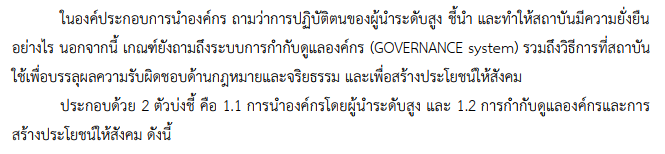
Criteria 1.1 การนำองค์กรโดยผู้นำระดับสูง (Senior Leadership)
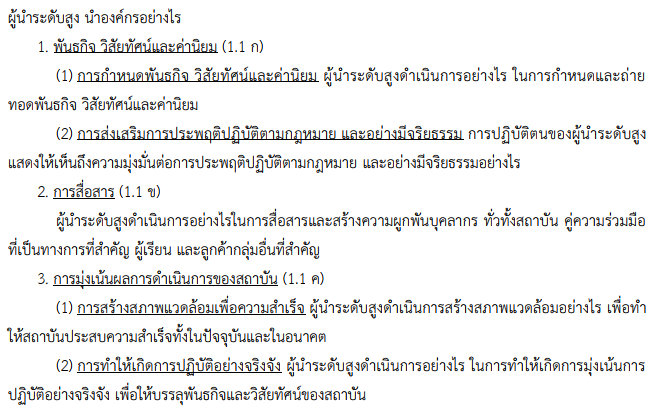
Requirements
Quality level assessment

Result 1.1
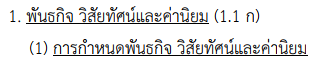
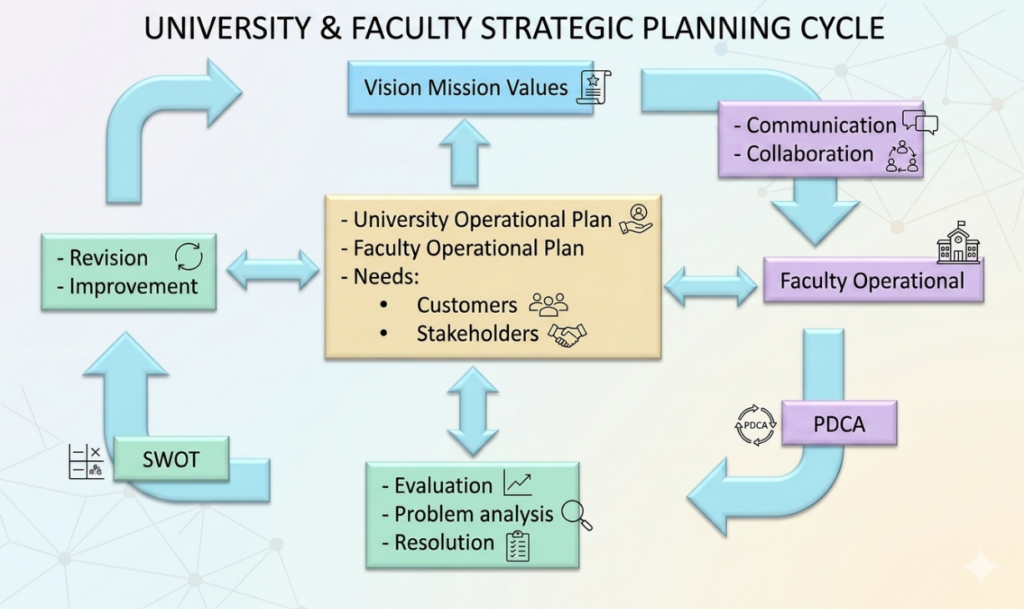
The Dean and the executive team-consisting of the Dean, Associate Deans, the Faculty Executive Committee, and Program Chairs-jointly convened to define the faculty’s vision, values, and mission in alignment with those of the university.
In each academic year, the faculty reviews its direction by analyzing key internal and external inputs, including:
- The organizational context and core competencies.
- Past performance outcomes in relation to the strategic plans of both the university and the faculty (2025-2029).
- The needs of learners, other student segments, and stakeholders.
- Changes in the external environment that impact competitiveness, strategic advantages, and challenges.
Furthermore, the faculty gathers feedback from stakeholders, students, and staff through the annual action plan review project. This feedback is used to evaluate operations and enhance processes through a SWOT analysis. The insights gained from this analysis are then applied to improve the faculty’s performance and operations in the subsequent year.
In 2025, the faculty updated its values, vision, and mission to clearly define the desired graduate identity as: “high-quality graduates with moral integrity and 21st-century learning skills in an international context.”
The Faculty utilizes the Plan-Do-Check-Act (PDCA) Quality Management Cycle to effectively implement and sustain its vision and values, ensuring organizational alignment through the following four stages:
1. Plan (Strategic Formulation):
The Dean, Executive Committee, faculty members, and support staff collaboratively design an implementation framework for the Faculty’s vision and values. This plan defines the organization’s strategic direction and establishes clear behavioral expectations for all personnel.
2. Do (Operational Execution):
The Faculty actively promotes these core values, encouraging all staff members to align their daily actions and responsibilities with them to ensure everyone moves cohesively toward the same strategic goals.
3. Check (Performance Evaluation):
Progress and alignment are systematically evaluated through regular review meetings conducted at both the faculty administration and individual program levels.
4. Act (Continuous Improvement):
Assessment findings are analyzed and leveraged to refine the faculty’s vision and values, while directly informing the development of both current and future strategic plans.
The Faculty’s determination, mission, vision, values, culture, and core competencies
| Issues | Descriptions | Result |
| Determination | Fostering academic and professional excellence to cultivate ethical, high-achieving citizens who thrive in both national and global contexts.” | |
| Vision | A leading faculty in the humanities and social sciences dedicated to producing high-quality graduates with moral integrity and 21st-century learning skills in an international context. | 7.4-1 |
| Mission | – Education: Developing adaptable, globally competent graduates who possess 21st-century skills and a deep understanding of human behavior, society, and culture. – Research: Generating impactful knowledge by integrating internal and external insights to foster growth at the individual, community, and organizational levels. – Academic Service: Empowering communities through initiatives in language learning, cultural preservation, and digital media knowledge transfer to drive sustainable development. | |
| Values We are the HuSo | H: Humility – Demonstrating modesty, respect, and openness by valuing collaboration and working harmoniously with others without arrogance or self-centeredness. U: Unity – Fostering strong connections among individuals from diverse backgrounds, cultures, and generations to achieve common organizational goals. S: Sustainability – Ensuring organizational practices balance environmental, social, and economic responsibilities to create long-term positive impact and development. O: Outstanding – Striving for excellence in every aspect of operation and consistently achieving exceptional results. | 7.4-8-10 |
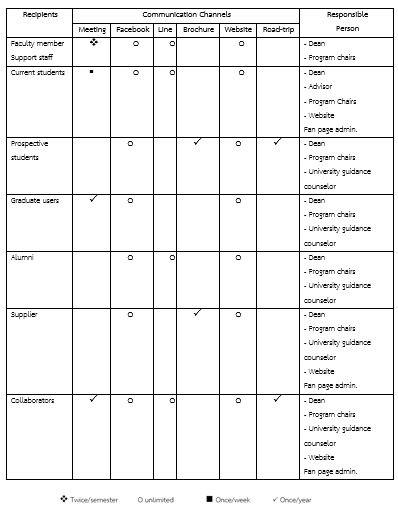
The Faculty has established tailored communication methods for staff, students, and other stakeholders, adapting formats to the current context to effectively share its mission, vision, and values. These core principles are actively demonstrated through the actions and leadership of the Dean and the administrative committee
Vision and Values Communicated to the Target Group
หลักฐาน
| รหัสหลักฐาน | ชื่อหลักฐาน(พร้อมแนบลิ้งค์) |
| 1.1.1 (1) -1 | แผ่นพับ |
| 1.1.1 (1) -2 | Faculty website |
| 1.1.1 (1) -3 | Facebook fan page ทั้ง 2 หลักสูตร |
| 1.1.1 (1) -4 | Road trip ของการตลาด |
| 1.1.1 (1) -5 | Open house |
| 1.1.1 (1) -6 | ปฐมนิเทศ |
| 1.1.1 (1) -7 | Advisor reports |

As an academic unit of St. Teresa International University-under the supervision of the Ministry of Higher Education, Science, Research, and Innovation-the Faculty of Humanities and Social Sciences strictly complies with all relevant legal and regulatory frameworks. This includes adhering to the University Act, policies set by the National University Council, and all university-wide and faculty-specific regulations.
The Dean holds primary responsibility for ensuring that all faculty operations—spanning teaching, research, academic services, and administration-align with these official directives. This oversight is maintained through dedicated governing bodies, including:
• The Faculty Committee: Handles general management.
• The Faculty Research Committee: Oversees academic and research activities.
•The Leadership Team: The Associate Dean and two Program Chairs manage day-to-day operations.
• Support Staff: Follow standardized operational manuals to ensure compliance.
To promote ethics and the Faculty’s core values, the Dean embedded ethical principles directly into academic programs. The Handbook of Good Governance guides operational integrity. To ensure accountability and continuous improvement, faculty members formally evaluate the Dean’s performance against these governance principles at the conclusion of each academic year.
To foster a shared sense of morality and collaboration, the Faculty explicitly communicates its core values to all faculty members and staff through the HuSo acronym:
•H – Humility: Demonstrating modesty, respect, and openness by valuing collaboration and working harmoniously with others, free from arrogance or self-centeredness.
• U – Unity: Fostering strong connections among individuals from diverse backgrounds, cultures, and generations to achieve common organizational goals.
• S – Sustainability: Ensuring organizational practices successfully balance environmental, social, and economic responsibilities for long-term positive impact.
• O – Outstanding: Striving for excellence in every aspect of operation and consistently achieving exceptional results.
As for the students, they were encouraged to develop deep ethical awareness by participating in key faculty initiatives, including:
• The “Moral and Ethics Project.”
• The “Green University” energy conservation campaign
• Cultural, traditional, and heritage events
• Community engagement efforts, including “Academic Service” and “Community Service” volunteers
Mirroring the faculty evaluation process, students are also invited to provide formal feedback on the Faculty’s overall performance at the end of each academic year to help shape future development.
Activities to Promote Ethical and Legal Conduct
| Target Group | Activity | Ethical and Legal Conduct | Responsible person | Results |
| Faculty members and support staff | Monitoring rule and regulation compliance regarding teaching activities and research | Being aware of complying with the rules and regulations governing work and duty | – Dean – Program chairs – Research Committee | – Good evaluation from students – Qualified research |
| Encouraging transparent work and conduct | Being aware of working and behaving on the principle of ‘Good Governance’ | – Good self and students’evaluation | ||
| Encouraging work and morality | Being aware of working and behaving following the Faculty’s values | – Good evaluation from students | ||
| Students | Encouraging rules and regulations compliance | – Strengthening good ethical conduct and morality – Strengthening a sense of public contribution and generosity | – Faculty committee – Program chairs – Advisors | – No record of students breaking rules and regulations – No plagiarism |
| Encouraging ethical conduct and morality based on the Faculty’s values and project participation | – Good evaluation from the community |
หลักฐาน
| รหัสหลักฐาน | ชื่อหลักฐาน(พร้อมแนบลิ้งค์) |
| 1.1.1 (2) -1 | ผลการประเมินจากผู้ใช้บัณฑิต |
| 1.1.1 (2) -2 | ระบบคุ้มครองสิทธิงานวิจัย |
| 1.1.1 (2) -3 | Research ethics handbook by the National Research Council of Thailand |
| 1.1.1 (2) -4 | Good Governance Handbook |
| 1.1.1 (2) -5 | Standard of Ethical Conduct |
| 1.1.1 (2) -6 | โครงการปลูกจิตสำนึกด้านสิ่งแวดล้อมและความรับผิดชอบต่อสังคม (HS 18) |
| 1.1.1 (2) -7 | โครงการพัฒนาคุณธรรมจริยธรรมของผู้สอน:Moral and Ethics for Lecturers (HS 11) |
| 1.1.1 (2) -8 | โครงการพัฒนาคุณธรรมจริยธรรมของนักศึกษา:Moral and Ethics for Student (HS 14) |
| 1.1.1 (2) -9 | โครงการบริการวิชาการ:Academic and Community Services (HS 27) |
| 1.1.1 (2) -10 | โครงการประเมินการบริหารงานของคณบดีตามหลักธรรมาภิบาล (HS 42) |
| 1.1.1 (2) -11 | โครงการ Evaluate to Become Great (อาจารย์ประเมินตนเอง) (HS 43) |
| 1.1.1 (2) -12 | ผลการประเมิน “นักศึกษาประเมินอาจารย์” |
The Dean has established effective two-way communication with faculty members, support staff, students, suppliers, strategic partners, and other stakeholders by identifying appropriate communication channels, timing, and content tailored to the needs of each stakeholder group.
Communication with faculty members is conducted through regular meetings held both monthly and each semester. Semester meetings are organized twice per semester: at the beginning of the semester to communicate strategic directions, operational plans, and key objectives, and at the end of the semester to review outcomes and evaluate performance. Monthly meetings are used to monitor progress on ongoing projects, discuss emerging issues, address urgent matters, and facilitate collaborative problem-solving. Faculty members, support staff, and students also have direct access to the Dean through face-to-face consultations and email correspondence for advice, support, and guidance.
Student engagement is maintained throughout the academic lifecycle. New students participate in an orientation program at the beginning of their first semester, where they receive information about their academic program and are provided with a Student Handbook containing essential policies, regulations, and academic guidelines. Continuing students are assigned academic advisors who provide support on academic, personal, and professional matters. Students are further encouraged to participate in faculty initiatives such as Academic Service, Ethics and Moral Development, Green University: Electricity Conservation, and Strong and Sustainable Community projects. These activities contribute to students’ ethical development, social responsibility, and community engagement while supporting the Faculty’s mission. Student concerns and complaints may be submitted through academic advisors, who forward them to the Faculty Committee for consideration and resolution.
To communicate with external stakeholders, including educational institutions and suppliers, the Faculty provides updated program and institutional information for promotional roadshows organized by the University’s public relations office. These outreach activities target schools across various regions and have contributed positively to student recruitment and enrollment growth.
The Faculty also engages with public and private organizations that host student internships or employ graduates. Feedback from these organizations is systematically collected and analyzed to assess student performance and ensure that graduate competencies remain aligned with the standards established by the Ministry of Higher Education, Science, Research and Innovation.
To support professional development, the Dean encourages faculty members to pursue doctoral studies and advance their academic careers through research, scholarly publications, and applications for academic titles. These efforts are guided by a five-year strategic development plan that includes individualized timelines and performance targets. Faculty members whose research or academic work is published, recognized, or patented receive formal recognition through certificates and are nominated for university-level awards.
The Faculty Committee conducts annual reviews of all major activities, projects, and performance outcomes. The results of these evaluations are used to identify opportunities for improvement and to inform planning and decision-making for the subsequent academic year, thereby supporting the Faculty’s commitment to continuous quality improvement.
Communication Scheme
| Communicated Issues | Target Audience | Communication Means | Frequency | Responsible Person |
| – Vision, mission, and values – Strategic plan and projects | – Faculty members – Program chairs | – Semester meeting – Monthly meeting | – Two per semester – Every month | – Dean |
| – Director of the Dept of Research and Planning | – Semester meeting – Random meeting | – Once a semester 2-4 times a semester | – Dean | |
| – Vision and values | – New students | – Orientation event | – Once a year | – Dean – Faculty committee |
| – General information – Rules and regulations | – Students | – Orientation event – Advisor hour – Final orientation | – Once a year – Once a week – Once a year | – Dean – Faculty committee |
| – Parents / Guardians | – Social media – Faculty Website – University’s public relations figure | – Unlimited | – Faculty committee – Public relations figure | |
| – Graduate users– Stakeholders | – Social media – Website | – Unlimited | – Program chairs | |
| – Faculty’s programs/activities | – Prospective students – High school teachers | – The University’s public relations figure – Social media – Faculty Website | – Once a year – Unlimited | – Dean – Program chairs |
| – Alumni | – Faculty Website – Social media | – Unlimited | – Program chairs | |
| – Graduate users – Stakeholders | – Faculty Website – Questionnaire – Interview | – Unlimited – Once a year | – Program chairs – Internship supervisors | |
| – Building a relationship – Problems and solutions | – Faculty members | – Faculty Meeting – Face-to-face meeting | – Once a month – Unlimited | – Dean |
| – Students | – Advisor hour – Face-to-face meeting with the Dean | – Once a week – Unlimited | – Advisors – Dean | |
| – Community – Graduate users | – Academic and Community Services – Interview – Questionnaire | – 2-3 times a year – Once a year | – Project charis – Internship supervisors |
หลักฐาน
| รหัสหลักฐาน | ชื่อหลักฐาน(พร้อมแนบลิ้งค์) |
| 1.1.2-1 | รายงานการประชุม |
| 1.1.2-2 | โครงการเตรียมความพร้อมนักศึกษาใหม่ปี 1 |
| 1.1.2-3 | โครงการปัจฉิมนิเทศ |
| 1.1.2-4 | คู่มือนักศึกษา |
| 1.1.2-5 | คลิปวิดีโอโครงการปลูกจิตสำนึกด้านสิ่งแวดล้อมและความรับผิดชอบต่อสังคม (HS 18) |
| 1.1.2-6 | จดหมายชื่นชมความสำเร็จงานวิจัย |
| 1.1.2-7 | PowerPoint ประชาสัมพันธ์หลักสูตร |
| 1.1.2-8 | รายงานผลการดำเนินงานตามแผนปฏิบัติการ ปีการศึกษา 2568 |
| 1.1.2-9 | Rector’s Award for Research Excellence |
To foster an environment that supports sustainable, long-term success, the Faculty operates according to the principles of Good Governance. This foundation emphasizes inclusive participation from all faculty members and support staff alike.
The Dean and the Faculty Committee collaboratively develop organizational strategies and operational action plans. By incorporating key performance indicators (KPIs) and explicit strategic goals, these plans directly address institutional challenges, strengths, and market opportunities. Operational excellence is maintained by aligning all initiatives with established quality frameworks and strategic tools:
- EdPEx (Education Criteria for Performance Excellence) & AUN-QA (ASEAN University Network-Quality Assurance)
- PDCA Cycle (Plan-Do-Check-Act) for continuous operational optimization
- SWOT Analysis for environmental scanning and strategic positioning
To ensure efficient, high-performing operations, the Faculty has cultivated a productive, secure, and supportive work environment across eight core elements:
| Elements for Success | The Role of the Dean & The Faculty Committee |
| Inclusive Planning & Monitoring | • Encourages all faculty members to shape organizational direction by participating in action planning, goal setting, and performance monitoring at both the faculty and program levels. • Assigns specific projects to faculty members to promote cross-functional learning and team collaboration. |
| External Collaboration | • Actively promotes strategic alliances with public and private organizations. •Establishes formal partnerships that enhance professional faculty development and expand student experiential learning. |
| Improved Physical Infrastructure | • Secures University backing to systematically upgrade physical facilities. • Provides faculty with high-speed internet, functional workspaces, and robust research resources. • Equips students with modern classrooms and dedicated independent study areas outside of class hours. |
| Academic Career Development | • Implements a supportive Five-Year Strategic Plan that guides lecturers to pursue doctoral degrees, launch research projects, and apply for higher academic titles. • Empowers individual lecturers to establish customized professional development timelines. • Mandates and funds participation in professional training and seminars (minimum of 15 hours annually) to refine teaching and assessment skills. |
| Support Staff Development | • Incentivizes support staff to participate in targeted internal and external training programs (primarily online formats). • Focuses skill cultivation on upgrading technical capabilities to streamline day-to-day faculty operations. |
| Student Institutional Involvement | • Mobilizes students through high-impact initiatives like Academic Service in neighboring communities. • Drives eco-responsibility via environmental campaigns such as Green University: Reducing Plastic and Foam. • Designs these projects to build critical soft skills while cementing ties between the Faculty and the local community. |
| Culture of Trust & Feedback | • Promotes an open, transparent environment where students feel safe and comfortable seeking help from faculty and staff. • Executes End-of-Semester Evaluations where students critique instructors/faculty performance, and faculty members formally assess the Dean. • Uses collected evaluation data as a direct baseline for continuous institutional improvement. |
| Leadership Pipeline Succession | • Prepares high-potential faculty members for future administrative and executive roles by providing deep-dive exposure to operational systems. • Delegated expanded operational responsibilities to select faculty members to systematically build leadership capacity. |
หลักฐาน
| รหัสหลักฐาน | ชื่อหลักฐาน(พร้อมแนบลิ้งค์) |
| 1.1.3 (1) -1 | แผนบริหารและพัฒนาบุคลากร (พ.ศ.2568-2572) |
| 1.1.3 (1) -2 | แผนปฏิบัติการ ปีการศึกษา 2568 |
| 1.1.3 (1) -3 | ห้อง Language and Art Edifice |
| 1.1.3 (1) -4 | ผลการประเมินตนเองของนักศึกษา “ผลลัพธ์ผู้เรียน” |
| 1.1.3 (1) -5 | ผลการประเมิน “อาจารย์ประเมินตนเอง” |
| 1.1.3 (1) -6 | ผลการประเมินคณบดีตามหลักธรรมาภิบาล |
| 1.1.3 (1) -7 | การนิเทศนักศึกษาฝึกงาน |
| 1.1.3 (1) -8 | โครงการปลูกจิตสำนึกด้านสิ่งแวดล้อมและความรับผิดชอบต่อสังคม (HS 18) |
| 1.1.3 (1) -9 | Top-up… |
| 1.1.3 (1) -10 | โครงการพัฒนาเครือข่ายความร่วมมือทางวิชาการ (ในประเทศและต่างประเทศ) (HS 26) |
| 1.1.3 (1) -11 | การฝึกอบรมของอาจารย์และเจ้าหน้าที่ |
| 1.1.3 (1) -12 | โครงการบริการวิชาการ HuSo สู่ชุมชน (HS 27) |
| 1.1.3 (1) -13 | รูปนักศึกษาที่ร่วมโครงการบริการวิชาการ |

The dean and committees are committed to taking action to achieve the Faculty’s mission and vision. The management approach is systematic, featuring clear divisions of responsibility and a structured execution process outlined below:
- Define the operational mission.
- Translate the mission into strategic plans.
- Establish operational guidelines aligned with the mission.
- Monitor and track progress.
When operations fall short of targets or the vision, reviews are conducted to adjust performance. This ensures continuous value creation for customers and all stakeholder groups. Furthermore, Faculty Key Performance Indicators (KPIs) are utilized as tools to drive active implementation. By establishing evaluation criteria, responsible persons are encouraged to focus on the Faculty’s overall performance outcomes in alignment with the institutional goals, as detailed in the action-driving table below.
Action-Driving Framework
| Mission | Action Guidelines | Monitoring / Review | Value Recipients | Outcomes |
| Curriculum | Organize activities that promote 21st-century skills to achieve excellence in management. | Dean and the relevant committee coordinate directly with project leaders. | * Students * Graduate Employers * Community | Graduates who meet academic and professional standards, demonstrating excellence and readiness for work. |
| Research | Promote the development of research focusing on local community and self-progression. | Dean and the relevant committee coordinate directly with researchers and the community | * Community * Faculty * Researchers * Funding Sources | Innovation and research outcomes that strengthen the community and |
| Academic Service | Build sustainability and elevate the community economy | Dean and the relevant committee coordinate directly with project leaders. | * General Public * Community | Strong, self-reliant communities within the Faculty’s responsible areas. |
หลักฐาน
| รหัสหลักฐาน | ชื่อหลักฐาน(พร้อมแนบลิ้งค์) |
| 1.1.3 (2) -1 | แผนปฏิบัติการปีการศึกษา 2568 (โครงการและชื่อผู้รับผิดชอบ) |
| 1.1.3 (2) -2 | รายงานผลการดำเนินงานตามแผนปฏิบัติการปีการศึกษา 2568 |
| 1.1.3 (2) -3 | รายงานผลการประเมิน SAR ของคณะและหลักสูตร ปีการศึกษา 2568 – CAR คณะ – CAR หลักสูตรศิลปศาสตรบัณฑิต – CAR หลักสูตรนิเทศศาสตรบัณฑิต |
Self-Assessment 1.1
| เกณฑ์คุณภาพ | ประเมินตนเอง | คะแนน |
| 1. พันธกิจ วิสัยทัศน์และค่านิยม | ||
| (1) การกำหนดพันธกิจ วิสัยทัศน์และค่านิยม (1 คะแนน) | / | 1 |
| (2) การส่งเสริมการประพฤติปฏิบัติตามกฎหมาย และอย่างมีจริยธรรม (1 คะแนน) | / | 1 |
| 2. การสื่อสาร (1 คะแนน) | / | 1 |
| 3. การมุ่งเน้นผลการดำเนินการของสถาบัน | ||
| (1) การสร้างสภาพแวดล้อมเพื่อความสำเร็จ (1 คะแนน) | / | 1 |
| (2) การทำให้เกิดการปฏิบัติอย่างจริงจัง (1 คะแนน) | / | 1 |
| รวมผลการประเมินตนเอง Criteria 1.1 | 5 | |