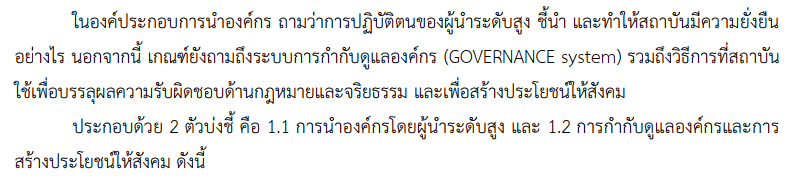
Criteria 1.2 การกำกับดูแลองค์กร และการสร้างประโยชน์ให้สังคม (GOVERNANCE and Societal Contributions)
Requirements
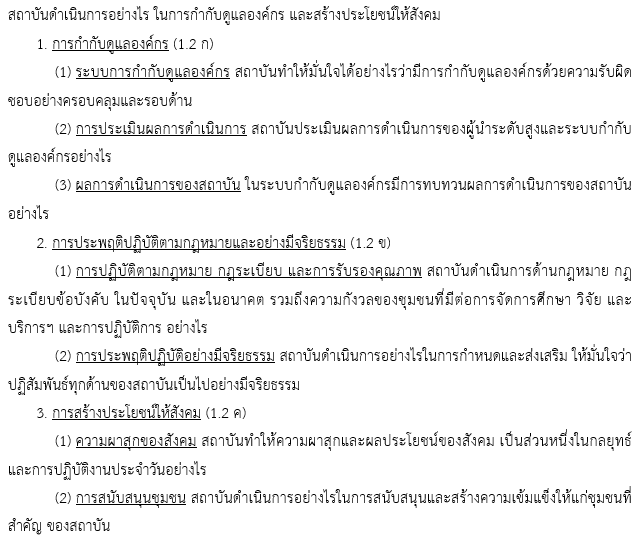
Quality level assessment

Result 1.2
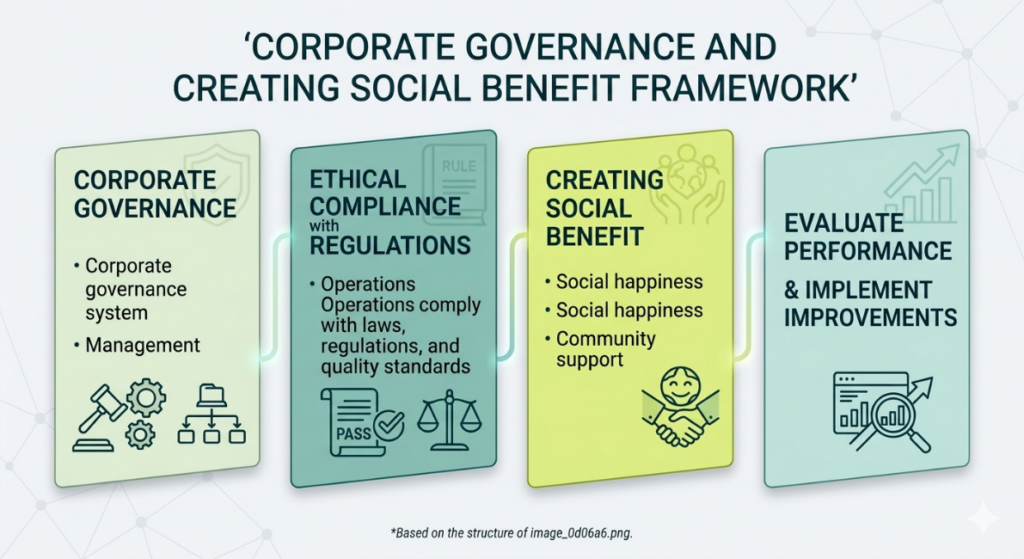
The Dean and faculty administrators across all levels operate under the governance of university regulations, policies, and official announcements. University strategies and policies are adopted as operational guidelines at the faculty level. This involves establishing organizational direction, cascading objectives into action, conducting operational reviews, maintaining organizational governance, and evaluating performance to ensure optimal efficiency.
The Dean has appointed an Executive Committee based on the faculty’s missions to manage and drive various operations. The committee comprises the Dean, one Associate Dean, two Program Chairs, and ad-hoc committee members. Their responsibilities include executing and monitoring operations to align with the strategies, missions, and vision specified in the annual fiscal action plan. Additionally, they ensure transparency and adherence to good governance practices across all operational, financial, and other relevant areas, as detailed in the table.”
Operations Aligned with Missions, Visions, and Strategies
| Mission | Operation | Duration | Responsible Person |
| Faculty Governance | – Managing internal administration under the university’s rules and regulations. – Directing operations to strictly adhere to policies and strategies. – Appointing various operating committees to ensure flexible operations. | Every month | Relevant committee |
| Budget and Financial Management | – Allocating budget to ensure consistency with the projects/activities of each program of study. – Monitoring reports on budget expenditure. | Every month | – Dean – Program chairs – Project leaders |
| Planning, Implementation, and Evaluation for the Fiscal Year | – Monitoring progress at least once a year through internal assessment processes, such as developing the Faculty’s Annual Self-Assessment Report (SAR). – Tracking operational progress according to the operational plan of each program of study. – Encouraging lectures to participate in proposing projects for inclusion in the annual action plan. | At least once a year | – Dean – Program Chairs – Relevant Committee |
| Education and Quality Assurance | – Monitoring operations regarding academic services, curriculum management, student quality assurance systems, TQF – Announcements, regulations, rules, and student advice. – Monitoring, controlling and evaluating administrative processes. – Organizing knowledge-sharing sessions regarding continuous improvement. | Every month throughout the academic year | – Dean – Associate Dean – Program Chairs |
| Student Development Activities, Arts and Culture Preservation, and Research | – Monitoring student development activities and financial reports for student projects. – Tracking progress regarding research work conducted by faculty members. – Promoting knowledge sharing through the Knowledge Management event | – Every month throughout the academic year – Twice / year | – Dean – Associate Dean – Program Chair – Relevant committee |
หลักฐาน
| รหัสหลักฐาน | ชื่อหลักฐาน(พร้อมแนบลิ้งค์) |
| 1.2.1 (1) -1 | การเปลี่ยนแปลงอาจารย์ผู้รับผิดชอบหลักสูตร – หลักสูตรศิลปศาตรบัณฑิต – หลักสูตรนิเทศศาสตรบัณฑิต |
| 1.2.1 (1) -2 | – การปรับปรุงหลักสูตรศิลปศาตรบัณฑิต (หลักสูตร 2567) – การปรับปรุงหลักสูตรนิเทศศาสตรบัณฑิต (หลักสูตร 2568) |
| 1.2.1 (1) -3 | รายงานผลการดำเนินงานตามแผนแผนปฏิบัติการ ปีการศึกษา 2568 |
| 1.2.1 (1) -4 | รายงานการประชุม |
| 1.2.1 (1) -5 | รายงานผลการประเมิน SAR ของคณะและหลักสูตร ปีการศึกษา 2567 – CAR คณะ – CAR หลักสูตรศิลปศาสตรบัณฑิต – CAR หลักสูตรนิเทศศาสตรบัณฑิต |
| 1.2.1 (1) -6 | ผลการประเมินความพึงพอใจของนักศึกษาที่ต่อหลักสูตรและการจัดการเรียนการสอน |
| 1.2.1 (1) -7 | ความเห็นของผู้ใช้บัณฑิต |

As each academic year draws to a close, the Faculty undergoes a comprehensive evaluation process structured to satisfy both university directives and internal development goals. Managed by the Dean and the faculty committee, these assessments rely on standardized university forms for administrative decisions and tailored questionnaires for internal growth.
The annual evaluation system operates across two primary levels of governance:
1. The Dean’s Evaluation
The Dean’s performance is assessed from both an organizational and an internal perspective:
- University-Level: The University’s executive committee evaluates the Dean based on a formal performance agreement that outlines her institutional responsibilities.
- Faculty-Level: Faculty members evaluate the Dean using a specialized questionnaire centered on principles of good governance.
2. Evaluation of Faculty Leadership and Members
The Dean directly assesses the Associate Dean, program chairs, and faculty members using a dual-method approach:
- For Internal Improvement: A faculty-level evaluation is conducted to identify areas for overall performance growth.
- For Administrative Actions: A university-level evaluation is executed to guide official decisions regarding contract renewals and salary promotions, strictly following the university’s official criteria.
To cultivate an inclusive and transparent academic community, the Dean maintains an open-door policy, welcoming direct feedback and personal suggestions from both students and faculty members.
Ultimately, all evaluation data aimed at organizational growth is compiled and submitted to the Department of Planning and Research. The collective performance of the Dean and the broader faculty operations are officially documented in the annual Internal Quality Assurance (IQA) report, which undergoes review by an external assessment board. These final insights form the strategic foundation for refining faculty management and operations in the upcoming academic year.
Characteristics of performance evaluation
| Assesse | Assessor | Assessing method | Frequency | Assessed issues |
| Dean | The University’s administrative committee | Evaluation according to the contract. | Once /year | Efficiency in management, according to agreement |
| Faculty members | Management evaluation form according to good governance principles | Once /year | Administration transparency | |
| – Program chairs – Faculty members | Dean | Evaluation of performance according to the strategic plan | Vary | Evaluation of performance according to the strategic plan for performance improvement |
| Dean | Evaluation of performance according to the strategic plan | Once /year | Evaluation of performance according to the strategic plan for salary promotion |
หลักฐาน
| รหัสหลักฐาน | ชื่อหลักฐาน(พร้อมแนบลิ้งค์) |
| 1.2.1 (2) -1 | ผลการประเมินคณบดี |

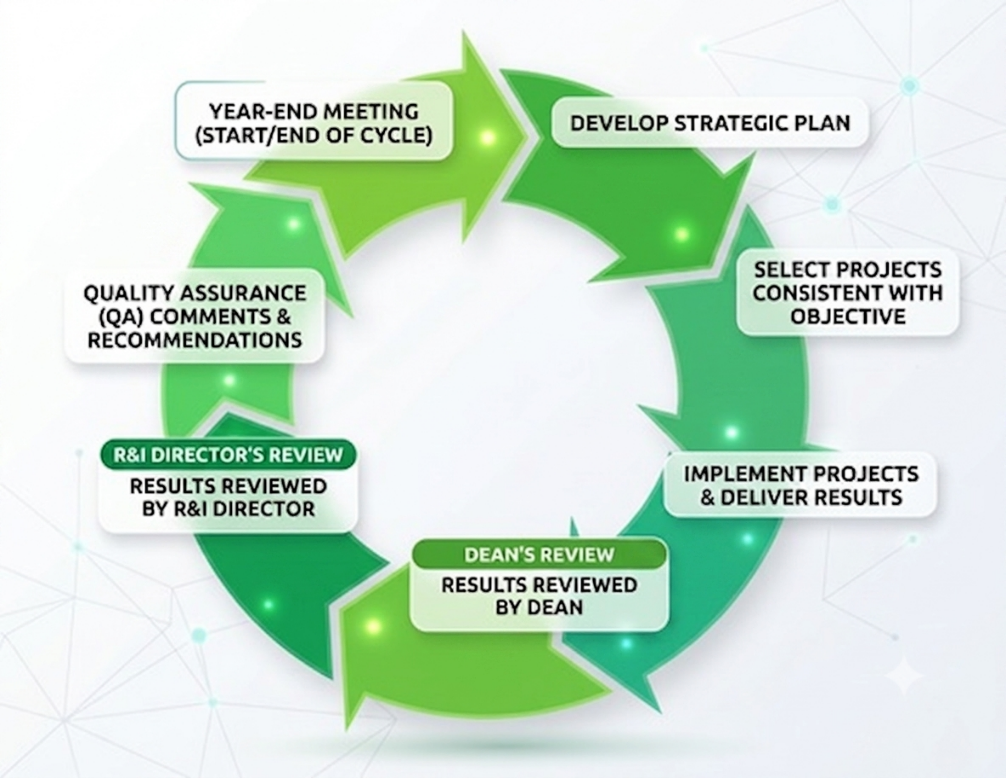
The Faculty carried out its operational plans through annual projects and administrative tasks. Once these were completed, the assigned individuals prepared summary reports and submitted them to the Dean. At the end of each quarter, the compiled reports were forwarded to the Director of the Department of Research and Planning, who then reviewed whether the Faculty had met the stated objectives and key performance indicators (KPIs). These outcomes were subsequently reported during the University’s academic committee meetings.
At the close of the academic year, the Dean prepares a comprehensive performance report for the Faculty, drawing from the outcomes of all projects, activities, and general operations. A SWOT analysis is applied to evaluate performance, highlighting internal strengths and weaknesses, as well as external opportunities and threats.
During the Quality Assurance (QA) session, the Dean presents this report to the assessors, who provide constructive feedback and recommendations for future improvements.
Finally, in the Faculty’s year-end meeting, the Dean and all faculty members review the year’s operational outcomes and collaborate to plan the projects and activities for the upcoming academic year.
หลักฐาน
| รหัสหลักฐาน | ชื่อหลักฐาน(พร้อมแนบลิ้งค์) |
| 1.2.1 (3) -1 | ผลการประเมิน IQA ปีการศึกษา 2568 |
| 1.2.1 (3)-2 | รายงานผลการดำเนินงานตามแผนปฏิบัติการปีการศึกษา 2568 |
| 1.2.1 (3)-3 | โครงการจัดทำและติดตามแผนกลยุทธ์และแผนปฏิบัติการ (HS 35) |

The Dean and the executive team proactively anticipate public concerns regarding the faculty’s curricula, services, and operations—both current and future—in a systematic manner through a comprehensive risk management process. The risk management process is structured as follows:
- Risk Identification by Leadership: The Dean and the executive team thoroughly consider and evaluate key operational risks across all areas.
- Committee Appointment: An Internal Control and Risk Management Committee is officially appointed.
- Risk Analysis and Planning: The Committee identifies critical risks, establishes key risk indicators (KRIs), and develops plans to control, monitor, and mitigate these risks and their impacts.
- Reporting and Strategy Integration: The Risk Control Committee reports its operational results to the Faculty Board once per semester. This data is used to refine the strategic and action plans, ensuring that major risks are effectively avoided in the future, as shown in the table.
Furthermore, this process actively promotes legal compliance, adherence to regulations, and alignment with institutional standards, as detailed in the table.
The process of monitoring compliance with laws and regulations
| Risk/Concern | Present | Future | Mitigation Process | Regulatory Authority |
| Under-standard curriculum | √ | √ | – Curriculum improvement was based on the Undergraduate Curriculum Standards B.E. 2565. | – Academic committee – Program Chairs – Curriculum responsible persons |
| Students’ English skills | √ | √ | -Monitoring students TOEIC practice according to the University’s schedule and following up monthly score | – Academic committee – Advisors |
| Research ethics and quality | √ | √ | -Monitoring researchers’ research ethics – monitoring and preventing plagiarism | – Research committee |
| Project impacts | √ | √ | – Closely supervise the projects according to the University’s regulations | -Dean – Academic committee – Project responsible persons |
| Community/Academic services | √ | √ | -Closely supervise the service according to the University’s regulations and the target community’s rules | -Dean – Community/ academic services committee |
Promoting conduct that complies with laws, regulations, and standards
| Aspect | Behavior | Auditing |
| Educational Management | Efficient educational management to meet standards | Teaching evaluation and curriculum assessment |
| Research and Innovation | Academic plagiarism; Research fund disbursement | Academic Committee; Research Development Committee |
| Academic Services | Disbursement for academic service projects; Implementation according to university regulations | University Audit Office; Academic Service Committee |
| Financial, procurement, and budget management transparency | ||
| Administration | Code of ethics for personnel | Dean and administration team |
| Integrity and transparency assessment in operations |
หลักฐาน
| รหัสหลักฐาน | ชื่อหลักฐาน(พร้อมแนบลิ้งค์) |
| 1.2.2 (1) -1 | Good governance |
| 1.2.2 (1) -2 | คู่มือและระบบกลไกการบริหารงานวิจัย |
| 1.2.2 (1) -3 | คู่มือการบริการวิชาการแก่สังคม |
| 1.2.2 (1) -4 | คำสั่งแต่งตั้งคณะกรรมการบริหารความเสี่ยง |
| 1.2.2 (1) -5 | มคอ. 2 หลักสูตรศิลปศาสตรบัณฑิต |
| 1.2.2 (1) -6 | มคอ. 2 หลักสูตรนิเทศศาสตรบัณฑิต |

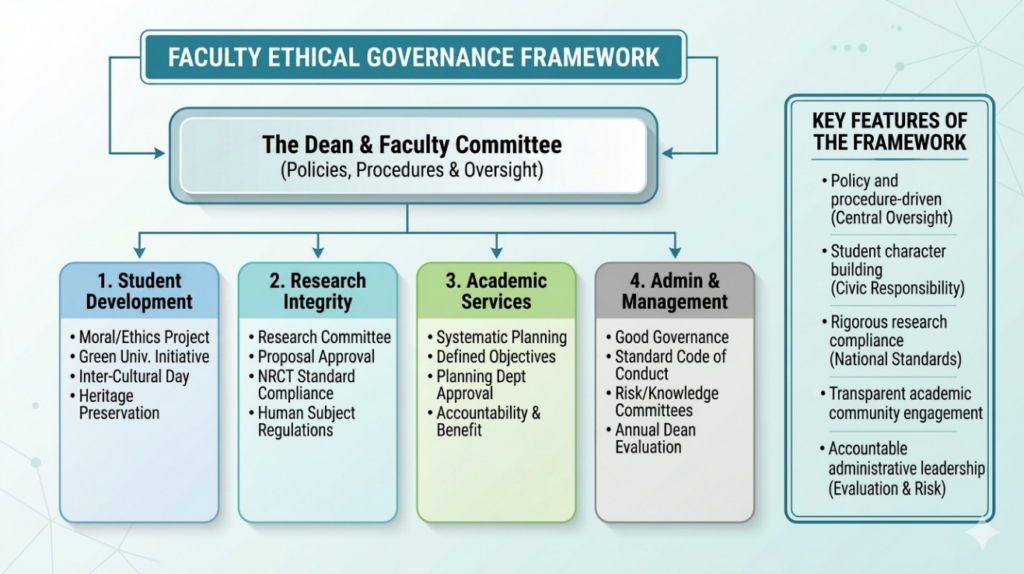
The Dean and Faculty Committee uphold ethical standards across all Faculty operations by implementing clear policies, procedures, and oversight mechanisms that ensure integrity in the Faculty’s core missions.
- Student Development: Ethical values and social responsibility are promoted through activities such as the Moral and Ethics Development for Students Project, Green University Initiative, Arts and Culture Study Visits, Inter-Cultural Day, and Cultural and Traditional Heritage Preservation programs.
- Research: A dedicated Research Committee reviews and approves research proposals. All research activities must comply with the ethical guidelines of the National Research Council of Thailand (NRCT), including requirements for research involving human participants.
- Academic Services: Community engagement activities follow a structured approval process that includes defining objectives and expected outcomes and obtaining approval from the Research and Planning Department. All activities are conducted in accordance with University policies and applicable regulations.
- Administration and Management: The Dean demonstrates ethical leadership through adherence to principles of good governance, professional ethics, and institutional regulations, ensuring transparency, fairness, and accountability. Faculty members evaluate the Dean’s ethical leadership annually. The Associate Dean, Program Chairs, faculty members, and staff are likewise required to comply with the University’s Standard Code of Conduct.
To strengthen ethical governance, the Dean has established key oversight committees, including the Research Committee, Risk Management Committee, and Knowledge Management Committee, to monitor compliance and ensure that all Faculty activities are conducted in accordance with ethical standards and institutional policies.
Ethical Conduct Supervision
| Mission | Process | Supervision Approach | Result |
| Student development | – Clarification of ethical conduct according to the regulations of the College for students – Integration of morality and ethical conduct into lessons – Extra-curricular activities focusing on morality ethical conduct | Supervision through advisors, lecturers, and project responsible persons | – No report on rule and ethical conduct violation – Good evaluation |
| Research | Researchers comply with – The Researcher Ethics Guideline – Research Ethics in Human Subjects. | Supervision through the research committee | – No research ethics violations |
| Academic service | – The approval of projects with objects, detailed procedures, prospective results, and evaluation | Supervision through the academic committee | – High level of satisfaction from the target community |
| Administration and management | – Dean complies with all measures of ethical conduct. – All faculty members comply with the standard code of conduct. | – Supervision through all committee and faculty members. – Supervision through the Dean and two program chairs | – No case of ethical conduct violations |
หลักฐาน
| รหัสหลักฐาน | ชื่อหลักฐาน(พร้อมแนบลิ้งค์) |
| 1.2.2 (2) -1 | Standard Code of Conduct |
| 1.2.2 (2) -2 | The principles of ‘Good Governance’ (ข้อบังคับ “ธรรมาภิบาล”) |
| 1.2.2 (2) -3 | Research Ethics in Human Subjects |
| 1.2.2 (2) -4 | Researcher Ethics Guideline (จรรยาวิชาชีพและแนวทางปฏิบัติ) |
| 1.2.2 (2) -5 | คำสั่งแต่งตั้งปีการศึกษา 2568 |
| 1.2.2 (2) -6 | โครงการพัฒนาคุณธรรมจริยธรรมของนักศึกษา (HS 14) |
| 1.2.2 (2) -7 | โครงการบริการวิชาการ HuSo สู่ชุมชน (HS 27) |
| 1.2.2 (2) -8 | โครงการบูรณาการงานด้านศิลปวัฒนธรรมกับรายวิชา (HS 32) |
| 1.2.2 (2) -9 | โครงการวันเทศกาลวัฒนธรรมนานาชาติ (HS 33) |
| 1.2.2 (2) -10 | โครงการ Thai Culture and Traditional Heritage Day (HS 34) |
| 1.2.2 (2) -11 | โครงการปลูกจิตสำนึกด้านสิ่งแวดล้อมและความรับผิดชอบต่อสังคม (HS 18) |
| 1.2.2 (2) -12 | โครงการประเมินการบริหารงานของคณบดีตามหลักธรรมาภิบาล (HS 42) |
| 1.2.2 (2) -13 | โครงการ Evaluate to Become Great (อาจารย์ประเมินตนเอง) (HS 43) |
The Faculty demonstrates its commitment to societal welfare through the core values of humility and sustainability. In alignment with the University’s policy to enhance quality of life and education, the Dean has initiated various community-oriented projects. These initiatives aim to build partnerships and collaborations between the Faculty and communities—ranging from local schools to sub-district levels—based on the specific needs and priorities of each community.
To achieve each project’s goals, the Dean assigned academic teams from both the BE and CA programs to work collaboratively with local stakeholders throughout the project cycle. Community satisfaction was measured using surveys, and the results were compiled and submitted to the Department of Research and Planning for evaluation and approval.
Projects to Promote Social Well-Being
| Project | Aspect creating Well-being | Community | Results |
| Academic camp | – English knowledge – Content creation using smartphones – Strong relationship | – Baan cha wag yao school – Pattarapittayakhan school | – High satisfaction level with the learned knowledge from students -Higher O-net scores – Basic methods – Basic methods using smartphones to create appealing online content |
| Academic service at the Ongkharak community | |||
| Strong and Sustainable Community | – Publicize this historical park to the public in general – Encourage tourism to the Park and to the Province – Tourist attraction promotion | – Dong La-khon Historical Park | – Clip video of the Historical park People in general learn the history and recognize the value of this historical park |
| Nakhon Nayok Channel |
หลักฐาน
| รหัสหลักฐาน | ชื่อหลักฐาน(พร้อมแนบลิ้งค์) |
| 1.2.3 (1) -1 | โครงการบริการวิชาการ HuSo สู่ชุมชน (HS 27) |
| 1.2.3 (1) -2 | โครงการชุมชนเข้มแข็ง(นครนายกชาแนล) (HS 29) |
| 1.2.3 (1) -3 | Video clip |

Regarding community support, the Faculty implements annual projects dedicated to various aspects of community development:
- Research (Academic Service Project): The Faculty conducted a research-based initiative aimed at enhancing English communication skills among young students. This project not only improved the students’ language proficiency and attitudes toward learning English but also generated valuable data for academic research, mutually benefiting the Faculty and the local community.
- Community Service (Nakhon Nayok Channel Project): Designed to support the local community and promote regional tourism, this initiative produced a promotional video clip that was shared via the Faculty’s official social media channels, successfully reaching audiences both within and outside the region.
- Cultural and Traditional Preservation (Strong and Sustainable Community Initiative): Lecturers and students from the CA program visited Dong-lakorn Historical Park to create a video documentary highlighting its heritage. Disseminating the park’s history to the public and local residents helps preserve community pride and fosters sustainable cultural awareness.
To ensure continuous improvement, each project was evaluated by the participating communities, with outcomes reported to the Dean and the Department of Research and Innovation. The Faculty conducted both quantitative and qualitative analyses of these findings, using the insights to guide strategic planning and project enhancements for the subsequent academic year.
หลักฐาน
| รหัสหลักฐาน | ชื่อหลักฐาน(พร้อมแนบลิ้งค์) |
| 1.2.3 (2) -1 | โครงการบริการวิชาการ HuSo สู่ชุมชน (HS 27) |
| 1.2.3 (2) -2 | โครงการชุมชนเข้มแข็ง(นครนายกชาแนล) (HS29) |
| 1.2.3 (2) -3 | Video clip ดงละคร |
Self-Assessment 1.2
| เกณฑ์คุณภาพ | ประเมินตนเอง | คะแนน |
| 1. การกำกับดูแลองค์กร (2 คะแนน) | ||
| (1) ระบบการกำกับดูแลองค์กร (2) การประเมินผลการดำเนินการ (1 คะแนน) | / | 1 |
| (3) ผลการดำเนินการของสถาบัน (1 คะแนน) | / | 1 |
| 2. การประพฤติปฏิบัติตามกฎหมายและอย่างมีจริยธรรม | ||
| (1) การปฏิบัติตามกฎหมาย กฎระเบียบ และการรับรองคุณภาพ (1 คะแนน) | / | 1 |
| (2) การประพฤติปฏิบัติอย่างมีจริยธรรม (1 คะแนน) | / | 1 |
| 3. การสร้างประโยชน์ให้สังคม | ||
| (1) ความผาสุกของสังคม (2) การสนับสนุนชุมชน (1 คะแนน) | / | 1 |
| รวมผลการประเมินตนเอง Criteria 1.2 | 5 | |