
Criteria 2.1 การจัดทำกลยุทธ์ (Strategy Development)
Requirements
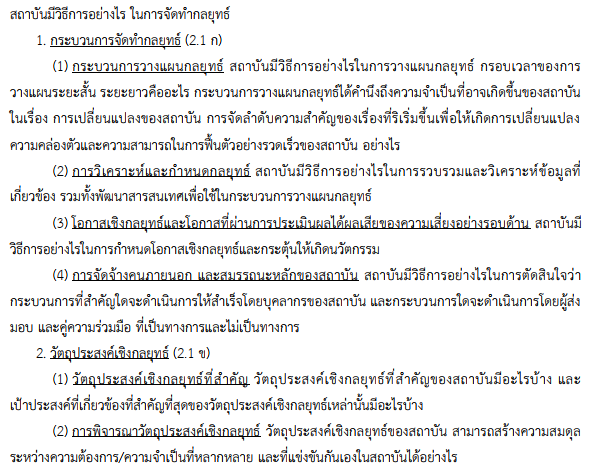
Quality level assessment

Result 2.1
Faculty Strategic Planning Process
The Faculty has developed a 5-year long-term strategic plan alongside its annual operational plans to align with the university’s policies, strategic direction, and the critical data shown in Table 21. By utilizing this data to conduct a SWOT analysis of internal and external factors, the strategic plan was formulated and subsequently presented to the Faculty Board. Furthermore, an annual seminar is held to review the strategic plan and adjust operational processes, ensuring readiness for rapid situational changes, agility, and operational flexibility. This systematic process includes clearly defined timelines and designated personnel responsible for implementation, as detailed in Table below.
Strategic Planning Process Table
| Step | Timeline | Outcomes / Deliverables | Responsible Party |
| 1. Collect and Analyze Input Data | Throughout the academic year | Crucial data obtained from: – Operational review of the strategic and operational plans – 2024 Internal Quality Assurance – Stakeholders | – Dean – The Planning and Strategy Management Team |
| 2. Review and Analyze Current Performance and SWOT Analysis | Throughout the academic year | 1. Guidelines for strategic plan adjustment 2. Results of the SWOT analysis | – Dean – The Planning and Strategy Management Team |
| 3. Review Vision, Mission, and Goals | March | Vision, mission, goals, strategic challenges, and strategic advantages | – Dean – Faculty committee |
| 4. Review the Strategic Plan, Define KPIs, and Align Projects | April | Draft of the Faculty’s Strategic Plan | – Dean – Associate dean – The Management Team, Faculty Board |
| 5. Approval of the Strategic Plan | May | Approved Faculty Strategic Plan | Faculty Board |
| 6. Formulate Operational Plans a | May | Mission-based plans and projects to drive faculty-level strategies | – Dean – Faculty Board |
| 7. Implementation According to Plans and KPIs | Throughout the academic year | Executed projects according to the established KPIs | Project Leaders |
| 8. Monitor, Supervise, and Evaluate Projects and KPIs (Quarterly) | Throughout the academic year | Quarterly operational performance reports | – Dean – Faculty Board |
| 9. Evaluate and Report on Annual Plan Achievements | End of the academic year | Achievement reports of projects and KPIs in accordance with the Strategic Plan | – Dean – The Office of Policy and Planning |
The process shown in the table above is arranged with the adoption of a structured strategic planning process consisting of four key steps, as illustrated in the figure below.
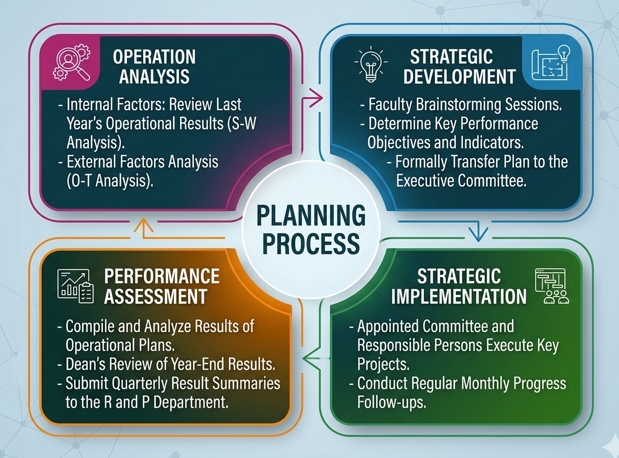
Steps, factors, and people involved in strategic planning
| Operation Analysis | Strategic Development | Strategic Implementation | Performance Assessment | |
| Inputs | – Vision and values – Internal and external factor – Last year’s operational performance – Stakeholders’ needs – Faculty’s core competency | – Vision and values – Faculty’s core competency – Strategic opportunities – Strategic challenges – Strategic advantages | – Vision and values– Faculty’s core competency – Strategic objectives – Performance indicators – Projects and activities | – Result Summary – Result reviewing process |
| Results | – Strategic opportunities – Strategic challenges – Weaknesses and risks | – Strategic objectives – Strategic plan indicators – Projects/Activities – Result projections – Personnel plan | – Information on monitoring the implementation of the action plan – Information on the following up action plan | – Operation result summary following the strategic objectives – Satisfaction evaluation |
| Responsible persons | – Dean – Boards of different Committee – Program Chairs – Appointed responsible persons | – Dean – Boards of different Committee – Program chairs – Appointed responsible persons | – Dean – Boards of different Committee – Program chairs – Appointed responsible persons | – Dean – Boards of different Committee – Program chairs – Appointed responsible Persons – Students – Graduate users – Other stakeholders |
หลักฐาน
| รหัสหลักฐาน | ชื่อหลักฐาน(พร้อมแนบลิ้งค์) |
| 2.1.1 (1) -1 | แผนบริหารและพัฒนาบุคลากร 5 ปี |
| 2.1.1 (1) -2 | รายงานผลการดำเนินงานตามแผนปฏิบัติการปีการศึกษา 2568 |
| 2.1.1 (1) -3 | ผลการประเมินความพึงพอใจของนักศึกษาที่มีต่อหลักสูตร |
| 2.1.1 (1) -4 | ผลการประเมินความพึงพอใจของผู้ใช้บัณฑิต |
| 2.1.1 (1) -5 | ผลการประเมิน นักศึกษาประเมินอาจารย์ |
| 2.1.1 (1) -6 | ผลการประเมิน อาจารย์ประเมินตนเอง |

Strategy Determination and Implementation
The Faculty gathered both internal and external data for the development of its strategic plan. Internal information included the 2024 IQA performance evaluation, stakeholder feedback, identified risks, and the allocated budget. External factors considered included current economic and social conditions, as well as technological trends.
Using SWOT analysis, the Faculty examined this information to identify strategic challenges, opportunities, and advantages, which served as the foundation for finalizing the 2025 academic year strategic plan. This plan was operationalized through a series of annual projects and activities, with responsibilities clearly communicated to all committees and faculty members.
For the 2025 academic year, the Faculty implemented a total of 44 projects—some newly introduced and others revised to reflect emerging needs and contextual changes. To ensure adaptability and prevent operational disruptions, the Faculty conducted a risk analysis and established a risk management framework to address potential future challenges.
A follow-up system was also implemented to monitor project outcomes. Project leaders were required to submit monthly progress summaries, which were regularly reviewed to assess performance and ensure alignment with strategic goals.
Factors and information used to analyze and determine strategies
| Factors | Collected information/issues/details | Person involved |
| Information from 2044 IQA | – Faculty’s strategy-based performance – Program’s performance | – Dean – Faculty Committee |
| University’s strategy | – Information required for the University’s rank upgrade – Allocated budget | – Research Committee – Faculty Committee |
| Stakeholders’ comments and recommendation | – Graduates’ quality, performance – Satisfaction with Faculty’s performance, students’ quality and performance, BE and CA curriculum – Recommendations and comments – Information from the Faculty’s brainstorming | – Dean – Faculty Committee – Program Chairs |
| Economic and social situation, technology | – Information and directions for changes in both economic and social aspects, and technology | – Dean – Faculty Committee |
หลักฐาน
| รหัสหลักฐาน | ชื่อหลักฐาน(พร้อมแนบลิ้งค์) |
| 2.1.1 (2) -1 | ผลประเมิน IQA ระดับคณะ ปีการศึกษา 2567 |
| 2.1.1 (2) -2 | ผลการประเมิน IQA ระดับหลักสูตร (หลักสูตรศิลปศาสตรบัณฑิต) ปีการศึกษา 2567 |
| 2.1.1 (2) -3 | ผลการประเมิน IQA ระดับหลักสูตร (หลักสูตรนิเทศศาสตรบัณฑิต) ปีการศึกษา 2567 |
| 2.1.1 (2) -4 | รายงานสรุปงบประมาณ ปีการศึกษา 2567 |
| 2.1.1 (2) -5 | ผลการประเมินความพึงพอใจของนักศึกษาที่มีต่อหลักสูตร |
| 2.1.1 (2) -6 | ผลการประเมินความพึงพอใจของผู้ใช้บัณฑิต |
| 2.1.1 (2) -7 | ผลการประเมิน “นักศึกษาประเมินอาจารย์” |
| 2.1.1 (2) -8 | ผลการประเมิน “อาจารย์ประเมินตนเอง” |

Innovation in Teaching, Research, and Community Service
The Faculty adopted the University’s policies on “Teaching and Learning Innovation,” “Research for Innovation,” and “Community/Academic Services for Innovation” as core missions integrated into its strategic planning. To effectively realize this mission, the Faculty analyzed its strategic challenges and advantages, focusing on areas aligned with its core competencies.
Following a brainstorming session led by the Dean, the mission was delegated to the Academic, Research, and Academic Service committees. Each committee then coordinated with faculty members, who successfully executed the mission.
Teaching and learning innovation
To foster innovation in teaching and learning, the Faculty promoted instructional approaches rooted in the philosophy of “productive learning.” This initiative emphasized hands-on experiences and learning beyond the classroom. As a result, students produced various academic and digital innovations, including 16 short films, 12 documentaries, and 7 theses. Concurrently, faculty members were encouraged to generate new knowledge by integrating their internal expertise with external sources. These innovative insights were subsequently shared during faculty meetings and the University’s Knowledge Management event.
Research for innovation
Guided by a focus on practical, community- and industry-driven innovation, the faculty achieved key research milestones this year. Notable successes include the publication of four articles in Scopus and TCI (Tier 1 & 2) journals by three faculty members. Additionally, intellectual property efforts are thriving, with one lecturer pursuing a second consecutive patent and several students currently advancing through the copyright application process for their innovations.
Academic service innovation
Following the annual strategic plan, the Faculty launched several academic and community service initiatives for local schools and communities. These projects aim to enhance education, improve the quality of life, and preserve local culture. As part of the “Strong and Sustainable Community” project, Communication Arts (CA) students—supervised by a faculty lecturer—produced a documentary exploring the rich history of Dong-lakhon Historical Park. This innovative video is currently being reviewed by the officials from the historical park and will be the subject of the copyright.
Innovation
| Innovation | Strategic Challenge | Strategic Advantage | Intelligence Risk | Results |
| Productive learning | – Other philosophies of teaching and learning exist | – Workforce capability | – Students learn real-world experiences. | – 16 short films – 12 documentaries – 6 theses – 25 posters – 6 newspaper volumes |
| A new body of knowledge | – Some lecturers stick to traditional knowledge. | – Adoption of the University’s Knowledge Management Event as a driving force. | – Faculty members’pedagogical development. – Students learn state-of-the-art knowledge. | – 2 KM innovations |
| Research article | – Some faculty members lack the skills to produce high-quality research work. | – Knowledge from the research committee and faculty members, with research experiences | – Some of the faculty’s research papers are not published in prestigious journals. | – One research paper published in the Scopus journal – Two research papers published in the TCI 1 journals – One research paper published in the TCI 2 journal |
| Innovation to enhance the community potential | – Teachers in target schools were occupied with routine work. – The students’ study load is demanding. | – Strong teamwork combining faculty members and student volunteers – A new faculty member with high expertise in digital media | – School English teachers lack tools to motivate students. – Students are not motivated to learn English. – Time limitation to produce a quality documentary from the beginning to the completion. | – A documentary video displaying the history of Dong-lakhon Historical Park |
หลักฐาน
| รหัสหลักฐาน | ชื่อหลักฐาน(พร้อมแนบลิ้งค์) |
| 2.1.1 (3)-1 | สรุปผลงานของนักศึกษาสาขา CA |
| 2.1.1 (3)-2 | ผลงานวิจัยของนักศึกษาสาขา BE |
| 2.1.1 (3)-3 | ผลงาน Thesis ของนักศึกษาสาขา CA |
| 2.1.1 (3)-4 | งานวิจัยของนักศึกษาที่ตีพิมพ์ |
| 2.1.1 (3)-5 | KM ปีการศึกษา 2568 |

Utilizing Core Competencies to Promote Performance Excellence
To drive institutional excellence, the Dean and faculty committee aligned internal operations with the Faculty’s strategic vision and core competencies. This restructuring streamlined workflows across all core missions and optimized resource allocation. By using these distinct capabilities as a decision-making framework, leadership successfully evaluated whether to handle essential operations internally, through strategic outsourcing to maximize long-term growth.
| Work System | Requirement | Key Process | Products/ Service Recipient | Faculty carry out | Outsourcing |
| Education Management | |||||
| – Program Administration | – Curriculum according to the Higher Education Framework | – Five-year- curriculum improvement cycle | – Improved Curriculum – All stakeholders | – Faculty | – External curriculum Analyst – Graduate users – Alumni |
| – Student development | – Student development according to TQF | – Students achieved 3 learner outcomes and 5 learning outcomes For BE /CA old curriculum, and 4 learning outcomes for BE/CA Improved curriculum | – Quality graduates – All stakeholders | – All Faculty’s committee | – University’s administrative board – Graduate users – Collaborators |
| Research | |||||
| Research management | – Quality research complying with research ethics in human | – Seek external funding Resources – Approval of human Research – Support research publication in an academic journal – Manage knowledge and disseminate research results. | – Number of research projects – Amount of research funding – Number of published research articles In the academic journal TCI, SCOPUS | – Faculty’s research committee | – External research funding resources – Academic journals |
| Academic Service | |||||
| Academic service management | -The service meets the community’s needs | – Coordinate and contact target communities – Design /organize services according to recipients’ need – Evaluate the satisfaction of recipients. – Improve services | – Number of service Recipients – Satisfaction level of Service recipient | – Academic service Committee – Student volunteers | – Target communities – Service recipients |
The Faculty conducts an annual review of its work systems and core competencies during the strategic planning process to ensure efficiency, adaptability to emerging strategic challenges, and alignment with institutional goals. This continuous improvement process aims to strengthen the Faculty’s ability to achieve its strategic objectives. Based on the 2024 performance review, the Faculty refined its academic service strategies to better align with the evolving needs of target communities and to support the broader missions of the University.
หลักฐาน
| รหัสหลักฐาน | ชื่อหลักฐาน(พร้อมแนบลิ้งค์) |
| 2.1.1 (4) -1 | เอกสารการขอรับทุนผลวิจัย ปีการศึกษา 2568 |
| 2.1.1 (4) -2 | มคอ.2 หลักสูตรศิลปศาสตรบัณฑิต สาขาวิชาภาษาอังกฤษเพื่อการสื่อสารทางธุรกิจ (หลักสูตรนานาชาติ /หลักสูตรปรับปรุง พ.ศ.2567) |
| 2.1.1 (4) -3 | มคอ.2 หลักสูตรนิเทศศาสตรบัณฑิต สาขาวิชาสื่อดิจิทัล (หลักสูตรปรับปรุง พ.ศ. 2568) |
| 2.1.1 (4) -4 | ข้อมูลการวิพากษ์หลักสูตร |
| 2.1.1 (4) -5 | ความคิดเห็นของผู้ใช้บัณฑิต (ที่นำมาปรับปรุงหลักสูตร) |
The Faculty established its main strategic objectives in alignment with both long-term strategic plans and short-term action plans, implemented through 44 targeted projects. These objectives are supported by clearly defined goals and performance indicators. While the strategic objectives remain consistent across planning periods, the target values are adjusted annually to reflect evolving priorities and capacities. Each objective includes a specific timeframe for achievement, with the end of the fiscal year serving as the evaluation point for overall progress.
Strategy, Strategic Objectives, and Indicators of the Faculty’s Success
| Strategic goal | Strategic Objective | Key Success Indicators | Collaborators | Counting Unit | Timeline 20_ _ | ||||
| 25 | 26 | 27 | 28 | 29 | |||||
| Teaching and Learning Management | Establish an academic cooperation network to develop active citizens by delivering productive learning experiences aligned with labor market demands | – Number of students’ work arising from productive learning – Number of programs improved or developed | – Community School – Government organizations – Private organizations – Alumni – qualified person | – Student‘s work – Program | 65 2 | 60 2 | 50 2 | 50 2 | 50 2 |
| Research and cooperation | – Deliver high-quality research and innovation that drives meaningful value for both the organization and local communities | – Number of research studies by the lecturer – Number of research studies by students | – External research funding resources – Research collaborators | – Lecturers’ Research – Students Research | 4 6 | 4 5 | 4 7 | 4 3 | 4 4 |
| – Academic services and cooperation with social Collaborators – Academic service with the Teacher Council | – Transfer knowledge to local communities to promote their economic development, and maintain the local culture, values, and traditional way of life – Provide education expertise to enhance foreign teachers’ teaching skills and management | – Successful academic and community services – Service recipients’ satisfaction – Complete the module objectives | – Local communities – Local schools – The Teacher Council of Thailand | – Number of services – Number of communities | 4 4 – | 4 4 – | 4 4 2 | 4 4 – | 4 4 – |
หลักฐาน
| รหัสหลักฐาน | ชื่อหลักฐาน(พร้อมแนบลิ้งค์) |
| 2.1.2 (1)-1 | สรุปจำนวนผลงานของนักศึกษา |
| 2.1.2 (1)-2 | สรุปผลงานวิจัยของอาจารย์ |
| 2.1.2 (1) -3 | งานวิจัยของนักศึกษา |
| 2.1.2 (1) -4 | โครงการบริการวิชาการ HuSo สู่ชมชน (HS 27) |
| 2.1.2 (1) -5 | รายงานโครงการ Module |

The Faculty Committee developed the strategic plan by identifying and refining strategic objectives aimed at enhancing the Faculty’s core missions. The process for setting strategic objectives involved the following steps:
- Reviewing key information derived from strategic challenges (SC), strategic advantages (SA), strategic opportunities (SO), as well as the needs and expectations of customers and stakeholders.
- Utilizing this information to revise and refine strategic objectives to effectively address the identified challenges and capitalize on the Faculty’s advantages.
For the 2025 fiscal year, the Faculty reviewed its strategic objectives and made necessary adjustments to the indicators and related projects. These revisions were aligned with the Faculty’s vision, core competencies, and overarching strategic plan to ensure continued relevance and effectiveness.
Consideration of Strategic Objectives
| Strategic Challenge | Strategic Advantage | Strategic Opportunity | Stakeholders’ Needs | Strategic Objectives |
| Education Management | ||||
| External strategic challenges: – Students and stakeholders’ expectations Internal strategic challenges: – Limited resources | – The Faculty’s core competencies – Cooperation between the Faculty and collaborators | – Create cooperation with alliance networks for the co-management of education to produce graduates with acceptable standards and qualities qualified for jobs in all domestic and international organizations. | – Graduates have knowledge and skills used for work – Graduates get a job immediately after graduating – Graduates apply knowledge to develop themselves, the community, and society. | – Create a network of academic cooperation to produce graduates to become an active citizen through organizing productive learning in line with the needs of the labor market. |
| Research and Innovation | ||||
| External strategic challenge: – Research results being adopted for implementation Internal strategic challenges: – Limited number of human resources | – The University’s and the Faculty’s core competencies – Consistent cooperation with collaborators | – Create cooperation with alliances and community | -More researchers to produce quality research and innovation – More research work and innovations used to develop the community and society | – Produce quality research and innovation beneficial for the organization or communities |
| Academic and Community Service | ||||
| External strategic challenge: – Community’s expectation Internal strategic challenges: – A new body of knowledge to be transferred | – The University’s support – Competent lecturers and service providers | – Create cooperation with alliances and community – Create strong relationships with the local community– Promote the local community regarding income and cultural and traditional sustainability | – Faculty members generate new knowledge – Local residents have a better and more sustainable life. – The College is more prestigious. | – Transfer knowledge to local communities to promote their economic development, and maintain the local culture, values, and traditional way of life |
หลักฐาน
| รหัสหลักฐาน | ชื่อหลักฐาน(พร้อมแนบลิ้งค์) |
| 2.1.2 (2) -1 | สรุปผลงานวิจัยของอาจารย์ |
| 2.1.2 (2) -2 | งานวิจัยของนักศึกษา |
| 2.1.2 (2) -3 | โครงการบริการวิชาการ HuSo สู่ชมชน (HS 27) |
| 2.1.2 (2) -4 | KM |
| 2.1.2 (2) -5 | โครงการบริการชุมชน ของ CA |
Self-Assessment 2.1
| เกณฑ์คุณภาพ | ประเมินตนเอง | คะแนน |
| 1. กระบวนการจัดทำกลยุทธ์ | ||
| (1) กระบวนการวางแผนกลยุทธ์ (2) การวิเคราะห์และกำหนดกลยุทธ์ (1 คะแนน) | / | 1 |
| (3) โอกาสเชิงกลยุทธ์และโอกาสที่ผ่านการประเมินผลได้ผลเสียของความเสี่ยงอย่างรอบด้าน (1 คะแนน) | / | 1 |
| (4) การจัดจ้างคนภายนอก และสมรรถนะหลักของสถาบัน (1 คะแนน) | / | 1 |
| 2. วัตถุประสงค์เชิงกลยุทธ์ | ||
| (1) วัตถุประสงค์เชิงกลยุทธ์ที่สำคัญ (1 คะแนน) | / | 1 |
| (2) การพิจารณาวัตถุประสงค์เชิงกลยุทธ์ (1 คะแนน) | / | 1 |
| รวมผลการประเมินตนเอง Criteria 2.1 | 5 | |