
Criteria 2.2 การนำกลยุทธ์ไปปฏิบัติ (Strategy Implementation)
Requirements
Quality level assessment

Result 2.2

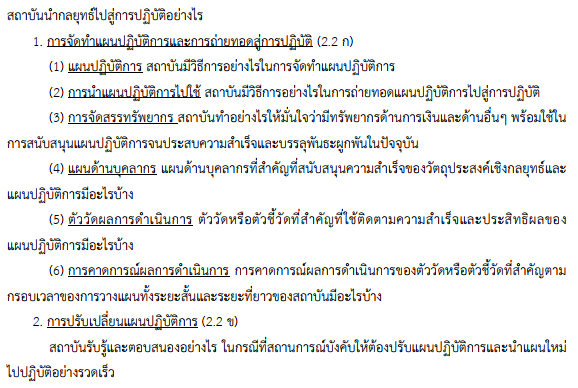
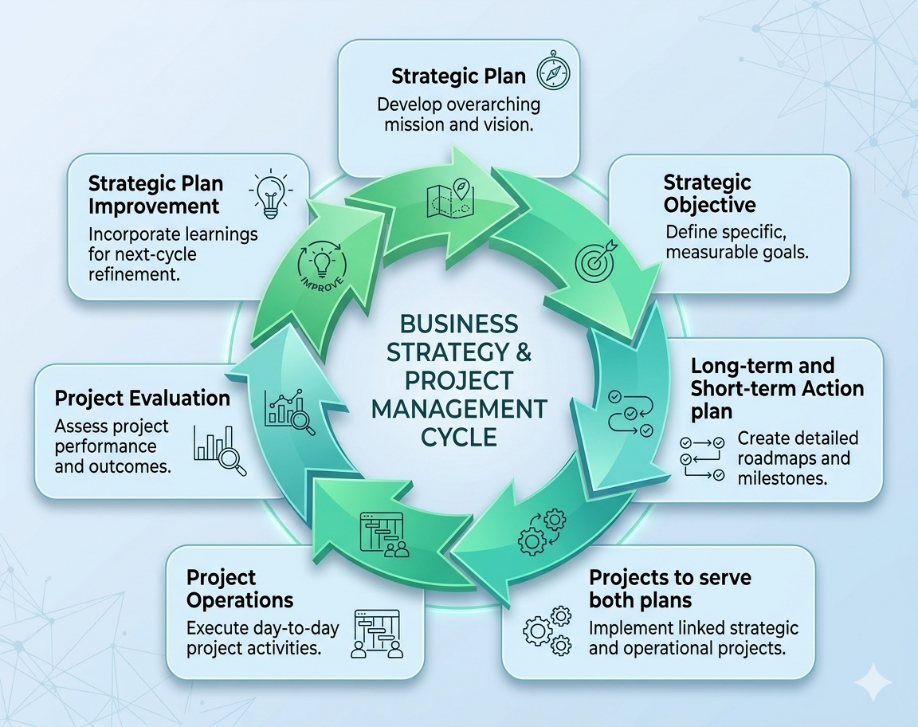
Once the Faculty’s strategic plan was established, the Dean, Associate Dean, and the Faculty committees collaborated to operationalize it through two levels of action plans: the Faculty Action Plan and the Program Action Plan. The Faculty Action Plan addresses the operations at the institutional level, while the Program Action Plan focuses on specific operations within each academic program.
These action plans are categorized into long-term and short-term plans.
- The long-term action plan consists of a series of projects aligned with the strategic goals outlined in the Faculty’s five-year strategic plan (2025–2029).
- The short-term action plan, referred to as the Annual Action Plan, includes projects proposed annually by the Associate Dean and Program Chairs to address current academic and operational needs.
All proposed action plans undergo a two-tier approval process: first by the Dean, and subsequently by the Director of the Office of Policy and Planning, ensuring alignment with institutional priorities and resource allocation.
หลักฐาน
| รหัสหลักฐาน | ชื่อหลักฐาน(พร้อมแนบลิ้งค์) |
| 2.2.1 (1) -1 | แผนยุทธศาสตร์ 5 ปีของคณะ |
| 2.2.1 (1) -2 | แผนปฏิบัติการประจำปีการศึกษา 2568 |
| 2.2.1 (1) -3 | รายงานผลการดำเนินงานตามแผนปฏิบัติการ ปีการศึกษา 2568 |

Transfer of Strategic Plans and Monitoring of Project Implementation
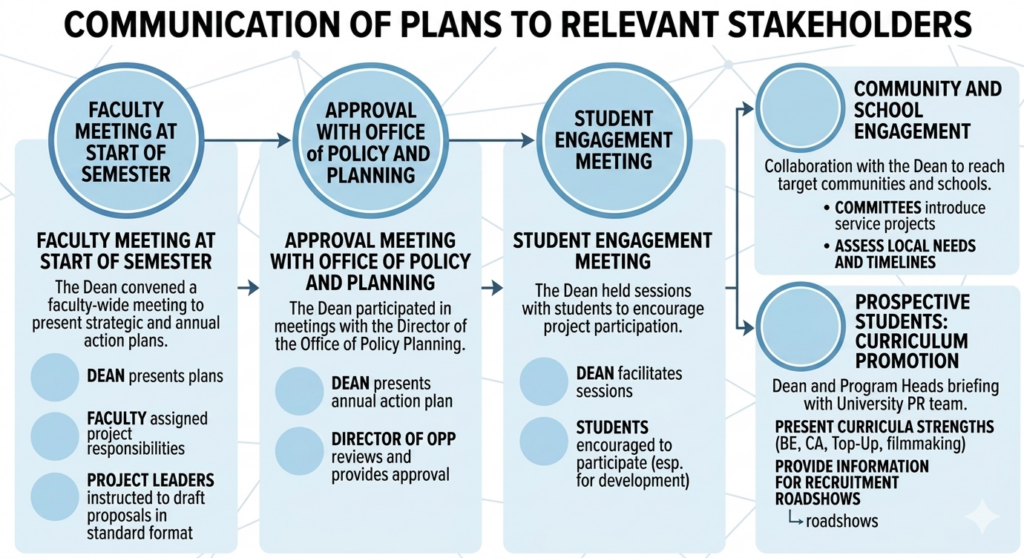
To effectively communicate and implement the strategic and action plans, the Dean carried out a series of structured engagements with stakeholders:
- Faculty Meeting at the Start of the Semester:
The Dean convened a faculty-wide meeting to present the overall strategic and annual action plans. During the meeting, individual faculty members were assigned responsibility for specific projects. Project leaders were instructed to draft their project proposals using the standard format issued by the Office of Policy and Planning. - Approval Meeting with the Office of Policy and Planning
The Dean participated in meetings organized by the Director of the Office of Policy Planning to present the annual action plan for approval. - Student Engagement Meeting:
The Dean held sessions with students to encourage their participation in relevant projects, particularly those designed for student development. - Community and School: Engagement
In collaboration with the Dean, the academic and community service committees reached out to target schools and communities. The initiative aimed to introduce upcoming academic and community service projects, survey local needs, and determine optimal timelines for project delivery.
- Prospective students: Curriculum Promotion:
The Dean and both Program Heads met with the University’s Public Relations team to present the strengths of the improved BE and CA curricula, the refined “Top-Up” program, and the filmmaking short course. This briefing provided the PR team with the necessary information to develop upcoming recruitment roadshows for prospective students.
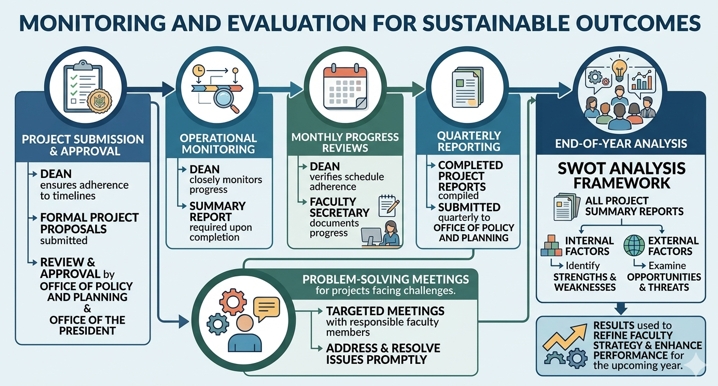
To ensure the successful execution and sustainability of all projects, the Dean and the Committees undertook a comprehensive monitoring and evaluation process:
- Project Submission and Approval:
The Dean ensured that project leaders adhered to project timelines and submitted formal project proposals for review and approval by the Office of Policy and Planning and the Office of the President. - Operational Monitoring:
During implementation, the Dean closely monitored project progress and required a summary report upon project completion. - Monthly Progress Reviews:
The Dean conducted monthly reviews to verify that projects were progressing according to schedule and the Faculty secretary documented the progress for report. - Quarterly Reporting:
Completed project reports were compiled and submitted quarterly to the Office of Policy and Planning. - Problem-Solving Meetings:
When projects encountered operational challenges, the Dean conducted targeted meetings with the responsible faculty members to resolve issues promptly.
- End-of-Year Analysis:
At the close of the academic year, all project summary reports were collectively analyzed using a SWOT analysis framework. Internal factors were evaluated to identify strengths and weaknesses, while external factors were examined for opportunities and threats. The results of this analysis were used to refine the Faculty’s strategy and enhance performance in the upcoming academic year.
Action Plan Transfer Channel
| Channel | Target Recipient | Time and Frequency | |
| Faculty meeting | Semester-start meeting | All faculty members and support staff | Once a semester |
| Monthly meeting | Every month | ||
| Research and Planning Meeting | Director of the Research and Planning Department. | Twice a year | |
| Meeting (informal) | The university’s public relations | Once a year | |
| Program Meeting | Two program chairs | Twice a semester | |
| Student meeting | Students | Not specific |
หลักฐาน
| รหัสหลักฐาน | ชื่อหลักฐาน(พร้อมแนบลิ้งค์) |
| 2.2.1 (2)-1 | รายงานผลการดำเนินงานตามแผนปฏิบัติการ ปีการศึกษา 2568 |
| 2.2.1 (2)-2 | รายการการประชุม |
| 2.2.1 (2)-3 | รายงานสรุปผลโครงการจากฝ่ายนโยบายและแผน |

The Dean and the faculty committee distributed resources—such as the budget, personnel, equipment, and facilities—to support projects and activities aligned with the annual action plan, aiming to meet strategic objectives. The operational process toward the end of the 2025 fiscal year included the following steps:
- The Faculty reviewed the 2024 project summaries, especially ongoing ones, to assess whether additional resources were required.
- The Dean consulted the two program chairs to identify resource needs, enabling each chair to prioritize them based on input from program lecturers and the program’s specific action plan.
- Together, the Dean and the program chairs compiled a list of projects, detailing the required budget, equipment, time, staff, and facilities. This list was submitted to the Office of Policy and Planning for approval.
- Once approved, each project was formally documented, specifying the necessary resources. These documents required a second round of approval from both the Office of Policy and Planning and the President Office.
- At the implementation stage, the designated project leaders handled the procurement of equipment, following the Finance Department’s procedures.
- The Dean and faculty committee oversaw resource usage and tracked project outcomes to ensure resources were used effectively and efficiently.
For any urgent or special resource requirements, the program chairs or project leaders reported to the Dean, who then sought approval from the Office of Policy and Planning.
หลักฐาน
| รหัสหลักฐาน | ชื่อหลักฐาน(พร้อมแนบลิ้งค์) |
| 2.2.1 (3) -1 | ผลการเปรียบเทียบงบประมาณ ปีการศึกษา 2567 กับปีการศึกษา 2568 |
| 2.2.1 (3) -2 | เปรียบเทียบงบประมาณโครงการที่ได้เพิ่มมากขึ้น ในปีการศึกษา 2568 |
| 2.2.1 (3) -3 | ขั้นตอนการเบิกจ่ายเงินตามงบประมาณของโครงการ |
| 2.2.1.(3) – 4 | งบประมาณปี 2567 ได้ 585,000 งบประมาณปี 2568 ได้ 495,000 |

.The Faculty developed two types of workforce plans: one focusing on workforce numbers and the other on workforce capacity building. Both plans align with the Human Resource Management and Development Plan (2025-2029) and the annual action plan.
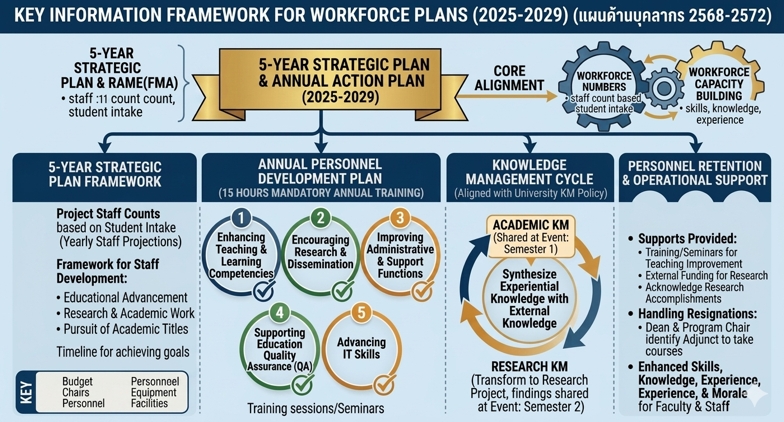
The five—year Human Resource Management and Development Plan (2025–2029) outlines the projected number of lecturers and support staff needed each year based on the anticipated student intake. It also includes a framework for staff development, covering educational advancement, engagement in research and academic work, and pursuit of academic titles, along with a timeline for achieving these goals.
When a faculty member resigns, the Dean collaborates with the program chair to identify a qualified adjunct lecturer to take over relevant courses. The annual action plan is implemented through various projects that reflect the strategic goals of enhancing the skills, knowledge, experience, and morale of both faculty and support staff. The yearly personnel development plan includes five key areas: (1) enhancing teaching and learning competencies, (2) encouraging research and its dissemination, (3) improving administrative and support functions, (4) supporting education quality assurance, and (5) advancing IT skills. These areas are addressed through a range of training sessions and seminars, all of which are evaluated upon completion. Every faculty and staff member must complete at least 15 hours of training or seminars annually.
Policy and Planning. The policy encompasses two categories: Academic KM and Research KM. Faculty members are encouraged to integrate experiential knowledge with current external knowledge and share their insights during Academic KM activities in the first semester. These insights are subsequently developed into research projects, with findings presented during Research KM activities in the second semester.
Due to scheduling constraints and conflicting commitments, the official University KM event was canceled. To ensure continued knowledge sharing, the Faculty organized its own KM activity, during which two faculty members presented and shared their developed knowledge with colleagues across the Faculty.
To support and retain personnel, the Faculty provides various forms of assistance—organizing training and seminars for teaching improvement, securing external funding for research, and acknowledging staff research accomplishments.
หลักฐาน
| รหัสหลักฐาน | ชื่อหลักฐาน(พร้อมแนบลิ้งค์) |
| 2.2.1 (4) -1 | แผนบริหารและพัฒนาบุคลากร 5 ปี |
| 2.2.1 (4) -2 | โครงการพัฒนาศักยภาพทางการสอนของอาจารย์ (HS 08) |
| 2.2.1 (4) -3 | โครงการการจัดการความรู้ (HS 10) |
| 2.2.1 (4) -4 | สรุปชั่วโมงอบรมของอาจารย์และสายสนับสนุน |
| 2.2.1 (4) -5 | Letter of recognition |

In terms of performance evaluation, the Faculty divided the measures into three categories: those assessing the Faculty’s three core missions, those evaluating the outcomes of annual projects, and those measuring progress in workforce capacity development.
Performance Measures
| Performance Types | Measures | |
| 1) Main Missions | Teaching and Learning Management | – Number of students’ work arising from productive Learning – Number of programs improved or developed |
| Research | – Number of research studies by the lecturer – Number of research studies by students – Number of copyrights | |
| Academic and Community Services | – Innovation – Service recipients’ satisfaction | |
| 2) Annual action plan via projects | – Results of the projects as stated | |
| 3) Workforce capacity development | – Faculty members teaching and learning development | – 15 hours of attending training/seminars – 2 pieces of KM work produced and presented – Satisfactory level for teaching quality rated by students and from self-evaluation – Satisfactory teaching quality from peer evaluation – examination paper with critical questions, both MCQ and Essay type questions |
| – Faculty members’ research endeavor | – Four research papers produced and published in SCOPUS or TCI Journals – 12 % of faculty members pursuing a doctoral degree – 31% of faculty members planning for an academic title | |
| – Support staff | – 15 hours of attending training/seminars – Satisfactory work quality rated by students and other suppliers | |
หลักฐาน
| รหัสหลักฐาน | ชื่อหลักฐาน(พร้อมแนบลิ้งค์) |
| 2.2.1 (5) -1 | จำนวนผลงานของนักศึกษา |
| 2.2.1 (5) -2 | สรุปชั่วโมงอบรมของอาจารย์และสายสนับสนุน |
| 2.2.1 (5) -3 | ผลงานทางวิชาการของอาจารย์ ปีการศึกษา 2568 |
| 2.2.1 (5) -4 | ผลการประเมิน “นักศึกษาประเมินอาจารย์” |
| 2.2.1 (5) -5 | ผลการประเมิน “อาจารย์ประเมินตนเอง” |
| 2.2.1 (5) -6 | รายงานผลการดำเนินงานตามแผนปฏิบัติการประจำปีการศึกษา 2568 |
| 2.2.1 (5) -7 | โครงการบริการวิชาการ HuSo สู่ชุมชน (HS 27) |

The Faculty has established three categories of performance projections: one aligned with the Five-Year Human Resource Management and Development Plan, another with the core missions outlined in the Five-Year Strategic Plan, and a third linked to the annual action plan.
The Human Resource Management and Development Plan emphasizes enhancing workforce capacity and provides specific annual targets, including:
- Faculty Recruitment: The plan outlines the number of faculty members and support staff are to be hired in each year.
- Faculty Development: The plan outlines the expected number of faculty members who will conduct research, pursue doctoral studies, or apply for academic ranks each year.
For the strategic plan’s main missions, the performance projections are detailed accordingly. These quantitative projections, set against a timeline, play a critical role in the yearly evaluation of progress.
| Strategic goal | Strategic Objective | Key Success Indicators | Collaborators | Counting Unit | Performance Projections | ||||
| 2025 | 2026 | 2027 | 2028 | 2029 | |||||
| Teaching and Learning Management | – Create a network of Academic cooperation to produce graduates to become active citizens through organizing productive-based learning in line with the needs of the labor market. | – Number of students’ work increasing from productive-based learning – Number of programs improved or developed | – Community School – Government organizations – Private organizations – Alumni – qualified person | -Student‘s work – Program | 60 2 | 60 2 | 50 2 | 50 2 | 50 2 |
| Research and cooperation | – Produce quality research and innovation beneficial for the organization or communities | – Number of research studies by lecturer – Number of research studies by students | – External research funding resources – Research collaborators | – Lecturers’ Research – Students Research – Research Collaborators | 4 6 2 | 4 5 3 | 4 7 3 | 4 3 3 | 4 4 3 |
| Academic services and cooperation with social collaborators | – Transfer knowledge to local communities to promote their economic development, and maintain the local culture, values, and traditional way of life | – Successful academic and community services – Service recipients’ satisfaction | – Local communities – Local schools | – Number of services – Number of communities | 4 4 | 4 4 | 4 4 | 4 4 | 4 4 |
The annual action plan was implemented through 47 projects, each outlining specific KPIs and targeted outcomes.
หลักฐาน
| รหัสหลักฐาน | ชื่อหลักฐาน(พร้อมแนบลิ้งค์) |
| 2.2.1 (6) -1 | แผนบริหารและพัฒนาบุคลากร |
| 2.2.1 (6) -2 | แผนยุทธศาสตร์ |
| 2.2.1 (6) -3 | รายงานผลการดำเนินงานตามแผนปฏิบัติการประจำปีการศึกษา 2568 |

The Dean, Executive Committee, and Program Heads continuously monitor both internal and external situations. Under normal circumstances, operational performance is monitored and evaluated every quarter.
In the event of an emergency or unforeseen situation that requires an adjustment to the operational plan, the Dean will convene a meeting with the relevant Committee to implement the following adjustment process:
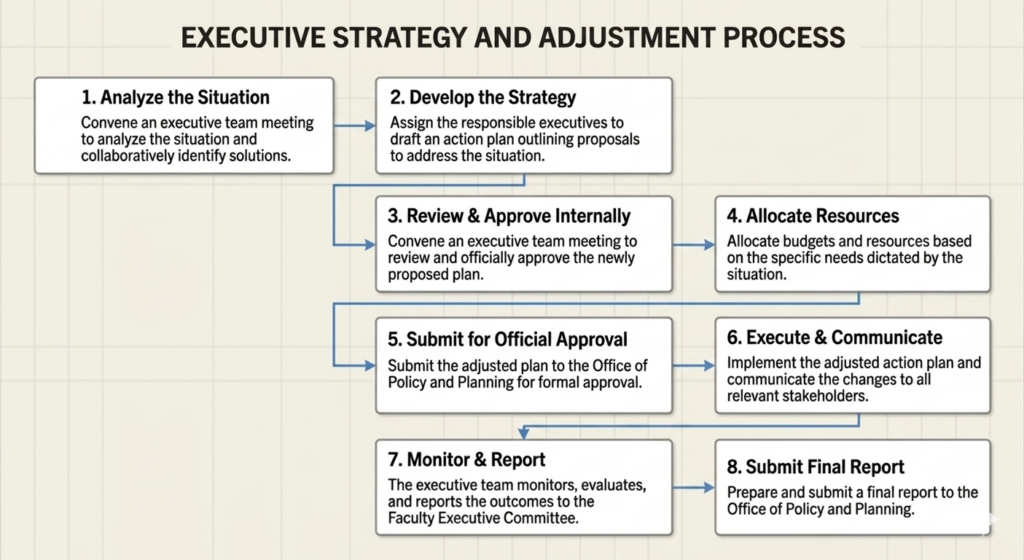
If the situation remains unresolved, the executive team will restart the process from the beginning to ensure ultimate operational success.
หลักฐาน
| รหัสหลักฐาน | ชื่อหลักฐาน(พร้อมแนบลิ้งค์) |
| 2.2.2-1 | การขอยกเลิกโครงการ |
| 2.2.2-2 | โครงการที่มีการปรับเปลี่ยน |
Self-Assessment 2.2
| เกณฑ์คุณภาพ | ประเมินตนเอง | คะแนน |
| 1. การจัดทำแผนปฏิบัติการและการถ่ายทอดสู่การปฏิบัติ | ||
| (1) แผนปฏิบัติการ (2) การนำแผนปฏิบัติการไปใช้ (1 คะแนน) | / | 1 |
| (3) การจัดสรรทรัพยากร (4) แผนด้านบุคลากร (1 คะแนน) | / | 1 |
| (5) ตัววัดผลการดำเนินการ (1 คะแนน) | / | 1 |
| (6) การคาดการณ์ผลการดำเนินการ (1 คะแนน) | / | 1 |
| 2. การปรับเปลี่ยนแผนปฏิบัติการ | ||
| (1) การปรับเปลี่ยนแผนปฏิบัติการ (1 คะแนน) | / | 1 |
| รวมผลการประเมินตนเอง Criteria 2.2 | 5 | |