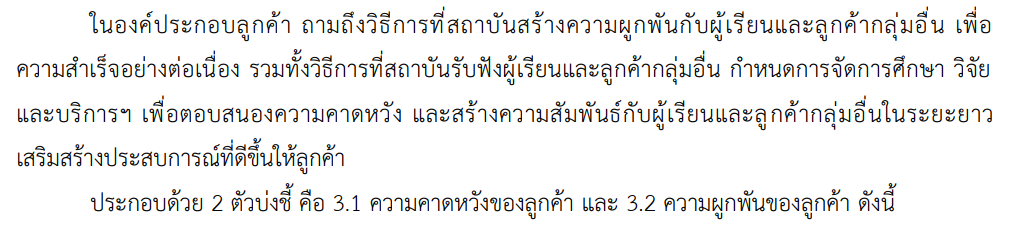
Criteria 3.1 ความคาดหวังของลูกค้า (Customer Expectations)
Requirements
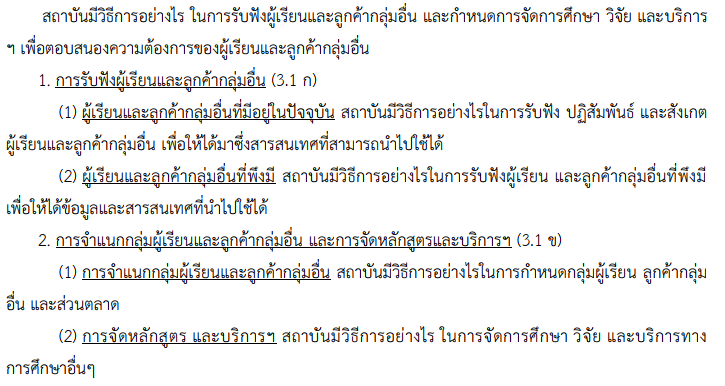
Quality level assessment

Result 3.1
.The Faculty establishes processes to listen to the voices of current students and other customer groups. The gathered data regarding their needs and expectations is utilized to design and improve operations across the Faculty’s primary missions: education, research, and academic/community services. Additionally, this process monitors the ongoing quality of these three core missions.
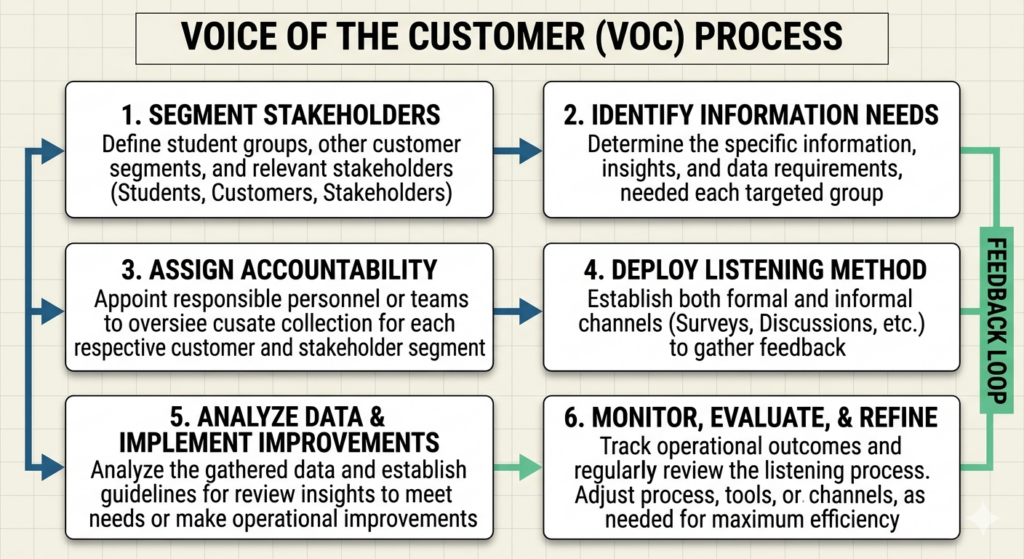
The comprehensive Voice of the Customer (VoC) process is structured as follows:
1.Segment Stakeholders: Define student groups, other customer segments, and relevant stakeholders:
2.Identify Information Needs: Determine the specific information, insights, and data requirements needed from each targeted group.
3.Assign Accountability: Appoint responsible personnel or teams to oversee data collection for each respective customer and stakeholder segment.
4.Deploy Listening Methods: Establish both formal and informal channels to gather feedback:
5.Analyze Data & Implement Improvements: Analyze the gathered data and establish guidelines for applying these insights to meet user needs or make operational improvements.
Example: Utilizing student satisfaction evaluations regarding teaching performance to actively improve instructional methods in the subsequent semester or academic year.
6.Monitor, Evaluate, & Refine: Track operational outcomes and regularly review the listening process itself. If a particular method proves ineffective or fails to yield actionable information, the process, tools, or communication channels will be adjusted or replaced to maximize the efficiency of the VoC system.
| Customers/ Stakeholders | Procedure | Tool | Time | Information Deployment |
| Educational Management | ||||
| Current students | – Program chairs and advisors meet and talk with students – Students evaluate lecturers, themselves, and faculty management. | – Questionnaires – Interview – Meeting | – Weekly meetings – At the end of the academic year | – Improve curriculum, teaching and learning – Create extracurricular activities – Coordinate with the University Administration Division to improve and develop central facilities. |
| Prospective Students | – Publicize both programs via the Faculty website and webpage, and the University’s public relations team. | – Brochure – PowerPoint – Faculty website, Facebook | Continuously | – Develop and improve communication channels with target customers – Provide the information of the Faculty and the two curricula |
| – Graduates – Alumni | – Ask for their opinions using a set of questionnaires via Google form – Interview | – Questionnaire – Line group – Telephone | – Once a year – At graduates’ available time | – Improving curriculum, and teaching and learning – Creating cooperation and networks for current students’ internships – Provide current students with real-world work experiences |
| Graduate users | – Ask for their opinions using a set of questionnaires via Google form – Interview | – Questionnaire – Telephone – Meeting in person | – Once at the end of the academic year – On an urgent occasion | – Improving curriculum, and teaching and learning – Creating cooperation and networks for current students’ internships |
| Research | ||||
| Current students | – Ask for the opinion regarding the lecturer teaching the course on business research. – Interview the students – Evaluate written research paper | – Interviews – Questionnaire | – During the semester | – Improve the course on business research – Allocate proper lecturers – Students’ research papers published and disseminated |
| Faculty members | – Survey their needs for research production – Survey their needs for research publications | – Interviews – Meeting | – Along the semesters | – Improve the research support System – Seek research funding sources – Provide help on the research production process for novices |
| Research collaborators | – Ask for their collaboration – Ask about their research needs | – Need Survey – Evaluation form for research results deployment – Study policy for collaborative research | – At the beginning of the academic year | – Improve the research support system |
| Academic/Community Service | ||||
| Current students | – Ask for their participation | – Advising hours – Personal meeting | – Before launching the services | – Improve students’ soft skills – Students transfer the learned knowledge into practice. |
| Faculty members | – Ask for their participation – Ask for their knowledge contribution | – Faculty meeting – Personal talk | – At the beginning of the first semester | – Research conduction and publication |
| Target communities | – Ask about the needs of the communities – Survey satisfaction using questionnaires – Knowledge deployment questionnaire | – Meeting with the communities – Visiting academic /community service sites | At the beginning of the semester | – Improve the quality of the services – Create benefits for communities. – Strengthen relationships between the communities and the University. – Create academic services and activities that support community development |
หลักฐาน
| รหัสหลักฐาน | ชื่อหลักฐาน(พร้อมแนบลิ้งค์) |
| 3.1.1 (1) -1 | ผลการประเมินความพึงพอใจของนักศึกษาที่มีต่อหลักสูตร |
| 3.1.1 (1) -2 | ผลการประเมินความพึงพอใจของผู้ใช้บัณฑิต |
| 3.1.1 (1) -3 | ผลการประเมิน “นักศึกษาประเมินอาจารย์” |
| 3.1.1 (1) -4 | แผ่นพับประชาสัมพันธ์หลักสูตร |
| 3.1.1 (1) -5 | PowerPoint ประชาสัมพันธ์หลักสูตร |
| 3.1.1 (1) -6 | ผลงานทางวิชาการของอาจารย์ |
| 3.1.1 (1) -7 | งานวิจัยของนักศึกษาชั้นปีที่ 4 |
| 3.1.1 (1) -8 | โครงการบริการวิชาการ HuSo สู่ชุมชน (HS 27) |

To expand its reach beyond current students and customers, the Faculty identifies new segments of potential students and customers. This initiative, with various partners, has classified potential stakeholders into two categories:
- Returning Customers: Individuals and organizations with prior engagement who are highly likely to utilize the Faculty’s services again. This includes alumni, past recipients of academic and community services, private corporations, and government agencies.
- New Customers: Individuals and organizations with no prior interaction with the Faculty. This segment targets high school students in regions unfamiliar with the Faculty, as well as government agencies and private firms that have not previously collaborated with the University.
Following this strategic segmentation, the Faculty established targeted data-collection methodologies to gather relevant information, ensuring robust support for its core institutional missions.
Channels for Gathering Required Information from Potential Students and Customers
| Customers | Required information | Channels/information-gathering procedure | Frequency |
| Educational Management | |||
| High school students/equivalents | – Expectations and needs from the curriculum – Information on further study – Curriculum information | – Open house event – Guidance from the University’s public relations team – Google form survey | – Once a year – Unlimited – Once a year |
| Graduate users | – Expectations for the quality of graduates and curriculum | – Questionnaire assessing satisfaction with graduate quality – Student internship /cooperative education supervision project | – Once a year |
| Private companies/ government agents | – Expectations for the quality of graduates and curriculum – Expectations from the curriculum | – Field trip – Questionnaire assessing satisfaction with graduate quality – Student internship /cooperative education supervision project | – Twice a year – Once a year |
| Research | |||
| Collaborators | – Research for community development | – Meeting | – Once a year/program |
| Academic service | |||
| High school students/ equivalents | – Extra-curricular activities required for university life | – Open house event – Guidance from the University’s public relations team | – Once a year – Unlimited |
| – Private companies – Government agents – Graduate users | – Expectations for academic services and activities that support performance – Short course program | – Field trip – Questionnaire assessing satisfaction with graduate quality – Student internship /cooperative education supervision project | – Twice a year – Once a year |
หลักฐาน
| รหัสหลักฐาน | ชื่อหลักฐาน(พร้อมแนบลิ้งค์) |
| 3.1.1(2) -1 | ผลประเมินความพึงพอใจของผู้ใช้บัณฑิต สาขา B.E. |
| 3.1.1(2) -2 | ผลประเมินความพึงพอใจของผู้ใช้บัณฑิต สาขา C.A. |
| 3.1.1(2) -3 | PowerPoint ประชาสัมพันธ์หลักสูตร |
| 3.1.1(2) -4 | คู่มือนักศึกษา |
| 3.1.1(2) -5 | งาน Open house |

After identifying and classifying both current and potential students and customers, and collecting their needs and expectations, the Dean and the faculty committee conducted an analysis of the Faculty’s internal components—such as its vision, mission, core values, BE and CA curricula, and strategic plans—in relation to the feedback from these groups. Based on this analysis, the Faculty then defined the target customer groups for each of its core missions: education management, research, and academic and community services, as outlined below.
| Mission | Types of students and other customer groups | Methods for classifying | Market share |
| Education management | Current students | Categorized by curriculum | Study in a program |
| Potential students | Categorized by curriculum | Future students | |
| Graduates/Alumni | Types of relationship with the Faculty | Stakeholders | |
| Graduate users | Types of relationship with the Faculty | Stakeholders | |
| Research | Current students | Categorized by curriculum | – Produce research |
| – Collaborate with the Faculty | |||
| Faculty members | Lecturers of the Faculty | – Produce research and publish to disseminate the results. | |
| Collaborators | Types of relationship with the Faculty | – Produce Collaborative research | |
| – Sources of information | |||
| – Provide a research grant | |||
| Academic and community services | Current students | Categorized by curriculum | – Participate in the services as volunteers |
| Potential students | Categorized by curriculum | – Prospective service volunteers | |
| Community | Categorized by the types of service | – Locations for service operations – Service recipients | |
| Private and government agents | Categorized by the Faculty’s needs | – Service recipients | |
| Graduates users | Types of relationship with the Faculty | – Provide data for operation improvement |

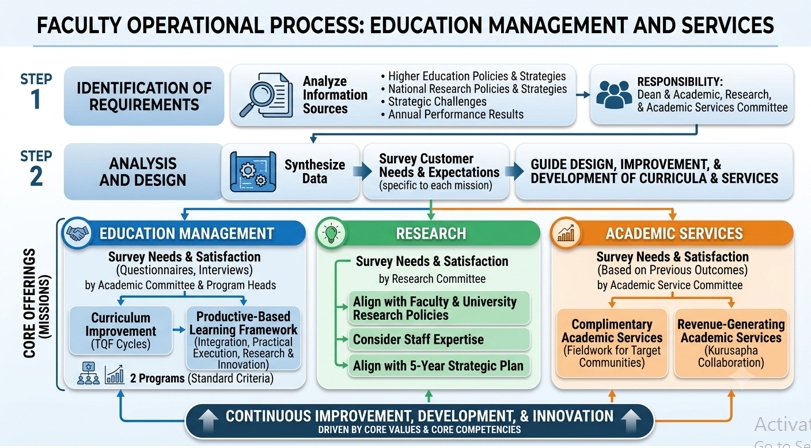
.The Faculty employs a systematic and effective approach to identifying key factors critical to success in education management and services. Operations are executed in alignment with the Faculty’s Strategic Plan, which directly corresponds to the University’s overall strategy. The core offerings of the Faculty are categorized into three main missions: Education Management, Research, and Academic Services. For each product and service area, the Faculty maintains a policy of continuous improvement, development, and the promotion of innovations, driven by its core values and core competencies. The operational process is structured as follows:
- Identification of Requirements: The Dean, along with the Academic, Research, and Academic Services Committee are responsible for identifying the needs of all customer segments. This involves analyzing various information sources, including Higher Education, Science, Research, and Innovation policies and strategies; National Research policies and strategies; strategic challenges; and annual performance results. This data is utilized to improve products and services to meet the needs and expectations of customers.
- Analysis and Design: The gathered information is analyzed and synthesized to guide the design, improvement, and development of curricula and services. This ensures they are highly appropriate and align with the needs of both current and future customers, based on surveys conducted by the committee responsible for each specific product and service as follows:
Educational Management
The Academic Committee, along with Program Heads, is responsible for surveying customer needs, expectations, and levels of satisfaction/dissatisfaction regarding educational management.
- Methodology: Questionnaires and interviews are utilized as tools to collect, gather, analyze, and synthesize this data.
- Scope: The findings summarize customer needs, expectations, and satisfaction/ dissatisfaction concerning the curriculum, faculty members, and learning support resources.
- Application: The gathered data is used to improve the curriculum, develop educational management, and design an educational framework centered on the philosophy of Productive-Based Learning. This approach emphasizes enabling learners to integrate knowledge, engage in practical execution, and create research and innovations that are modern, meet customer demands, and respond to current global situations.
Currently, the Faculty offers two programs that adhere to standard curriculum criteria, both of which undergo revisions according to the cycles specified by the Thailand Qualifications Framework (TQF).
Research
The Research Committee is responsible for surveying customer needs, expectations, and satisfaction/dissatisfaction, aligning with the research policies and strategies of both the Faculty and the University.
- Key considerations include staff expertise and alignment with the research development goals outlined in the 5-Year Strategic Plan.
Academic Services
The Academic Service Committee serves as the primary body responsible for surveying customer needs, expectations, and satisfaction based on the outcomes of the previous year’s academic services. This data is then used to formulate the current year’s Academic and Community Service Plan aimed at local development, in alignment with the Faculty’s core competencies.
Academic service products can be categorized into two main types:
- Complimentary Academic Services: Fieldwork initiatives dedicated to developing target communities in accordance with the Faculty’s policies.
- Revenue-Generating Academic Services: Academic service projects executed through collaborative agreements between the University and the Teachers’ Council (Kurusapha).
หลักฐาน
| รหัสหลักฐาน | ชื่อหลักฐาน(พร้อมแนบลิ้งค์) |
| 3.1.2(2) -1 | ผลสำรวจความต้องการของผู้มีส่วนได้ส่วนเสียทั้ง BE / CA |
| 3.1.2(2) -2 | โครงการบริการวิชาการ |
| 3.1.2(2) -3 | หลักสูตรปรับปรุงทั้ง 2 |
| 3.1.2(2) -4 | ผลงานของนักศึกษา |
| 3.1.2(2) -5 | งานวิจัยอาจารย์ |
| 3.1.2(2) -6 | โครงการ module ของคุรุสภา |
Self-Assessment 3.1
| เกณฑ์คุณภาพ | ประเมินตนเอง | คะแนน |
| 1. การรับฟังผู้เรียนและลูกค้ากลุ่มอื่น | ||
| (1) ผู้เรียนและลูกค้ากลุ่มอื่นที่มีอยู่ในปัจจุบัน – ผู้เรียนที่มีอยู่ในปัจจุบัน (1 คะแนน) | / | 1 |
| – ลูกค้ากลุ่มอื่นที่มีอยู่ในปัจจุบัน (1 คะแนน) | / | 1 |
| (2) ผู้เรียนและลูกค้ากลุ่มอื่นที่พึงมี (1 คะแนน) | / | 1 |
| 2. การจำแนกกลุ่มผู้เรียนและลูกค้ากลุ่มอื่น และการจัดหลักสูตรและบริการฯ | ||
| (1) การจำแนกกลุ่มผู้เรียนและลูกค้ากลุ่มอื่น (1 คะแนน) | / | 1 |
| (2) การจัดหลักสูตร และบริการฯ (1 คะแนน) | / | 1 |
| รวมผลการประเมินตนเอง Criteria 3.1 | 5 | |