Criteria 3.2 ความผูกพันของลูกค้า (Customer Engagement)
Requirements
Quality level assessment

Result 3.2

(1) การจัดการความสัมพันธ์
The Faculty actively listens to the voice of the customer, builds and manages relationships with students, other customer groups, and stakeholders. This is achieved by systematically surveying their needs regarding the Faculty’s curricula and services. The gathered insights directly drive execution across three core missions:
1. Education Management
- Curriculum Review & Analysis: Before any curriculum updates, the Faculty conducts program self-assessments and analyzes shifting global, economic, and social trends, alongside government and university policies.
- Stakeholder Alignment: Curricula are continuously updated to align with current global situations and the specific demands of stakeholders.
- Unique Identity: The Faculty designs distinct, identity-driven programs tailored to attract prospective learners.
- Communication: Multiple communication channels are maintained to ensure students and customers can access information and get in touch at any time (e.g., Website, Telephone, email, and Facebook).
2. Research and Innovation
- Mentorship for Faculty: The Research Committee supports less experienced faculty members by providing step-by-step mentorship, guiding them from initial research conception through to final publication.
- Student Research Support: The Faculty provides direct support to 4th-year students to help them get their research papers published.
3. Academic Services
- Diversified Delivery Formats: Moving beyond traditional training and seminars, the Faculty offers diverse academic service models. These include on-site fieldwork within target communities and official TOEIC testing services.
- Community: The Faculty encourages and supports its personnel in providing specialized academic services to external communities and various external organizations.
Relationship Establishment with Customers
| Mission/Products | Customer Group | Procedure | Results |
| Education Management | Current student | – Arranging relationship-building activities: orientation, final orientation – Creating extracurricular activities – Consulting and monitoring of academic performance by advisors and the academic committee | – A good attitude toward the program and the Faculty – Knowledge and life-long learning skills development |
| Potential student | – Organizing academic service: academic camps – Disseminating the Faculty’s overall information and BE and CA curricula through the Road Show activities by the University’s marketing team. b – Publicizing the Faculty’s news and both curricula through social media | – Recruit new students to the BE and CA programs – Students in the target schools realize the academic potential of the Faculty. | |
| Alumni | – Creating an alumni network to coordinate various academic services – Creating alumni participation activities, such as inviting alumni to exchange knowledge and experiences with current students. – Asking for their opinions to improve the Faculty’s operation and both BE and CA curricula | – Alumni are willing to contribute to the Faculty’s success. – Alumni relay the Faculty’s curriculum, academic success, and a variety of extracurricular activities to people in general. | |
| Graduate users | – Embracing their opinion for improvement – Visiting their organization during the internship to create sustainable relationships | – They provide up-to-date information to the Faculty that is useful in producing graduates with qualifications that meet the needs of the business sector. – They are willing to be guest speakers to provide their current experience to the current students. | |
| Research | Current student | – Helping students while they are conducting research. – Asking students to participate in the Faculty’s research. | – Students’ research work was published, which proves the efficiency of the Faculty. |
| Faculty members | – Meeting to discuss the research concept – Arrange regular meetings for research development until the last stage of publication | – More faculty members, as research novices, produced and published research papers. | |
| Academic/ Community service | Current student | – Collaborating with the project leaders to organize activities with the community requesting services – Participate in activities | – Students create self-actualization during the service process. – Students transfer the learned knowledge and skills into practice. |
| Target community | – Organizing activities with the community and providing academic services according to the needs of the community. | – The community accepted the Faculty’s capability and potential to create a good image. – The community’s needs were met. – The good relationship was strengthened between the community and the Faculty. |
หลักฐาน
| รหัสหลักฐาน | ชื่อหลักฐาน(พร้อมแนบลิ้งค์) |
| 3.2.1(1) -1 | โครงการบริการวิชาการ HuSo สู่ชุมชน (HS 27) |
| 3.2.1(1) -2 | KM |
| 3.2.1(1) -3 | โครงการสัมมนากับผู้เชี่ยวชาญ (HS 06) |

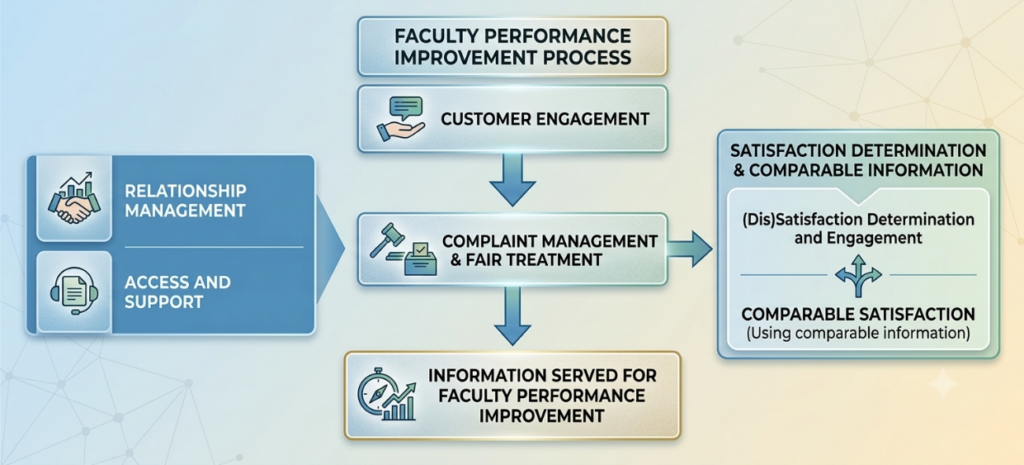
Following the completion of the relationship management analysis, the Dean, together with the Academic, Research, and Academic Service Committees, identified strategies to enhance customer access to the Faculty’s information and support services.
After establishing communication and access channels for all customer groups, the Dean officially presented the Faculty’s vision and operational plans for the 2025 academic year during a faculty meeting. To improve information accessibility, key details about the Faculty, including the BE and CA programs, have been made available on the newly redesigned Faculty website. The website enables users to conveniently search for information in various categories, such as curriculum details, faculty members and support staff, and faculty activities.
In addition to the website, the Faculty has developed multiple communication channels, including Line groups, dedicated Facebook fan pages for the BE and CA programs, and the Faculty’s official Facebook page. Faculty members and support staff from both programs have been assigned responsibility for regularly updating and maintaining these platforms to ensure that information remains accurate, timely, and accessible.
| Customers | Communication Channel | Support | |
| Education Management | Current Students | – Faculty’s and the University’s website / the Faculty’s Facebook page/Line/faculty phone /advisor / Program heads/ Student Handbook/bulletin board | – Scholarships/learning facilities / extra-curricular activities/consultation / official documents /code of conduct for students |
| Potential Students | – The Faculty’s and the University’s website /the Faculty’s Facebook page/Line/faculty phone / publicizing the BE and CA programs, and the Faculty via the Road Show activities | – Scholarships/learning facilities / extra-curricular activities/consultation / official documents/code of conduct for students/ living on campus life advice | |
| Alumni | The Faculty’s and the University’s website / the Faculty’s Facebook page / Line/faculty phone | – Updated curriculum information / Career Guideline | |
| Graduate Users | – The Faculty’s and the University’s website /the Faculty’s Facebook page/ Line/faculty phone /internship observer | – Updated curriculum information – Short-course curriculum – Academic service | |
| Research | Current students | – Studying with the Instructor of the “Business Research” course – Meeting with the Research Committee | – Provided help with their research – Submitted their research paper to a journal for publication |
| Faculty members | – Research committee / MIS / the University’s research mentoring system | Research database, research consultation/ research and publication funding,/Recognition letter for research endeavor success | |
| Academic and Community Service | – Current students | – Meeting with academic/community service project leaders | – Informed them of the details of the services – Allocated their duties and responsibilities |
| – Research collaborators Schools/ communities | – The Faculty’s and the University’s website /the Faculty’s Facebook page/Line/faculty phone/field visit / Research – Meeting in person with academic/community service project leaders | – Local personnel development training/ consulting for project implementation – Promote community sustainability by developing media that disseminates local culture, traditions, ways of life, and indigenous wisdom to the broader public. | |
หลักฐาน
| รหัสหลักฐาน | ชื่อหลักฐาน(พร้อมแนบลิ้งค์) |
| นักศึกษาปัจจุบัน | |
| 3.2.1(2) -1 | Facebook Fanpage คณะ |
| 3.2.1(2) -2 | คู่มือนักศึกษา |
| 3.2.1(2) -3 | คำสั่งแต่งตั้งอาจารย์ที่ปรึกษา |
| 3.2.1(2) -4 | การให้คำปรึกษาในช่องทางต่างๆ |
| 3.2.1(2) -5 | โครงการบริการวิชาการ |
| นักศึกษาในอนาคต | |
| 3.2.1(2) -6 | PowerPoint ประชาสัมพันธ์หลักสูตร |
| อาจารย์ | |
| 3.2.1(2) -7 | โครงการสนับสนุนทุนวิจัย (HS 24) |
| 3.2.1(2) -8 | โครงการสนับสนุนการตีพิมพ์บทความวิจัยและบทความวิชาการ (HS 25) |
| 3.2.1(2) -9 | คำสั่งแต่งตั้งคณะกรรมการวิจัย |
| 3.2.1(2) -10 | Letter of recognition |

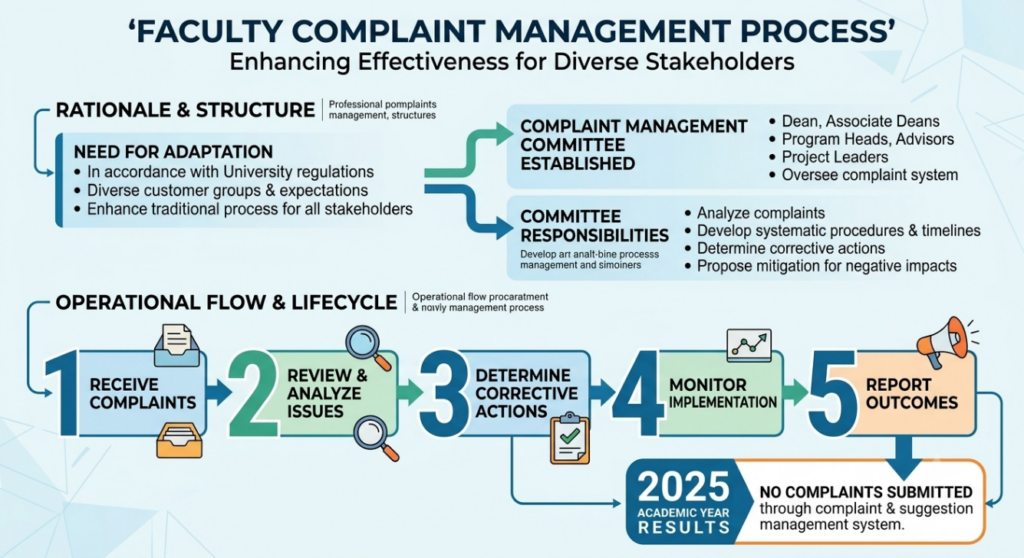
The Faculty has implemented a complaint management process in accordance with the University’s regulations.
However, due to the diversity of its customer groups, the traditional complaint-handling process may not fully address the needs and expectations of all stakeholders. To enhance the effectiveness of complaint management, the Faculty established a Complaint Management Committee to analyze complaints and develop appropriate guidelines and procedures.
The Committee consists of the Dean, Associate Deans, Program Heads, Advisors, and Project leaders. It is responsible for overseeing the complaint management system, analyzing complaints, and establishing systematic procedures, methods, and timelines for complaint resolution. The Committee also proposes guidelines and measures to mitigate any potential negative impacts arising from complaints.
The complaint management process includes receiving complaints, reviewing and analyzing issues, determining corrective actions, monitoring implementation, and reporting outcomes. During the 2025 academic year, no complaints were submitted through the Faculty’s complaint and suggestion management system.
Communication Channels tailored to specific customer groups
| Complainer | Complaint Recipient | Channel for Complaint | Complaint Resolution | Complaint Result Report |
| – Current students | – Advisors – Program chairs | – Meet in person/ file complaints via Line | – Advisors meet with Program chairs/ the Associate Dean/Dean | – Advisors informed students of complaint resolution results |
| – Parents/ Guardians | – Advisors – Program chairs – Dean | – Telephone, email, or meet in person | – Advisors meet with Program chairs/ the Associate Dean/Dean | – Associate Dean/ Dean informed of complaint resolution results |
| Faculty Members | – Dean – Associate Dean | – Meet in person/ file complaints via Line, email, or telephone | – Faculty members filing complaints meet with and discuss the complaints with the Associate Dean and Dean | Associate Dean/Dean informed of complaint resolution results |
| Graduate Users | – Program Chairs – Associate Dean | – File complaints via Line/telephone/ in person with program chairs | – Associate Dean, -The program chairs or meet with the Dean | – Associate Dean or Program chairs informed of complaint resolution results |
| – Collaborator – Local community | – Dean – Research Project Leaders – Community service project head | – Meet in person – Telephone – Email | – The project chairs meet with the Dean and the Faculty committee. | – Dean or Project Leaders informed of the resolutions. |
หลักฐาน
| รหัสหลักฐาน | ชื่อหลักฐาน(พร้อมแนบลิ้งค์) |
| 3.2.1(3) -1 | การจัดการข้อร้องเรียนที่ระบุในเล่มหลักสูตร |
| 3.2.1(3) -2 | ช่องทางการติดต่อระหว่างนักศึกษากับอาจารย์ |

The Faculty is dedicated to upholding the principles of equal opportunity by fostering an environment that values diversity, inclusion, and equity, in line with the University’s commitment to fairness and social justice. This dedication also ensures compliance with all legal obligations.
This policy covers all students, faculty, staff, stakeholders, and collaborators, extending beyond the workplace and working hours to all work-related activities and locations. The Faculty actively supports strategies and programs designed to address the needs of these individuals and respond proactively.
Being an international university, St. Teresa hosts a diverse community of personnel and students from various backgrounds. Therefore, the Faculty is firmly committed to preventing discrimination, bullying, harassment, victimization, and defamation within the workplace. It will take all necessary measures to guarantee fair treatment with dignity and respect for everyone.
Overall, the Faculty promotes a culture of fairness where all actions and behaviors reflect these core principles for all customers.
| Customer | 1 | 2 | 3 | 4 | 5 | 6 | 7 | 8 | 9 | 10 | 11 | 12 |
| Current student | √ | √ | √ | √ | √ | √ | √ | √ | √ | √ | √ | √ |
| Potential student | √ | √ | √ | √ | √ | √ | √ | √ | √ | √ | √ | √ |
| Alumni | √ | √ | √ | √ | √ | √ | √ | √ | √ | √ | √ | √ |
| Faculty member | √ | √ | √ | √ | √ | √ | √ | √ | √ | √ | √ | √ |
| Graduate users | √ | √ | √ | √ | √ | √ | √ | √ | √ | √ | √ | √ |
| Collaborators | √ | √ | √ | √ | √ | √ | √ | √ | √ | √ | √ | √ |
1. Respect 2. Dignity 3. Equality 4. Responsibility 5. Honesty 6. Openness 7. Support
8. Unity 9. Inclusivity 10. Integrity 11. Transparency
If a customer submits a complaint, the Faculty follows a complaint procedure that guarantees confidentiality, promptness, impartiality, and fairness throughout the process.
The Faculty communicates its fair treatment policy to all faculty members during meetings and shares it with other customers through designated faculty personnel involved in relevant work or projects.
The Faculty ensures that this policy is well understood and acknowledged by both faculty staff and customers, as demonstrated by the absence of any complaints filed with the Faculty or directly to the Dean in the past year.

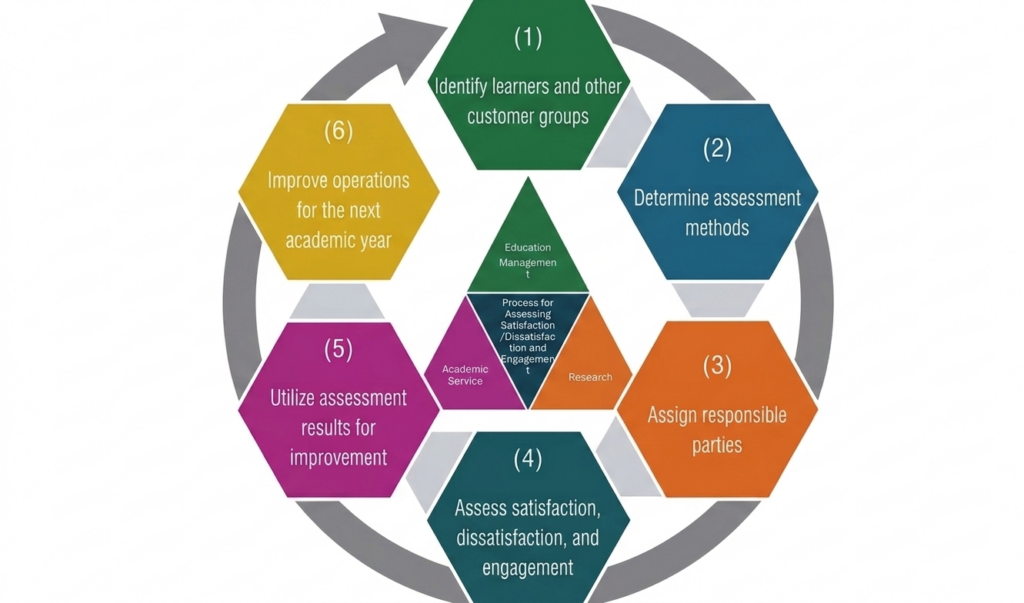
Led by the Dean and relevant committees, the Faculty convened to review existing questionnaires and establish a comprehensive ‘Satisfaction, Dissatisfaction, and Engagement Assessment Process’ for students and other customer groups. The process consists of six systematic steps:
- Identify target learners and other customer groups;
- Determine assessment tools, specifically utilizing structured questionnaires;
- Assign responsible parties for the process;
- Conduct the assessments;
- Analyze the gathered data for potential areas of improvement; and
- Utilize the findings to enhance operations in the subsequent academic year.
This assessment comprehensively covers the Faculty’s three core missions: Education Management, Research, and Academic/Community Services.
Based on the evaluation, the Faculty found that the quantitative results for the 2025 academic year were higher than those of 2024. This improvement reflects that the current assessment process effectively captures the specific needs of various customer groups, which successfully enabled the Faculty to implement impactful operational improvements throughout the 2025 academic year.”
Assessment of (dis) satisfaction and engagement of students and other customer groups
| Customers | (Dis)Satisfaction | Engagement | ||
| Assessment Tool | Responsible Person | Assessment Tool | Responsible Person | |
| Education Management | ||||
| Current students | – Instructional assessment questionnaire – Project assessment Questionnaire – Questionnaire on (dis)satisfaction | – Program Chairs – Project-responsible persons | – Participation in projects/activities – Q/A for Suggestions – Questionnaire on engagement | – Project-responsible persons – Advisors / Program Chairs |
| Graduates and Alumni | – Employment survey questionnaire – Curriculum improvement questionnaire | – Associate Dean – Dean | – Being guests to meet with current students – Join the Alumni Line Group | – Dean – Secretary – Alumni -Line-group responsible person |
| Graduate Users | – Internship assessment questionnaire – Interview | – Associate Dean | – Q/A for suggestions – High questionnaire rate | – Associate Dean – Secretary |
| Faculty members | – Dean-assessment questionnaire – Self assessment questionnaire – Questionnaire on (dis)satisfaction | – Dean – Secretary | – Participation in activities and projects – Project operators – Questionnaire on engagement | – Dean – Program chairs |
| Academic/Community Service | ||||
| Schools/ community receiving services | – Questionnaire assessing service quality – Q/A for suggestions | – Academic- Service responsible person – Community – Service responsible person | – Continuous participation in an academic service project – Providing facilities and feedback | – The program chairs – Project responsible persons |
| Faculty members | – Evaluation forms – Questionnaire on (dis)satisfaction | – Service recipients – Dean – Academic service committee | – Continuous participation in an academic service project – Create new types of services and preparation | – Dean – Academic service committee |
| Research | ||||
| Faculty members | – Research paper publication – Recognition award – Questionnaire on (dis)satisfaction | – Research Committee – Dean | – Attend research /patent seminar – Produce research work | – Research Committee |
| Current students | – Research paper passed the rubric – Questionnaire on (dis)satisfaction | – Program chairs – Lecturers responsible for the students’ research projects | – Fully cooperate with their research projects | – Lecturers responsible for the student’s research project |
หลักฐาน
Self-Assessment 3.2
| เกณฑ์คุณภาพ | ประเมินตนเอง | คะแนน |
| 1. ประสบการณ์ของผู้เรียนและลูกค้ากลุ่มอื่นๆ | ||
| (1) การจัดการความสัมพันธ์ (1 คะแนน) | / | 1 |
| (2) การเข้าถึงและการสนับสนุนผู้เรียนและลูกค้ากลุ่มอื่น (1 คะแนน) | / | 1 |
| (3) การจัดการข้อร้องเรียน (1 คะแนน) | / | 1 |
| (4) การปฏิบัติอย่างเป็นธรรม (1 คะแนน) | / | 1 |
| 2. การค้นหาความพึงพอใจ ความไม่พึงพอใจและความผูกพันของผู้เรียนและลูกค้ากลุ่มอื่น (1 คะแนน) | / | 1 |
| รวมผลการประเมินตนเอง Criteria 3.2 | 5 | |