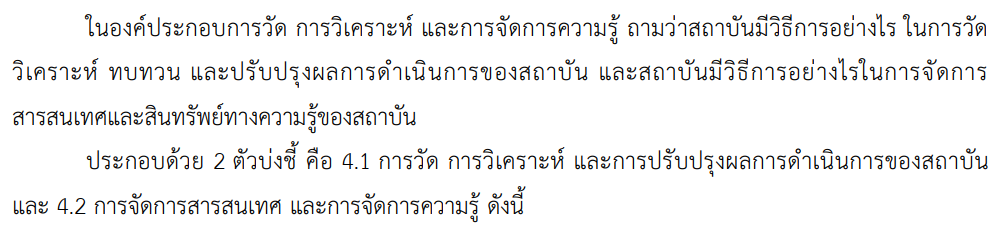
Criteria 4.1 การวัด การวิเคราะห์ และการปรับปรุงผลการดำเนินการของสถาบัน (Measurement, Analysis, Review, and Improvement of Organizational Performance)
Requirements
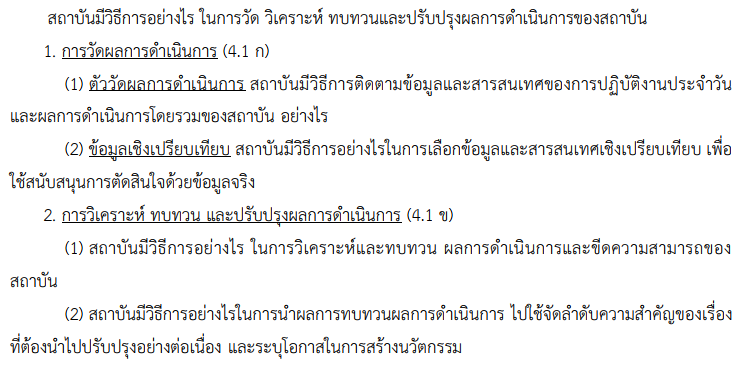
Quality level assessment

Result 4.1
(1) ตัววัดผลการดำเนินการ
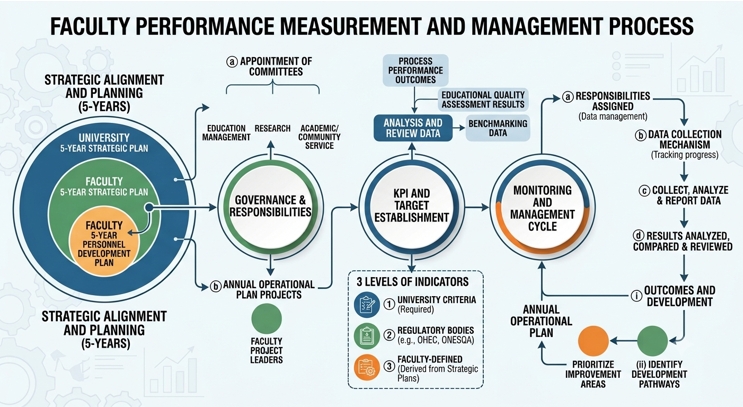
The Faculty measures its performance by defining key performance indicators (KPIs) aligned with its 5-year strategic plan and 5-year personnel development plan, which in turn align with the university’s 5-year strategic development plan. Following this, committees are appointed to oversee the three core missions, namely Education Management, Research, and Academic/Community Service, as well as faculty members in charge of projects included in the annual operational plan.
To analyze, review, and establish KPIs and targets, the Faculty utilizes process performance outcomes, educational quality assessment results, and benchmarking data. Performance indicators are defined at three levels:
1. Indicators required by the university’s criteria.
2. Indicators required by regulatory bodies (e.g., OHEC, ONESQA).
3. Indicators defined by the Faculty based on its 5-year strategic and personnel development plans, which are then integrated into the annual operational plan.
These indicators are selected based on key factors or outcomes derived from strategic objectives. Responsibilities are assigned for monitoring, collecting, analyzing, and reporting data and information according to the specified indicators. A data collection mechanism is in place to track operational progress, ensuring the achievement of objectives that drive the Faculty’s processes. Results from each category are analyzed, compared, and reviewed to prioritize areas for improvement and identify development pathways to meet operational goals.
The Dean and relevant committees jointly establish the schedule and reporting formats for performance monitoring to gather data and information, which are then analyzed using SWOT analysis (Strengths, Weaknesses, Opportunities, and Threats) to facilitate development in subsequent years. The timeframe for monitoring and reporting is structured as follows:
1. Daily Monitoring: Program Heads and the Academic Committee monitor daily teaching and learning activities for courses offered each semester. This includes student absenteeism, tardiness, faculty leaves or absences, and the readiness of teaching facilities. The responsible personnel report to the Dean through the Faculty Secretary.
2. Monthly Monitoring: Project leaders submit a summary of their project performance to the Faculty Secretary, who consolidates and presents the findings to the Dean. Additionally, progress on TOEIC practice exams is monitored by the Faculty Secretary, who tracks data from the university’s IT department.
3. Quarterly Monitoring: The Dean compiles and summarizes the monthly monitoring results to forward to the Office of Policy and Planning for review and endorsement.
4. Semester-based Monitoring: The Education, Research, and Academic Service Committee monitors the overall outcomes of each strategy and submits a summary report to the Dean.
5. End-of-Academic-Year Monitoring: Strategic committees monitor, gather, and write summary reports of the key data and submit to the Dean for the Internal Quality Assurance report :
- The Academic Committee collects various assessment data from current students, faculty members, graduate users, and all stakeholder groups, as well as innovative works by both the faculty members and students.
- The Research Committee gathers data regarding faculty members’ and students’ research publications, internal and external research grants, and publication support funding.
- The Academic Service Committee monitors and collects data on the implementation and outcomes of academic and community services, focusing on satisfaction rates and innovations that generate sustainable impacts on the community.
หลักฐาน
| รหัสหลักฐาน | ชื่อหลักฐาน(พร้อมแนบลิ้งค์) |
| 4.1.1 (1) -1 | ข้อมูลภาวะการมีงานทำของบัณฑิต |
| 4.1.1 (1) -2 | ข้อมูลการสำเร็จการศึกษา |
| 4.1.1 (1) – 3 | คำสั่งแต่งตั้งคณะทำงานพัฒนาหลักสูตร BE |
| 4.1.1 (1) -4 | คำสั่งแต่งตั้งคณะทำงานพัฒนาหลักสูตร CA |
| 4.1.1 (1) -5 | คำสั่งแต่งตั้งคณะกรรมการวิพากษ์หลักสูตร BE |
| 4.1.1 (1) -6 | คำสั่งแต่งตั้งคณะกรรมการวิพากษ์หลักสูตร CA |
| 4.1.1 (1) -7 | สรุปผลงานของนักศึกษา |
| 4.1.1 (1) -8 | ผลงานทางวิชาการของอาจารย์ |
| 4.1.1 (1) -9 | โครงการบริการวิชาการ HuSo สู่ชุมชน (HS 27) |
| 4.1.1 (1) -10 | การขาดเรียนของนักศึกษา |
| 4.1.1 (1) -11 | การลา มาสายของอาจารย์ |
| 4.1.1 (1) -12 | คะแนนฝึก TOEIC รายเดือน |
| 4.1.1 (1) -13 | สรุปโครงการ |

The Faculty planned to select both domestic and international benchmarking partners, following the previous year’s approach. However, due to a lack of data from the Faculty of Liberal Arts at Union Christian College (Philippines)—the international partner from last year—the Faculty decided to focus on domestic benchmarking partners. This selection was conducted through a systematic and step-by-step process as follows:
- Defining Benchmarking Objectives: The Faculty identified specific benchmarking areas to leverage as opportunities for performance development. The areas covered by the indicators in “Education Management” involved the faculty members’ qualifications, graduates, and research.
- Selecting Benchmarking Partners: This year, the Faculty officially selected domestic institutions with similar contexts—specifically, private, international universities of comparable size, with similar faculties, and offering similar academic programs. These included the Faculty of Arts and Humanities at Asia-Pacific International University and Eastern Asia University. Additionally, to introduce a more challenging target for performance improvement, the Faculty also selected the Faculty of Humanities and Social Sciences at Burapha University as a benchmarking partner for this year, utilizing data from the CHE-QA Online system.
- Gap Analysis for Improvement: The data was analyzed to identify opportunities for improvement by comparing performance outcomes, targets, and trends with the benchmarking partners. This analysis was used to establish guidelines for elevating overall performance.
- Monitoring, Evaluation, and Continuous Improvement: The Faculty monitored and evaluated performance against the set targets. Based on this year’s data evaluation and benchmarking analysis, the Faculty has summarized the findings into two key areas:
Internal Trend Analysis (Comparison over the past 3 years)
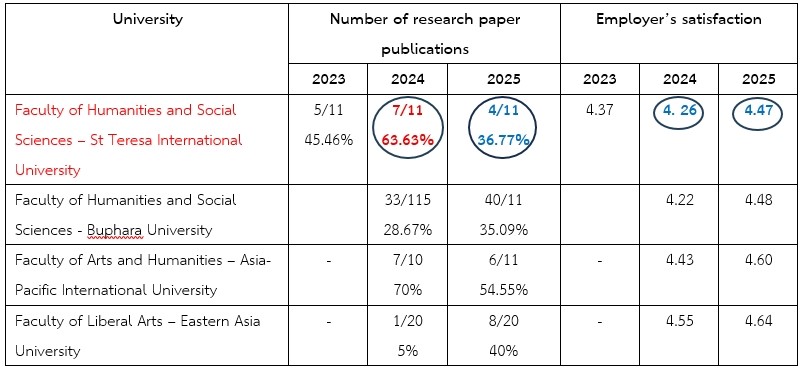
- Research Publications: The number of research papers published by faculty members in TCI-indexed journals and international journals has decreased over the past three years.
- Graduate Satisfaction: Conversely, the employers’ satisfaction level with graduates in the 2025 academic year has increased compared to both 2023 and 2024.
Peer Benchmarking Analysis (Comparison over the past 2 years)
- Research Publications: In the 2025 academic year, the percentage of the Faculty’s published research papers was slightly higher than that of the Faculty of Humanities and Social Sciences at Burapha University. However, it was significantly lower than both the Faculty of Arts and Humanities at Asia-Pacific International University and the Faculty of Liberal Arts at Eastern Asia University.
- Employer Satisfaction: The satisfaction level of employers toward the Faculty’s graduates was lower than that of all benchmarked peers.
These results indicate that the Faculty still has areas requiring improvement to enhance operational efficiency in the 2026 academic year. The Faculty is currently brainstorming and collaborating with all committees and faculty members to determine effective action plans for improvement.
The table below highlights specific areas requiring improvement when measured against the two private international universities. Employers’ satisfaction with graduates and the number of research paper publications
หลักฐาน
| รหัสหลักฐาน | ชื่อหลักฐาน(พร้อมแนบลิ้งค์) |
| 4.1.1 (2) -1 | คำสั่งแต่งตั้งคณะกรรมการวิจัย |
| 4.1.1 (2) -2 | คำสั่งแต่งตั้งคณะกรรมการวิชาการ |
| 4.1.1 (2) -3 | จำนวนงานวิจัยที่ตีพิมพ์ย้อนหลัง 5 ปี |
| 4.1.1 (2) -4 | ความพึงพอใจผู้ใช้บัณฑิต ปี 2566-2568 |
| 4.1.1 (2) -5 | ตารางเปรียบเทียบกับ 3 มหาวิทยาลัย |
| 4.1.1 (2) -6 | ตารางเปรียบเทียบของปีที่แล้ว |

To ensure strong performance and organizational capacity, the Faculty has established a structured method for analyzing and reviewing operational outcomes and capabilities during the strategic planning process. This is conducted through meetings at the faculty, committee, and program levels, focusing on performance measurement and organizational analysis. The method includes the following steps:
1. Appointing various committees to oversee, monitor, and follow up on their assigned missions.
2. Communicating both long-term and short-term strategic objectives to the Program Heads to ensure program activities align with and support goal achievement.
3. Assigning project leaders to implement projects through completion and report their summaries to the Dean.
4. Holding small meetings to address emerging changes and challenges.
5. Reviewing all reports, results, and project summaries every quarter.
6. Submitting project summaries to the Office of Policy and Planning for review.
7. Analyzing all plans and project outcomes to identify strengths and weaknesses, which inform the development of the following year’s strategic plan.
8. Reporting all operational outcomes at the end of the year during the Internal Quality Assurance (IQA) session.
9. Using the IQA results to guide improvements for operations in the upcoming year.
Performance analysis and review system
| Mission | Responsible person | Frequency | Objective | Reviewed information | Analysis method | Application |
| Education Management | – Academic Committee – Program Heads – Lecturers | – Quarterly – Monthly – Weekly | – Work – Communication – Operation transfer – Operation decision – Operation follow-up – Operation Summary | – Work plan – Target work value – Operated project/activity – Work process – Budget received for projects and activities | – SWOT – PDCA – Benchmark | – Curriculum improvement – Guidelines Productivity-based teaching and learning – Provide teaching and learning facilities |
| Research | – Research Committee | – Quarterly | – SWOT – Benchmark | Guidelines to Improve/ Develop, and Promote Research | ||
| Academic and community service | – Academic and community service committee – Project leaders | – Monthly – Quarterly | – PDCA – SWOT | Guidelines to improve project arrangement and activities to accommodate the community |
Based on the performance analysis and review, the Faculty has identified several best practices, as recognized by the Quality Assurance Committee:
1. Establishing academic partnerships with international universities, providing students with opportunities to experience English learning in native-speaking environments.
2. Successfully implementing a production-based learning approach, as demonstrated by the quality and quantity of students’ academic and tangible creative outputs.
3. Delivering academic and community services that effectively address the specific needs of local communities.
หลักฐาน
| รหัสหลักฐาน | ชื่อหลักฐาน(พร้อมแนบลิ้งค์) |
| 4.1.2 (1) -1 | คำสั่งแต่งตั้งคณะกรรมการบริการวิชาการ |
| 4.1.2 (1) -2 | คำสั่งแต่งตั้งคณะกรรมการวิจัย |
| 4.1.2 (1) -3 | คำสั่งแต่งตั้งคณะกรรมการกิจการนักศึกษา |
| 4.1.2 (1) -4 | รายงานผลการดำเนินงานตามแผนปฏิบัติการ ปีการศึกษา 2568 |
| 4.1.2 (1) -5 | ผลการประเมิน IQA ระดับคณะ (ปี 2564-2567) |
| 4.1.2 (1) -6 | ผลการประเมิน IQA ระดับหลักสูตร (ปี 2564-2567) |
| 4.1.2 (1) -7 | PowerPoint Top-up |
| 4.1.2 (1) -8 | ผลงานนักศึกษา BE และ CA |

การดำเนินงานในอนาคต (Future Performance)
Based on performance evaluations, Internal Quality Assurance (IQA) outcomes, and benchmarking data, the Faculty convened meetings to plan future improvements through the following actions:
1. Developing the 2025–2029 Strategic Plan: Following the conclusion of the 2020–2024 strategic plan, the Faculty initiated a review process to draft its successor. This new five-year plan integrates internal performance data, core competencies, and feedback from faculty, students, and stakeholders. To ensure institutional alignment, the Faculty explicitly incorporated key elements from the university’s overarching 2025–2029 strategic roadmap.
2. Optimizing the Annual Action Plan: The Faculty evaluated ongoing annual projects to determine their continuity. While most projects will proceed, their objectives, funding, processes, target communities, and collaborators will be adjusted to maximize efficiency and impact.
3. Leveraging Benchmarking Data: The Faculty analyzed insights from self-benchmarking and institutional comparisons, specifically focusing on employer satisfaction with graduates and research publication outputs. These insights will drive performance enhancements in the upcoming academic year.
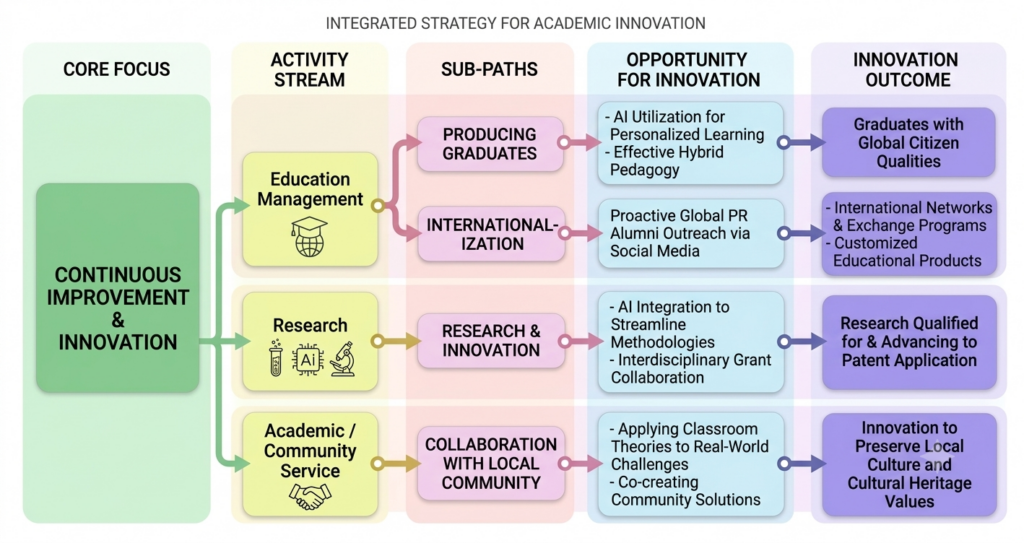
Moving forward, the Faculty is prioritizing missions that require continuous development and innovation, specifically:
• Equipping Business English (BE) and Communication Arts (CA) graduates with the ability to integrate interdisciplinary knowledge and transition theory into practice.
• Advancing research capabilities and fostering innovation.
• Collaborating with local communities on academic and community service initiatives.
• Steering the Faculty toward internationalization, in alignment with both Faculty and University visions.
These development plans have been communicated during faculty meetings and delegated to Committees, Program Heads, and faculty members for implementation.
การปรับปรุงอยางต่อเนื่องและการสร้างนวัตกรรม (Continuous Improvement and Innovation)
As previously noted in the ‘Future Performance’ section, the Faculty has identified three core missions that will be pursued on a long-term basis. Each mission includes not only primary objectives; but also associated risks. These responsibilities and potential challenges are communicated to all faculty members during faculty meetings, where specific duties are assigned. Given the complexity of these missions, they require sustained planning and cannot be completed in a short time frame.
1. Producing Quality Graduates:
To ensure high-quality graduate outcomes, the Faculty relies on three key sources of input: the visions of both the Faculty and the University, the four learning outcomes defined by Thailand’s National Qualifications Framework for Higher Education, and stakeholder feedback. This information guides the BE and CA programs in both ongoing minor curriculum revisions during the academic year and major revisions conducted every five years, as mandated by the Ministry of Higher Education, Science, Research, and Innovation. These efforts are focused on developing graduates with global competence and the necessary skills for career success.
2. Research and Innovation:
The Faculty encourages curriculum-responsible persons, and faculty members to consistently produce research outputs required by the Office of the Higher Education Commission (OHEC). For those faculty members who have not yet engaged in research or innovation, the research committee offers full support, including guidance from project initiation to publication. The committee highlights the dual benefit of research—enhancing both the Faculty’s standing and individual career progression. For experienced researchers, the Faculty hosts sessions on securing patents or copyrightsto ensure that their work qualifies as a recognized innovation.
3. Community Engagement:
The Faculty carries out no fewer than four annual projects aimed at delivering academic and community services. These initiatives are regularly reviewed and adjusted to better align with community needs, including changes to project goals, activities, outcomes, budgets, and target groups. The academic service committee oversees these modifications to ensure relevance and effectiveness.
4. Internationalization:
Following its transition from St. Teresa International College to St. Teresa International University two years ago, the institution has significantly intensified its commitment to global excellence. Consequently, the Faculty is expected to align its strategic initiatives with both the University’s evolving global identity and the rigorous standards set by the Ministry of Higher Education, Science, Research, and Innovation. This alignment requires a focused effort to foster an inclusive international campus environment, elevate the institution’s reputation for balancing exceptional academic quality with affordability, and expand internal capacities to effectively support international students throughout their academic journeys.
หลักฐาน
| รหัสหลักฐาน | ชื่อหลักฐาน(พร้อมแนบลิ้งค์) |
| 4.1.2 (2) -1 | แผนบริหารและพัฒนาบุคลากร 2568-2572 |
| 4.1.2 (2) -2 | รายงานผลการดำเนินงานตามแผนปฏิบัติการประจำปี 2568 |
| 4.1.2 (2) -3 | รายงาน IQA ของหลักสูตร Ed. E. ของคณะศึกษาศาสตร์ |
| 4.1.2 (2) -4 | คำสั่งแต่งตั้งคณะกรรมการบริการวิชาการ |
| 4.1.2 (2) -5 | คำสั่งแต่งตั้งคณะกรรมการวิจัย |
| 4.1.2 (2) -6 | คำสั่งแต่งตั้งคณะกรรมการกิจการนักศึกษา |
| 4.1.2 (2) -7 | การปรับปรุงหลักสูตร (ปรับเล็กและใหญ่) |
| 4.1.2 (2) -8 | ผลงานทางวิชาการของอาจารย์ |
| 4.1.2 (2) -9 | Patent of Dr.Ekta |
| 4.1.2 (2) -10 | โครงการบรการวิชาการ HuSo สู่ชมชน (HS 27) |
Self-Assessment 4.1
| เกณฑ์คุณภาพ | ประเมินตนเอง | คะแนน |
| 1. การวัดผลการดำเนินการ | ||
| (1) ตัววัดผลการดำเนินการ – ติดตามข้อมูลและสารสนเทศของการปฏิบัติงานประจำวัน (1 คะแนน) | / | 1 |
| – ติดตามผลการดำเนินการของสถาบัน (1 คะแนน) | / | 1 |
| (2) ข้อมูลเชิงเปรียบเทียบ (1 คะแนน) | / | 1 |
| 2. การวิเคราะห์ ทบทวน และปรับปรุงผลการดำเนินการ | ||
| (1) วิเคราะห์และทบทวน ผลการดำเนินการและขีดความสามารถของสถาบัน (1 คะแนน) | / | 1 |
| (2) จัดลำดับความสำคัญของเรื่องที่ต้องนำไปปรับปรุงอย่างต่อเนื่อง และระบุโอกาสในการสร้างนวัตกรรม (1 คะแนน) | / | 1 |
| รวมผลการประเมินตนเอง Criteria 4.1 | 5 | |