
Criteria 6.1 กระบวนการทำงาน (Work Processes)
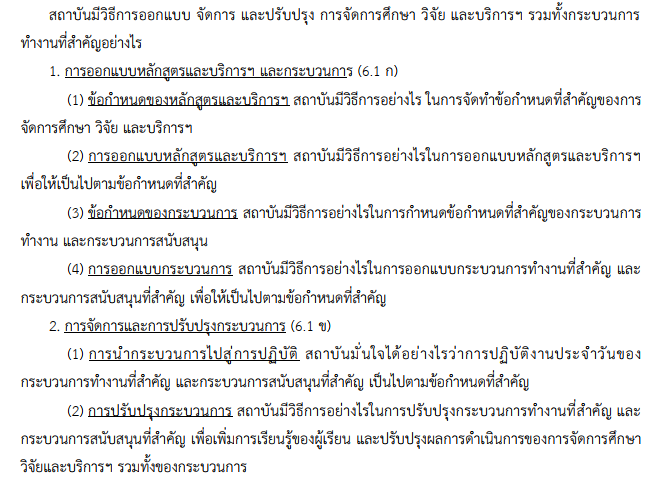
Requirements
Quality level assessment

Result 6.1
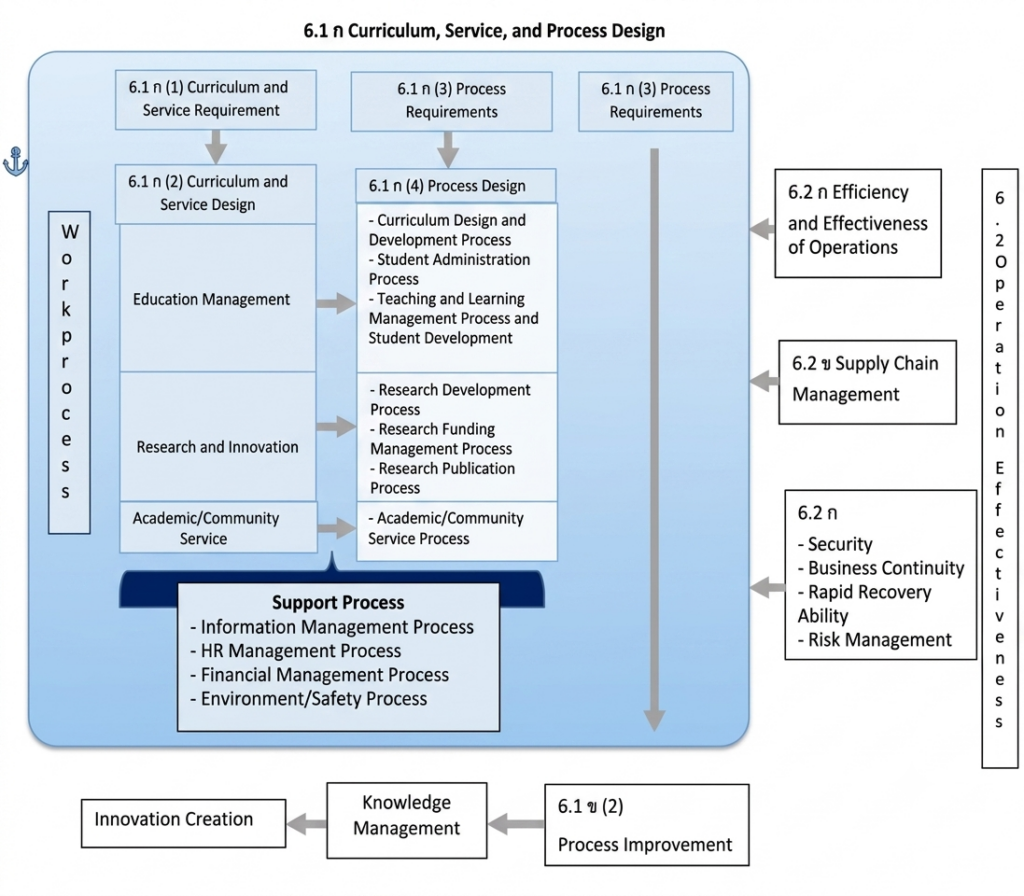

The Faculty has established a systematic process to identify the key requirements of its curricula and services by collecting and analyzing critical internal and external inputs. The Dean and Faculty Committees review the Faculty’s mission, vision, strategic plan, stakeholder and student needs, relevant regulations, national policies, Ministry of Higher Education, Science, Research and Innovation (MHESI) standards, and previous performance results to determine these requirements.
The identified requirements provide the foundation for designing curricula, core services, and operational processes. Through collaborative planning, the Faculty executives and the two Program Chairs develop and manage the Business English (BE) and Communication Arts (CA) programs, which support the Faculty’s core missions of educational management, research, and academic/community services. To ensure effective implementation, responsible personnel are assigned to establish, deploy, and monitor key performance indicators (KPIs) for both process and outcome measures. Performance across all core missions is regularly monitored, evaluated, and used to drive continuous improvement
| Mission | Requirements | Responsible committee/person |
| Education management (Curricula) Each program focuses on achieving key learning outcomes aimed at producing graduates who: 1. possess critical thinking skills that enable them to apply theoretical knowledge in practical settings, 2. are equipped to become entrepreneurs, and 3. demonstrate a strong sense of social responsibility and public-mindedness. | 1. The curriculum is designed in alignment with the Higher Education Qualifications Framework. 2. Teaching focuses on project-based learning by simulating real-life scenarios in the classroom and providing opportunities for experiential learning in real-world settings. 3. Various activities are implemented to foster and support lifelong learning. | 1. The Dean 2. The Associate Dean 3. The Academic Committee 3. The Program Chairs 4. Program-Responsible Persons |
| Research 1. Conduct research supported by the University or external funding agencies, 2. Establish collaborative networks with relevant collaborators and local communities, 3. Incorporate research findings into teaching and learning activities. | 1. Conduct research aligning with the Research Management Handbook 2. Conduct research that meets established quality standards and contributes to both teaching enhancement and academic advancement. 3. Carry out high-quality research that supports both instructional improvement and academic progression. 4. Ensure timely completion and publication of research in accredited journals. 5) Monitor research impact through citation counts and H-index metrics. | 1. The Dean 2. The Associate Dean 3. The Research Committee 4. The Department of Research and Planning 5. Project heads 6 Collaborators |
| Academic/Community Service 1. Apply the Faculty’s expertise to benefit society, local communities, and the broader public. 2. Ensure service recipients are satisfied and experience tangible benefits. 3. Foster partnerships and build collaborative networks with relevant stakeholders. | 1. Provide academic and community services aligning with the Handbook of Academic Service to Society 2. Provide academic services that address the specific needs of local communities. 3. Maintain consistent and continuous delivery of academic services. | 1. The Dean 2. The Associate Dean 3. The Academic Service Committee 3. The Program Chairs 4. Project heads 5. Local communities and residents |
หลักฐาน
| รหัสหลักฐาน | ชื่อหลักฐาน(พร้อมแนบลิ้งค์) |
| 6.1.1 (1) -1 | คำสั่งแต่งตั้งคณะทำงานพัฒนาหลักสูตร BE |
| 6.1.1 (1) -2 | คำสั่งแต่งตั้งคณะทำงานพัฒนาหลักสูตร CA |
| 6.1.1 (1) -3 | ทุนผลงานทางวิชาการของอาจารย์ |
| 6.1.1 (1) -4 | โครงการบริการวิชาการ HuSo สู่ชุมชน (HS 27) |
| 6.1.1 (1) -5 | จำนวน Citation และ H-Index |
| 6.1.1 (1) -6 | เกณฑ์การจัดทำหลักสูตร 2565 |
| 6.1.1 (1) -7 | ความต้องการของผู้ใช้บัณฑิต |

Following the determination of program and service requirements in the Item 1, the faculty leadership—including the Dean, Academic Committee, Research and Academic Service Committees, and both Program Chairs—collaboratively evaluated the essential design criteria for the two curricula and three primary services. Through a series of brainstorming sessions, faculty executives and members established the following key product specifications:
- Review Regulatory Frameworks: Study the Standard Criteria for Higher Education Qualification to guide curriculum improvements.
- Consult Operational Guidelines: Analyze the Research Management Handbook and the Handbook of Academic Service to Society.
- Evaluate Core Offerings: Determine and review the Faculty’s primary products and services based on relevant input factors.
- Align with Strategic Vision: Incorporate the Faculty’s mission, vision, and the specific needs and expectations of service recipients.
- Segment and Classify Customers: Identify, classify, and map customer groups according to specific product and service offerings.
| Products | Design Concept | Customers |
| Education management (Curricula) | 1. Two undergraduate curricula are certified according to the 2565 Standard Criteria for Higher Education Qualifications. 2. The programs emphasize a productivity-based teaching approach. 3. The Faculty’s success is demonstrated by graduates who possess the program’s required characteristics and learning outcomes and who are gainfully employed. | 1. Current students 2. Prospective students 3. Graduate users 4 Private and public institutes 5. Faculty members 6. Parents 7. The University |
| Research | 1. Offer research funding from both internal and external sources. 2. Motivate faculty members to conduct research related to their expertise, self-developed knowledge, or emerging knowledge trends. 3. The Faculty’s research success is demonstrated by the growth in funding received and the rise in the number of researchers and published research articles. 4. The research results can be applied in academic, teaching, and business sectors. | 1. Internal and external funding resources 2. The Faculty and University 3. Faculty members 4. Public and private institutions 5. Alumni |
| Academic/Community service | 1. There are two categories of academic service: general and specific. 2. The primary recipients of these services are local communities. 3. The objective is to share and impart knowledge essential for community development. 4. The Faculty’s success in Academic Service is reflected in the expansion of external partnerships/collaborators and the effective transfer of knowledge that addresses the needs of communities and local areas. | 1. The Faculty and University 2. Faculty members 3. Current students 4. Alumni 5. Local communities and residents |
หลักฐาน
| รหัสหลักฐาน | ชื่อหลักฐาน(พร้อมแนบลิ้งค์) |
| 6.1.1 (2) -1 | ผลการประเมินความพึงพอใจของผู้ใช้บัณฑิต |
| 6.1.1 (2) -2 | ข้อมูลการมีงานทำของบัณฑิต |
| 6.1.1 (2) -3 | ผลงานทางวิชาการของอาจารย์ |
| 6.1.1 (2) -4 | โครงการบริการวิชาการ HuSo สู่ชุมชน (HS 27) |
| 6.1.1 (2) -5 | ผลงานของนักศึกษา |
| 6.1.1 (2) -6 | หลักสูตรปรับปรุงทั้งสองหลักสูตร |

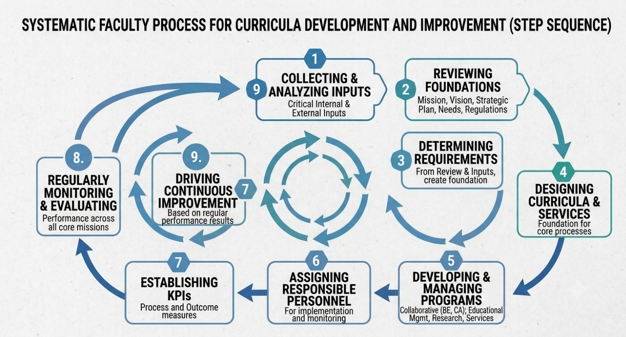
The Dean, together with the Faculty Committee, systematically identifies and reviews the Faculty’s key work processes and support processes to ensure alignment with the Faculty’s strategic direction, as presented in Category 1. This process integrates the Faculty’s vision, core competencies, strategic objectives, and the requirements and expectations of students, stakeholders, and other key customers.
Through this systematic review, the Faculty determines the processes critical to achieving its educational, research, and academic/community service goals while ensuring operational effectiveness and organizational sustainability. The identified key work and support processes establish the operational framework for delivering value to stakeholders, achieving strategic goals, and driving continuous performance improvement.
The Faculty’s key work processes and support processes related to its core administrative functions are presented below.
| Key work process | Support process | REQUIREMENT |
| Education Management Process (Curricula) | ||
| 1. Producing high-quality graduates who achieve the intended learner outcomes and learning outcomes and possess program-specific skills and twenty-first-century skills that align with stakeholder needs. 2. Producing curricula based on the National Higher Education Qualification Standards B.E. 2565 | 1. Collaborating with stakeholders to gather their advice, feedback, and recommendations. 2. Collaboration between the academic committee and program-responsible persons to foster the curriculum development process 3. Encouraging lecturers to develop their teaching competencies 4. Fostering support from qualified IT personnel | 1. Effective student development programs designed to meet stakeholders’ expectations 2. Accredited curriculum approved by the Ministry, ensuring high academic standards 3. Fostering lecturers with strong teaching competencies focusing on the production-based learning management 4. Collaborating with IT Department |
| Research and Innovation Development | ||
| 1. Conducting high-quality research suitable for publication in reputable academic journals 2. Producing research and innovations that meet the criteria for patent applications 3. Disseminating research findings and innovations to the wider public, as evidenced by the number of citations and H-Index citations | 1. Working closely with the Department of Research and Planning to receive guidance, feedback, and suggestions 2. Seeking research funding from external organizations 3. Organizing seminars on research and academic innovation, including guidance on writing compelling research papers for publication | 1. High-quality research papers published in SCOPUS/ TCI academic journals 2. Patents granted for research and innovative work 3. Awards received for outstanding research or innovation 4. Number of citations and H-Index citations |
| Academic and Community Services | ||
| 1. Surveying the needs of the target communities 2. Processes for developing and transferring knowledge 3. Promoting collaboration between the Faculty and local communities | 1. Collaborating with the community to identify and address their specific needs 2. Requesting the community’s approval before delivering services 3. Evaluating the community’s satisfaction with the services | 1. Sharing community service activities through social media platforms 2. Community members gained new knowledge 3. The community successfully preserved cultural traditions while generating income. |
หลักฐาน
| รหัสหลักฐาน | ชื่อหลักฐาน(พร้อมแนบลิ้งค์) |
| 6.1.1 (3) -1 | คำสั่งแต่งตั้งคณะทำงานพัฒนาหลักสูตร BE |
| 6.1.1 (3) -2 | คำสั่งแต่งตั้งคณะทำงานพัฒนาหลักสูตร CA |
| 6.1.1 (3) -3 | แบบสำรวจความคิดเห็นและความต้องการของหลักสูตร |
| 6.1.1 (3) -4 | ข้อมูลทุนวิจัย |
| 6.1.1 (3) -5 | ผลงานทางวิชาการของอาจารย์ |
| 6.1.1 (3) -6 | โครงการการจัดการความรู้ (HS 10) |
| 6.1.1 (3) -7 | Video clip ของ CA บน สื่อออนไลน์ |
| 6.1.1 (3) -8 | ผลงานทางวิชาการของอาจารย์ที่ตีพิมพ์ |
| 6.1.1 (3) -9 | Patent ของ Ekta |
| 6.1.1 (3) -10 | Citation and H-Index |

To strengthen the effectiveness, efficiency, and agility of its key work and support processes, the Faculty employs a systematic approach through collaborative brainstorming and analysis conducted by the Dean and Faculty Committees. Based on the identified operational requirements, the Faculty determines and deploys the essential support processes and resources, including information technology systems, digital technologies, facilities, public relations, financial and procurement management, student support services, and stakeholder engagement mechanisms.
Implementing and monitoring these support processes rely on defined performance measures. Performance data and stakeholder feedback are regularly analyzed and reviewed to identify opportunities for innovation, process improvement, and risk mitigation. This integrated approach enhances operational reliability, supports organizational resilience, and ensures that key work processes consistently achieve strategic objectives while responding effectively to changing internal and external conditions.
Requirements, Measures, and Support Factors for Key and Support Processes
| Key work process | Support process | Requirement | Support Factors |
| Education Management Process (Curricula) | |||
| 1. Producing high-quality graduates who achieve the intended learner outcomes and learning outcomes and possess program-specific skills and twenty-first-century skills that align with stakeholder needs. 2. Producing curricula based on the National Higher Education Qualification Standards B.E. 2565 | 1. Collaborating with stakeholders to gather their advice, feedback, and recommendations. 2. Collaboration between the academic committee and program-responsible persons to foster the curriculum development process 3. Encouraging lecturers to develop their teaching competencies 4. Fostering support from qualified IT personnel | 1. Effective student development programs designed to meet stakeholders’ expectations 2. Accredited curriculum approved by the Ministry, ensuring high academic standards 3. Fostering lecturers with strong teaching competencies focusing on the production–based learning management 4. Collaborating with IT Department | – Technology and IT – Physical Facilities – Public relations, – Finance and supplies, – Student Affairs – Stakeholders’ recommendations |
| Research and Innovation Development | |||
| 1. Conducting high-quality research suitable for publication in reputable academic journals 2. Producing research and innovations that meet the criteria for patent applications 3. Disseminating research findings and innovations to the wider public, as evidenced by the number of citations and H-Index citations | 1. Working closely with the Department of Research and Planning to receive guidance, feedback, and suggestions 2. Seeking research funding from external organizations 3. Organizing seminars on research and academic innovation, including guidance on writing compelling research papers for publication | 1. High-quality research papers published in SCOPUS/ TCI academic journals 2. Patents granted for research and innovative work 3. Awards received for outstanding research or innovation 4. Number of citations and H-Index citations | – Technology and IT – Physical Facilities – Research funding resources – Supplies, – Department of Research and Planning – Stakeholders – Collaborators |
| Academic and Community Services | |||
| 1. Surveying the needs of the target communities 2. Processes for developing and transferring knowledge 3. Promoting collaboration between the Faculty and local communities | 1. Collaborating with the community to identify and address their specific needs 2. Requesting the community’s approval before delivering services 3. Evaluating the community’s satisfaction with the services | 1. Sharing community service activities through social media platforms 2. Community members gained new knowledge 3. The community successfully preserved cultural traditions while generating income. | – Technology – Physical Facilities – Finance and supplies – The Office of Policy and Planning – Collaborators – Local communities and residents |
หลักฐาน
| รหัสหลักฐาน | ชื่อหลักฐาน(พร้อมแนบลิ้งค์) |
| 6.1.1 (4) -1 | ห้องปฏิบัติการคอมพิวเตอร์ไอแมค |
| 6.1.1 (4) -2 | ห้องปฏิบัติการถ่ายภาพ |
| 6.1.1 (4) -3 | ห้องปฏิบัติการภาษา |
| 6.1.1 (4) -4 | ห้องปฏิบัติการแสดง |
| 6.1.1 (4) -5 | ห้องสตูดิโออัดเสียง |
| 6.1.1 (4) -6 | สรุปงบประมาณปีการศึกษา 2568 |
| 6.1.1 (4) -7 | ข้อแนะนำจากผู้ใช้บัณฑิต |
| 6.1.1 (4) -8 | ทุนวิจัย |
| 6.1.1 (4) -9 | งานวิจัยที่ตีพิมพ์ |
| 6.1.1 (4) -10 | ผลงานของนักศึกษา |
| 6.1.1 (4) -11 | การบริการวิชาการ และบริการชุมชน |
The Faculty employs a systematic approach to manage, monitor, and continuously improve its Key Work Processes and Support Processes, ensuring effective execution of its strategic objectives and core missions. Each key work process is assigned to a designated committee responsible for planning, implementing, monitoring, and improving process performance.
Process implementation is monitored through daily operations and formally reviewed on a monthly and quarterly basis using defined performance indicators and key process measures. Each committee collects and analyzes operational and performance data to evaluate process effectiveness, efficiency, and alignment with strategic goals and stakeholder requirements.
Each committee applies the Plan–Do–Check–Act (PDCA) methodology to evaluate process performance, identify strengths and opportunities for improvement, implement corrective and preventive actions, and promote innovation where appropriate. The outcomes of these reviews are documented and incorporated into process improvement plans.
At the Faculty’s monthly meeting, each committee presents their performance results, analyses, and improvement actions to the Dean and the Faculty Committee. These meetings provide an opportunity for reviewing progress, sharing best practices, addressing operational risks, and making evidence-based decisions to improve organizational performance.
In addition, the Faculty consolidates and submits quarterly performance reports to the Office of Policy and Planning. The findings from these reports are used to review strategic and operational performance, refine work processes, strengthen organizational effectiveness, and support continuous improvement in the subsequent academic year.
| Key work process | Support process | Requirement | INDICATORS | Follow-up Period |
| Education Management Process (Curricula) | ||||
| 1. Producing high-quality graduates who achieve the intended learner and learning outcomes and possess program-specific skills and twenty-first-century skills that align with stakeholder needs. 2. Producing curricula based on the National Higher Education Qualification Standards B.E. 2565 | 1. Collaborating with stakeholders to gather their advice, feedback, and recommendations. 2. Collaboration between the academic committee and program-responsible persons to foster the curriculum development process 3. Encouraging lecturers to develop their teaching competencies 4. Fostering support from qualified IT personnel | 1. Effective student development programs designed to meet stakeholders’ expectations 2. Accredited curriculum approved by the Ministry, ensuring high academic standards 3. Fostering lecturers with strong teaching competencies focusing on the production – learning management 4. Collaborating with IT Department | 1. Both curricula are revised within a 5-year cycle according to the Thai Qualifications Framework for Higher Education and approved by the Higher Education Standards Committee 2. Reviewing the TQF 3/4, 5/6 3. Peer observation results 4.Students’ evaluation /Graduate users’ evaluation | 1. At program-level: monthly At faculty –level: twice/year 2. Every day within 2 weeks before the semester starts and after the final examination 3. Twice/year 4. Twice/year |
| Research and Innovation Development | ||||
| 1. Conducting high-quality research suitable for publication in reputable academic journals 2. Producing research and innovations that meet the criteria for patent applications 3. Disseminating research findings and innovations to the wider public, as evidenced by the number of citations and H-Index citations | 1. Working closely with the Department of Research and Planning to receive guidance, feedback, and suggestions 2. Seeking research funding from external organizations 3. Organizing seminars on research and academic innovation, including guidance on writing compelling research papers for publication | 1. High-quality research papers published in SCOPUS/ TCI academic journals 2. Patents granted for research and innovative work 3. Awards received for outstanding research or innovation 4. Number of citations and H-Index citations | 1. The number of research papers published in SCOPUS or TCI journals 2. Number of patents 3. Number of awards 4. Number of citations and H-Index citations | Twice/year |
| Academic and Community Services | ||||
| 1. Surveying the needs of the target communities 2. Processes for developing and transferring knowledge 3. Promoting collaboration between the Faculty and local communities | 1. Collaborating with the community to identify and address their specific needs 2. Requesting the community’s approval before delivering services 3. Evaluating the community’s satisfaction with the services | 1. Sharing community service activities through social media platforms 2. Community members gained new knowledge 3. The community successfully preserved cultural traditions while generating income. | 1. Number of the target community recipients 2. Community’s Satisfaction with the services 3. Video clips publicize the community to public | 1. Every day during the service operations 2. Twice/semester for satisfaction evaluation and video clips release to public |
หลักฐาน
| รหัสหลักฐาน | ชื่อหลักฐาน(พร้อมแนบลิ้งค์) |
| 6.1.2 (1) -1 | คำสั่งแต่งตั้งคณะทำงานพัฒนาหลักสูตร BE |
| 6.1.2 (1) -2 | คำสั่งแต่งตั้งคณะทำงานพัฒนาหลักสูตร CA |
| 6.1.2 (1) -3 | ผลการตรวจสอบหลักสูตร BE |
| 6.1.2 (1) -4 | ผลงานของนักศึกษา |
| 6.1.2 (1) -5 | ข้อมูลทุนวิจัยของอาจารย์ |
| 6.1.2 (1) -6 | ข้อมูลผลงานตีพิมพ์และการอ้างอิงจากฐานข้อมูล Scopus/H-Index |
| 6.1.2 (1) -7 | ผลงานคลิปวิดีจากโครงการบริการวิชาการ |
| 6.1.2 (1) -8 | ผลการประเมินความพึงพอใจในการให้บริการวิชาการ |
| 6.1.2 (1) -9 | ชิ้นงานของนักศึกษา |
| 6.1.2 (1) -10 | รางวัลที่อาจารย์ได้รับ |
| 6.1.2 (1) -11 | citation and H-Index |
| 6.1.2 (1) -12 | clip video ของ CA |

The Faculty systematically improves its Key Work Processes by applying the Plan–Do–Check–Act (PDCA) methodology across all projects and activities supporting its core strategic missions of producing quality graduates, advancing research and innovation, and delivering academic services. This structured approach enables consistent process management, effective deployment of strategic initiatives, and continuous evaluation of operational performance.
At the end of each academic year, the Faculty conducts a comprehensive review of organizational performance through its Internal Quality Assurance (IQA) process, supported by a SWOT analysis and an evaluation of key performance indicators, project outcomes, stakeholder feedback, and operational results. These multiple sources of information are analyzed to identify organizational strengths, opportunities for improvement, emerging challenges, and strategic priorities.
The findings are integrated into strategic and operational planning to refine work processes, improve process effectiveness and efficiency, strengthen core competencies, and encourage innovation. Improvement actions are incorporated into the Faculty’s Annual Action Plan and deployed throughout the organization to enhance performance in the subsequent academic year.
This systematic cycle of performance measurement, analysis, organizational learning, and continuous improvement enables the Faculty to reduce process variation, increase operational agility, improve organizational effectiveness, and ensure that its Key Work Processes continue to meet strategic objectives and stakeholder requirements.
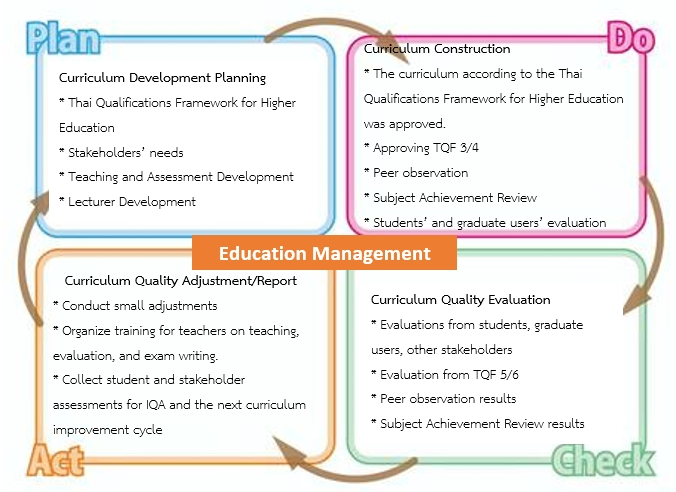
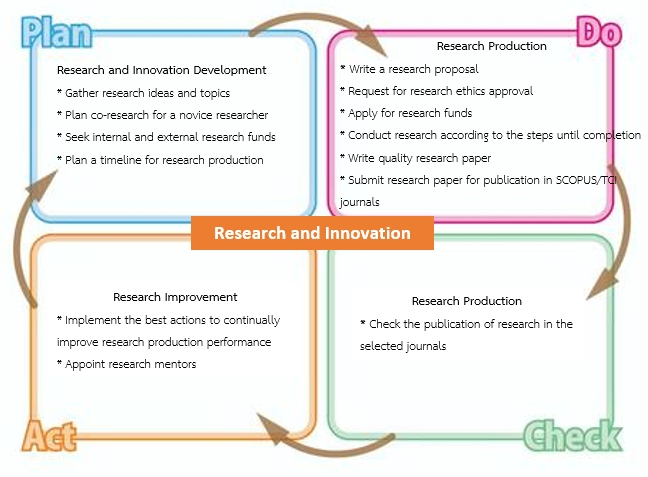
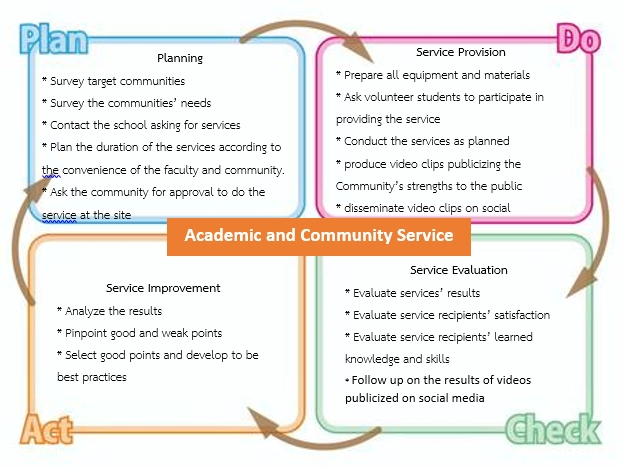
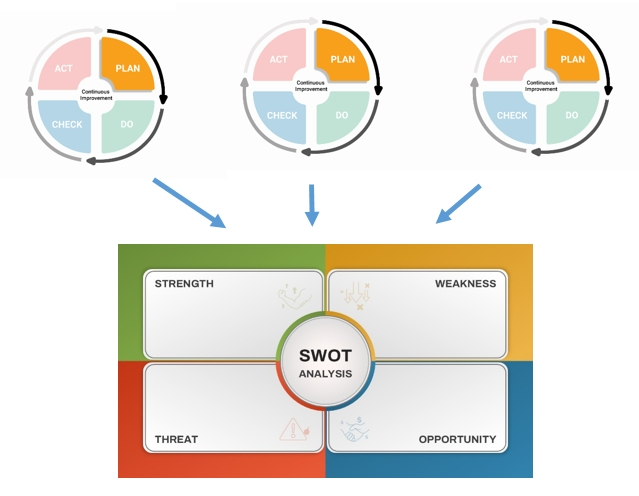
หลักฐาน
| รหัสหลักฐาน | ชื่อหลักฐาน(พร้อมแนบลิ้งค์) |
| 6.1.2 (2) -1 | หลักสูตรฉบับปรับปรุง หลักสูตร BE 2567 |
| 6.1.2 (2) -2 | หลักสูตรฉบับปรับปรุง หลักสูตร CA 2568 |
| 6.1.2 (2) -3 | ผลการประเมินความพึงพอใจของนักศึกษาที่มีต่อหลักสูตร |
| 6.1.2 (2) -4 | ผลการประเมินความพึงพอใจของอาจารย์ที่มีต่อหลักสูตร |
| 6.1.2 (2) -5 | จำนวนชิ้นงานของนักศึกษา |
| 6.1.2 (2) -6 | Peer observation |
| 6.1.2 (2) -7 | ผลงานทางวิชาการของอาจารย์ |
| 6.1.2 (2) -8 | ทุนผลงานทางวิชาการของอาจารย์ |
| 6.1.2 (2) -9 | Citations and H-Index citations |
| 6.1.2 (2) -10 | โครงการบริการวิชาการ ของสาขา BE |
| 6.1.2 (2) -11 | clip video นครนายกชาแนล |
| 6.1.2 (2) -12 | โครงการชุมชนเข้มแข็ง |
Self-Assessment 6.1
| เกณฑ์คุณภาพ | ประเมินตนเอง | คะแนน |
| 1. การออกแบบหลักสูตรและบริการฯ และกระบวนการ | ||
| (1) ข้อกำหนดของหลักสูตรและบริการฯ (2) การออกแบบหลักสูตรและบริการฯ (1 คะแนน) | / | 1 |
| (3) ข้อกำหนดของกระบวนการ (1 คะแนน) | / | 1 |
| (4) การออกแบบกระบวนการ (1 คะแนน) | / | 1 |
| 2. การจัดการและการปรับปรุงกระบวนการ | ||
| (1) การนำกระบวนการไปสู่การปฏิบัติ (1 คะแนน) | / | 1 |
| (2) การปรับปรุงกระบวนการ (1 คะแนน) | / | 1 |
| รวมผลการประเมินตนเอง Criteria 6.1 | 5 | |