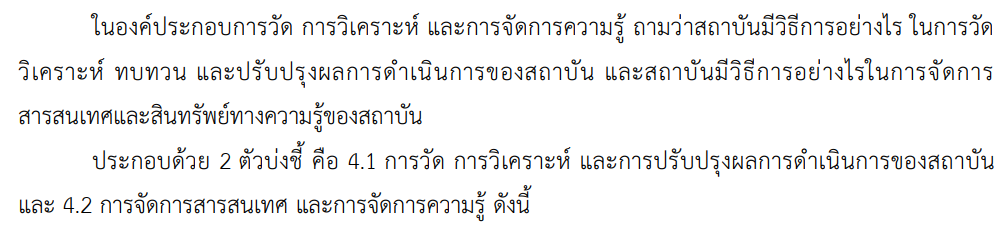
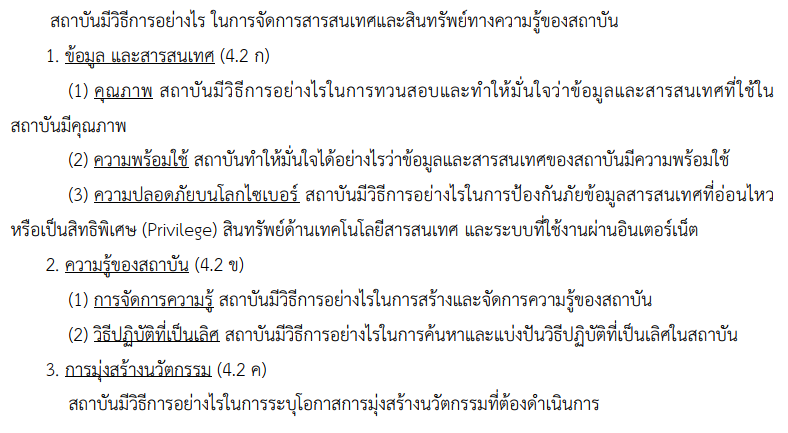
Criteria 4.2 การจัดการสารสนเทศ และการจัดการความรู้ (Information, and Knowledge Management
Requirements
Quality level assessment

Result 4.2
The Faculty manages information, knowledge systems, and innovation to drive operational improvements. To ensure seamless execution and quality assurance, the Dean convenes meetings with all relevant committees to implement the following strategic steps:
1) Appointment of Committees: Designate specific committees and responsible personnel to clearly define roles, duties, and accountabilities.
2) Data Verification: Conduct audits to verify the accuracy, completeness, timeliness, and reliability of data every time new information is generated.
3) Information Dissemination: Distribute and publicize information across appropriate channels tailored to the specific nature and target audience of the data.
4) Monitoring and Evaluation: Track performance and assess outcomes through direct observation as well as structured satisfaction and dissatisfaction surveys.
The critical information to be disseminated encompasses the following key areas:
1. Educational Information:
This includes data supporting teaching, learning, and curriculum management, such as the education registration system, E-learning platforms, and Google Classroom.
2. Research and Academic Service Information:
This data supports research quality improvement and research ethics certification and is stored in university databases such as the E-Research system.
3. Administrative and Management Information:
These include systems that assist with Faculty operations, such as financial systems, student information systems, electronic document management, and more.
To store and disseminate this information, the Faculty uses three main platforms:
- University Management Information System (MIS):
This platform is used solely for storing information. Access is restricted to authorized faculty members and staff through secure login credentials. Users can view and retrieve data as permitted. - Faculty Website:
This serves both as a storage and information dissemination platform. All content, including text and images, is first reviewed and approved by the Dean before being uploaded by the IT officer in charge of the website. - Faculty Fan Page:
This platform is used for sharing more informal or community-driven content. Posts may originate from students, lecturers, or the media. However, all content must be reviewed by a designated page moderator appointed by the Dean before publication.
To maintain the accuracy, reliability, integrity, and timeliness of all data, each platform has a responsible party for review:
- For the MIS, the University’s IT Department ensures data integrity.
- For the Faculty’s website and fan page, content is reviewed by the Dean and a designated moderator before publication.
| Platform | Data Source | Data Reviewer | Regulator | Data Retriever | Data Quality | |||
| 1 | 2 | 3 | 4 | |||||
| MIS | – All faculties – The University’s personnel | – Administrative Office | – IT Dept. | The College’s authorized personnel with assigned username and password | √ | √ | √ | √ |
| Faculty’s Website | – Faculty’s personnel | – Dean Administrative Office | – IT Dept. | – Open to all | √ | √ | √ | √ |
| Faculty’s fan page | – Faculty’s personnel Students – Alumni – Stakeholders | – Dean – Appointed regulator | – Appointed regulator | – Open to all | √ | √ | √ | √ |
1. Accurate 2. Reliable 3. Intrigrous 4. Current
หลักฐาน
| รหัสหลักฐาน | ชื่อหลักฐาน(พร้อมแนบลิ้งค์) |
| 4.2.1 (1) -1 | ระบบ MIS |
| 4.2.1 (1) -2 | website คณะ |
| 4.2.1 (1) -3 | fan page คณะ |
IT Infrastructure and Platform Accessibility
To ensure seamless operations, the Faculty utilizes the University’s centralized server system, which hosts the Management Information System (MIS) and internet infrastructure. Managed by university IT professionals, this infrastructure guarantees 24/7 system availability.
Information and data management within the Faculty are structured across three primary platforms, categorized by their accessibility parameters:
- Public Access Platforms: The Faculty Website and the Faculty Facebook Fan Page serve as the open-access online channels. These platforms enable personnel, partners, and stakeholders to seamlessly retrieve and share general information from any location at any time.
- Restricted Access System: The Management Information System (MIS) is strictly secured to protect sensitive institutional data. Access is confined to authorized personnel and requires secure credentials managed by the University’s IT Department.
| Platform | Available Time | Access Mechanism | User |
| MIS | 24 hours | The Internet through the University’s system | Only authorized users with an issued username and password |
| Faculty’s Website | 24 hours | The Faculty’s web address | Open access to any interested individual |
| Faculty’s Facebook Fan Page | 24 hours | The Faculty’s Facebook | Open access to any interested individual |
หลักฐาน
| รหัสหลักฐาน | ชื่อหลักฐาน(พร้อมแนบลิ้งค์) |
| 4.2.1 (2) -1 | ระบบ MIS |
| 4.2.1 (2) -2 | website คณะ |
| 4.2.1 (2) -3 | fan page คณะ |

As a compact institution, St. Teresa International University centralizes its cybersecurity infrastructure, meaning that individual faculties do not maintain separate systems. Instead, they rely on the University’s integrated cybersecurity system to safeguard all types of data—including sensitive data, personally identifiable information, personal data, and intellectual property—from theft and damage. This system also secures digital assets, controls user access, and prevents unauthorized processing, transfer, or deletion of data, thereby ensuring the confidentiality, integrity, and availability of information.
The University emphasizes three key areas of cybersecurity:
- Network Security: Safeguards interconnected systems through detection and monitoring tools.
- Cloud Security: Protects data stored and managed on cloud platforms.
- Application Security: Ensures software security through secure coding practices and the use of web application firewalls.
To ensure faculty and support staff remain proficient with the MIS system, the Faculty conducts an annual review of its functions and capabilities using the system manual. If staff encounter unclear areas or new system features, IT personnel are invited to lead a targeted review session.
Additionally, the Faculty has implemented precautionary measures for its personnel to help protect data assets. These include:
- Device Security: Use strong passwords to lock and protect devices.
- Malware Protection: Enable and regularly update antivirus software and perform frequent scans.
- Data Backup: Store critical backups in a separate physical location and conduct regular testing.
- Data Disposal: Permanently delete sensitive information when it is no longer required.
- System Maintenance: Keep devices, browsers, and applications updated by enabling automatic updates and restarting devices periodically to ensure installations are complete.
หลักฐาน
| รหัสหลักฐาน | ชื่อหลักฐาน(พร้อมแนบลิ้งค์) |
| 4.2.1 (3) -1 | คู่มือระบบ MIS |
The Faculty has established a structured approach to knowledge management and the ongoing enhancement of knowledge assets to support its operations. This process is integrated into various faculty activities and aims to promote organizational development, individual growth, and improved work efficiency. The Dean, committee boards, and the two program chairs all place strong emphasis on aligning knowledge initiatives with the Faculty’s core missions.
The Faculty’s knowledge management strategy is based on six key steps, forming a comprehensive framework for cultivating and expanding its knowledge base.
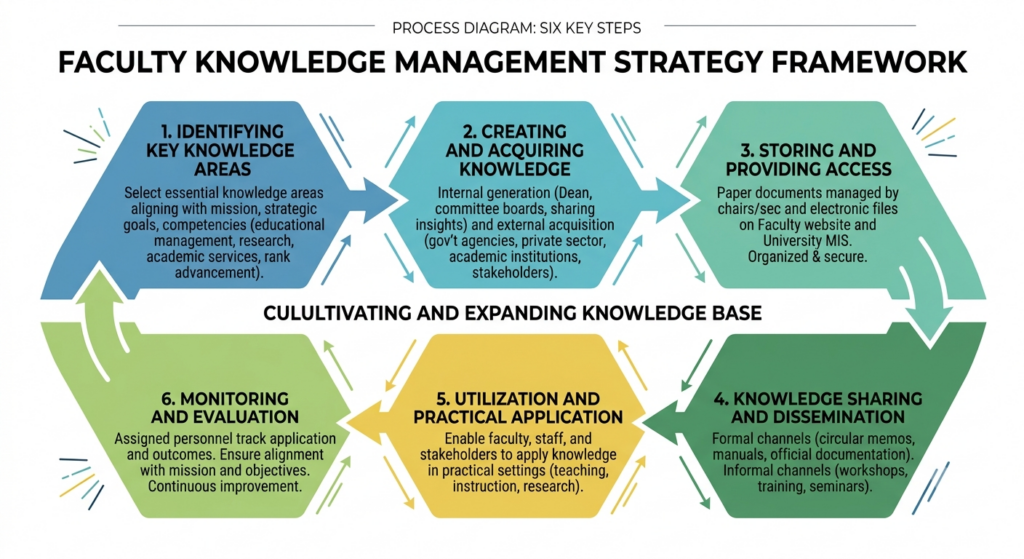
- Identifying Key Knowledge Areas
The Faculty identifies essential knowledge areas that align with its core mission, strategic goals, and institutional competencies. This includes knowledge related to educational management, research, academic services, and academic rank advancement, derived from performance indicators and operational outcomes. - Creating and Acquiring Knowledge
Knowledge is generated internally and sourced externally. Internally, the Dean and the committee boards oversee knowledge creation that enhances key operational processes. For example, the academic committee supports academic promotion by inviting faculty with academic titles to share insights into the application process and documentation requirements. Externally, knowledge is acquired from government agencies, private sector partners, educational institutions, peer organizations, and stakeholders. - Storing and Providing Access to Knowledge
Knowledge is stored in both physical and digital formats. Paper documents are managed and archived by the program chairs and the faculty secretary. Electronic files are maintained on the Faculty’s website and the University’s Management Information System (MIS), ensuring organized, secure, and accessible storage. - Knowledge Sharing and Dissemination
Knowledge is shared through both formal and informal channels. Formal sharing includes circular memos, manuals, and official documentation. Informal sharing occurs through workshops, training sessions, and seminars, allowing for interactive and dynamic exchange among faculty members and support staff. - Utilization and Practical Application
The purpose of knowledge transfer is to enable faculty, staff, and stakeholders to apply acquired knowledge in practical settings. This includes using knowledge to improve teaching practices, develop instructional activities, and conduct research. - Monitoring and Evaluation
Assigned personnel are responsible for tracking the application and outcomes of knowledge use, ensuring alignment with the Faculty’s mission and objectives. This step ensures continuous improvement and the effective use of knowledge assets.
Based on last year’s operations and the results from the Internal Quality Assurance (IQA) assessment, the Faculty has identified the achievement of knowledge management as laid out below.
Achievement of Knowledge Management
| Operation | Achievement |
| 1. Indicating the body of knowledge | – All boards of committees were able to identify the knowledge and indicators required for the main mission operations |
| 2. Constructing and seeking knowledge | – All boards of committees were able to locate the internal and external knowledge sources |
| 3. Knowledge storage and access system | – The Faculty made great use of the MIS in storing all-important knowledge and information. |
| 4. Knowledge transfer and exchange | – Through meetings and internal seminars, the faculty members exchange and transfer knowledge. |
| 5. Application and Learning | – The faculty members applied the learned knowledge (Explicit knowledge) combined with their experiences (Tacit knowledge) to construct a new body of knowledge used in their classrooms, research work, and academic services. |
| 6. Monitoring and auditing | – Monthly, the results of the projects and activities relating to KM were collected and reported to the Dean. – Quarterly, the summary of the operation was submitted to the Office of Policy and Planning. |
หลักฐาน
| รหัสหลักฐาน | ชื่อหลักฐาน(พร้อมแนบลิ้งค์) |
| 4.2.2 (1) -1 | โครงการเกี่ยวกับการจัดการศึกษา |
| 4.2.2 (1) -2 | โครงการเกี่ยวกับวิจัย |
| 4.2.2 (1) -3 | โครงการเกี่ยวกับบริการวิชาการและชุมชน |
| 4.2.2 (1) -4 | โครงการบริการวิชาการ HuSo สู่ชุมชน (HS 27) |
| 4.2.2 (1) -5 | โครงการชุนเข้มแข็ง(นครนายกชาแนล) (HS 29) |
| 4.2.2 (1) -6 | โครงการพัฒนาทักษะความรู้ความสามารถทางเทคโนโลยีสารสนเทศ (HS 40) |
| 4.2.2 (1) -7 | โครงการการจัดการความรู้ (HS 10) |
| 4.2.2 (1) -8 | ภาพกิจกรรมงาน KM |
| 4.2.2 (1) -9 | ภาพกิจกรรมการบริการวิชาการ |

The Faculty operates by aligning its long-term, five-year strategic plans with short-term annual initiatives. Committed to operational efficiency, the Faculty prioritizes a streamlined workflow that spans from initial planning through execution to final evaluation.
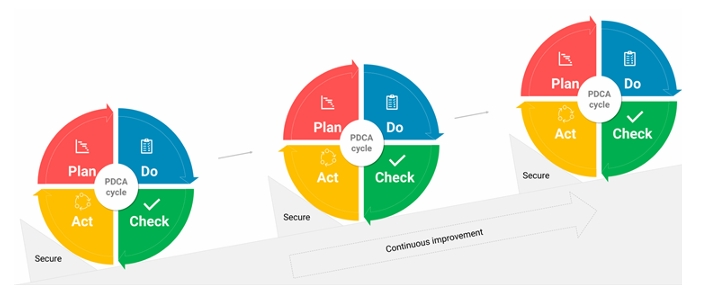
To drive continuous improvement, the Faculty uses the PDCA (Plan-Do-Check-Act) cycle as its core methodology. This iterative framework ensures ongoing refinement and optimization of processes through systematic planning, implementation, evaluation, and adjustment.
The Faculty implements the PDCA cycle to achieve five core objectives:
- Systematic Problem-Solving: The four-stage execution model ensures that solutions are continuously monitored, minimizing the systemic impact of initial problems.
- Data-Driven Decision-Making: Relying on concrete information and ongoing data verification improves the accuracy and effectiveness of decisions.
- Fostering Innovation: The cycle provides a structured space for testing new ideas, allowing the Faculty to deploy innovative solutions to complex challenges.
- Flexibility and Agility: It empowers the Faculty to adapt quickly and seamlessly to constant institutional and environmental changes.
- Continuous Quality Improvement: By emphasizing repeated rounds of process optimization, the framework steadily elevates quality standards across all operations.
The PDCA cycle is applied both organizationally and individually. The Dean actively promotes this methodology among faculty members, support staff, and students, embedding a culture of continuous improvement throughout the institution. This focus on personal and professional development serves as a primary driver of the Faculty’s collective success.
Impact & Best Practices: Through sustained implementation of the PDCA method, the Faculty has established numerous best practices across its core missions. These efforts have yielded highly satisfactory outcomes, which the Faculty actively shares with stakeholders to foster collaboration, learning, and mutual development.
| Mission | Best Practice | Achievement / Outcome | Key Stakeholders |
| Education Management | Curriculum Administration: Production-based instructional model | Delivery of 60 creative student workpieces per year | * Students * Graduate users |
| Extra-Curricular Development: “Diplomat in Filming” short course | International reach (e.g., successful course completion by a student from Myanmar) | * Potential students * Parents | |
| Research & Innovation | Knowledge Management (KM): Bridging explicit and tacit knowledge construction | Successful KM transfer to research, creative production, and academic/community services | * Faculty members & students * Research collaborators * Graduate users |
| Research Support Mechanism | Increased research publications, patent filings, and prestigious research awards | * Faculty members & students * Collaborators & graduate users * Target communities | |
| Academic & Community Services | Academic Outreach: English language alignment and learning support | Significant increase in O-Net English scores at Ban Chawagyao School; enhanced student self-confidence and positive attitudes | * Faculty members * Local students * Collaborators & target community |
| Community Engagement: Publicizing target communities through social media video clips | High-impact promotional video production for Dong-lakhon Historical Park | * Local community * Current students * General public |
หลักฐาน
| รหัสหลักฐาน | ชื่อหลักฐาน(พร้อมแนบลิ้งค์) |
| 4.2.2 (2) -1 | ผลงานของนักศึกษา |
| 4.2.2 (2) -2 | ผลงานทางวิชาการของอาจารย์ |
| 4.2.2 (2) -3 | หลักสูตรระยะสั้นของ อ. คมสัน |
| 4.2.2 (2) -4 | Flowchart เกี่ยวกับการสนับสนุนการทำวิจัย |
| 4.2.2 (2) -5 | KM ของ Leo / Pushpraj |
| 4.2.2 (2) -6 | Video clips การบริการชุมชนดงละคร |
| 4.2.2 (2) -7 | Power Point PDCA |

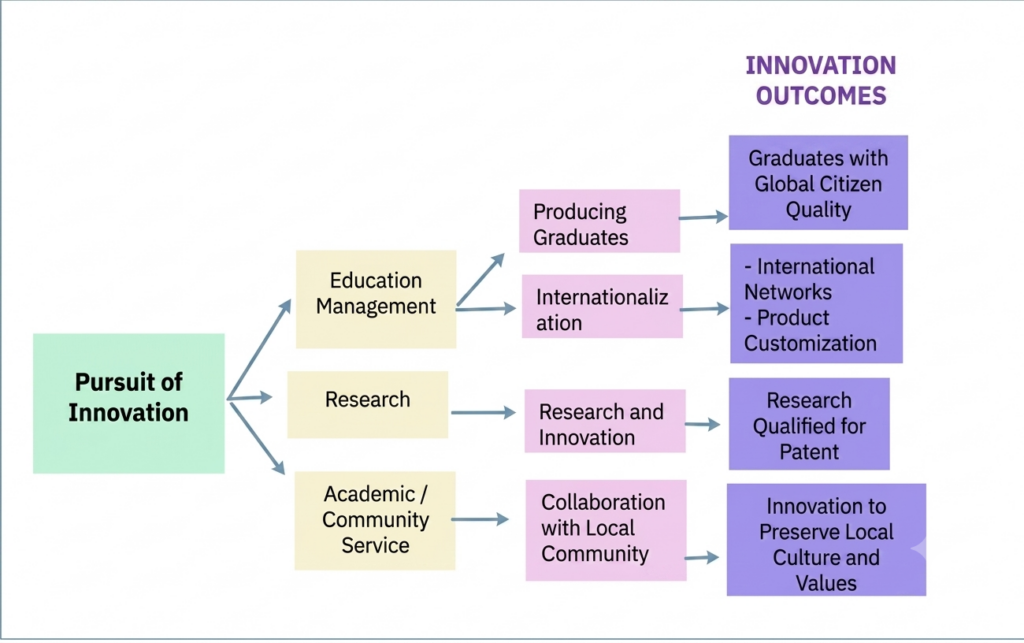
The Faculty aims to drive innovation within its core missions through the following steps:
- Strategic & Personnel Alignment: Utilize the 5-year Strategic Plan, the Human Resource Development Plan, and the Faculty’s performance results from the previous academic year as guidelines to establish the Annual Action Plan, which includes development projects for all three core missions.
- Stakeholder Collaboration: Incorporate feedback and ideas from staff and students, alongside data from external stakeholders, to shape the Annual Action Plan and its respective projects.
- Project Proposal: Draft and submit project proposals for approval to the Office of Policy and Planning.
- Role Assignment: Convene a faculty meeting to delegate responsibilities and assign project leaders.
- Project Implementation: Execute the projects according to the PDCA (Plan-Do-Check-Act) framework within the specified timeline.
- Quarterly Reporting: Summarize and report project results quarterly to the Office of Policy and Planning.
- Year-End Evaluation: Analyze the overall operational results at the end of the academic year using a SWOT analysis.
- Continuous Improvement: Utilize the evaluation results to refine and improve the Faculty’s innovation development process.
This process is conducted annually to evaluate operational outcomes, foster strategic improvements, and ultimately cultivate the definitive best practices and innovations presented below.
หลักฐาน
| รหัสหลักฐาน | ชื่อหลักฐาน(พร้อมแนบลิ้งค์) |
| 4.2.3 -1 | รายงานผลการดำเนินงานตามแผนปฏิบัติการ ปีการศึกษา 2568 |
| 4.2.3 -2 | ผลการประเมินความพึงพอใจของนักศึกษาที่มีต่อหลักสูตร |
| 4.2.3-3 | ผลการประเมินความพึงพอใจของผู้ใช้บัณฑิต |
| 4.2.3-4 | ผลการประเมิน “นักศึกษาประเมินอาจารย์” |
| 4.2.3-5 | ผลการประเมินผลลัพธ์ผู้เรียน |
| 4.2.3-6 | เปรียบเทียบ ฐานข้อมูลวารสารที่ตีพิมพ์งานวิจัยปี 2567 กับ 2568 |
| 4.2.3-7 | ผลสอบ TOEIC ปีการศึกษา 2565-2568 |
| 4.2.3-8 | รายชื่อโรงเรียน/ชุมชนที่รับบริการทางวิชาการ |
| 4.2.3-9 | แผนบริหารและพัฒนาบุคลากร พ.ศ.2568-2572 |
| 4.2.3-10 | แผนกลยุทธ์ ปีการศึกษา 2568-2572 |
| 4.2.3-11 | video ดงละคร |
| 4.2.3-12 | MOU |
Self-Assessment 4.2
| เกณฑ์คุณภาพ | ประเมินตนเอง | คะแนน |
| 1. ข้อมูล และสารสนเทศ | ||
| (1) คุณภาพ (2) ความพร้อมใช้ (1 คะแนน) | / | 1 |
| (3) ความปลอดภัยบนโลกไซเบอร์ (1 คะแนน) | / | 1 |
| 2. ความรู้ของสถาบัน | ||
| (1) การจัดการความรู้ (1 คะแนน) | / | 1 |
| (2) วิธีปฏิบัติที่เป็นเลิศ (1 คะแนน) | / | 1 |
| 3. การมุ่งสร้างนวัตกรรม (1 คะแนน) | / | 1 |
| รวมผลการประเมินตนเอง Criteria 4.2 | 5 | |