
Criteria 6.2 ประสิทธิผลของการปฏิบัติการ (Operational Effectiveness)
Requirements
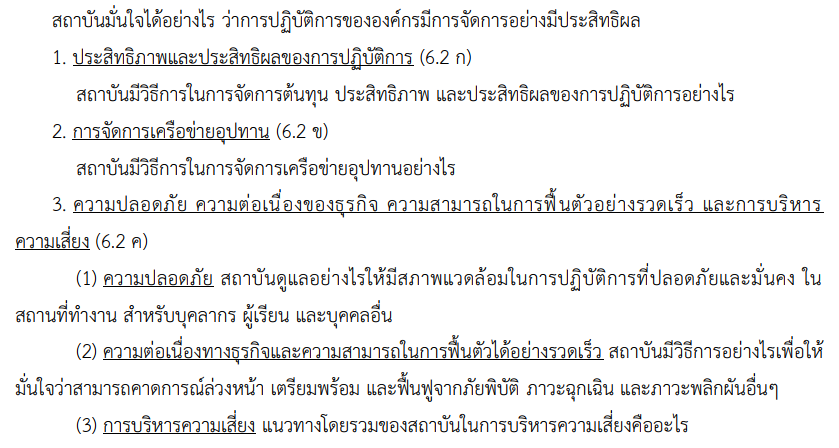
Quality level assessment

Result 6.2

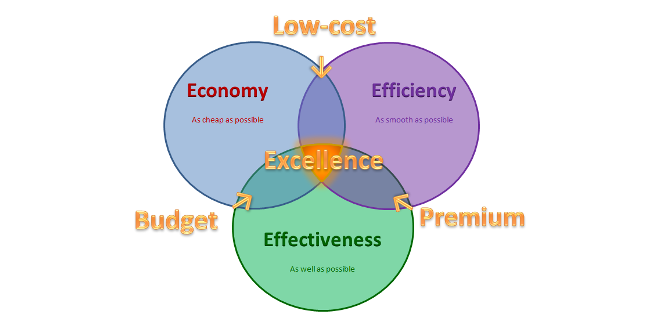
Operational Efficiency and Effectiveness
The Faculty systematically manages operational efficiency and effectiveness by integrating performance management, risk management, and resource optimization across its Key Work and Support Processes. The Dean and responsible committees establish annual operational plans, risk management plans, performance indicators (KPIs), and reporting schedules to optimize the use of time, financial resources, and workforce capacity while achieving strategic objectives.
To ensure effective process execution, the Faculty promotes a culture of quality by engaging faculty and staff in project planning, action plan development, resource allocation, and continuous improvement. This collaborative approach enhances resource utilization, controls operational costs, reduces risks, and ensures projects are implemented according to defined goals, timelines, and performance expectations.
The Faculty applies the PDCA (Plan–Do–Check–Act) methodology to systematically review and improve all key work processes across its three core missions: education management, research and innovation, and academic services. Process performance is regularly monitored, analyzed, and reviewed by the Faculty committees, with the results incorporated into subsequent planning cycles to drive continuous improvement, operational effectiveness, organizational agility, and performance excellence.
| Operational Efficiency | Benefit | Operational Effectiveness | Benefit | Recipient |
| Educational Management (Curricula) | ||||
| 1. Optimize resources: put the right people on the right task at the right time 2. Review process: fit-for-purpose and efficiency 3. Cross-team collaboration: work well together and share information 4. Invest in time management: Focusing on manpower and their skills 5. Empower men | 1. Reducing costs 2. Product quality and customer Satisfaction 3. Increased agility 4. Self engagement and retention | 1. Clear communication and foster collaboration 2. Operational learning and infrastructure 3. Improve personnel and customer retention 4. Leverage technology with resource management | 1. maximize the use of inputs to produce its outputs 2. Gain a competitive advantage 3. Develop products at a fast rate 4. Continuously improve performance | – Students – Potential Students – Lecturers – Faculty’s Administrators – Private and government institutes/ companies – The University – Alumni |
| Research and Innovation | ||||
| 1. Optimize resources: put the right people on the right task at the right time 2. Review process: fit-for purpose and efficiency 3. Cross-team collaboration: work well together and share information 4. Make data more accessible | 1. Reducing costs 2. Product quality and customer Satisfaction 3. Increased agility 4. Self engagement and retention | 1. Clear communication and foster collaboration 2. Operational learning and infrastructure 3. Improve personnel and customer retention 4. Leverage technology with resource management | 1. maximize the use of inputs to produce its outputs 2. Gain a competitive advantage 3. Develop products at a fast rate 4. Continuously improve performance | – Lecturers – Students – The Faculty – The College – Research fund Sources – Alumni – General public |
| Academic and Community Service | ||||
| 1. Task control: manage risks emerging unexpectedly 2. Optimize resources: put the right people on the right task at the right time 3. Review: fit-for purpose and efficiency 4. Cross-team collaboration: work well together and share information | 1. Reducing costs 2. Product quality and customer Satisfaction 3. Increased agility 4. Self engagement and retention | 1. Clear communication and foster collaboration 2. Operational learning and infrastructure 3. Improve personnel and customer retention 4. Leverage technology with resource management | 1. maximize the use of inputs to produce its outputs 2. Gain a competitive advantage 3. Develop products at a fast rate 4. Continuously improve performance | – Communities and residents – The province – Lecturers – Students – The Faculty – The University |
หลักฐาน
| รหัสหลักฐาน | ชื่อหลักฐาน(พร้อมแนบลิ้งค์) |
| 6.2.1 -1 | งบประมาณตามแผนปฏิบัติการย้อนหลัง 3 ปี |
| 6.2.1 -2 | โครงการตามแผนปฏิบัติการที่ไม่ใช้งบประมาณ |
| 6.2.1 -3 | ผลการประเมินความพึงพอใจของผู้ใช้บัณฑิต |
| 6.2.1 -4 | การบริการวิชาการของสาขา CA ที่ทำร่วมกับบริษัท เดอร์มาเอมดี จำกัด “Think Before You Sell: STRATEGY & EXECUTION” |

The Faculty systematically manages its supply network by analyzing its work processes and supply chain to ensure that key suppliers and partners can support its three core missions: education management, research and innovation, and academic services. Customer and stakeholder feedback is used to identify requirements and verify that suppliers and collaborative partners can effectively meet the needs and expectations of learners and other key stakeholders.
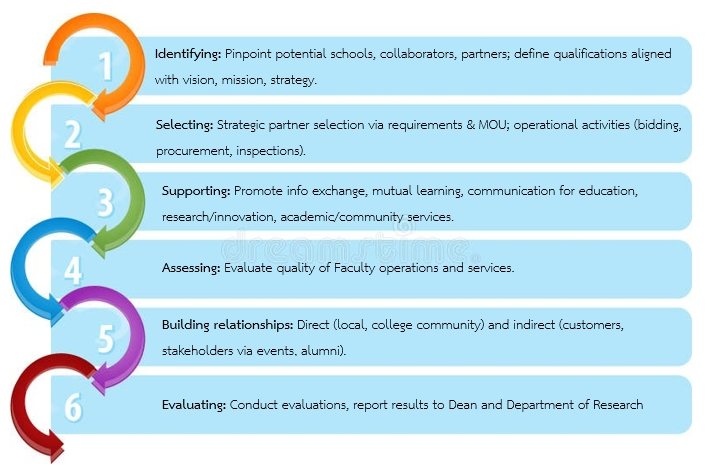
To strengthen operational efficiency, through brainstorming during the semester meeting, the Faculty has established a six-step supply network management approach that enables relevant units, suppliers, and strategic partners to develop a shared understanding of the overall work processes, mission objectives, roles, responsibilities, and performance expectations. This systematic approach enhances collaboration, improves process integration, and supports the effective delivery of the Faculty’s strategic objectives.
| Suppliers Partners Collaborators | Selection of Suppliers Partners Collaborators | Contributed Information | Problem-solving Operations |
| Education Management (Curricula) | |||
| 1. Students 2. Potential students 3. Lecturers 4. Entrepreneurs 5. Government and private companies/ Institutions | 1. Open to all schools contacted by the University’s PR team. 2. Open to all within the collected pool and new | 1. Curriculum information 2. Extracurricular activities 3. Student recruitment process 4. Education Expenses 5. Student qualifications | 1. Direct contact with the Faculty or the University’s Administrative Office |
| Research and Innovation | |||
| 1. Lecturers 2. Research collaborators 3. The University’s research division – Research fund Sources 4. Academic journals | 1. Open to all lecturers and research fund sources 2. Current research collaborators 3. Contact new collaborators fitting the research topic and innovation | 1. Timeline for proposal submission and research completion 2. Research fund 3. Research knowledge and guidance 4. List of prestigious journals | 1. Meet the research Committee 2. Meet the Head of the Research Division 3. Meet the collaborators |
| Academic and Community Service | |||
| 1. Current students 2. Service responsible personnel 3. Target community | 1. Open to students volunteering to participate 2. Assign faculty members matching the services 3. Old collaborative community 4. The new community interested in the provided service | 1. The knowledge to be provided 2. Service approach 3. Tools or equipment 4. Timeline for service | 1. Meet the academic service committee 2. Discuss with the service-responsible personnel |
หลักฐาน
| รหัสหลักฐาน | ชื่อหลักฐาน(พร้อมแนบลิ้งค์) |
| 6.2.2 -1 | มคอ.2 หลักสูตรศิลปศาสตรบัณฑิต สาขาวิชาภาษาอังกฤษเพื่อการสื่อสารทางธุรกิจ (หลักสูตรนานาชาติ/หลักสูตรปรับปรุง พ.ศ. 2567) |
| 6.2.2 -2 | มคอ.2 หลักสูตรนิเทศศาสตรบัณฑิต สาขาวิชาสื่อดิจิทัล (หลักสูตรปรับปรุง พ.ศ.2568) |
| 6.2.2 -3 | คู่มือนักศึกษา |
| 6.2.2 -4 | โครงการสอบวัดความรู้ภาษาอังกฤษ (HS 22) |
| 6.2.2 -5 | PowerPoint เผยแพร่ข้อมูลของคณะ |
| 6.2.2 -6 | Top up program |
| 6.2.2 -7 | ข้อมูลทุนวิจัยของอาจารย์ (แหล่งทุน) |
| 6.2.2 -8 | คำสั่งแต่งตั้งคณะกรรมการวิจัย |
| 6.2.2 -9 | คำสั่งแต่งตั้งคณะกรรมบริการวิชาการ |
| 6.2.2 -10 | โครงการบริการวิชาการ HuSo สู่ชุมชน (HS 27) |
| 6.2.2 -11 | โครงการการจัดการความรู้ (HS 10) |

Cybersecurity and Physical Security
The Faculty operates under the University’s institutional security management system, which ensures the protection of information, information assets, and physical resources through comprehensive cybersecurity and physical security measures.
Cybersecurity
The University’s Information Technology (IT) Department is responsible for implementing and maintaining cybersecurity practices to safeguard institutional data and digital assets. Key measures include:
- Cybersecurity Threat Prevention – The IT Department continuously monitors emerging cybersecurity threats and implements preventive measures, including the use of firewall protection on all institutional computers and the installation of antivirus software to minimize security risks.
- Secure User Authentication – Access to the University’s internet network and information systems is controlled through authenticated user login procedures, ensuring that only authorized personnel and students can access institutional resources.
- Critical Information System Management – The University identifies and prioritizes critical information systems and operational platforms. Appropriate operating systems are selected to optimize hardware performance, while regular software updates and security patches are applied to enhance system reliability and cybersecurity.
- Cyber Incident Detection, Response, and Recovery – Critical information systems are protected against cybersecurity incidents through continuous monitoring, threat detection, incident response, and system recovery mechanisms. Backup and recovery systems are implemented to ensure business continuity and minimize service disruptions in the event of a cyberattack.
- Cloud-Based Data Storage – Secure cloud services are provided for faculty members, staff, and students to support reliable data storage, collaboration, backup, and information accessibility while maintaining data security.
As the Faculty is housed within the University’s administration building, physical security, safety, and emergency preparedness are managed through the University’s comprehensive security management system. The University establishes, implements, and communicates safety policies, procedures, and emergency response guidelines to ensure a safe and secure environment for faculty members, staff, students, visitors, facilities, and institutional assets.
The Faculty reinforces these requirements by regularly reminding personnel to comply with established safety practices, while lecturers and academic advisors educate students on appropriate responses to emergency situations. The University maintains a secure campus through controlled access to buildings, 24-hour security personnel, CCTV surveillance, emergency alarm systems, fire protection equipment, routine safety inspections, and emergency preparedness procedures to minimize risks and ensure business continuity.
To promote health and well-being, the Faculty continues to encourage faculty members, staff, and students to follow appropriate endemic health precautions, including regular hand hygiene, maintaining reasonable physical distancing when appropriate, and wearing face masks when necessary.
Collectively, these systematic physical security and safety practices support a secure learning and working environment, protect institutional resources, and enhance the resilience and operational effectiveness of the Faculty.
Safety and Security
| Aspect | Recipients | Responsible Agency | |
| University | Faculty | ||
| Physical | Personnel/student | √ | |
| Psychological | √ | √ | |
| Cyber | √ | √ | |
| Accident prevention | √ | √ | |
| Disease prevention | √ | √ | |
| Security guards | √ | ||
| Campus | √ | ||
หลักฐาน
| รหัสหลักฐาน | ชื่อหลักฐาน(พร้อมแนบลิ้งค์) |
| 6.2.3 (1) -1 | ป้ายเตือนให้ใส่ mask |
| 6.2.3 (1) -2 | ภาพระบบรักษาความปลอดภัย (กล้องวงจรปิด/เจ้าหน้าที่รักษาความปลอดภัย) |
| 6.2.3 (1) -3 | การเข้าระบบ MIS |

The Faculty maintains organizational resilience through a systematic emergency preparedness and business continuity process encompassing pre-disaster preparedness, emergency response, and post-disaster recovery. This process minimizes operational disruptions, protects personnel and institutional assets, and ensures the continuity of academic and administrative operations.
During the preparedness phase, the Faculty conducts risk assessments and contingency planning to identify potential emergencies, including infectious disease outbreaks, fire, flooding, earthquake, and information technology failures. Preventive measures are implemented in collaboration with the University, including public health protocols, fire protection systems, routine safety inspections, CCTV monitoring, and updated emergency communication procedures.
During the response phase, incidents are promptly reported to University leadership, and emergency communications are activated through official channels. Faculty leadership coordinates response activities, assigns responsibilities, monitors the situation, and implements appropriate mitigation measures to ensure the safety of personnel and the continuity of operations.
During the recovery phase, the Faculty assesses operational impacts, implements recovery plans in accordance with University policies, restores normal operations, and strengthens communication and coordination among stakeholders. Recovery activities are monitored and evaluated, and lessons learned are incorporated into improved emergency procedures to enhance organizational resilience and business continuity.
Examples of emergency preparedness
| Emergency | Preparedness | Further action | Responsible Agency |
| Fire | Each building is fitted with fire escapes and fire extinguishers. | Notice signs pointing out the fire escape | University |
| Notice of instruction on fire extinguisher use | |||
| Accident | Security guards and dormitory staff are available around the clock to respond to accidents or transport injured individuals to the hospital. | Raise awareness of the accident within the campus to avoid future occurrences. | University |
| Power outage | Provide advance notice if known beforehand. | Identify locations to carry on essential activities | University Faculty |
| Disease outbreak | Communicate the outbreak and carry out emergency procedures. | Use online instruction as a substitute for classroom teaching. | |
| Clean up the buildings | |||
| Cyber attack | * Save essential information on alternative platforms. * Back up important data to different platforms. | Reactivate the system to improve functionality. | University Faculty |
หลักฐาน
| รหัสหลักฐาน | ชื่อหลักฐาน(พร้อมแนบลิ้งค์) |
| 6.2.3 (2) -1 | รูปทางหนีไฟ |
| 6.2.3 (2) -2 | กล้องวงจรปิด |
| 6.2.3 (2) -3 | ป้ายรักษาความปลอดภัย |

The Dean appoints the Risk Management Committee as the process owner of the Faculty’s risk management system. The Committee conducts an annual risk management cycle that includes identifying risk owners, assessing strategic, operational, financial, and regulatory risks, evaluating likelihood and impact, developing and approving mitigation plans, communicating actions to responsible personnel, monitoring implementation, and reviewing performance for continuous improvement.
Risk management is integrated into the Faculty’s annual operational planning and performance review. The Committee regularly monitors risk indicators, evaluates mitigation effectiveness, and assesses residual and acceptable risk levels to prioritize improvement actions and strengthen organizational resilience.
Over the past three years, the Faculty has managed two key strategic risks: (1) BE and CA student enrollment remaining below strategic targets, and (2) low participation in the University’s TOEIC practice program, resulting in many fourth-year students initially failing to achieve the required TOEIC score of 600.
Annual reviews show that student recruitment remains the Faculty’s highest strategic risk, as enrollment continues to fall short of targets despite mitigation efforts. In contrast, TOEIC performance has improved through closer monitoring and stricter implementation of the practice program, leading to a growing proportion of graduating students meeting the University’s TOEIC benchmark.
Annual risk assessment results are used to update mitigation plans, guide resource allocation, and strengthen the Faculty’s risk management system in alignment with its strategic objectives and continuous improvement.
| Risk | 2023 | 2024 | 2025 |
| Number of recruited students | 19 | 20 | 9 |
| Percentage of students scoring over 600 | 26.92 | 41.67 | 22.22 |
Both risks have impacted the Faculty’s performance as shown below
| Risk | Curricula | Personnel | Finance | Supply-Network | Process Implementation |
| First risk | BE and CA | Dean/Program chairs | Lower per-head income | University | Improve BE and CA curricula |
| Second risk | BE and CA | The faculty’s personnel | – | Stakeholders as graduate users | Strict supervision and regulation |
To address these risks, the Faculty has taken the following actions:
- Updated the information about the Faculty and the two programs so the University’s PR team can share it more effectively during school visits.
- Participated in the University’s ‘Open House’ event to meet school guidance counselors from various regions and provide them with detailed information about the Faculty and its programs.
หลักฐาน
| รหัสหลักฐาน | ชื่อหลักฐาน(พร้อมแนบลิ้งค์) |
| 6.2.3 (3) -1 | ผลของโครงการบริหารความเสี่ยง |
| 6.2.3 (3) -2 | ภาพกิจกรรมงาน Open House |
| 6.2.3 (3) -3 | Top up |
| 6.2.3 (3) -4 | ข้อมูลนักศึกษาแรกเข้า (ตัวเลข) |
| 6.2.3 (3) -5 | ข้อมูลคะแนน TOEIC สามปีย้อนหลัง |
Self-Assessment 6.2
| เกณฑ์คุณภาพ | ประเมินตนเอง | คะแนน |
| 1. ประสิทธิภาพและประสิทธิผลของการปฏิบัติการ (1 คะแนน) | / | 1 |
| 2. การจัดการเครือข่ายอุปทาน (1 คะแนน) | / | 1 |
| 3. ความปลอดภัย ความต่อเนื่องของธุรกิจ ความสามารถในการฟื้นตัวอย่างรวดเร็ว และการบริหารความเสี่ยง | ||
| (1) ความปลอดภัย (1 คะแนน) | / | 1 |
| (2) ความต่อเนื่องทางธุรกิจและความสามารถในการฟื้นตัวได้อย่างรวดเร็ว (1 คะแนน) | / | 1 |
| (3) การบริหารความเสี่ยง (1 คะแนน) | / | 1 |
| รวมผลการประเมินตนเอง Criteria 6.2 | 5 | |