Criterion 1 – Expected Learning Outcomes
Criterion
Requirements
Quality level assessment

Result
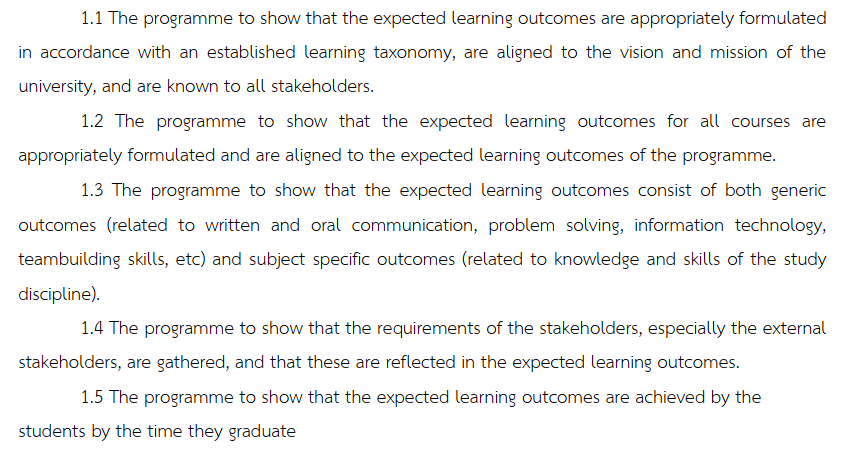
1.1 The programme to show that the expected learning outcomes are appropriately formulated in accordance with an established learning taxonomy, are aligned to the vision and mission of the university, and are known to all stakeholders.
Operational Result
The Bachelor of Accountancy Program at St. Theresa International University has been designed with Bloom’s Revised Taxonomy as a framework for the Expected Learning Outcomes (ELOs) so that ELOs range from recall of foundational knowledge to creative synthesis and critical evaluation, which covers the higher cognitive levels. The program’s curriculum mapping documentation explicitly refers to the six domains of Bloom’s taxonomy (Remember, Understand, Apply, Analyze, Evaluate, and Create), and these are evident in the curriculum in all four years of study.
The Expected Learning Outcomes (ELOs) of the program are directly aligned with TRSU’s institutional vision: “To be a leading international university that develops graduates with excellence in knowledge, professional ethics, and global citizenship,” and the institutional mission to cultivate graduates who contribute meaningfully to national and international economic development. The accountancy program’s ELOs operationalize this vision by focusing on professional accounting competence, ethical integrity, digital literacy in accounting information systems, and cross-cultural communication skills suitable for the ASEAN business environment.
Stakeholder communication of Expected Learning Outcomes (ELOs) is conducted through multiple channels: ELOs are published in the official program handbook, displayed on the faculty website, included in all course syllabi (Course Learning Outcomes mapped to Program Learning Outcomes), presented during new student orientation sessions, shared with employers during advisory board meetings, and referenced in graduate exit surveys. Faculty are trained on ELO alignment during curriculum development workshops held annually.
PLO ในเล่ม มคอ.2 หลักสูตรบัญชีบัณฑิต พ.ศ.2563 ที่ สกอ.ประทับตรารับทราบ มีจำนวนรวม 14 รายการ ดังต่อไปนี้
คุณธรรมจริยธรรม (Moral and Ethics)
1.1 มีความรู้ความเข้าใจในหลักจริยธรรมพื้นฐานทางวิชาชีพบัญชี
Explain the basic principle of ethics applicable to accounting profession
1.2 สามารถประยุกต์หลักจริยธรรมพื้นฐานทางวิชาชีพในการแก้ไขปัญหาทางปฏิบัติได้อย่างเหมาะสม
Apply the basic ethical principle for accounting profession appropriately to solving problems in the professional practice
1.3 แสดงออกถึงความเป็นคนซื่อสัตย์สุจริจ เที่ยงธรรม ระมัดระวังรอบคอบในการทำงาน และมีความรับผิดชอบต่อตนเอง วิชาชีพและสังคม
Demonstrate the personal conducts based on the principle of honesty, integrity, justice and caution in work, and responsibility to oneself, profession and society
ความรู้ (Knowledge)
2.1 มีความรู้ความเข้าใจในสาระสำคัญของศาสตร์ทางการบัญชีเพียงพอที่จะประยุกต์ใช้ในการจัดทำและนำเสนอสารสนเทศที่เป็น ประโยชน์ต่อผู้ใช้
Explain and apply key principles and concepts in accounting to prepare financial reports and communicate useful information for the users
2.2 มีความรู้ความเข้าใจในศาสตร์อื่นที่เกี่ยวข้องเพียงพอที่จะประยุกต์ใช้ในการประกอบวิชาชีพบัญชี
Explain and apply other professional related concepts to perform accounting tasks according to the standards
2.3 มีความสามารถในการประยุกต์ใช้หลักคณิตศาสตร์และสถิติในการประกอบวิชาชีพบัญชี
Apply mathematical and statistical concepts or techniques to perform accounting tasks and professional practice
ทักษะทางปัญญา (Cognitive or Intellectual skills)
3.1 มีความสามารถในการสืบค้นและวิเคราะห์ข้อมูลด้วยวิธีการที่ถูกต้องและเหมาะสมกับปัญหา
Research and analyze information using sound and appropriate methods for problems concerned
3.2 มีความสามารถในการเรียนรู้และติดตามการเปลี่ยนแปลงในศาสตร์ทางการบัญชีและศาสตร์อื่นที่เกี่ยวข้อง และรู้เท่าทันการเปลี่ยนแปลงของสังคมและของโลก
Seek to acquire updated knowledge or new standard of practice in accounting and professional related disciplines and stay up to date with social and global changes
3.3 มีความสามารถในการใช้ดุลยพินิจในการระบุปัญหาในการปฏิบัติทางบัญชีในเรื่องที่มีความสำคัญต่อองค์กร และสามารถแสดง ความคิดเห็นหรือเสนอแนวทางการแก้ไขปัญหา
Use informed judgment in identifying problems in accounting practice and issues important to the organization, and propose workable idea or solution to the problems
ทักษะความสัมพันธ์ระหว่างบุคคลและความรับผิดชอบ (Interpersonal skills and responsibility)
4.1 มีทัศนคติที่ดีต่อการทำงานเป็นทีม มีความรับผิดชอบในการทำงานของตนเองร่วมกับผู้อื่น และสามารถปรับตัวให้เข้ากับสถานการณ์และวัฒนธรรมขององค์กร
Take responsibility of own work and think positively when working in a team or with the others and adapt well to situation and organizational culture
4.2 มีหลักคิดและวิธีการปฏิบัติงานที่เป็นระบบ มีความรับผิดชอบในการทำงานให้สำเร็จตามเป้าหมายภายในระยะเวลาที่กำหนด
Use rationale and systematic work procedures and take responsibility to accomplish assignments within a given time
ทักษะการวิเคราะห์ตัวเลข สื่อสารและใช้เทคโนโลยีสารสนเทศ (Numerical and ICT literacy)
5.1 มีความสามารถในการวิเคราะห์เชิงปริมาณและคุณภาพ รวมทั้งการใช้ความรู้ความสามารถเชิงเทคนิคในการวางแผนงาน การควบคุม การประเมินผล และการรายงานผลได้อย่างถูกต้องและเหมาะสม โดยคำนึงถึงผลกระทบที่อาจเกิดขึ้นจากการตัดสินใจ
Use quantitative and qualitative analysis methods together with the technical competence in planning, controlling, evaluating and reporting correctly and appropriately while considering the impact of the decisions
5.2 มีความสามารถในการสื่อสารอย่างมีประสิทธิภาพทั้งการพูดและการเขียน โดยใช้รูปแบบการนำเสนอที่เหมาะสมกับสถานการณ์
Communicate effectively in verbal and written with audiences using appropriate mode of presentation for the situation
5.3 มีความสามารถในการประยุกต์ใช้เทคโนโลยีสารสนเทศทางการบัญชี โดยเฉพาะเทคโนโลยีดิจิทัลที่มีในปัจจุบัน เพื่อพัฒนากระบวนการทำงานด้านวิชาชีพบัญชีให้มีประสิทธิภาพ
Apply accounting information technology and available digital technology to enhance the efficiency of accounting practice
Evidence:
| ID_Evidence | Name_Evidence |
| 1.1.1 | University Website Social Media to promote the course |
| 1.1.2 | B.Accountancy Program 2565(2023) Learning Outcomes |
| 1.1.3 | Brochure |
| 1.1.4 | TQF2 |
| 1.1.5 | Vision & Mission |
| 1.1.6 | Student handbook |
| 1.1.7 | Curriculum Mapping |
1.2 The programme to show that the expected learning outcomes for all courses are appropriately formulated and are aligned to the expected learning outcomes of the programme.
Operational Result
The Bachelor of Accountancy Program comprises 129 credits organized across four academic years, including general education courses, professional core accounting courses, elective courses, and a project/internship component. For every course within the programme, Course Learning Outcomes (CLOs) have been developed and explicitly mapped to the Programme Learning Outcomes (PLOs) through a comprehensive curriculum matrix.
Each course syllabus (TQF-3) clearly identifies the Programme Learning Outcomes (PLOs) addressed by the course, specifying the level of contribution (major or minor) and the corresponding teaching, learning, and assessment methods. The curriculum mapping ensures that all five PLOs are comprehensively covered across the programme, with no essential competencies left unaddressed.
Foundational courses provide prerequisite knowledge and skills, while advanced courses such as Financial Reporting, Auditing, Taxation, and Accounting Information Systems serve as primary contributors to the achievement of PLOs. This structured approach guarantees that students progress from basic knowledge acquisition to advanced application and professional judgment, ensuring constructive alignment throughout the curriculum.
Course and programme Learning outcomes are published in syllabi, on the university website, and within the Learning Management System (LMS). Students are introduced to them during orientation and reinforced through academic advising. Faculty use the mapping matrix to guide lesson planning, delivery, and assessment design, ensuring constructive alignment. Industry stakeholders participate in curriculum reviews to confirm relevance to labour market expectations.
Alignment of CLOs and PLOs is monitored through annual internal academic audits and programme assessment reports. Courses rated as having “strong alignment” validate programme coherence, while those rated “moderate” are subject to targeted improvement plans.
Periodic curriculum reviews, chaired by the programme coordinator, further assess CLO–PLO alignment, identify gaps, and update syllabi in response to changes in accounting standards (e.g., new TFRS updates, new tax policies in Thailand), technological developments, and stakeholder feedback.
Evidence
| ID_Evidence | Name_Evidence |
| 1.2.1 | Sample TQF 3 |
| 1.2.2 | Sample TQF 5 |
| 1.2.3 | TQF 2 |
1.3 The programme to show that the expected learning outcomes consist of both generic outcomes (related to written and oral communication, problem solving, information technology, teambuilding skills, etc) and subject specific outcomes (related to knowledge and skills of the study discipline).
The Bachelor of Accountancy (B.Acc) program at St. Teresa International University (TRSU) has established Expected Learning Outcomes (ELOs) that encompass both generic competencies and subject-specific knowledge and skills. The ELOs are developed in alignment with the university’s vision and mission, the Thailand Qualifications Framework (TQF), professional accounting standards, and stakeholder expectations. This balanced approach ensures that graduates possess not only strong technical accounting expertise but also the transferable skills required for success in a rapidly evolving global business environment.
The programme incorporates a range of generic learning outcomes that are embedded across courses and co-curricular activities. These include effective written and oral communication skills, critical thinking and problem-solving abilities, teamwork and interpersonal skills, leadership, ethical and professional responsibility, and information technology competency. Students develop these competencies through presentations, case analyses, group projects, business simulations, classroom discussions, internship experiences, and the use of digital learning platforms and accounting software applications.
In addition to generic competencies, the programme emphasizes subject-specific learning outcomes that reflect the knowledge and professional skills required in the accounting discipline. Students acquire competencies in financial accounting and reporting, managerial and cost accounting, auditing and assurance, taxation, accounting information systems, financial management, business law, and corporate governance. These disciplinary outcomes are developed through a combination of theoretical instruction, practical exercises, case studies, computerized accounting applications, and industry-oriented projects.
The integration of generic and subject-specific learning outcomes is reflected throughout the curriculum structure, teaching and learning strategies, and assessment methods. As a result, graduates of the Bachelor of Accountancy program are equipped with the communication, analytical, technological, and collaborative skills necessary for professional practice, while also demonstrating the technical knowledge and competencies expected of accounting professionals. This comprehensive approach enables graduates to contribute effectively to organizations, pursue professional certification, and adapt successfully to the changing demands of the accounting profession.
| Generic Outcomes (Transferable Skills) | Subject-Specific Outcomes (Accountancy Discipline) |
| • Written and oral communication in Thai and English • Analytical and critical thinking / problem-solving • Information technology • Teamwork, leadership, and interpersonal skills • Ethical reasoning and professional integrity • Lifelong learning and adaptability • Cross-cultural awareness for ASEAN business contexts | • Financial accounting and reporting (TFRS/IFRS) • Auditing standards and assurance services • Taxation law and practice (Thai Revenue Code) • Management accounting and cost analysis • Accounting information systems (AIS) and accounting software proficiency (Quickbooks, Tally, Waveapps) • Corporate governance and internal controls • Financial statement analysis and valuation |
Evidence
| ID_Evidence | Name_Evidence |
| 1.3-1 | Programme ELO Classification Framework (Generic vs. Discipline-Specific), |
| 1.3-2 | PLO Matrix |
| 1.3-3 | PLO-1 to PLO-5 Descriptors with Bloom’s Level Mapping |
| 1.3.4 | Knowledge Management Report |
1.4 The programme to show that the requirements of the stakeholders, especially the external stakeholders, are gathered, and that these are reflected in the expected learning outcomes.
Operational Result
The Bachelor of Accountancy (B.Acc) program at St. Teresa International University (TRSU) systematically gathers and analyzes feedback from both internal and external stakeholders to ensure that the Expected Learning Outcomes (ELOs) remain relevant, current, and responsive to the needs of the accounting profession and society. Stakeholder engagement is an integral part of the programme design, review, and continuous improvement processes.
The programme identifies key stakeholders, including employers, professional accountants, accounting firms, industry representatives, internship supervisors, alumni, students, academic staff, professional bodies, and regulatory agencies. Stakeholder input is collected through surveys, curriculum review meetings, internship evaluations, alumni feedback, employer satisfaction surveys, advisory committee consultations, and industry discussions. Particular emphasis is placed on external stakeholders, whose feedback highlights the importance of technical accounting knowledge, digital literacy, communication skills, analytical thinking, ethical conduct, teamwork, problem-solving, and adaptability to technological changes. Input from professional bodies and regulatory agencies also ensures alignment with current accounting standards and professional requirements. The feedback gathered is used to refine the programme’s Expected Learning Outcomes (ELOs), leading to the inclusion of competencies related to accounting information systems, digital accounting applications, professional ethics, communication skills, critical thinking, and lifelong learning.
The information collected from stakeholders is analyzed during curriculum review and programme development activities. The results are used to refine and update the Expected Learning Outcomes, ensuring that they reflect both disciplinary
External stakeholder engagement includes:
(1) annual meetings of the Programme Advisory Board, which comprises representatives from the Big Four accounting firms, listed companies in Thailand, the Stock Exchange of Thailand, the Federation of Accounting Professions (FAP), and small-to-medium enterprise (SME) accounting offices; (2) employer surveys distributed to organizations that have hired TRSU Accountancy graduates; (3) alumni surveys conducted through the university’s annual alumni tracking system; and (4) Review of competency frameworks published by the FAP, the Institute of Certified Accountants and Auditors of Thailand (ICAAT), and the International Federation of Accountants (IFAC) IAESB standards for accounting education.
Stakeholder feedback collected in 2025 resulted in the following ELO revisions:
(a) Strengthening of digital accounting competencies to include cloud-based accounting software (e.g., QuickBooks, Tally and Waveaccount) and data analytics tools (Excel advanced functions, Excel, and Power BI basics); (b) addition of sustainability reporting awareness as an emerging competency in response to SEC Thailand and FAP guidance on ESG disclosure; (c) enhanced emphasis on communication skills in English for international accounting contexts, reflecting employer feedback that accountancy graduates needed stronger business English proficiency; and (d) reinforcement of internal audit skills following industry demand from corporate governance functions.
Evidence
| ID_Evidence | Name_Evidence |
| 1.4-1: | Programme Advisory Board Meeting Minutes |
| 1.4-2: | Employer Survey Results and Analysis Report |
| 1.4-3: | Alumni Satisfaction Survey Report |
1.5 The programme to show that the expected learning outcomes are achieved by the students by the time they graduate
Operational Result
The Bachelor of Accountancy Program at St. Teresa International University systematically monitors, assesses, and evaluates the achievement of Program Learning Outcomes (PLOs) to ensure that graduates attain the competencies, skills, values, and professional attributes expected upon completion of the program.
The program has established a comprehensive Outcome-Based Education (OBE) framework that integrates Program Learning Outcomes (PLOs), Course Learning Outcomes (CLOs), teaching and learning activities, assessment methods, and continuous quality improvement processes. Student achievement of learning outcomes is measured through both direct and indirect assessment methods throughout the program lifecycle.
The assessment system is designed to verify that graduates acquire competencies in accounting knowledge, professional skills, ethical responsibility, critical thinking, communication, digital literacy, and lifelong learning consistent with the Thailand Qualifications Framework (TQF), International Education Standards (IES), and industry requirements.
Direct Assessment of Programme Learning Outcomes
The programme employs multiple direct assessment methods to evaluate students’ achievement of the PLOs, including:
- Midterm and final examinations
- Case study analyses
- Individual and group projects
- Presentations and oral examinations
- Research assignments
- Accounting software applications
- Internship performance evaluations
- Capstone projects
- Comprehensive course assessments
Each course contributes to specific PLOs through a structured CLO-PLO mapping matrix. Student performance data are collected and analyzed annually to determine the extent to which the expected learning outcomes have been achieved.
The program committee reviews PLO attainment reports annually and identifies areas requiring improvement through the PDCA (Plan-Do-Check-Act) quality assurance cycle.
Evidence
| ID_Evidence | Name_Evidence |
| 1.5.1 | Evaluation Rubric |
| 1.5.2 | Curriculum Mapping (PLO/ELO to CLO Mapping Matrix) |
| 1.5.3 | Practical Accounting Software Training Assessments |
Self-Assessment
| Requirements | Result | Score |
| 1.1 The program shows that the expected learning outcomes are appropriately formulated in accordance with an established learning taxonomy, are aligned to the vision and mission of the university, and are known to all stakeholders. | / | 1 |
| 1.2 The program shows that the expected learning outcomes for all courses are appropriately formulated and are aligned to the expected learning outcomes of the programme. | / | 1 |
| 1.3 The program to show that the expected learning outcomes consist of both generic outcomes and subject-specific outcomes. | / | 1 |
| 1.4 The program to show that the requirements of the stakeholders, especially the external stakeholders, are gathered and that these are reflected in the expected learning outcomes. | / | 1 |
| 1.5 The programme to show that the expected learning outcomes are achieved by the students by the time they graduate | / | 1 |
| Overall | 5 | |