Criterion 2 – Programme Structure and Content
Criterion
Requirements
Quality level assessment

Result
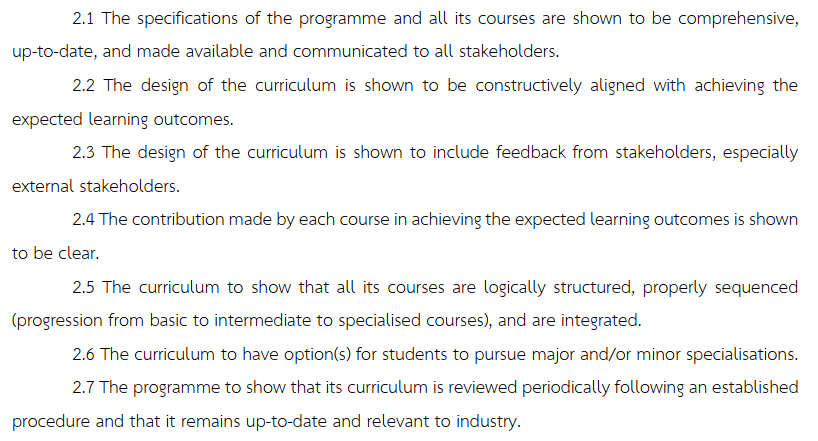
2.1 The specifications of the programme and all its courses are shown to be comprehensive and up-to-date and made available and communicated to all stakeholders.
Operational Results
The Bachelor of Accountancy (B.Acc.) Programme at St. Teresa International University maintains comprehensive, current, and transparent programme and course specifications to ensure that all stakeholders have a clear understanding of the programme’s objectives, curriculum structure, learning outcomes, and academic requirements. The programme recognizes that accurate and accessible information is essential for informed decision-making, effective learning, and continuous quality enhancement.
Comprehensive Programme and Course Specifications:
| Programme Specifications | Course Specifications |
| Programme vision, mission, and educational philosophy | Course descriptions and objectives |
| Expected Learning Outcomes (ELOs) aligned with the Thai Qualifications Framework (TQF), professional accounting standards, and international competencies | Course Learning Outcomes (CLOs) and their alignment with Programme Expected Learning Outcomes (ELOs) |
| Curriculum structure and study plans | Weekly teaching and learning plans |
| Admission and graduation requirements | Teaching methodologies and learning activities |
| Credit requirements and curriculum mapping | Assessment strategies and grading criteria |
| Language of instruction | Learning resources and reference materials |
| Teaching and learning strategies | Required prerequisites and co-requisites |
| Assessment and evaluation methods | Student workload and independent learning expectations |
B.Acc program ensures that the expected learning outcomes are translated and embedded into individual course objectives and learning modules. Each course explicitly demonstrates its contribution to the achievement of program-level outcomes through curriculum mapping. The curriculum places strong emphasis on professional accounting competencies, ethical practices, analytical and critical thinking skills, digital literacy, communication skills, and the application of International Financial Reporting Standards (IFRS) and global accounting practices, thereby preparing graduates to meet both local and international professional requirements.
Review and Updating Process
To ensure currency and relevance, program specifications are reviewed annually by the Curriculum Committee in collaboration with program administrators and academic staff. The review process considers:
- Changes in national higher education policies and regulations;
- Requirements of the Thailand Qualification Framework (TQF);
- Developments in accounting standards, taxation laws, and auditing regulations;
- International trends in accounting education;
- Technological advancements and digital transformation in the accounting profession;
- Benchmarking with leading national and international accounting programmes; and
- Feedback from stakeholders, including students, alumni, employers, professional bodies, and industry partners.
Course specifications are prepared and updated by course coordinators prior to the commencement of each academic year and whenever significant changes occur in professional standards or industry requirements. The programme’s quality assurance system requires course coordinators to review course contents, teaching strategies, learning materials, and assessment methods to ensure continued alignment with program learning outcomes and stakeholder expectations.
The curriculum also incorporates experiential learning components, including internships, field studies, case analyses, and industry projects, to ensure that program specifications remain relevant to contemporary professional practices and labour market demands.
Accessibility and Communication to Stakeholders
The Bachelor of Accountancy program is committed to transparency and effective dissemination of programme information. Program and course specifications are made available through multiple communication channels to ensure accessibility for all stakeholders.
The information is disseminated through:
- University Website (in both English and Thai);
- Faculty and Programme webpages;
- Student Handbook;
- Programme Brochure and Prospectus;
- Learning Management System (LMS);
- Course syllabi and course files;
- Orientation programmes for new students;
- Academic advising sessions;
- Faculty meetings and departmental briefings;
- Parent meetings and open-house activities;
- Employer engagement sessions and internship orientations; and
- Alumni and industry networking activities.
The university website is designed to be user-friendly and easily navigable, enabling prospective students, current students, parents, employers, and accrediting bodies to access accurate and updated programme information at any time.
Communication and Stakeholder Engagement
The programme adopts a systematic approach to communicating programme information and receiving stakeholder feedback. Information regarding curriculum revisions, new courses, programme requirements, and academic regulations is communicated through:
- Official university announcements;
- Email communications;
- LMS notifications;
- Social media platforms;
- Student and faculty meetings;
- Programme advisory committee meetings; and
- Industry consultation sessions.
Stakeholder engagement mechanisms, including surveys, focus group discussions, employer consultations, alumni feedback sessions, and graduate tracer studies, provide valuable input regarding the clarity, accessibility, and relevance of programme information. Feedback from these stakeholders is systematically analysed and used to improve programme and course specifications.
Evidence of Effectiveness
Evidence indicates that stakeholders demonstrate a high level of satisfaction with the accessibility, comprehensiveness, and clarity of programme information. Students report that programme specifications and course information effectively support academic planning and learning. Employers and alumni confirm that the programme’s stated learning outcomes and curriculum accurately reflect industry requirements and professional expectations.
The systematic review, regular updating process, and multiple communication channels ensure that the Bachelor of Accountancy Programme maintains comprehensive, current, and stakeholder-oriented programme and course specifications that support transparency, quality assurance, and continuous improvement in accordance with the principles of AUN-QA Version 4.0.
Evidence
| ID_Evidence | Name_Evidence |
| 2.1.1 | University Website |
| 2.1.2 | Bachelor of accounting program |
| 2.1.3 | Program and Course Specifications in TQF 2 |
| 2.1.4 | Course Brochure |
| 2.1.5 | Study Plan |
| 2.1.6 | Curriculum Committee Revision Meeting |
| 2.1.7 | Annual Personnel Meeting |
| 2.1.8 | Freshman Orientation |
2.2 The design of the curriculum is shown to be constructively aligned with achieving the expected learning outcomes.
Operational Result
The Bachelor of Accountancy (B.Acc.) Programme at St. Teresa International University adopts the principles of constructive alignment in designing and implementing its curriculum to ensure that all graduates achieve the programme’s Expected Learning Outcomes (ELOs). The curriculum is systematically designed so that programme learning outcomes, course learning outcomes, teaching and learning activities, and assessment methods are coherently aligned and mutually reinforce one another.
Alignment of Curriculum with Programme Expected Learning Outcomes
The programme’s Expected Learning Outcomes (ELOs) are formulated based on:
- The mission and vision of the university and faculty;
- The Thailand Qualifications Framework for Higher Education (TQF);
- Requirements of the accounting profession and relevant professional bodies;
- Expectations of employers and industry stakeholders;
- International accounting education standards and practices;
- Benchmarking with leading national and international accounting programmes; and
- Feedback from students, alumni, and other stakeholders.
The curriculum is designed to ensure that each ELO is progressively developed and achieved throughout the four-year programme. The programme outcomes encompass knowledge, professional competencies, cognitive and analytical skills, ethical and professional values, communication abilities, digital literacy, leadership, teamwork, and lifelong learning capabilities.
Curriculum Mapping and Constructive Alignment
A comprehensive curriculum mapping process is employed to demonstrate the relationship between programme ELOs and individual courses. Each course specifies Course Learning Outcomes (CLOs) that directly contribute to one or more programme ELOs. The curriculum map identifies the level at which each outcome is:
- Introduced (I);
- Reinforced (R); and
- Mastered (M).
This progressive approach ensures that students develop competencies systematically from foundational knowledge to advanced professional applications.
The curriculum is organized into:
- General Education Courses;
- Business Foundation Courses;
- Core Accounting Courses;
- Specialized Accounting Electives;
- Internship and Cooperative Education Components; and
- Capstone and Integrative Learning Experiences.
The sequencing of courses enables students to acquire fundamental concepts before progressing to more advanced and complex accounting subjects, thereby supporting the gradual achievement of programme learning outcomes.
Alignment of Teaching and Learning Strategies
Teaching and learning activities are internationally designed to support the attainment of the program ELOs and corresponding course learning outcomes. The program adopts student-centered and outcome-based educational approaches, incorporating diverse teaching methodologies such as:
- Interactive lectures and tutorials;
- Case-based learning;
- Problem-based learning;
- Project-based learning;
- Group discussions and collaborative learning;
- Simulations and practical exercises;
- Accounting software applications;
- Industry projects and field studies;
- Independent learning activities;
- Research assignments and presentations; and
- Internship and experiential learning opportunities.
The programme places particular emphasis on integrating theoretical knowledge with practical application to prepare graduates for professional accounting practice. Students are provided with opportunities to apply accounting concepts, analytical skills, and ethical reasoning in authentic and real-world business situations.
Alignment of Assessment Methods
Assessment strategies are also constructively aligned with the intended learning outcomes. Both formative and summative assessments are employed to measure students’ achievement of course and programme outcomes. Assessment methods include:
- Written examinations;
- Quizzes and assignments;
- Case analyses and problem-solving exercises;
- Individual and group projects;
- Oral presentations;
- Research reports;
- Practical accounting exercises;
- Internship evaluations;
- Portfolio assessments; and
- Capstone projects.
Assessment rubrics and performance criteria are developed to ensure that evaluations accurately measure the intended competencies and provide meaningful feedback for student improvement. The programme regularly reviews assessment methods to ensure their validity, reliability, and alignment with learning outcomes.
Integration of Professional Competencies
The curriculum design integrates competencies required by the accounting profession and emerging industry demands. In addition to technical accounting knowledge, the curriculum emphasizes:
- Professional ethics and integrity;
- Critical and analytical thinking;
- Communication and interpersonal skills;
- Information technology and digital competencies;
- Leadership and teamwork;
- Entrepreneurial thinking;
- Sustainability and social responsibility; and
- Lifelong learning and professional development.
The curriculum also incorporates contemporary developments in accounting, including international financial reporting standards, taxation updates, data analytics, digital accounting systems, and business sustainability practices to ensure graduates remain relevant in a rapidly changing professional environment.
Experiential and Work-Integrated Learning
To strengthen the achievement of programme outcomes, the curriculum includes experiential learning opportunities such as:
- Internship and cooperative education programmes;
- Industry projects and case competitions;
- Professional seminars and workshops;
- Community engagement activities; and
- Exposure to real business and accounting environments
These activities enable students to integrate knowledge, skills, and professional attitudes acquired throughout the programme and demonstrate their competencies in authentic settings.
Review and Continuous Improvement
The curriculum design is periodically reviewed through the programme’s quality assurance processes. The Curriculum Committee, faculty members, industry representatives, alumni, and other stakeholders evaluate the effectiveness of the curriculum in achieving the expected learning outcomes.
Evidence used in curriculum review includes:
- Course evaluation reports;
- Assessment data and student performance;
- Graduate tracer studies;
- Employer satisfaction surveys;
- Alumni feedback;
- Internship evaluations;
- External examiner reports; and
- Benchmarking with peer institutions.
Evidence
| ID_Evidence | Name_Evidence |
| 2.2.1 | Committee for curriculum review |
| 2.2.2 | TQF 2 |
| 2.2.3 | University Website |
| 2.2.4 | Brochure |
| 2.2.5 | Employers’ Feedback/Comments |
| 2.2.6 | Alumni Survey form |
2.3 The design of the curriculum is shown to include feedback from stakeholders, especially external stakeholders.
Operational Result
The Bachelor of Accountancy (B.Acc.) Programme at St. Teresa International University adopts a participatory and stakeholder-driven approach in curriculum design and review to ensure that the programme remains relevant, responsive, and aligned with the needs of the accounting profession and society. The programme recognizes that continuous engagement with both internal and external stakeholders is essential for maintaining curriculum quality and ensuring that graduates possess the competencies required by the labour market and professional standards.
Stakeholder Involvement in Curriculum Design
The programme systematically collects and utilizes feedback from a wide range of stakeholders during curriculum development, revision, and periodic review processes. The key stakeholders involved include:
| Internal Stakeholders | Role in Curriculum Design and Review |
| Current Students | Provide feedback on learning experiences, curriculum relevance, teaching methods, and assessment practices. |
| Academic Staff and Course Coordinators | Design, review, and improve curriculum content, learning outcomes, and assessment strategies. |
| Programme Administrators | Coordinate curriculum implementation, quality assurance, and programme review processes. |
| University Management | Provide strategic direction and ensure alignment with institutional vision, mission, and policies. |
| Support Staff and Academic Advisors | Provide information regarding student support needs, academic progression, and learning challenges. |
| External Stakeholders | Role in Curriculum Design and Review |
| Employers and Industry Partners | Identify industry needs, required competencies, and emerging trends in the accounting profession. |
| Alumni | Share insights on program effectiveness and workplace applicability of acquired competencies. |
| Representatives from Accounting and Auditing Firms | Recommend technical and professional skills required for graduate employability. |
| Government Agencies and Regulatory bodies | Ensure compliance with national regulations, educational frameworks, and qualification standards. |
| Professional Organizations and Accreditation Agencies | Provide guidance on professional competencies, accreditation requirements, and quality standards. |
| Internship Supervisors and Cooperative Education Partners | Evaluate student workplace performance and recommend improvements to practical learning components. |
| Community Representatives and Business Organizations | Provide perspectives on societal needs, community engagement, and business-related competencies. |
The curriculum review process is coordinated by the Curriculum Committee and Faculty Academic Committee, which regularly examine stakeholder feedback and recommendations to ensure that the curriculum remains current and relevant to the rapidly changing business and accounting environment.
Mechanisms for Gathering Stakeholder Feedback
The programme utilizes various mechanisms to obtain stakeholder input, including:
- Employer satisfaction surveys;
- Graduate tracer studies;
- Alumni surveys and focus group discussions;
- Industry consultation meetings;
- Internship and cooperative education evaluations;
- Programme advisory committee meetings;
- Student course evaluations;
- Exit surveys of graduating students;
- Informal consultations with professional practitioners and industry experts;
- Benchmarking with national and international accounting programmes.
The information collected is systematically analyzed and discussed during curriculum review meetings, and recommendations are incorporated into curriculum enhancement initiatives.
Use of Employer Feedback in Curriculum Design
The programme places particular emphasis on obtaining feedback from employers, as they represent one of the most important external stakeholders and are direct users of programme graduates. Employer feedback provides valuable insights regarding graduates’ competencies, employability skills, professional behaviour, and industry expectations.
The employer satisfaction survey for 2025 indicated high levels of contentment with graduates’ ethics (avg. 4.60 out of 5.00), professional knowledge (avg. 3.80 out of 5.00), and intellectual abilities (Avg. 3.80 out of 5.00); Interpersonal skills and
responsibilities (avg. 4.40 out of 5.00), / Numerical analysis skills in using media and technology (avg. 4.60 out of 5.00). The Summary of satisfaction with the attributes of graduates of the Faculty of Business Administration, Bachelor of Accounting program: The average score is 4.20 out of 5, which is considered a high level of satisfaction.
According to the Summary of the Satisfaction Assessment Results of Graduate Employers regarding the Quality of Graduates according to the National Qualifications Framework for Higher Education and the Desired Attributes of Graduates of St. Teresa International University, Faculty of Business Administration, Bachelor of Accountancy Programme, Academic Year 2025, Knowledgeable Person The level of satisfaction towards graduates of St. Theresa International University in terms of their knowledge and well-roundedness is expressed through an overall average score of 4.00 out of 5.00; creativity (innovative) has an overall average score of 3.60 out of 5.00 and A strong citizen 4.40 Out of 5.00
Employers reported an overall average satisfaction score of 4.06 out of 5.00, representing a high level of satisfaction with the quality and competencies of programme graduates.
Areas Covered in the Assessment
| Knowledge and Professional Competencies | Intellectual and Interpersonal Skills | Ethics and Desired Graduate Attributes |
|---|
| Accounting knowledge and technical competencies | Critical thinking and decision-making abilities | Professional ethics and integrity |
| Ability to apply accounting principles and standards | Communication skills | Responsibility and discipline |
| Analytical and problem-solving skills | Teamwork and leadership | Social responsibility and professionalism |
| Ability to use accounting software and digital technologies | Adaptability and lifelong learning skills | Positive attitudes and work commitment |
The high satisfaction score demonstrates that graduates generally possess the competencies expected by employers and that the curriculum is effectively aligned with labor market needs.
Curriculum Improvements Based on Stakeholder Feedback
Feedback from employers and other external stakeholders has resulted in several curriculum improvements and enhancements, including:
- Strengthening the integration of digital accounting systems and accounting software applications such as SAP,
- Increasing the use of case studies and practical business simulations;
- Enhancing courses related to taxation, auditing, and international accounting standards;
- Strengthening communication, leadership, and teamwork activities;
- Increasing industry engagement through guest lectures and professional seminars.
Feedback from alumni also indicated the importance of practical skills and workplace readiness, leading to the inclusion of additional professional development activities and experiential learning components.
Industry and Professional Engagement
The programme maintains close collaboration with industry and professional partners through:
- Internship placements and supervision;
- Guest lectures by practitioners;
- More professional seminars and workshops;
- More collaborative projects and field visits;
- Networking activities with accounting firms and business organizations.
These collaborations enable the programme to monitor changes in the accounting profession and ensure that curriculum content reflects current industry practices, emerging technologies, and professional requirements.
Continuous Quality Improvement Process
Stakeholder feedback is incorporated into the programme’s continuous quality improvement (CQI) cycle through the following process:
- Collection of stakeholder feedback and performance data;
- Analysis and identification of strengths and areas for improvement;
- Discussion and recommendations by the Curriculum Committee;
- Revision of curriculum structure, course content, and learning activities;
- Implementation of improvements;
- Monitoring and evaluation of the effectiveness of changes.
The programme ensures that curriculum revisions are evidence-based and responsive to stakeholder expectations while maintaining alignment with the Expected Learning Outcomes (ELOs), the Thailand Qualifications Framework (TQF), and professional accounting standards.
Evidence of Effectiveness
The systematic involvement of internal and external stakeholders in curriculum design and review, together with the high employer satisfaction rating of 4.06 out of 5.00, demonstrates that the Bachelor of Accountancy Program effectively utilizes stakeholder feedback to maintain curriculum relevance and quality.
The programme’s continuous engagement with employers, alumni, industry partners, and professional bodies ensures that the curriculum remains dynamic, responsive to changing industry needs, and capable of producing graduates who possess the knowledge, skills, and professional attributes required by the accounting profession and society. Consequently, the curriculum design process reflects a strong commitment to stakeholder engagement, evidence-based decision-making, and continuous quality improvement in accordance with the principles of AUN-QA.
Evidence
| ID_Evidence | Name_Evidence |
| 2.3.1 | University Website |
| 2.3.2 | Brochure |
| 2.3.3 | Curriculum Committee Review |
| 2.3.4 | Students’ Feedback |
| 2.3.5 | Employers’ Feedback/Comments |
| 2.3.6 | Teachers’ Feedback |
2.4 The contribution made by each course in achieving the expected learning outcomes is shown to be clear.
Operational Result:
The Bachelor of Accountancy (B.Acc.) Programme at St. Teresa International University adopts an Outcome-Based Education (OBE) approach to ensure that every course contributes systematically and transparently to the achievement of the programme’s Expected Learning Outcomes (ELOs). The programme has established a comprehensive curriculum mapping system that clearly demonstrates the alignment and progression among Programme Learning Outcomes (PLOs), Year Learning Outcomes (YLOs), Course Learning Outcomes (CLOs), teaching and learning activities, and assessment methods.
The programme recognizes that effective achievement of the ELOs requires a well-structured curriculum in which each course has a clearly defined role and contributes progressively to students’ knowledge, skills, and professional competencies.
Alignment of ELOs, PLOs, YLOs, and CLOs
The programme’s curriculum design follows a hierarchical alignment framework:
Expected Learning Outcomes (ELOs)
↓
Programme Learning Outcomes (PLOs)
↓
Year Learning Outcomes (YLOs)
↓
Course Learning Outcomes (CLOs)
↓
Teaching, Learning, and Assessment Activities
This constructive alignment ensures that students progressively develop competencies from foundational knowledge to advanced professional practice throughout the four-year programme.
Programme Learning Outcomes (PLOs)
The Programme Learning Outcomes describe the competencies that graduates are expected to demonstrate upon completion of the Bachelor of Accountancy programme. The PLOs encompass:
Year Learning Outcomes (YLOs)
To ensure systematic progression toward the achievement of the PLOs, the programme has established Year Learning Outcomes (YLOs) that specify the competencies expected at the end of each academic year.
Year 1 Learning Outcomes (YLO 1)
At the end of Year 1, students are expected to:
- Demonstrate fundamental knowledge of business, economics, and accounting principles and taxation policy.
- Apply basic quantitative and communication skills.
- Utilize information technology and digital tools for academic purposes.
- Demonstrate ethical awareness and responsibility.
- Develop independent learning and teamwork skills.
Year 2 Learning Outcomes (YLO 2)
At the end of Year 2, students are expected to:
- Apply intermediate accounting concepts and business knowledge.
- Analyze accounting information and business transactions.
- Develop problem-solving and critical thinking skills.
- Demonstrate effective communication and collaboration.
- Apply accounting software and information systems in practical situations.
Year 3 Learning Outcomes (YLO 3)
At the end of Year 3, students are expected to:
- Integrate advanced accounting knowledge and professional standards.
- Analyze complex accounting, auditing, and taxation issues.
- Conduct research and apply analytical skills to business problems.
- Demonstrate leadership and professional judgment.
- Apply ethical principles in professional decision-making.
Year 4 Learning Outcomes (YLO 4)
At the end of Year 4, students are expected to:
- Integrate multidisciplinary knowledge to solve complex professional problems.
- Demonstrate professional competencies required by the accounting profession.
- Apply strategic thinking and decision-making skills.
- Communicate effectively with diverse stakeholders.
- Demonstrate readiness for employment, professional certification, and lifelong learning.
Course Learning Outcomes (CLOs)
Each course in the curriculum has clearly articulated Course Learning Outcomes (CLOs) that specify the knowledge, skills, and competencies students are expected to achieve upon completion of the course. The CLOs are systematically mapped to the corresponding PLOs and YLOs.
Course coordinators prepare course specifications that explicitly identify:
- The PLOs addressed by each course;
- The YLOs supported by the course;
- The level of contribution of each course;
- Teaching and learning activities used to achieve the outcomes; and
- Assessment methods used to measure student attainment.
The curriculum map demonstrates whether each course contributes to learning outcomes at the following levels:
- I – Introduced: Students are introduced to fundamental concepts and competencies.
- R – Reinforced: Students further develop and practice the competencies.
- M – Mastered: Students demonstrate proficiency and integration of competencies.
This mapping allows the programme to monitor students’ learning progression and ensure that all learning outcomes are adequately covered throughout the curriculum.
Contribution of Courses to Programme Learning Outcomes
The curriculum is intentionally sequenced so that courses progressively contribute to the achievement of the programme outcomes.
General Education Courses
General education courses contribute primarily to:
- Communication skills;
- Critical thinking;
- Information literacy;
- Ethics and social responsibility;
- Lifelong learning competencies.
Evidence
| ID_Evidence | Name_Evidence |
| 2.4.1 | Curriculum Mapping |
| 2.4.2 | PLO-CLO-ULO Mapping |
2.5 The curriculum to show that all its courses are logically structured, properly sequenced (progression from basic to intermediate to specialized courses), and are integrated.
Operational Result
The Bachelor of Accountancy (B.Acc.) Programme at St. Teresa International University has established a curriculum that is systematically designed to ensure logical progression, appropriate sequencing, and effective integration of knowledge and skills throughout the four-year programme. The curriculum follows the principles of Outcome-Based Education (OBE), whereby courses are intentionally arranged to facilitate students’ progressive development from foundational knowledge to advanced professional competencies and lifelong learning capabilities.
The programme ensures that students acquire the necessary knowledge, skills, and professional attributes through a carefully planned curriculum structure that supports the achievement of the Programme Learning Outcomes (PLOs), Year Learning Outcomes (YLOs), and Expected Learning Outcomes (ELOs).
Logical Curriculum Structure
The curriculum is organized into several interconnected components:
- General Education Courses;
- Business Foundation Courses;
- Core Accounting Courses;
- Advanced and Specialized Accounting Courses;
- Elective Courses;
- Internship and Cooperative Education;
- Capstone and Integrative Learning Experiences.
Each component contributes to students’ academic and professional development and is aligned with the programme’s expected competencies.
The curriculum structure ensures that students first acquire broad knowledge and transferable skills before progressing to discipline-specific and specialized accounting competencies.
Proper Sequencing of Courses
The programme adopts a clear progression model in which learning advances from basic concepts to intermediate knowledge and finally to specialized and professional applications.
Year 1 – Foundation Level:
Courses such as Accounting Principles, Microeconomics, Statistics, and Business Law establish fundamental concepts and skills, including communication, IT literacy, critical thinking, and ethical awareness.
Year 2 – Development Stage (Intermediate Level):
Courses such as Taxation, Intermediate Accounting, Cost Accounting, Business Finance, and Accounting Information Systems emphasize applied knowledge, analytical skills, and teamwork. These courses reinforce foundational competencies while preparing students for advanced study (YLO2).
Year 3 – Integration Stage (Advanced Level):
Courses such as auditing, advanced accounting, and strategic financial management require synthesis of knowledge, professional judgment, and ethical decision-making. Students engage with complex accounting issues and real-world applications (YLO3).
Year 4 – Professional and Specialization Stage (Mastery Level):
The final year emphasizes mastery of professional competencies, leadership, and readiness for employment or certification. Capstone projects, internships, and integrative experiences ensure students achieve PLOs at the mastery level (YLO4).
Integration of Theory and Practice
The curriculum bridges theory and practice through case studies, simulations, accounting software, research projects, industry collaborations, guest lectures, field trips, and internships. These experiences strengthen professional readiness.
Prerequisites and Co-requisites
Prerequisite requirements ensure proper sequencing, such as:
- Principles of Accounting → Intermediate Accounting
- Intermediate Financial Accounting → Advanced Financial Accounting
- Cost Accounting → Management Accounting
- Core courses completed before Auditing and Taxation
Continuous Monitoring and Review
The Curriculum and Programme Committees conduct regular reviews through curriculum mapping, outcome assessments, student feedback, employer surveys, and alumni input. Adjustments are made to address gaps, overlaps, or sequencing issues.
Evidence
| ID_Evidence | Name_Evidence |
| 2.5.1 | TQF 2 |
| 2.5-2 | Course evaluations, employer feedback, graduate tracer |
| 2.5.3 | Study Plan |
2.6 The curriculum to have option(s) for students to pursue major and/or minor specializations.
Operational Result
The Bachelor of Accountancy programme at St. Teresa International University offers a well-structured curriculum that allows students to specialize in key areas of accounting while maintaining a balanced foundation in general business knowledge.
Major Specialization:
The primary specialization offered under the program is accountancy. This major focuses on developing professional expertise through core subjects such as financial accounting, cost accounting, auditing, taxation, and accounting information systems. The curriculum is designed to prepare students for careers as professional accountants, auditors, and financial analysts.
Minor or Elective Flexibility:
While the program is highly focused on the accountancy track, it incorporates elective subjects and cross-functional courses in finance, management, and economics, which allow students to pursue personalized academic interests or functional minors within business administration. These may include areas such as business finance, entrepreneurship, or corporate law; though formally titled minors may not be declared, the elective system supports interdisciplinary exposure.
Balance of Specific and General Courses:
The curriculum maintains a proper balance between the following:
- Major-specific courses in Accountancy (e.g., auditing, international standards)
- General education courses (e.g., communication skills, ethics, statistics)
- Business foundation courses (e.g., business mathematics, management, and law) are equipped with critical thinking, communication, and ethical decision-making skills.
Program Structure Explanation:
The program follows a tiered structure:
- Year 1: Foundational and general education courses.
- Year 2–3: Core and intermediate accountancy subjects.
- Year 4: Advanced specialization courses, practical projects, and internship.
This progression ensures academic depth, skill integration, and readiness for professional practice or further studies.
Evidence
| ID_Evidence | Name_Evidence |
| 2.6.1 | TQF 2 |
2.7 The programme to show that its curriculum is reviewed periodically following an established procedure and that it remains up-to-date and relevant to industry.
Operational Result
The Bachelor of Accountancy (B.Acc.) Programme at St. Teresa International University has established a systematic and evidence-based process for the periodic review and continuous improvement of its curriculum. The review process ensures that the programme remains academically rigorous, professionally relevant, and responsive to the changing needs of the accounting profession, industry, and society. The curriculum review mechanism is aligned with the principles of outcome-based education (OBE), the Thailand Qualifications Framework (TQF), and the university’s internal quality assurance policies.
Established Procedure for Curriculum Review
The programme follows a structured curriculum review cycle that consists of both annual programme monitoring and periodic comprehensive curriculum reviews.
Annual Curriculum Review
The programme conducts annual reviews through:
- Review of course specifications (TQF3);
- Review of course reports (TQF5);
- Annual programme reports;
- Analysis of student performance and learning outcome attainment;
- Evaluation of stakeholder feedback;
- Review of teaching and assessment methods.
Course coordinators update the TQF3 (Course Specifications) before the beginning of each semester to ensure that course contents, learning activities, and assessment methods remain current and aligned with Programme Learning Outcomes (PLOs) and Expected Learning Outcomes (ELOs).
At the end of each semester, instructors prepare TQF5 (Course Reports), which document the following:
- Proposed changes to learning materials and instructional strategies.
- Student achievement and attainment of Course Learning Outcomes (CLOs);
- Teaching and assessment effectiveness;
- Challenges encountered during course delivery;
- Recommendations for course improvement;
The annual review process allows the programme to make timely improvements and respond quickly to changes in professional standards, student needs, and industry requirements.
Periodic Comprehensive Curriculum Review: In addition to annual monitoring, the programme undertakes a comprehensive curriculum review at regular intervals in accordance with the regulations of the Ministry of Higher Education, Science, Research and Innovation and university policies. The review process is coordinated by the Programme Committee and Curriculum Development Committee, which consist of:
- Programme Chair and Programme Directors;
- Full-time faculty members;
- Academic administrators;
- Industry representatives;
- Alumni representatives;
- External experts and professional practitioners.
The committee evaluates the effectiveness, relevance, and alignment of the curriculum and recommends revisions where necessary.
Systematic Evaluation of Programme and Courses :
The programme adopts a data-driven and triangulated approach in evaluating curriculum effectiveness. Information is collected from multiple sources to ensure that curriculum decisions are evidence-based.
Student Feedback:
Students provide feedback through:
- End-of-course evaluations;
- Course experience surveys;
- Student satisfaction surveys;
- Exit surveys for graduating students;
- Academic advising meetings.
The feedback is documented in TQF5 reports and is used to improve course content, teaching methodologies, and learning resources.
For example, students recommended incorporating more practical applications in financial planning and personal finance. In response, instructors integrated additional case studies, practical exercises, and real-world financial scenarios into relevant courses.
Faculty Self-Evaluation:
Faculty members conduct self-evaluations through:
- Reflection on course delivery and student performance;
- Assessment of learning outcome achievement;
- Identification of areas requiring improvement;
- Development of action plans for curriculum enhancement.
These self-evaluation reports form an important component of the programme’s continuous quality improvement process.
Peer Review and External Evaluation:
The program also utilizes:
- Peer observations and reviews;
- External academic assessments;
- External examiner reports;
- Professional consultations.
External reviewers may be invited to evaluate curriculum content, student performance, and learning outcomes against national and international standards and provide recommendations for improvement.
Direct Assessment of Student Learning:
The program evaluates curriculum effectiveness through direct assessment measures, including:
- Final examinations;
- Student portfolios;
- Case studies and projects;
- Problem-solving exercises;
- Internship reports;
- Capstone projects;
- Research assignments and presentations.
Assessment results are analyzed to determine whether students have achieved the intended learning outcomes and whether curriculum improvements are necessary.
Involvement of Academic Staff and Students
The curriculum review process is highly participatory and encourages active involvement from both faculty members and students.
Academic Staff Participation
–
TRSU faculty members contribute through:
- Departmental meetings;
- Curriculum review workshops;
- Programme Committee meetings;
- Quality assurance committees;
- Curriculum development subcommittees.
- TRSU faculty members regularly discuss the following:
- Learning outcome attainment;
- Emerging trends in accounting education;
- Industry requirements;
- New pedagogical approaches;
- Curriculum gaps and overlaps.
Student Participation
Students contribute through:
- Course evaluations;
- Focus group discussions;
- Student representative meetings;
- Suggestions during academic advising sessions.
Student feedback provides valuable insights regarding course sequencing, workload, learning experiences, and practical skill development.
Industry Relevance and External Stakeholder Involvement
Maintaining industry relevance is a key objective of the curriculum review process. The programme actively engages external stakeholders to ensure that graduates possess the competencies required by employers and professional organizations.
Employer and Alumni Feedback
Feedback is collected through:
- Employer satisfaction surveys;
- Graduate tracer studies;
- Alumni surveys;
- Internship evaluations;
- Industry consultations and advisory meetings.
Stakeholders consistently emphasize the importance of:
- Digital accounting competencies;
- Data analytics skills;
- Professional communication;
- Practical problem-solving abilities;
- Ethical and professional behaviour.
As a result, the programme continuously updates its curriculum by incorporating
-
Contemporary accounting software applications;
-
Practical case studies;
-
Industry expert sessions;
-
Internship experiences;
-
Real-world business simulations.
Curriculum contents such as:
- Cash Budgeting;
- Working Capital Management;
- Strategic Financial Management;
- International Finance;
- Accounting Information Systems; and
- International Financial Reporting Standards (IFRS) are regularly revised to reflect current business practices and global accounting developments.
Industry Engagement Activities
The programme strengthens curriculum relevance through:
- Guest lectures by industry practitioners;
- Professional seminars and workshops;
- Field visits and industry projects;
- Internship and cooperative education programmes;
- Professional networking activities.
These engagements ensure that curriculum content remains responsive to changes in the accounting profession and labour market expectations.
Benchmarking and External Reference Standards
Benchmarking is an integral component of the curriculum review process. Although the program does not maintain formal benchmarking agreements or MOUs with leading universities, it continuously reviews and adopts relevant developments, best practices, and curriculum updates from reputable accounting programs in Thailand and the ASEAN region. The program also benchmarks its curriculum against recognized professional and regulatory frameworks to ensure relevance and quality.
The key benchmarking references include:
| Benchmarking Criteria | Purpose |
| International Education Standards (IES 2) | Ensures that technical competencies and professional accounting knowledge are aligned with internationally recognized expectations for professional accountants. |
| The Federation of Accounting Professions (TFAC) Requirements | Ensures compliance with national professional standards, competency requirements, and accounting education guidelines in Thailand. |
| International Financial Reporting Standards (IFRS) | Ensures that accounting and financial reporting content reflects current international practices and standards. |
| Thai Qualifications Framework (TQF) and National Higher Education Standards | Ensures alignment with national educational requirements and graduate competency expectations |
The results of each review cycle are documented and used as evidence for subsequent curriculum revisions and strategic planning. This continuous, feedback-based, and data-driven review system guarantees that the Bachelor of Accountancy curriculum remains current, competitive, and aligned with both national qualifications and international industry expectations.
Evidence
| ID_Evidence | Name_Evidence |
| 2.7-1 | FAP Competency Framework |
| 2.7-2 | IES 2 Exposure |
| 2.7.3 | IFRS/TFRS Adoption |
Self-Assessment
| Requirements | Result | Score |
| 2.1 The specifications of the programme and all its courses are shown to be comprehensive, up-to-date, and made available and communicated to all stakeholders. | / | 1 |
| 2.4 The contribution made by each course in achieving the expected learning outcomes is shown to be clear. | / | |
| 2.2 The design of the curriculum is shown to be constructively aligned with achieving the expected learning outcomes. | / | 1 |
| 2.3 The design of the curriculum is shown to include feedback from stakeholders, especially external stakeholders. | / | |
| 2.5 The curriculum to show that all its courses are logically structured, properly sequenced and integrated. | / | 1 |
| 2.6 The curriculum to have option(s) for students to pursue major and/or minor specialisations. | / | 1 |
| 2.7 The programme to show that its curriculum is reviewed periodically following an established procedure and that it remains up-to-date and relevant to industry. | / | 1 |
| Overall | 5 | |