Criterion 3 – Teaching and Learning Approach
Criterion
Requirements
Quality level assessment

Result
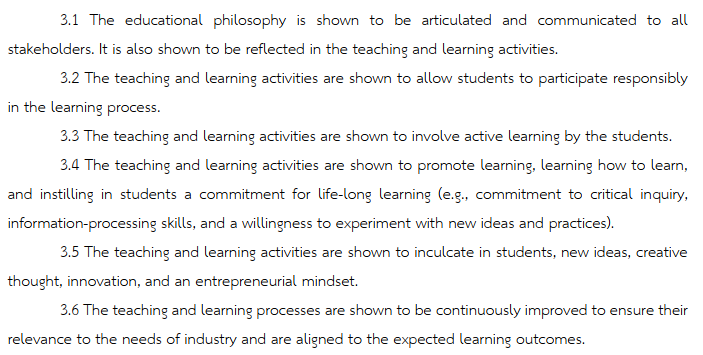
3.1 The educational philosophy is shown to be articulated and communicated to all stakeholders. It is also shown to be reflected in the teaching and learning activities.
Operational Result
The Bachelor of Accountancy (B.Acc.) Programme at St. Teresa International University (TRSU) articulates a clear educational philosophy that emphasizes the holistic development of students into competent, ethical, and adaptable accounting professionals. This philosophy is consistently communicated to all stakeholders: faculty, students, administrative staff, alumni, employers, and external partners and is deeply embedded in teaching and learning activities across the programme.
Articulation of Educational Philosophy
The programme’s philosophy is grounded in three core pillars:
1. Professional Competence: equipping students with technical expertise, analytical skills, and problem-solving abilities required in the accounting profession.
2. Ethical Responsibility: instilling integrity, accountability, and social responsibility to ensure graduates uphold professional and societal trust.
3. Lifelong Learning and Adaptability: fostering critical thinking, digital literacy, and continuous professional development to prepare graduates for evolving global business environments.
.
This philosophy is formally documented in programme handbooks, institutional policies, and accreditation reports, and is disseminated through:
- Orientation sessions for new students
- Faculty development workshops
- Advisory board meetings with industry partners
- TRSU website and programme brochures
Communication to Stakeholders
The philosophy is communicated through structured channels to ensure shared understanding:
Students: Orientation, mentoring, and academic advising sessions emphasize the philosophy and its link to Expected Learning Outcomes (ELOs).
Faculty: Training workshops and curriculum mapping exercises ensure teaching staff align their pedagogy with programme objectives.
External Stakeholders: Employers, alumni, and professional bodies are engaged through consultations, internships, and cooperative education programmes, reinforcing the philosophy’s relevance to industry needs.
Reflection in Teaching and Learning Activities
Teaching and learning activities are intentionally designed to embody the philosophy:
- Experiential Learning: Case studies, simulations, internships, and industry projects integrate theory with practice.
- Ethics and Professionalism: Courses embed ethical decision-making frameworks and professional standards.
- Interdisciplinary Integration: General education courses (e.g., communication, IT, economics) are aligned with programme outcomes to strengthen transferable skills.
- Outcome-Based Education (OBE): All courses are mapped to PLOs, YLOs, and ELOs, ensuring coherence and targeted delivery.
Faculty across departments are briefed on the programme’s philosophy, ensuring that general education courses contribute meaningfully to the holistic development of accounting students.
Monitoring and Continuous Improvement
The alignment of philosophy with teaching and learning is systematically monitored through:
- Curriculum mapping and review exercises
- Outcome-based assessments
- Student feedback and peer evaluations
- Employer and alumni surveys
- External benchmarking against international accounting programmes
These mechanisms ensure that the philosophy remains current, relevant, and effective in achieving graduate attributes and professional standards.
Faculty of Business self-assessment report EdPEx based Program self-assessment reportAUN QA based Bachelor of Business Administration program (BBA) Bachelor of Business Administration in Airline business program (BBAB) Bachelor of Accountancy program (BACC) Bachelor of Science in Aeronautics program (BSAR) Bachelor of Science in Air Traffic Control program (BSATC) Master of Business Administration program (MBA)
Educational Philosophy-to-Practice Mapping Table
| Philosophy Pillar | Curriculum Components | Teaching & Learning Methods | Assessment Strategies | Evidence of Effectiveness |
|---|---|---|---|---|
| Professional Competence | Core Accounting Courses (Accounting Principles, Intermediate Accounting, Auditing, Advanced Accounting, Strategic Financial Management) | Lectures, tutorials, case studies, accounting software training, industry projects | Written exams (midterm and Final), problem-solving assignments, project reports, internship evaluations | Student performance data, Professional Exam readiness, employer satisfaction surveys |
| Ethical Responsibility | Business Law, Auditing, Corporate Governance, Ethics in Accounting. | Ethical case studies, debates, role-play scenarios, and guest lectures from other program | Reflective essays, ethical decision-making projects, peer evaluations | Graduate tracer studies, employer feedback on integrity and professionalism |
| Lifelong Learning & Adaptability | General Education Courses, Capstone Projects, Electives, Internships & Cooperative Education | Project-based learning, Case study, business simulations, independent study. | Portfolio assessments, capstone evaluations | Alumni surveys, evidence of career progression, adaptability in diverse roles |
| Critical Thinking & Analytical Skills | Statistics, Economics, Cost Accounting, Taxation, Strategic Management | Problem-based learning, group projects, analytical exercises, simulations | Data analysis reports, case study evaluations, oral presentations | Student feedback, industry partner evaluations |
| Integration of Theory & Practice | Internship, Cooperative Education, Capstone & Integrative Learning Experiences | Field trips, seminars, applied projects, accounting software applications (QuickBooks, Tally, Wave app) | Internship reports, capstone project defense, | Internship assessments, employer surveys, graduate employment rates |
The Bachelor of Accountancy Programme at TRSU demonstrates a well-articulated, widely communicated, and effectively implemented educational philosophy. This philosophy is not only embedded in teaching and learning activities but also continuously reviewed to ensure alignment with AUN-QA standards, international best practices, and the evolving demands of the accounting profession.
Evidence
| ID_Evidence | Name_Evidence |
| 3.1.1 | University Website |
| 3.1.2 | Handbook |
| 3.1.3 | Brochure |
| 3.1.4 | Curriculum mapping |
| 3.1.5 | Intensive English Program Orientation |
| 3.1.6 | General Orientation |
| 3.1.7 | Annual Personnel Meeting |
| …………………………………….. | employer satisfaction surveys |
3.2 The teaching and learning activities are shown to allow students to participate responsibly in the learning process.
Operational Result
The Bachelor of Accountancy (B.Acc) program at TRSU provides multiple opportunities for students to actively and responsibly engage in the learning process. This is evidenced through consistent student participation in structured academic tasks and assessments managed via the institution’s digital learning platform, Google Classroom.
Student Participation in Learning Design
At the beginning of each course, instructors communicate:
- Course Learning Outcomes (CLOs);
- Teaching and learning activities;
- Assessment methods and grading criteria;
- Learning expectations and responsibilities;
- Course schedules and assignments.
Students are encouraged to discuss learning expectations and clarify course requirements, enabling them to take an active role in planning and managing their learning.
Active Learning Strategies
The programme employs a variety of student-centered learning strategies, including:
Case-Based Learning
Students analyze real business and accounting cases, identify problems, and propose solutions based on accounting principles and professional standards.
Problem-Based Learning
Students work individually and collaboratively to solve practical accounting and business problems that require analytical and critical thinking.
Project-Based Learning
Students undertake individual and group projects that require research, planning, communication, and presentation skills.
Collaborative Learning
Group assignments and team activities encourage students to work responsibly with others, share knowledge, and develop leadership and interpersonal skills.
Experiential Learning
Internships, field visits, and practical exercises provide opportunities for students to apply classroom knowledge in real-world settings and assume professional responsibilities.
These assignments and tests require students to:
- Comprehend theoretical concepts.
- Apply accounting knowledge to practical questions.
- Manage their time for task completion and submission.
- Reflect on feedback provided via the platform.
Use of Technology to Support Active Participation
The TRSU B.Acc programme integrates digital technologies and online learning platforms to enhance student engagement, including:
- Learning Management System (LMS);
- Online discussions and forums via Google Classrooms, Ms. Teams, Line application,
- Digital learning materials: Trsu E-Library,
- Accounting software applications: QuickBooks and Tally ERP.
- Collaborative online assignments.
Technology-supported learning enables students to access TRSU learning resources, collaborate with peers, and take greater responsibility for their learning.
Overall, the B.Acc. program effectively nurtures a learner-centered environment, where students are not passive recipients but active participants, consistently demonstrating their roles and responsibilities in achieving academic success.
Evidence
| ID_Evidence | Name_Evidence |
| 3.2.1 | Google Classrooms, |
| 3.2.2 | TRSU LMS |
| 3.2.3 | Line application |
| 3.2.4 | TRSU E-Library |
| 3.2.5 | Accounting software applications |
3.3 The teaching and learning activities are shown to involve active learning by the students.
Operational Result
The Bachelor of Accountancy (B.Acc) program at TRSU actively promotes responsible student participation in the learning process through a combination of pedagogical strategies, digital platforms, and responsive teaching practices. The department’s faculty members consistently encourage students to engage with learning materials prior to class, participate during sessions, and collaborate with peers, thereby fostering a deeper understanding of accounting concepts and their practical application.
Students are expected to study materials in advance, facilitated by early access to course presentations and assignments via Google Classroom. This promotes active preparation, enabling students to contribute meaningfully during class discussions and to introduce new perspectives that enrich peer learning. Teachers monitor participation closely, using in-class observation and contributions to evaluate both individual and group engagement. This process also supports the development of communication skills and peer-to-peer learning.
Assignments and tests are distributed and submitted digitally, allowing students to manage their deadlines, receive prompt feedback, and reflect on areas for improvement. Teachers regularly acknowledge student efforts and provide constructive input to guide students in developing their analytical, creative, and problem-solving skills.
Further enhancing the interactive learning environment, teachers gather feedback from students through surveys, informal conversations, and structured course evaluations (as part of TQF5). These inputs allow faculty members to better understand students’ experiences and continuously refine their teaching methods to meet learners’ needs.
The department’s approach reflects a commitment to student-centered education, ensuring that students are not only recipients of knowledge but active participants in their educational journey. Through structured support, clear expectations, and regular feedback, students develop a strong sense of ownership over their learning, aligned with the intended learning outcomes (ELOs) of the program.
Evidence
| ID_Evidence | Name_Evidence |
| 3.3.1 | Study Tours |
| 3.3.2 | Sample TQF 3 |
| 3.3.3 | Sample TQF 5 |
3.4 The teaching and learning activities are shown to promote learning, learning how to learn, and instilling in students a commitment for life-long learning (e.g., commitment to critical inquiry, information-processing skills, and a willingness to experiment with new ideas and practices).
Operational Result
The Bachelor of Accountancy program at TRSU is deeply committed to nurturing students into independent, self-directed learners and future-ready professionals. Faculty members adopt a multifaceted approach to support students both inside and outside the classroom, with the long-term goal of instilling a mindset of lifelong learning.
Recognizing the ever-evolving nature of accounting—driven by emerging regulations, technologies, and industry practices—the program emphasizes continuous learning as an essential professional competency. Students are encouraged to embrace critical inquiry and intellectual curiosity. Teaching methods foster a questioning attitude and deeper comprehension of core accounting principles, thus laying the foundation for ongoing academic and professional growth.
Educators actively cultivate innovation and critical thinking in their classrooms. By exposing students to diverse perspectives and challenging assumptions, faculty empower learners to develop independent opinions and creative problem-solving abilities. These skills are essential for success in dynamic business environments and are strongly aligned with 21st-century learning competencies.
The program promotes self-directed learning by giving students responsibility over their education. Assignments uploaded via Google Classroom, such as the Chapter 2 activity on monetary and non-monetary items, are designed to prompt critical thought and application of knowledge. Students who take initiative in reviewing learning materials before class, completing work independently, and seeking instructor feedback are consistently acknowledged for their efforts.
Independent study and research activities are another core component. Students are regularly tasked with exploring specific areas of accounting through case studies, literature reviews, and practical exercises. These activities not only strengthen their research capabilities but also teach them to identify knowledge gaps, interpret data, and contribute meaningfully to the accounting field.
Technology-enhanced learning is central to the program. The use of Google Classroom allows for early access to resources, timely assignment submission, and constructive feedback. Furthermore, the curriculum incorporates professional development opportunities such as seminars, guest lectures, and workshops. These engagements expose students to current industry practices, technological innovations, and real-world applications, ensuring they remain updated and adaptable.
In summary, the program’s holistic learning design encourages students to take ownership of their academic journey, develop independent learning habits, and remain professionally competent well beyond graduation. These strategies position graduates as agile, critical thinkers capable of lifelong contribution to the field of accountancy.
Evidence
| ID_Evidence | Name_Evidence |
| 3.4.1 | Sample Exam Paper |
| 3.4.2 | Morals and Ethics/Team Building |
3.5 The teaching and learning activities are shown to inculcate in students new ideas, creative thought, innovation, and an entrepreneurial mindset.
Operational Result
In the Bachelor of Accountancy program, teaching and learning activities are intentionally designed not only to strengthen students’ accounting knowledge but also to cultivate an entrepreneurial mindset. Students actively participated in national competitions like the Thailand National Accounting Competition organized by TFAC. These activities simulate real-world business challenges, encouraging students to analyze complex situations, evaluate alternatives, and develop innovative solutions—skills essential to entrepreneurship.
These methods are well aligned with the course learning outcomes, particularly in developing higher-order thinking skills and 21st-century competencies. As evidenced by employer satisfaction scores (average 4.20 out of 5 across all indicators), graduates are perceived to demonstrate strong competencies in the five domains of learning outcomes under TQF, including critical thinking and problem-solving, core components of entrepreneurial capacity.
Assessment of entrepreneurial mindset development is embedded in the evaluation of case presentations, peer-reviewed projects, and reflective assignments, which measure creativity, initiative, and independent thinking. Additionally, student-led activities such as tax education campaigns, where students applied their knowledge of Thai taxation to raise public awareness, further demonstrate the program’s success in motivating students to apply knowledge creatively and act autonomously.
Evidence
| ID_Evidence | Name_Evidence |
| 3.5.1 | Curriculum and Course Design |
| 3.5.2 | Participation in Thailand National Accounting challenge |
3.6 The teaching and learning processes are shown to be continuously improved to ensure their relevance to the needs of industry and are aligned to the expected learning outcomes.
Operational Result
The teaching and learning approach in the Bachelor of Accountancy programme is systematically evaluated through a combination of student assessments, assignment grading, and performance tracking on platforms such as Google Classroom. Each learning activity, including class tests and assignments, is assessed individually, with scores reflecting both content mastery and application skills. For example, in the case study titled “Financial Reporting under Inflation: Identifying Monetary and Non-Monetary Assets and Liabilities,” students demonstrated a strong understanding of accounting concepts related to price-level changes, with individual scores such as 9/10 indicating high engagement and comprehension.
Evaluation procedures incorporate regular formative assessments, including class tests and assignments, alongside summative feedback mechanisms through which instructors analyse both individual and class-level performance. The insights gained from these assessments inform instructional improvements and identify areas requiring further reinforcement. The continuous monitoring of class averages and student achievement (e.g., Test 2 average = 4.25/5; Chapter 1 average = 8.25/10) also provides valuable feedback on teaching effectiveness.
To promote continuous improvement, the curriculum integrates real-world problem-solving through practical exercises and case-based discussions. Students further apply their knowledge during internships, where theoretical concepts are tested in actual industry settings. This cycle of classroom instruction, practical application, and reflective evaluation ensures that teaching strategies remain aligned with industry expectations and programme learning outcomes. The successful employment of graduates in accounting and audit firms further validates the effectiveness of the programme’s pedagogy, demonstrating that the curriculum equips students with both the academic foundation and practical competencies required for professional success in the accounting field.
Graduate employment in accounting and audit firms further validates the effectiveness of our pedagogy. The curriculum’s alignment with professional standards ensures that our graduates possess both the academic foundation and the applied skills necessary for success in the accounting sector.
Evidence
| ID_Evidence | Name_Evidence |
| 3.6.1 | TQF 2 |
| 3.6.2 | Sample TQF 3 |
| 3.6.3 | Sample TQF 5 |
| 3.6.4 | Sample Exam paper review |
| 3.6.5 | Stakeholders’ Feedback |
Self-Assessment
| Requirements | Result | Score |
| 3.1 The educational philosophy is shown to be articulated and communicated to all stakeholders. It is also shown to be reflected in the teaching and learning activities. | / | 1 |
| 3.2 The teaching and learning activities are shown to allow students to participate responsibly in the learning process. | / | 1 |
| 3.3 The teaching and learning activities are shown to involve active learning by the students. | / | |
| 3.4 The teaching and learning activities are shown to promote learning, learning how to learn, and instilling in students a commitment for life-long learning. | / | 1 |
| 3.5 The teaching and learning activities are shown to inculcate in students, new ideas, creative thought, innovation, and an entrepreneurial mindset. | / | 1 |
| 3.6 The teaching and learning processes are shown to be continuously improved to ensure their relevance to the needs of industry and are aligned to the expected learning outcomes. | / | 1 |
| Overall | 5 | |