Criterion 6 – Student Support Services
Criterion
Requirements
Quality level assessment

Result
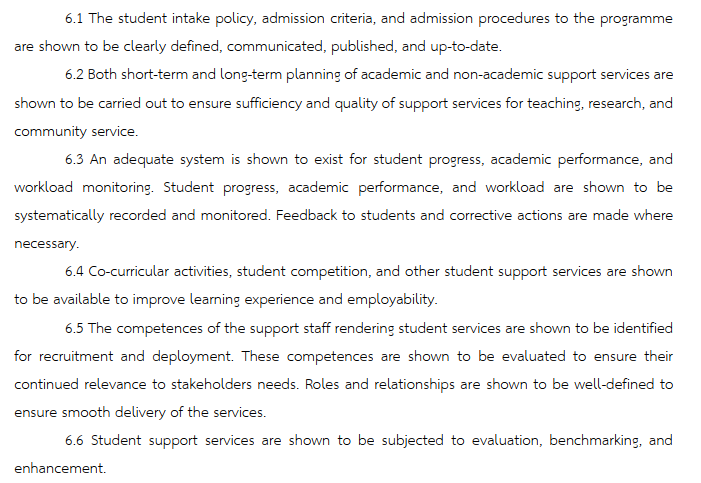
6.1 The student intake policy, admission criteria, and admission procedures to the programme are shown to be clearly defined, communicated, published, and up-to-date.
Operational Result
Student Intake Policy
The Bachelor of Accountancy (BACC) Programme adheres to the student admission policies and regulations established by the Ministry of Higher Education, Science, Research and Innovation (MHESI) and Thaksin University (TRSU). The student intake policy is designed to ensure transparency, fairness, equal opportunity, and the recruitment of qualified applicants who demonstrate the potential to successfully complete the programme and achieve the intended learning outcomes.
The programme annually determines its student intake in accordance with the approved curriculum specifications outlined in the Thailand Qualifications Framework (TQF2), institutional capacity, and national higher education regulations. Information regarding admission policies, eligibility requirements, application procedures, and selection criteria is communicated through official university channels and is regularly reviewed to ensure currency and compliance with regulatory requirements.
Admission Criteria
The admission criteria for the Bachelor of Accountancy Programme are clearly defined and aligned with the regulations of TRSU and MHESI. The programme establishes admission requirements to ensure that applicants possess the academic background and personal attributes necessary for successful participation in accounting education.
The admission process includes the following key criteria:
- The programme determines the annual student admission plan in accordance with the approved curriculum specifications (TQF2).
- The programme specifies the qualifications required of prospective students and communicates these requirements to the faculty and relevant university offices.
- The programme establishes student selection criteria, including academic qualifications, English language proficiency requirements (where applicable), and other relevant competencies.
- Eligible applicants must have successfully completed upper secondary education (M.6) or an equivalent qualification recognized by the Ministry of Education.
- Applicants are expected to demonstrate satisfactory academic performance and possess appropriate physical and mental health conditions that enable effective participation in higher education studies.
- Student selection is conducted according to the established admission criteria and institutional regulations.
- Successful applicants are formally announced through official university communication channels.
- The programme regularly reviews and evaluates the effectiveness of admission procedures and implements improvements to ensure that student intake aligns with programme objectives and enrolment targets specified in TQF2.
Admission Procedures
The admission procedures are systematically implemented to ensure consistency, transparency, and fairness throughout the recruitment and selection process.
Applicants are required to submit a completed application form together with supporting documents, including academic transcripts and identification documents (National Identification Card for Thai applicants or Passport for international applicants), to the University’s Registration Office for verification.
Following document verification, eligible applicants may be invited to participate in interviews designed to assess their motivation, discipline, communication skills, and professional attitudes relevant to the accounting profession. Upon successful completion of the evaluation process, qualified applicants are offered admission to the programme and subsequently complete the enrolment and registration process as university students.
Assessment of the Process
The Programme Committee reviewed the effectiveness of the admission process and identified opportunities to enhance prospective students’ understanding of the programme. It was recommended that academic staff provide comprehensive information regarding programme facilities, learning resources, laboratories, and student support services during admission-related visits and recruitment activities.
Improvements and Development
In response to the Programme Committee’s recommendations, the Head of the Department was assigned to collaborate with the University’s Marketing and Student Recruitment Unit to strengthen promotional activities and provide prospective students with more comprehensive information about the Bachelor of Accountancy Programme, its learning environment, facilities, and career opportunities. This initiative aims to improve student recruitment effectiveness and support informed decision-making among prospective applicants.students accepted for the program is governed by the regulations of MHESI.
- The curriculum or program determines the student admission plan according to the TQF 2.
- The curriculum or program determines the qualifications of students and notifies the faculty/college.
- The curriculum or program specifies the criteria used for student selection which consists of academic criteria, English language requirements (if any) and other areas and notifies the faculty/college.
- The curriculum or program in co-operations with the faculty and the college proceeds with the announcement of student applications.
- The curriculum or program examines students’ qualifications. Applicants must have successfully completed high school (M.6) or equivalent majoring with a CGPA greater than or equal to 3. Applicants should be able to demonstrate excellent mental and physical health.
- The curriculum or program selects students.
- The curriculum or program announces selected students.
- The curriculum or program evaluates student admissions procedures and analyzes the problems and set up improvements to ensure the number of students in accordance with the TQF2.
- Students report and register to be college students.
Admission Procedures:
- The completed application form need to submit to the registration office along with the transcript, National ID for Thai and Passport of International students for verification purpose.
- The applicant’s qualification has to be verified by the college and they will call for face-to-face interviews to identify the applicant’s discipline and professional attitude. After all these processes, qualified applicants are admitted into the program.
Assessment of the Process:
The program committee suggested to assign a lecturer to demonstrate and explain the infrastructure facilities in the BACC program to the students who visit the institution regarding admission.
Improvements/Development:
As per the decision made by the program committee, Our Head of the Department was assigned to coordinate with the marketing team to support student admission.
Evidence
| ID_Evidence | Name_Evidence |
| 6.1.1 | Brochure |
| 6.1.2 | Program and University website |
| 6.1.3 | Admission system and mechanism |
| 6.1.4 | Admission Guidelines |
| 6.1.5 | International Marketing |
| 6.1.6 | Social Media Advertisement |
| 6.1.7 | Testimonials from the graduates |
6.2 Both short-term and long-term planning of academic and non-academic support services are shown to be carried out to ensure sufficiency and quality of support services for teaching, research, and community service.
Operational Result
The Bachelor of Accountancy program at TRSU demonstrates a systematic and forward-looking approach in planning and providing both academic and non-academic support services to ensure quality in teaching, research, and community engagement. These support services are strategically designed and implemented from the point of student admission to graduation.
Short-Term Planning and Implementation:
Upon enrollment, students are immediately given access to a comprehensive suite of academic and administrative support services. These include:
- Academic Assistance through orientation sessions, academic advising, and access to faculty consultation hours.
- Technological Infrastructure such as access to fully equipped computer labs, Wi-Fi-enabled classrooms, smart projectors, and visualizers for diversified teaching strategies.
- Learning Facilities including a computer suite, universal-conference rooms, and air-conditioned lecture halls equipped with modern instructional tools such as LCD projectors, whiteboards, and flipcharts.
- Digital Services like e-learning platforms, e-registration, e-assessment systems, and the Management Information System (MIS) to streamline administrative and academic operations.
- Library Services which offer textbooks, academic journals, research databases, digital archives, and private study rooms to support academic inquiry and research.
Long-Term Planning and Infrastructure Development:
The Faculty has adopted a continuous improvement strategy to enhance its support services infrastructure in line with evolving academic needs and student expectations. This includes:
- Upgrading Classrooms and Tools: Ongoing investments in air conditioning units, interactive smart TVs, and better teaching aids to improve classroom environments.
- Campus Development: Facilities such as student dormitories, athletic fields (football, badminton, volleyball), a swimming pool, food centers, wellness services, and banking support (e.g., KTB ATM) are being gradually expanded and modernized.
- Sustainability and Inclusivity Projects: Aesthetic features like a man-made pond with student-operated duck boats and green open spaces are included in long-term campus development plans to promote well-being and environmental consciousness.
Support for Holistic Student Development:
The Faculty, in collaboration with the Office of Student Affairs, implements co-curricular and extracurricular programs designed to promote leadership, communication, and intercultural competence. These include:
- Workshops and Seminars
- Leadership and Community Engagement Projects
- Cultural and Sports Events
- Wellness and Counseling Services
These initiatives are structured with both immediate student needs and long-term developmental goals in mind. Regular assessment and feedback mechanisms are in place to monitor service effectiveness and to make data-informed improvements annually.
Evidence
| ID_Evidence | Name_Evidence |
| 6.2.1 | General orientation |
| 6.2.2 | Summer Intensive English Program |
| 6.2.3 | Dorm Night |
| 6.2.4 | Fitness and Sports Area |
| 6.2.5 | Library Conference |
| 6.2.6 | Computer rooms |
| 6.2.7 | Moodle for TOEIC Practices |
| 6.2.8 | Faculty and Staff Development Plan |
| 6.2.9 | Digital Library Link |
| 6.2.10 | Library Facilities |
| 6.2.11 | Management Information System |
6.3 An adequate system is shown to exist for student progress, academic performance, and workload monitoring. Student progress, academic performance, and workload are shown to be systematically recorded and monitored. Feedback to students and corrective actions are made where necessary.
Operational Result
The Bachelor of Accountancy program at TRSU maintains a robust and systematic mechanism to monitor student academic progress, performance, and workload through the institution’s Management Information System (MIS). This digital platform enables real-time tracking and evaluation of each student’s academic journey, providing a data-driven foundation for personalized academic support and timely intervention.
Systematic Monitoring via MIS:
Each student is assigned a secure login (Username and Password) to access the MIS platform, which stores:
- Course registration details and credit load
- Semester-wise academic performance
- Attendance records
- Cumulative academic progress
The Faculty of Business Administration’s Academic Committee regularly reviews aggregated MIS data to identify patterns of academic risk and performance trends across the student population. Faculty academic advisors are also granted controlled access to the system, allowing them to:
- Monitor individual student workloads
- Track credit accumulation and GPA trends
- Enter and review notes on specific learning or personal challenges
- Generate student progress reports and summaries
Role of Academic Advisors:
Academic advising is a cornerstone of the student support system, with each faculty advisor mentoring approximately 10–15 students. Advisors play a vital role not only in academic planning but also in holistic student development. Their responsibilities include:
- Guiding course selection and scheduling
- Advising on credit loads to ensure manageable workload distribution
- Supporting goal setting and career planning
- Clarifying institutional and academic policies
- Addressing academic difficulties and recommending support measures
- Referring students to specialized resources when needed (e.g., counseling, learning support)
The advising system operates through structured documentation that includes:
- Individual Student Problem Record
- Student Academic Performance Record
- Advisor Summary Reports
These tools ensure consistency in monitoring and facilitate early identification of at-risk students, enabling timely feedback and corrective measures such as academic counseling, revision of workload, or referral to student support services.
Feedback and Corrective Action:
Feedback to students is given through multiple channels:
- One-on-one advisor meetings
- Written academic performance reports
- Course instructor feedback via MIS or direct communication
Corrective actions may include revising a student’s academic plan, reducing credit load, assigning academic remediation tasks, or involving parents (if necessary).
Continuous Improvement:
The advising system also functions as a two-way communication channel, encouraging students to engage in meaningful academic discussions and express concerns. Advisors assist students in aligning their personal, moral, and professional goals with academic expectations, thus enriching their college experience.
This structured and proactive approach ensures that academic progress, performance, and workload are not only systematically monitored, but also effectively managed, with built-in mechanisms for intervention and student success.
Evidence
6.4 Co-curricular activities, student competition, and other student support services are shown to be available to improve learning experience and employability.
Operational Result
The Bachelor of Accountancy program at TRSU integrates a comprehensive system of co-curricular activities, student competitions, and personalized support services to enrich the student learning experience and boost employability. These activities are designed to align with the Program Learning Outcomes (PLOs) and national education standards, while also preparing graduates to thrive in the 21st-century global economy.
Advisor-Advisee System for Developmental Guidance:
Each student is assigned an academic advisor from enrollment to graduation at a consistent advisor-to-advisee ratio of 1:10–15. The advisor provides continuous academic, personal, and career guidance, supporting students in achieving program goals and addressing challenges. This mentorship model ensures students are encouraged to actively engage in co-curricular learning opportunities and professional development pathways.
Co-Curricular Integration to Foster Employability:
The program emphasizes holistic student development through structured co-curricular activities that reflect TRSU’s commitment to producing socially responsible, skilled, and employable graduates. These activities aim to instill:
- Civic responsibility and community service
- Ethical and moral reasoning
- Digital and communication literacy
- Leadership and teamwork
- Global and cultural competence
Participation in co-curricular programs is mandatory for graduation, with students required to complete a minimum of 100 hours, divided into:
- 40 hours of core (obligatory) activities, and
- 60 hours of elective activities aligned with individual interests and career goals.
Evidence
| ID_Evidence | Name_Evidence |
| 6.3.1 | International Day |
| 6.3.2 | Loy Krathong |
| 6.3.3 | Songkran |
| 6.3.4 | Wai Khru |
| 6.3.5 | Sports Day |
| 6.3.6 | Employment Status of Accounting Graduates |
6.5 The competences of the support staff rendering student services are shown to be identified for recruitment and deployment. These competences are shown to be evaluated to ensure their continued relevance to stakeholders needs. Roles and relationships are shown to be well-defined to ensure smooth delivery of the services.
Operational Result
The Bachelor of Accountancy program at TRSU ensures the delivery of efficient and student-centered services through the recruitment, development, and evaluation of qualified support staff. The college adopts a competency-based framework to guide recruitment, deployment, and performance evaluation, ensuring that support personnel effectively meet academic and non-academic student needs.
Competency Identification and Recruitment:
All support staff are hired based on clearly defined qualifications and job-specific competencies, which are aligned with the expectations of students, faculty, and institutional standards. The recruitment process includes:
- Job description alignment with departmental needs
- Screening for technical and interpersonal skills
- Interviews assessing service orientation, communication, and problem-solving abilities
The Human Resources Department, in collaboration with the Dean and Department Heads, defines core and functional competencies required for each role, ensuring relevance to evolving stakeholder needs.
Orientation, Training, and Deployment:
Upon hiring, new staff undergo an induction program led by the HR Office, Dean, and academic leadership. This training covers:
- Institutional policies and code of conduct
- Student service standards and expectations
- Departmental processes and communication protocols
- Tools and technologies necessary for service delivery
Support staff are deployed according to their area of specialization and trained to provide prompt, courteous, and efficient service to students.
erformance Monitoring and Continuous Improvement:
The performance of support staff is systematically evaluated through:
- Annual performance appraisals conducted by the HR Department and relevant supervisors
- Student satisfaction feedback surveys
- Peer reviews and supervisor observations
The goal is to ensure continuous improvement and identify opportunities for skill development, re-training, or reassignment as needed. High-performing staff are recognized and encouraged through professional development incentives.
Defined Roles and Responsibilities:
Roles and relationships of support staff are clearly documented and communicated to ensure smooth coordination and accountability across departments. Key roles include:
- Program Secretary (BBA Office): Coordinates academic-industry linkages for study visits, manages documentation and approvals, and follows through until project completion.
- Registrar’s Office: Manages academic calendars, communicates key deadlines such as exam schedules and enrollment periods, and supports students in academic record-keeping and registration processes.
- Librarians: Professionally trained in information science, they assist students in accessing digital and physical resources, manage research support tools, and provide guidance on academic referencing and citation tools.
- Student Affairs Staff: Facilitate co-curricular and community service programs, uphold student discipline, and support moral and ethical development activities. They act as a liaison between students and administration for welfare-related concerns.
- IT and Facilities Support Staff: Provide technical assistance during academic competitions and events, maintain campus technology infrastructure, and support students in resolving electrical or electronic equipment issues in labs, auditoriums, and classrooms.
- Stakeholder-Centered Approach:
- Support staff are encouraged to engage directly with students and faculty to understand service expectations. Periodic training and workshops ensure their skills remain current and aligned with student needs and institutional goals.
Evidence
| ID_Evidence | Name_Evidence |
| 6.5.1 | Credentials of support staff |
| 6.5.2 | Satisfaction of Students |
| 6.5.3 | Staff Development Plan |
| 6.5.4 | Student Support Satisfaction |
| 6.5.5 | Benchmarking and Continuous Improvement on Student Support Services |
6.6 Student support services are shown to be subjected to evaluation, benchmarking, and enhancement.
Operational Result
The Bachelor of Accountancy program at TRSU is committed to delivering student-centered support services that are regularly evaluated and enhanced to meet the evolving expectations of students and align with national and international quality standards.
Evaluation Mechanisms:
The Faculty recognizes the importance of evidence-based service delivery and employs multiple methods to evaluate the effectiveness and relevance of student support services. These include:
- Annual student satisfaction surveys
- Focus group discussions with students and staff
- Structured interviews with stakeholders
- Observation reports and suggestion boxes
- Advisor and committee feedback channels
Evaluation tools are designed to assess not only satisfaction but also usability, accessibility, and responsiveness of support services across academic, administrative, and welfare domains.
Benchmarking Against Standards:
The department systematically benchmarks its support services against:
- Ministry of Higher Education, Science, Research and Innovation (MHESI) quality indicators
- National and institutional student service standards
- Best practices from peer institutions, particularly those with high graduate employability outcomes
These benchmarks help assess service adequacy, identify performance gaps, and establish strategic improvement targets.
Continuous Improvement through Data Analysis:
Insights gained from feedback and benchmarking are analyzed to guide policy adjustments, resource allocation, and new initiative planning. Key focus areas include:
- Improving digital services and internet infrastructure
- Enhancing dormitory conditions and student safety
- Strengthening career support and advisory mechanisms
- Upgrading physical facilities and cleanliness
- Enhancing the responsiveness of academic and administrative services
Recent Student Satisfaction Survey Results:
A comprehensive student satisfaction survey using a 5-point Likert scale was conducted. The summary below reflects key findings across several service domains:Evidence
ese results have prompted targeted enhancements, including:
- Expanding first aid training and facilities
- Renovating dormitory kitchens and common rooms
- Introducing new library orientation sessions
- Improving waste management and sustainability education
- Adding digital information kiosks and enhancing real-time updates
Commitment to Quality and Responsiveness:
The department fosters a culture of continuous quality improvement, where student voice is central to service refinement. Evaluation results are regularly reported to faculty leadership and used to:
- Set service improvement KPIs
- Plan professional development for support staff
- Introduce pilot programs and digital innovations
This structured process ensures that student support services remain relevant, high-quality, and responsive to current and future stakeholder needs.
| ID_Evidence | Name_Evidence |
| 6.6.1 | Student Support Satisfaction |
| 6.6.2 | Benchmarking and Continuous Improvement on Student Support Services |
Self-Assessment
| Requirements | Result | Score |
| 6.1 The student intake policy, admission criteria, and admission procedures to the programme are shown to be clearly defined, communicated, published, and up-to-date. | / | 1 |
| 6.2 Both short-term and long-term planning of academic and non-academic support services are shown to be carried out to ensure sufficiency and quality of support services for teaching, research, and community service. | / | 1 |
| 6.4 Co-curricular activities, student competition, and other student support services are shown to be available to improve learning experience and employability. | / | |
| 6.3 An adequate system is shown to exist for student progress, academic performance, and workload monitoring. Student progress, academic performance, and workload are shown to be systematically recorded and monitored. Feedback to students and corrective actions are made where necessary. | / | 1 |
| 6.5 The competences of the support staff rendering student services are shown to be identified for recruitment and deployment. These competences are shown to be evaluated to ensure their continued relevance to stakeholders needs. Roles and relationships are shown to be well-defined to ensure smooth delivery of the services. | / | 1 |
| 6.6 Student support services are shown to be subjected to evaluation, benchmarking, and enhancement. | / | 1 |
| Overall | 5 | |