Criterion 8 – Output and Outcomes
Criterion
Requirements
Quality level assessment

Result
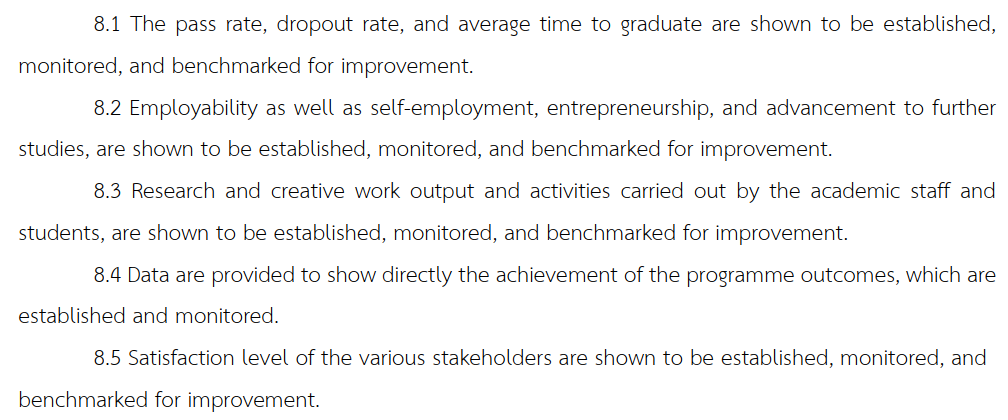
8.1 The pass rate, dropout rate, and average time to graduate are shown to be established, monitored, and benchmarked for improvement.
Operational Result
The Bachelor of Accountancy program at TRSU has established a systematic framework for monitoring and evaluating key student performance indicators, including the pass rate, dropout rate, and average time to graduate, as measures of program effectiveness and student success. Data are regularly collected and analyzed through institutional academic information systems and reviewed by the program committee to assess trends, identify areas for improvement, and support evidence-based decision-making. The program further benchmarks these indicators against institutional targets, historical performance data, and relevant comparable programs to ensure continuous quality enhancement. Findings from the monitoring and benchmarking processes are utilized to implement appropriate academic and student support interventions aimed at improving retention, academic achievement, and timely graduation.
Tracking of Enrollment and Student Progression
The program collects and analyzes longitudinal data on student cohorts from admission to graduation. The table below summarizes student enrollment and progression trends over recent academic years:
| Year of Admission | No. of Students Enrolled | Intensive Enrollment | Year 1 | Year 2 | Year 3 | Year 4 | No. of Graduates |
| 2018 | |||||||
| 2019 | |||||||
| 2020 | |||||||
| 2021 | |||||||
| 2022 | 9 | 3 | 3 | 3 | – | – | — |
| 2023 | 12 | 6 | 3 | 3 | – | – | — |
| 2024 | 26 | 8 | 6 | – | – | – | — |
| 2025 | 0 | 0 | |||||
| 2026 | 3 | 3 | |||||
| Total | 113 | 49 | 36 | 25 | 16 | 14 | 14 |
Discrepancies in progression and graduation rates are analyzed to determine contributing factors such as academic preparedness, student support effectiveness, and industry engagement.
Evidence
The Academic Committee conducts an annual review of these statistics, comparing them against institutional benchmarks and national averages for similar programs.
Discrepancies in progression and graduation rates are analyzed to determine contributing factors such as academic preparedness, student support effectiveness, and industry engagement.
Improvement Measures Implemented:
In response to the high dropout rate and fluctuating enrollment:
- A faculty member was designated to coordinate with the marketing and admissions team to better communicate program benefits and career pathways.
- A structured student orientation and academic advising program was introduced to support early engagement and career alignment.
- The program committee developed career guidance seminars, particularly focusing on accounting and finance industries, to enhance motivation and help students connect academic learning to real-world opportunities.
- Internship and core industry alignment efforts were improved to increase student commitment and employment prospects.
These initiatives are already showing early signs of improved student retention and engagement in newer cohorts.
Ongoing Monitoring:
The program maintains a continuous quality improvement loop by:
- Regularly collecting and reviewing student progression data
- Adjusting academic and non-academic support systems
- Benchmarking against peer institutions
- Setting internal targets for enrollment, retention, and completion
This comprehensive approach ensures that student success indicators remain a central part of program management and institutional accountability.
| ID_Evidence | Name_Evidence |
| 8.1.1 | Accounting Admission and Graduate |
| 8.1.2 | Advisory System |
| 8.1.3 | Retention and Improvement Interventions |
8.2 Employability as well as self-employment, entrepreneurship, and advancement to further studies, are shown to be established, monitored, and benchmarked for improvement.
Operational Result
The Bachelor of Accountancy (B.Acc.) program at TRSU is committed to preparing students not only for employment in the accounting profession, but also for entrepreneurship, self-employment, and further academic advancement. The program implements a well-defined system to monitor, benchmark, and improve graduate outcomes in alignment with its mission and strategic goals.
Established Mechanisms for Monitoring Employability
The program maintains a graduate tracking system to collect employment and academic progression data annually. This data includes:
- Full-time employment in accounting, auditing, and finance sectors
- Self-employment and entrepreneurial ventures
- Enrollment in postgraduate or professional certification programs
Graduate Employment Outcomes (Past Five Years)
| Academic Year | Number of Graduates | Employed/Self-Employed | Employment Rate |
|---|---|---|---|
| – | – | – | |
| 2019 | – | – | – |
| 2020 | 2 | 2 | 100% |
| 2022 | 5 | 5 | 100% |
| 2023 | 3 | 3 | 100% |
| 2024 | 3 | 3 | 100% |
| 2025 | 1 | 1 | 100% |
Over the last three reporting years, the program has achieved a 100% employment rate, reflecting strong alignment with industry needs and the effectiveness of its academic and practical training components.
Examples of Graduate Employment
| Grad. Year | Student ID | Name | Company/Organization |
|---|---|---|---|
| 2020 | 172231001 | Suphanan Kaewnoy | Bara Windsor Company |
| 2020 | 172231002 | Piyapat Sriwoarakul | Muang Thai Life Insurance |
| 2022 | 182231001 | Phiraiporn Saeher | Dream Destiny Co. (DDES Accounting) |
| 2022 | 182231005 | Rungploy Netklin | Karin Audit |
| 2022 | 182231009 | Suphitchaya Wanthongsuk | Rödl & Partner Ltd. |
| 2022 | 182231011 | Bantita Painsap | Land and Houses Public Co. Ltd. |
| 2023 | 182231012 | Supannee Bangkerd | Baltiphong Securities Co. Ltd. |
| 2023 | 192231004 | Mookrada Nisanta | PK Audit Ltd. |
| 2023 | 192231002 | Sunisa Jansongsri | PK Audit Ltd. |
| 2024 | 202231003 | Phatsatapon Chaikhot | Nexia ASV(TH)Ltd. |
| 2024 | 202231005 | Sineepas Ungmeepit | Phyathai 1 Hospital |
| 2024 | 202231007 | Ploynapat Rungchathiran | ASKN International audit service Co.,Ltd. |
| 2025 | 202231007 | Ploynapat Rungchathiran | https://pkfthailand.asia/ |
Entrepreneurship and Self-Employment Opportunities
While most graduates pursue careers in auditing and corporate finance, the program encourages entrepreneurial pathways through:
- Elective courses in small business management and entrepreneurship
- Guest lectures from startup founders and accounting consultants
- Business incubation support in collaboration with TRSU’s Innovation Unit
Support for Further Studies and Professional Advancement
The program promotes continuous learning and supports graduates who wish to pursue:
- Postgraduate degrees in accounting, finance, or business
- Professional certifications such as CPA, ACCA, or TFAC licenses
Advisory sessions and preparatory resources are available to guide students on eligibility, applications, and career planning.
Benchmarking and Continuous Improvement
To ensure sustainability and improvement:
- Employment data is reviewed annually by the Program Committee
- Graduate and employer surveys inform curriculum revisions
- Stakeholder input guides enhancement of internship programs, career services, and professional skills workshops
The TRSU B.Acc. program effectively supports graduate employability, entrepreneurship, and academic progression through structured tracking, curriculum alignment, and stakeholder engagement. Its consistently high employment outcomes and employer satisfaction confirm that the program prepares graduates to thrive in diverse professional environments.
Evidence
| ID_Evidence | Name_Evidence |
| 8.2.1 | Employment Data |
| 8.2.2 | Employability Monitoring and Benchmarking |
| 8.2.3 | Benchmarking for Continuous Improvement |
8.3 Research and creative work output and activities carried out by the academic staff and students, are shown to be established, monitored, and benchmarked for improvement.
Operational Result
The Bachelor of Accountancy (BACC) program at TRSU actively engages with a range of external stakeholders—including employers, regulatory bodies, professional associations, and industry practitioners—to ensure that the expected learning outcomes (ELOs) are aligned with the evolving demands of the accounting profession.
Stakeholder Engagement and Feedback Mechanism
The program maintains regular communication and feedback loops with:
- Employers and internship supervisors in accounting firms and industry
- Professional bodies such as the Thai Federation of Accounting Professions (TFAC)
- Regulatory authorities and certification boards
- Alumni working in public and private accounting sectors
Through formal surveys, focus group discussions, and advisory committee meetings, these stakeholders provide input on:
- Required technical competencies
- Ethical standards and professional behaviors
- Emerging trends in accounting technology and standards
- Expectations for workplace readiness and communication skills
Curriculum Alignment with Stakeholder Expectations
In response to stakeholder feedback, the program has structured its curriculum to reflect industry-relevant competencies and standards. Specifically, students are expected to:
- Apply ethical principles and uphold professional codes of conduct, such as those defined by TFAC.
- Demonstrate knowledge of current financial reporting standards, including:
- Thai Financial Reporting Standards (TFRS)
- International Financial Reporting Standards (IFRS)
- Generally Accepted Accounting Principles (GAAP)
- Achieve software proficiency in widely-used accounting applications such as:
- QuickBooks
- SAP
- Tally ERP
This ensures students gain hands-on experience with industry-standard tools, bridging the gap between theoretical knowledge and practical application.
Graduate Readiness and Industry Recognition
By aligning learning outcomes with stakeholder needs:
- Graduates are equipped with the technical, ethical, and digital competencies valued by the accounting profession.
- Employers consistently recognize TRSU BACC graduates as well-prepared, job-ready professionals capable of contributing immediately in the workplace.
- The program maintains high levels of employer satisfaction and graduate employability, further validating the effectiveness of outcome alignment.
The TRSU BACC program demonstrates a robust mechanism for collecting, analyzing, and integrating external stakeholder requirements into its expected learning outcomes. This ensures that the curriculum remains relevant, responsive, and effective in preparing graduates for the demands of a dynamic and competitive accounting profession.
Evidence
| ID_Evidence | Name_Evidence |
| 8.3.1 | Accounting Research Outputs |
| 8.3.2 | Research Improvement Plans |
| 8.3.3 | Business Investment and Innovation |
| 8.3.4 | Citation Index |
8.4 Data are provided to show directly the achievement of the programme outcomes, which are established and monitored.
Operational Result
The Bachelor of Accountancy (B.Acc.) program at TRSU demonstrates the attainment of program learning outcomes (PLOs) through comprehensive data collection, assessment tools, and stakeholder feedback mechanisms. All key performance indicators show that the program outcomes are effectively achieved, monitored, and reviewed to ensure ongoing improvement and alignment with national and institutional standards.
1. Program Learning Outcomes Achievement
The program evaluates student achievement of learning outcomes based on the Thai Qualifications Framework for Higher Education (TQF:HEd) across five domains. Data collected from employer satisfaction surveys and internal assessments indicate that graduates consistently achieve above the threshold level (3.51) in all domains.
| Learning Outcome Domains (TQF:HEd) | Score (Out of 5.00) |
|---|---|
| 1. Moral and Ethics | 4.10 |
| 2. Knowledge | 3.90 |
| 3. Cognitive Skills | 4.00 |
| 4. Interpersonal Skills and Responsibility | 4.30 |
| 5. Numerical and IT Skills | 3.90 |
| Average | 4.04 |
2. ONESQA-Based Learner Outcome Indicators
Aligned with ONESQA (Office for National Education Standards and Quality Assessment) expectations, the B.Acc. program tracks learner transformation outcomes across three dimensions. Feedback from industry employers and academic supervisors confirms the following scores:
| ONESQA Indicators | Score (Out of 5.00) |
|---|---|
| 1. Lifelong Learner | 4.30 |
| 2. Co-creator | 3.90 |
| 3. Active Global Citizen | 4.50 |
| Average | 4.23 |
3. English and 21st-Century Competency Development
To ensure global competitiveness and holistic graduate attributes, the program integrates skills related to communication, innovation, digital fluency, and professional preparedness. Based on program assessment and alumni surveys, the scores reflect strong competency:
| 21st-Century and English Skills | Score (Out of 5.00) |
|---|---|
| 1. English Language Proficiency | 4.00 |
| 2. Learning and Innovation Skills | 4.10 |
| 3. Media and Technology Literacy | 3.90 |
| 4. Life and Career Readiness | 4.00 |
| Average | 4.00 |
4. Graduation Metrics and Employment Outcomes
| Metric | Achievement |
|---|---|
| Mean Overall PLO Score | > 4.00 / 5.00 |
| Average Time to Graduate | 4 to 5 years |
| Employment Rate | 100% (Last 3 Cohorts) |
The program closely tracks these metrics through exit surveys, graduate tracking systems, and industry feedback to benchmark progress and identify areas for enhancement.
The TRSU B.Acc. program demonstrates strong achievement across all program learning outcome domains. Results exceed the minimum benchmark (mean score > 3.51), reflecting the program’s effectiveness in producing competent, ethical, and industry-ready accounting professionals. These outcomes are validated through employer feedback, graduate data, and performance reviews, and are continually monitored to uphold academic excellence.
Evidence
| ID_Evidence | Name_Evidence |
| 8.4.1 | Satisfaction Survey on Students |
| 8.4.2 | Summary of Employment Status |
8.5 Satisfaction level of the various stakeholders are shown to be established, monitored, and benchmarked for improvement.
Operational Result
The Bachelor of Accountancy (B.Acc.) program at TRSU maintains a systematic process for gathering, analyzing, and responding to stakeholder satisfaction, ensuring that feedback from all relevant parties is used to enhance the teaching and learning environment. Stakeholder input plays a central role in curriculum refinement, instructional quality, and student services improvement.
Stakeholder Engagement and Feedback Mechanism
The program collects feedback from multiple stakeholder groups through regular online surveys and evaluation tools, conducted at key points during and after the academic cycle. The primary stakeholders include:
- Students
- Faculty Members
- Graduates
- Employers
- Internship Supervisors
- Advisory Board Members
Each group is asked to assess specific aspects of the program based on their experience and expectations, such as curriculum relevance, teaching effectiveness, graduate quality, and readiness for employment.
Satisfaction Survey Process and Monitoring
- Surveys are distributed using a web-based system to ensure easy access, timely completion, and centralized data management.
- The program committee reviews the survey results annually and identifies areas where scores fall below the institutional benchmark of 3.51 (on a 5-point scale).
- Any score below 3.51 is flagged and formally discussed in program review meetings. Immediate corrective action plans are drafted and implemented, followed by follow-up surveys where necessary.
Benchmarking and Continuous Improvement
- Survey results are benchmarked against previous academic years, institutional performance targets, and, where applicable, external standards or peer programs.
- The Program Quality Assurance Team ensures that recurring feedback is addressed through:
- Faculty development workshops
- Course content revision
- Enhanced student support services
- Updated instructional technologies
Examples of Stakeholder Satisfaction Use Cases
Student feedback on classroom learning conditions led to improved internet access and upgraded instructional materials.
Employer input on graduate workplace readiness led to the increased integration of accounting software training (e.g., Tally, QuickBooks).
Alumni responses on professional development needs contributed to the addition of English communication and soft skill workshops.
The TRSU B.Acc. program has a well-established and proactive stakeholder satisfaction system that supports the goal of continuous program enhancement. Regular collection and benchmarking of satisfaction data, followed by timely intervention, ensure that the program remains responsive, relevant, and aligned with stakeholder expectations.
Evidence
| ID_Evidence | Name_Evidence |
| 8.5.1 | Employers’ Satisfaction |
| 8.5.2 | Feedback from Stakeholders |
| 8.5.3 | Lecturer’s Satisfaction Survey |
Self-Assessment
| Requirements | Result | Score |
| 8.1 The pass rate, dropout rate, and average time to graduate are shown to be established, monitored, and benchmarked for improvement. | / | 1 |
| 8.2 Employability as well as self-employment, entrepreneurship, and advancement to further studies, are shown to be established, monitored, and benchmarked for improvement. | / | 1 |
| 8.3 Research and creative work output and activities carried out by the academic staff and students, are shown to be established, monitored, and benchmarked for improvement. | / | 1 |
| 8.4 Data are provided to show directly the achievement of the programme outcomes, which are established and monitored. | / | 1 |
| 8.5 Satisfaction level of the various stakeholders are shown to be established, monitored, and benchmarked for improvement. | / | 1 |
| Overall | 5 | |