Criterion 1 – Expected Learning Outcomes
Criterion
Requirements
Quality level assessment

Result
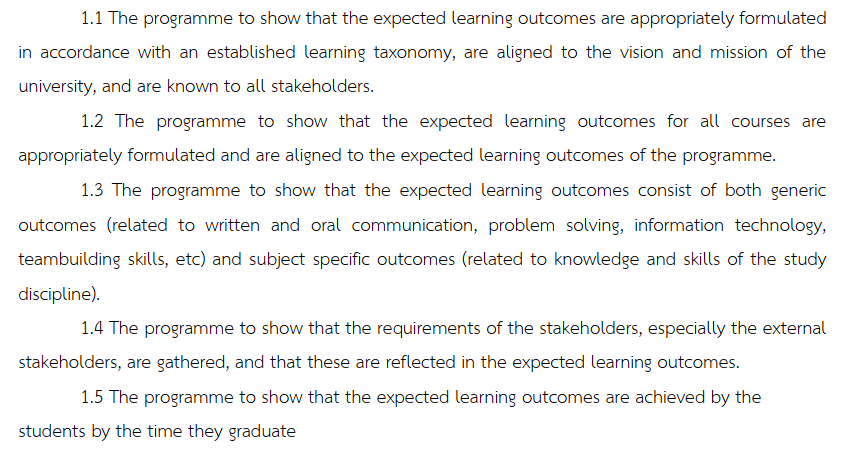
1.1 The programme to show that the expected learning outcomes are appropriately formulated in accordance with an established learning taxonomy, are aligned to the vision and mission of the university, and are known to all stakeholders.
Operational Result
- The Bachelor of Science in Aeronautics program aims to produce graduates who:
- Demonstrate high moral and ethical values
- Adapt effectively to rapidly evolving technologies
- Excel in multitasking and possess strong language proficiency
- The Program Learning Outcomes (PLOs):
- Are structured based on the objectives of the program
- Are aligned with the levels of Bloom’s Taxonomy (cognitive, psychomotor, affective domains)
- Support a progressive development of knowledge, skills, and attitudes
- The formulation of the PLOs is:
- Closely aligned with the vision and mission of St Teresa International University, focusing on producing graduates who can compete globally
- Reviewed and validated as part of continuous quality assurance
- Stakeholder involvement:
- Faculty members, students, alumni, and industry partners were consulted during curriculum review meetings
- Stakeholders provided feedback on the relevance and clarity of the PLOs
- Final PLOs were shared through faculty meetings, student orientations, handbooks, and official platforms
- Transparency and communication:
- The PLOs are clearly communicated and well-known to all stakeholders
- They are consistently referenced in course design, assessment, and curriculum delivery
- A table is provided (see below) to show:
- The alignment between each PLO and Bloom’s Taxonomy
- The corresponding linkage with the institutional vision and mission
| S.No. | Stakeholders |
| 1 | Employers |
| 2 | Intern supervisors |
| 3 | Alumni |
| 4 | Graduates |
| 5 | Industry expert |
| 6 | Instructors |
| 7 | Students |
| Program Learning Outcomes | Bloom’s Domain and Level |
| PLO1 Moral and Ethics | |
| 1.1/ E1 Rationale and reflection based on honesty and integrity, self-sacrifice and moral or ethical choices | Affective Level: Value |
| 1.2/ E2 Personal appearance in terms of self-discipline and punctuality (and responsibilities for profession and society). | Affective Level: Value |
| 1.3/ E3 Reflective act of compliance or positive inclination toward rules, regulations and custom of the organization and society | Affective Level: Value |
| 1.4/ E4 Self-perception about impact or contribution that one’s major subjects have toward people, organization and society | Affective Level: Value |
| 1.5/ E5 Reflective practice and ethical decision based on academic and professional codes of ethics | Affective Level: Value |
| PLO2 Knowledge | |
| 2.1/ K1 Sound knowledge and understanding about principles and theories of the subject(s) | Cognitive Level: Understand |
| 2.2/ K2 Analytical thinking and understanding to elaborate in academic terms the requirements of Aeronautics | Cognitive Level: Analyze |
| 2.3/ K3 Practical understanding to apply relevant knowledge, skills and tools to solve the problems | Cognitive Level: Apply |
| 2.4/ K4 Analytical understanding to help design or improve the management practice of Aeronautics to meet the new regulations | Cognitive Level: Analyze |
| 2.5/ K5 Integrated and applied knowledge of the major subjects and their applications to other relevant subjects | Cognitive Level: Apply |
| PLO 3 Cognitive skills | |
| 3.1/ C1 Conceptual and systematic thinking based on available information | Cognitive, Apply |
| 3.2/ C2 Effective use of scientific methods to solve problems | Cognitive, Apply |
| 3.3/ C3 Problem solving skills that can resolve complex scenarios of learning into creative solutions | Cognitive, Apply |
| 3.4/ C4 Creative thinking and intellectual leadership in terms of innovative and visionary teaching & learning | Cognitive, Apply |
| PLO4 Interpersonal Skills and Responsibilities | |
| 4.1/ I1 Effective communication with range of people in Thai and English | Cognitive, Apply |
| 4.2/ I2 Helpful contribution and facilitation in situational problem solving as a team leader or team member | Affective Level: Value |
| 4.3/ I3 Contribution to the society scholarly guidance in issues related to the subject matters | Affective Level: Value |
| 4.4/ I4 Accountability to self-responsibility and group performance | Affective Level: Value |
| PLO5 Numerical Analysis, Communication and Information Technology Skills | |
| 5.1/ N1 Skillful use of essential tools readily available to accomplish tasks involving computers | Psychomotor, Manipulated |
| 5.2/ N2 Creative problem-solving skills based on mathematical information or applied statistics | Psychomotor, Manipulated |
| 5.3/ N3 Effective verbal or written communication with appropriate use of presentation media. | Psychomotor, Manipulated |
| 5.4/ N4 Appropriate use of information and communication technology | Psychomotor, Manipulated |
| PLO1 Ethics | PLO2 Knowledge | PLO3 Cognitive | PLO4 Interpersonal | PLO5 Numerical | |
| Vision St Theresa International University aims to be established and recognized as a leading university in terms of specialized and professional education programs and research contributions that will enable the graduates to have successful career and quality of life | 1.1-1.5 | 2.1-2.5 | 3.1-3.4 | 4.1-4.4 | 5.1-5.4 |
| Mission 1 Produce graduates with high academic achievement and English language proficiency | 2.1-2.5 | 3.1-3.4 | 4.1,4.2 | ||
| Mission 2 Develop research and academic works that is acknowledged and recognized nationally and internationally | 1.4,1.5 | 4.2,4.3 | |||
| Mission 3 Develop a Center of Excellence for Academics, Professional Development, and English Language Competency | 2.3-2.5 | 3.3,3.4 | 4.1,4.3 | ||
| Mission 4 Preserve Thai and International arts and culture to form a coexisting multi-cultural society | 1.1-1.5 | ||||
| Mission 5 Employ an administrative system that achieves excellent in organizational management | 1.1-1.5 | 4.1-4.4 | 5.1-5.4 |
| Vision and Mission of the Institution | PLO 1.1 | PLO 1.2 | PLO 1.3 | PLO 1.4 | PLO 1.5 | PLO 2.1 | PLO 2.2 | PLO 2.3 | PLO 2.4 | PLO 2.5 | PLO 3.1 | PLO 3.2 | PLO 3.3 | PLO 3.4 | PLO 4.1 | PLO 4.2 | PLO 4.3 | PLO 4.4 | PLO 5.1 | PLO 5.2 | PLO 5.3 | PLO 5.4 |
| Vision St Theresa International University aims to be established and recognized as a leading university in terms of specialized and professional education programs and research contributions that will enable the graduates to have successful career and quality of life. | * | * | * | * | * | * | * | * | * | * | * | * | * | * | * | * | * | * | * | * | * | * |
| Missions | * | * | * | * | * | * | * | * | * | * | * | |||||||||||
| Produce graduates with high academic achievement and English language proficiency. | ||||||||||||||||||||||
| Develop research and academic works that is acknowledged and recognized nationally and internationally. | * | * | * | * | ||||||||||||||||||
| Develop a Center of Excellence for Academics, Professional Development, and English Language Competency. | * | * | * | * | * | * | * | * | * | |||||||||||||
| Preserve Thai and International arts and culture to form a coexisting multi-cultural society. | * | * | * | * | * | |||||||||||||||||
| Employ an administrative system that achieves excellent in organizational management. | * | * | * | * | * | * | * | * | * | * | * | * | * |
Evidence
| ID_Evidence | Name_Evidence |
| 1.1-1 | TQF 2 |
1.2 The programme to show that the expected learning outcomes for all courses are appropriately formulated and are aligned to the expected learning outcomes of the programme.
Operational Result
For the Aeronautics (AR) program, all Course Learning Outcomes (CLOs) are:
- Formulated by the course instructors themselves with the help of course coordinators
- Designed to directly support and achieve the Program Learning Outcomes (PLOs)
Teaching and assessment alignment:
- Teaching and learning activities are designed to match the intended CLOs
- Assessment methods are carefully mapped to evaluate the achievement of each CLO
- All mappings and alignments are reviewed and approved by both the program and academic committees
Use of Management Information System (MIS):
- Instructors upload their teaching plans and assessment plans through the MIS
- MIS ensures alignment between course delivery and learning outcomes
- Enables real-time monitoring of student progress (e.g., attendance, midterm/final performance)
Utilization of Google Classroom:
- All courses are integrated with Google Classroom for learning management
- Instructors use it to:
- Upload teaching materials, lecture slides, and course notes
- Schedule and assign quizzes, class tests, and assignments
- Facilitates formative assessment tracking and ongoing performance monitoring
Support for student performance improvement:
- Continuous tracking helps identify underperforming students
- Instructors can adopt alternative teaching strategies to help students achieve the CLOs
- Students can directly communicate with lecturers through these platforms for additional support
Integration of Learning Management Systems (LMS):
- Midterm and final exams are conducted via the LMS to ensure consistency and accessibility
- LMS also supports:
- Discussion forums for collaborative learning
- Feedback mechanisms for students and lecturers to exchange insights and suggestions
| Program Learning Outcomes | Course Learning Outcome (example) 222 407 Airport Operations Management |
| Learning Outcome 1 Moral and Ethics | |
| E1 – Rationale and reflection based on honesty and integrity, self-sacrifice and moral or ethical choices | |
| E2 – Personal appearance in terms of self-discipline and punctuality (and responsibilities for profession and society). | |
| E3 – Reflective act of compliance or positive inclination toward rules, regulations and custom of the organization and society | The students can show their responsibilities to society and – follow self-discipline, punctuality, and work ethics during the airside and landside operations. |
| E4 – Self-perception about impact or contribution that one’s major subjects have toward people, organization and society | – Understand the application of the course in the environmental context with imagining the professional role towards people, society and nations. – Put conceptual mapping with contextualizing the impact of the learning in the life of common people and aviation industries. |
| E5 – Reflective practice and ethical decision based on academic and professional codes of ethics | |
| Learning Outcomes 2 Knowledge learning outcomes | |
| K1 – Sound knowledge and understanding about principles and theories of the subject(s) | – Understand the knowledge of basic skills of aviation industries – Show familiarity with handling the Airport Operations |
| K2 – Analytical thinking and understanding to elaborate in academic terms the requirements of aeronautics | – Understand and Apply the knowledge in real-time practices in airport industries |
| K3 – Practical understanding to apply relevant knowledge, skills and tools to solve the problems | |
| K4 – Analytical understanding to help design or improve the management practice of aeronautics to meet the new regulations | |
| K5 – Integrated and applied knowledge of the major subjects and their applications to other relevant subjects | |
| Learning Outcomes 3 Cognitive skills learning outcomes | |
| C1 – Conceptual and systematic thinking based on available information | – Apply the subject knowledge to handle the airside and landside operations and – find the best practice to identify the root of the mistakes/error to solve in an easy way |
| C2 – Effective use of scientific methods to solve problems | – Apply the autonomous systems to assist the passengers – identify and mitigate the criminal acts inside the airport |
| C3 – Problem solving skills that can resolve complex scenarios of learning into creative solutions | |
| C4 – Creative thinking and intellectual leadership in terms of innovative and visionary teaching & learning | |
| Learning Outcomes 4 Interpersonal Skills and Responsibilities | |
| I1 – Effective communication with range of people in Thai and English | – Communicate with the national and international persons to assist, coordinate or help them to complete the task, and – Assist the international passengers on the landside operations |
| I2 – Helpful contribution and facilitation in situational problem solving as a team leader or team member | – Handle technical issues, passenger handling during peak time, and aircraft delays, and – Handle/ monitor the team members to complete the assigned task in the proper manner |
| I3 – Contribution to the society scholarly guidance in issues related to the subject matters | |
| I4 – Accountability to self-responsibility and group performance | |
| Learning Outcomes 5 Numerical Analysis, Communication and Information Technology Skills | |
| N1 – Skillful use of essential tools readily available to accomplish tasks involving computers | |
| N2 – Creative problem solving skills based on mathematical information or applied statistics | |
| N3 – Effective verbal or written communication with appropriate use of presentation media. | |
| N4 – Appropriate use of information and communication technology | – Know the purpose of the airport software and how to help the team members, and passengers by using the advance communication technology skills |
Evidence
| ID_Evidence | Name_Evidence |
| 1.2-1 | Management Information System Page |
| 1.2-2 | Sample TQF 3 & 5 |
| 1.2-3 | Google Class Room |
1.3 The programme to show that the expected learning outcomes consist of both generic outcomes (related to written and oral communication, problem solving, information technology, teambuilding skills, etc) and subject specific outcomes (related to knowledge and skills of the study discipline).
The Bachelor of Science in Aeronautics program ensures that its learning outcomes encompass both:
- Subject-specific outcomes: Focused on core aeronautical knowledge and professional skills
- Generic outcomes: Focused on transferable skills essential for lifelong learning and global employability
The curriculum framework explicitly defines learning outcomes in both domains:
- Based on the guidelines provided in Chapter 4 of TQF2
- Aligned with Office of the Higher Education Commission (OHEC) and Ministry of Higher Education standards for bachelor’s degree qualifications
Subject-Specific Learning Outcomes include:
- Knowledge of aeronautical sciences, aircraft systems, and flight operations
- Understanding of air navigation, meteorology, and aviation regulations
- Application of scientific and engineering principles in aviation-related scenarios
- Proficiency in using tools, simulators, and instruments relevant to the field
Generic Learning Outcomes aim to develop:
- Written and oral communication skills in both English and Thai (where applicable)
- Problem-solving and critical thinking abilities across academic and professional tasks
- Teamwork and collaboration within multi-disciplinary and multicultural environments
- Information and communication technology (ICT) competencies
- Ethical responsibility and moral reasoning
- A mindset of lifelong learning, adaptability, and global citizenship
These outcomes are:
- Embedded throughout the curriculum via teaching strategies, assessments, projects, and internships
- Reflected in course learning outcomes (CLOs) and mapped to Program Learning Outcomes (PLOs)
- Reviewed and updated to remain relevant to industry expectations and societal needs
A detailed table showing the mapping of generic and subject-specific learning outcomes is included below.
| S.No | Program Learning Outcome | Generic | Subject specific |
| PLO1 Moral and Ethics | |||
| 1.1 | Aware of the value and morality, ethics, sacrifice and honesty | * | * |
| 1.2 | Be disciplined, punctual and responsible for oneself and society. | * | * |
| 1.3 | Respect the rules and regulations of the organization and society | * | * |
| 1.4 | Be able to analyze the impact of the aviation industry on individuals organizations and society | * | * |
| 1.5 | Having academic and professional ethics | * | * |
| PLO2 Knowledge | |||
| 2.1 | K1 – Sound knowledge and understanding about principles and theories of the subject(s) | * | |
| 2.2 | K2 – Analytical thinking and understanding to elaborate in academic terms the requirements of aeronautics | * | |
| 2.3 | K3 – Practical understanding to apply relevant knowledge, skills and tools to solve the problems | * | |
| 2.4 | K4 – Analytical understanding to help design or improve the management practice of aeronautics to meet the new regulations | * | |
| 2.5 | K5 – Integrated and applied knowledge of the major subjects and their applications to other relevant subjects | * | |
| 2.6 | Demonstrate knowledge and understanding of principles and theories in a broad and systematic general knowledge base | * | |
| 2.7 | Demonstrate knowledge, understanding and ability to use language for communication taking into account the context of Thai and international society | * | |
| 2.8 | Demonstrate knowledge and understanding of the thinking system life goals, arts, culture, human relations and daily life Including applying it to solve their problems. | * | |
| 2.9 | Demonstrate the ability to learn can use technology to search for knowledge related to living in society | * | |
| 2.10 | Demonstrate basic knowledge and understanding of social, economic, political, scientific and technological phenomena and changes. | * | |
| PLO3 Cognitive skills | |||
| 3.1 | C1 – Conceptual and systematic thinking based on available information | * | |
| 3.2 | C2 – Effective use of scientific methods to solve problems | * | |
| 3.3 | C3 – Problem solving skills that can resolve complex scenarios of learning into creative solutions | * | |
| 3.4 | C4 – Creative thinking and intellectual leadership in terms of innovative and visionary teaching & learning | * | |
| 3.5 | Have the ability to search for facts, find information, understand information and Evaluate information from a variety of sources and use the information in solving the problem by yourself. | * | |
| 3.6 | Skills in using judgment, thinking, analyzing and synthesizing things. | * | |
| 3.7 | Skills in problem solving Offer options and decide how to solve problems. | * | |
| 3.8 | Skills in initiative and creativity in the quest for more knowledge and truth properly | * | |
| PLO4 Interpersonal Skills and Responsibilities | |||
| 4.1 | I1 – Effective communication with range of people in Thai and English | * | |
| 4.2 | I2 – Helpful contribution and facilitation in situational problem solving as a team leader or team member | * | |
| 4.3 | I3 – Contribution to the society scholarly guidance in issues related to the subject matters | * | |
| 4.4 | I4 – Accountability to self-responsibility and group performance | * | |
| 4.5 | Ability to adapt have good human relations and good interaction; respect and value oneself and others; | * | |
| 4.6 | have the ability to express themselves appropriately in various situations; working with others in leadership roles Group Leaders and Members | * | |
| 4.7 | Learn to live responsibly with others. and with volunteer a spirit | * | |
| 4.8 | accepting individual differences and diverse cultures, learn to live Join members of a multicultural society happily. | * | |
| PLO5 Numerical Analysis, Communication and Information Technology Skills | |||
| 5.1 | N1 – Skillful use of essential tools readily available to accomplish tasks involving computers | * | |
| 5.2 | N2 – Creative problem-solving skills based on mathematical information or applied statistics | * | |
| 5.3 | N3 – Effective verbal or written communication with appropriate use of presentation media. | * | |
| 5.4 | N4 – Appropriate use of information and communication technology | * | |
| 5.5 | Have the ability to apply mathematical and statistical principles in analysis. information in everyday life | * | |
| 5.6 | Have the ability to interpret mathematical and statistical information effectively effectiveness | * | |
| 5.7 | Have the ability to communicate effectively in speaking, listening, reading and writing using the national language and English | * | |
| 5.8 | Have the ability to select information technology for searching, collecting, interpreting, evaluating and presenting information for education appropriately and knowledgeably. | * |
Evidence
| ID_Evidence | Name_Evidence |
| 1.3-1 | Curriculum Mapping |
1.4 The programme to show that the requirements of the stakeholders, especially the external stakeholders, are gathered, and that these are reflected in the expected learning outcomes.
The Bachelor of Science in Aeronautics program actively ensures that the requirements of stakeholders, especially external stakeholders, are:
- Systematically gathered
- Analyzed and integrated into the formulation and review of the Program Learning Outcomes (PLOs)
Following the principles of Outcome-Based Education (OBE):
- The first step in curriculum development focuses on identifying the culminating learning outcomes
- PLOs are designed to reflect both academic rigor and real-world professional expectations
The program has enhanced its stakeholder engagement process from previous years by including both internal and external stakeholders
Sources and methods of data collection:
- Regulatory bodies:
- Requirements from OHEC and MHESI were gathered through official documentation reviews
- STIC’s vision and mission were reviewed to ensure alignment with institutional goals
- Current students: Input gathered through direct discussions and feedback sessions
- Alumni: Perspectives collected via structured interviews and surveys
- Employers:
- Feedback obtained through employer satisfaction surveys
- Discussions and evaluations regarding alumni performance in the workplace
- Supervisors: Opinions sought from those overseeing student internships and placements
- Academic staff: Participated in course evaluations and curriculum review discussions
- Recent graduates: Reflected on learning outcomes and employability through end-of-program evaluations
Data analysis and implementation:
- All gathered data were systematically analyzed and categorized
- Findings were used to revise or affirm existing PLOs, ensuring they are:
- Congruent with the expectations of the aviation industry and educational authorities
- Aligned with national higher education standards as defined by MHESI
- Relevant to the global needs of the aviation sector
The process ensures that the PLOs:
- Are up-to-date, industry-relevant, and stakeholder-driven
- Support the graduate’s readiness for professional roles, further study, and global competitiveness
Evidence
| ID_Evidence | Name_Evidence |
| 1.4-1 | Internship Supervisor’s Feedback |
| 1.4-2 | Graduate Feedback |
| 1.4-3 | Alumni Feedback |
| 1.4-4 | Employer Feedback |
1.5 The programme to show that the expected learning outcomes are achieved by the students by the time they graduate.
The Bachelor of Science in Aeronautics program ensures that all Program Learning Outcomes (PLOs) are systematically achieved by students upon graduation
Framework and Assurance Mechanisms:
- In compliance with TQF standards:
- TQF3 (theory course specification) and TQF4 (practicum course specification) are used for curriculum implementation
- Every course clearly defines Course Learning Outcomes (CLOs) aligned with the PLOs
- Successful course completion implies that students have achieved the related CLOs and contributed to achieving the PLOs
Course Auditing and Quality Assurance:
- The program includes a course auditing system in compliance with OHEC regulations, ensuring at least 25% of courses are externally audited
- An academic committee appoints a course auditing sub-committee to:
- Review teaching-learning strategies and assessment methods
- Verify whether students can achieve the CLOs and thereby the PLOs
- Provide recommendations to course coordinators for continuous improvement
Progression and Sequencing:
- The curriculum is designed sequentially, progressing from basic knowledge in earlier years to advanced, mastery-level skills in later years
- Students must complete prior-year coursework before advancing, ensuring logical and cumulative development of competencies
Graduation Criteria:
- To graduate, students must:
- Achieve a minimum CGPA of 2.0 as per curriculum standards
- Fulfill all course requirements including practical components
- Pass the English Exit Requirement: A minimum TOEIC score, demonstrating communication proficiency required for global aviation workplaces
- If a student fails to meet the 2.0 CGPA requirement:
- The student coordinator arranges academic support and remediation to help the student improve and meet the learning outcomes
Final Evaluation and Verification:
- Upon completing all academic and language requirements, the academic committee conducts a final review
- This ensures that each student has achieved all PLOs as indicated in TQF2
Graduate Performance Evidence:
- Alumni and recent graduates working in aviation organizations demonstrate:
- Effective English communication skills in professional settings, enabling client interaction and teamwork
- Strong ethical standards aligned with organizational values
- Efficient multi-tasking and problem-solving abilities in complex and dynamic work environments
| EPLOs of Aeronautics | Evidence to show that students achieved EPLO by the time they graduate |
| 1. Have morals and ethics. – Discipline in the study and life – Responsibility towards oneself and society – Good personalities and are able to express themselves appropriately | learning outcomes through the question papers serves as evidence that the graduate has acquired higher-order thinking skills through summative assessment. The graduate showed significant improvement in values and skills throughout the studies at the university. Performance in classroom activities such as group discussions, individual presentations, peer teaching collaborations, project work, and roleplays clearly exhibited achievement of the expected learning outcomes (ELO). According to the intern supervisor: a. The AR student performed much better compared to other university students. b. The student’s English proficiency was also better compared to the other interns. c. As the student’s basic aviation understanding was strong, they were able to understand the work easily. d. The student was able to communicate and work effectively as a team member. The graduate is involved in entrepreneurship at present and preparing for his higher studies. |
| 2. Able to search for information and knowledge and – present or communicate in English | |
| 3. Have basic knowledge of mathematics and basic science including starting to learn about the basic rules of aviation, airports | |
| 4. Have additional basic knowledge of air navigation and air traffic, Aircraft structure and materials, aviation regulations. | |
| 5. Able to apply basic knowledge of human factors in aviation, flight safety | |
| 6. Professional knowledge of the aviation industry, aviation regulations, and safety | |
| 7. Have in-depth knowledge and skills in specific professional subjects and air navigation management such as meteorology, aircraft components and systems, flight performance aircraft performance control. 8. Preparation of aviation information and airport management | |
| 9. Knowledge of various systems of the plane and human factors affecting flight | |
| 10. Have knowledge and understanding of aviation accident investigation principles, and learn various systems of aircraft | |
| 11. Have knowledge and skills, good human relations high responsibility, professional ethics, have a high level of English language skills and practice to take the exam and become a pilot Air Cargo, Aviation Support Officer or related businesses | |
| 12. Have sufficient knowledge and skills for further study at a higher level |
Evidence
| ID_Evidence | Name_Evidence |
| 1.5-1 | Employer Satisfaction Survey |
| 1.5-2 | Sample Student Testimonials |
| 1.5-3 | Job Status of the Alumni |
| 1.5-4 | Internship Supervisor Evaluation Report (Interns Performace) |
| 1.5-5 | Graduate Job Status |
| 1.5.6 | Reflective Essay |
Self-Assessment
| Requirements | Result | Score |
| 1.1 The programme to show that the expected learning outcomes are appropriately formulated in accordance with an established learning taxonomy, are aligned to the vision and mission of the university, and are known to all stakeholders. | / | 1 |
| 1.2 The programme to show that the expected learning outcomes for all courses are appropriately formulated and are aligned to the expected learning outcomes of the programme. | / | 1 |
| 1.3 The programme to show that the expected learning outcomes consist of both generic outcomes and subject specific outcomes. | / | 1 |
| 1.4 The programme to show that the requirements of the stakeholders, especially the external stakeholders, are gathered, and that these are reflected in the expected learning outcomes. | / | 1 |
| 1.5 The programme to show that the expected learning outcomes are achieved by the students by the time they graduate | / | 1 |
| Overall | 5 | |