Criterion 2 – Programme Structure and Content
Criterion
Requirements
Quality level assessment

Result
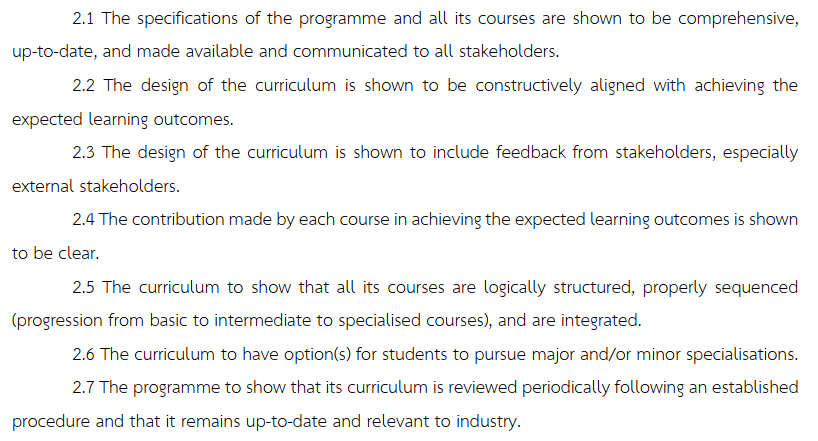
2.1 The specifications of the programme and all its courses are shown to be comprehensive, up-to-date, and made available and communicated to all stakeholders.
Operational Result
- The Bachelor of Science in Aeronautics program is designed in line with OHEC guidelines and is approved by the Ministry of Higher Education, Science, Research and Innovation (MHESI)
- The program structure is based on Outcome-Based Education (OBE) principles, focusing on:
- Preparing students for global aviation industry challenges
- Enhancing higher-order thinking skills
- Ensuring real-world readiness upon graduation
- Curriculum Enrichment Activities:
- Study visits to aviation-related organizations were conducted to provide hands-on exposure
- Guest lectures and expert talks were organized to bridge the gap between theory and real-world applications
- Faculty Competency Development:
- Instructors underwent regular training programs, seminars, and workshops to update their knowledge and teaching methods
- Focus was placed on modern technologies and trends in the aviation industry
- The Program Learning Outcomes (PLOs) and Course Learning Outcomes (CLOs) were strategically formulated to:
- Promote critical and high-level thinking
- Provide students with broader career opportunities
- Deliver a rich and effective learning experience
- Curriculum Revision and Industry Alignment:
- To ensure currency and relevance, the curriculum was periodically reviewed
- Inputs were collected from a wide range of stakeholders, including:
- Aviation school experts
- Industry professionals
- Academic scholars
- Graduates and alumni
- The previous curriculum, which offered limited pathways for pilot-focused careers, was expanded to include three major career tracks:
- Flight training and piloting
- Ground operations and aviation management roles
- Aviation technical English and communication
- Stakeholder Communication:
- All curriculum updates, including the introduction of the three specialization tracks, were clearly communicated to stakeholders through:
- Official faculty meetings and academic committee discussions
- Student and parent orientations
- Updates via the STIC website, MIS system, and Google Classroom
- Notifications to alumni and partner organizations through newsletters and academic bulletins
- All curriculum updates, including the introduction of the three specialization tracks, were clearly communicated to stakeholders through:
- These measures ensure that:
- The program remains comprehensive, current, and stakeholder-informed
- All stakeholders are well-informed about program content and updates
| Stakeholder | Mode of Communication |
| Students | Orientation |
| instructors | Orientation, department meetings Internship visits |
| Internship hosts | Hardcopy/Softcopy are sent through the interns |
| employer | Through Alumni |
| Ministry of higher education | TQF2 |
| Flight schools | During study visits |
Evidence
| ID_Evidence | Name_Evidence |
| 2.1-1 | Curriculum Revision Meeting Order |
| 2.1-2 | Lecturer orientation report |
| 2.1-3 | Student orientation report |
| 2.1-4 | Communication to employer |
| 2.1-5 | Graduate survey |
2.2 The design of the curriculum is shown to be constructively aligned with achieving the expected learning outcomes.
Operational Result
- The Bachelor of Science in Aeronautics (AR) program curriculum is designed in alignment with the Program Learning Outcomes (PLOs), which are themselves based on the institution’s vision and mission to produce globally competent graduates.
- The Course Learning Outcomes (CLOs) are formulated across the five core domains of higher education standards:
- Moral and ethical behavior
- Knowledge and understanding
- Cognitive skills
- Interpersonal and responsibility skills
- Numerical and information technology skills
- Alignment Strategy:
- CLOs are directly mapped to the PLOs to ensure consistency in learning progression.
- Instructors align lesson-level learning outcomes with CLOs during teaching plan development.
- This ensures a vertically integrated curriculum that supports achievement of program-level goals.
- Focus Areas of the PLOs and CLOs:
- Positive attitude and behavior development
- Strong foundation in theoretical and applied knowledge
- Emphasis on problem-solving and critical thinking
- Development of teamwork, coordination, and communication skills
- Teaching Strategies and Assessment:
- Teaching methods are dynamically adapted based on student performance and learning feedback.
- Both formative and summative assessment methods are used to evaluate and improve student competencies.
- Formative: quizzes, group projects, classroom discussions
- Summative: midterm/final exams, presentations, practical tests
- Stakeholder Involvement:
- Instructors and academic staff maintain strong communication with internal and external stakeholders to ensure curriculum relevance.
- Course evaluations are collected every semester via the online platform.
- Feedback is analyzed by the course coordinator, and any necessary revisions to CLOs and PLOs are proposed and implemented.
- The constructive alignment of institutional vision → PLOs → CLOs → lesson outcomes → assessment ensures that students are able to meet all expected learning outcomes by graduation.
| Course Learning Outcomes | Program Learning Outcome | ||
| CLO1 Moral and Ethics | |||
| 1. Are aware of the value and morality, ethics, sacrifice and honesty | Have morals and ethics – Discipline in the study and life – Responsibility towards oneself and society – Good personalities and able to express themselves appropriately | ||
| 2. Be disciplined, punctual and responsible for oneself and society | |||
| 3. Respect the rules and regulations of the organization and society | |||
| 4. (be able to) Analyze the impact of the aviation industry on individuals organizations and society | |||
| 5. have academic and professional ethics | |||
| CLO2 Knowledge learning outcomes | |||
| 1. Use knowledge and understanding of key principles and theories in the content studied | – Have basic knowledge of mathematics and basic science including starting to learn about the basic rules of aviation, airports – Have additional basic knowledge of air navigation and air traffic, Aircraft structure and materials, aviation regulations – Professional knowledge in the aviation industry, aviation regulations and safety – Knowledge of various systems of the plane and human factors affecting flight – Have knowledge and understanding of aviation accident investigation principles, and learn various systems of aircraft | ||
| 2. (be able to) Analyze problem and, understand and explain aviation requirements | |||
| 3. (be able to) Apply knowledge, skills and use of appropriate tools to solve problems | |||
| 4. (be able to) Analyze, design, and improve aviation management systems to meet professional requirements | |||
| 5. (be able to) Integrate knowledge in the study with knowledge in other fields | |||
| CLO3 Cognitive skills learning outcomes | |||
| 1. Develop concepts with careful consideration. under the sufficiency of information and systematically | – Able to apply basic knowledge of human factors in aviation, flight safety – Have in-depth knowledge and skills in specific professional subjects and air navigation management such as meteorology, aircraft components and systems, flight performance aircraft performance control – Preparation of aviation information and airport management – Have sufficient knowledge and skills for further study at a higher level | ||
| 2. (be able to) Solve problems with scientific processes | |||
| 3. (be able to) Solve complex problems in learning management Propose solutions and lead to creative solutions | |||
| 4. Possess intellectual leadership in creative thinking and visionary development of learning management | |||
| CLO4 Interpersonal Skills and Responsibilities | |||
| 1. (be able to) Communicate with a wide range of people and able to converse effectively in both Thai and foreign languages | – Have knowledge and skills, – good human relations high responsibility, professional ethics, – have a high level of English language skills and practice to take the exam and become a pilot Air Cargo Aviation Support Officer or related businesses | ||
| 2. can Provide assistance and facilitate resolving various situations in the group both in the role of leader and team member | |||
| 3. (be able to) Apply knowledge in science to guide society on appropriate issues | |||
| 4. Be responsible for one’s own actions and responsible for work in the group. | |||
| CLO5 Numerical Analysis, Communication and Information Technology Skills | |||
| 1. Skilled in using statistical or mathematical techniques to make creative decisions in interpretation. and suggest ways to solve problems or disputes | – Be able to search for information and knowledge – Able to present or communicate in English | ||
| 2. (be able to) Communicate effectively both verbally and in writing. Know how to choose and use presentation styles that are suitable for different problems and audience groups. | |||
| 3. (be able to) Select suitable information technology and communication techniques for data collection interpreting and communicating information and with caution Be deliberate in sharing information with others | |||
| 4. (be able to) Produce video or infographics Without copying other people’s work and having the right copyright | |||
Evidence
| ID_Evidence | Name_Evidence |
| 2.2-1 | TQF-3: Learning Activities and Assessment Method Alignment with the Learning Outcomes |
| 2.2-2 | Curriculum Mapping |
2.3 The design of the curriculum is shown to include feedback from stakeholders, especially external stakeholders.
Operational Result
The Aeronautics (AR) program ensures that the curriculum remains industry-relevant by regularly collecting feedback from both internal and external stakeholders.
Stakeholders consulted include:
- Current students
- Program instructors
- Internship hosts
- Employers of graduates
- The Ministry of Higher Education, Science, Research and Innovation (MHESI)
- Flight schools
- Aviation industry experts
Methods used to gather feedback:
- Surveys and opinion forms (via email, Google Forms, and in-person interviews)
- Stakeholder meetings and curriculum review sessions
- Course and internship evaluations
Previous implementation (2020 curriculum revision):
- Incorporated major feedback from stakeholders
- Introduced three elective tracks in the final year based on stakeholder and review committee recommendations:
- Pilot Training
- Aviation Communication
- Other Aviation Fields (e.g., ground operations, dispatch)
- This provided students with flexible career paths aligned with their interests and industry demand
Ongoing improvements for the 2024 curriculum update based on recent stakeholder suggestions:
- Cargo Handling subject: Integrate ICAO safety procedures and policies
- Aviation Meteorology subject: Add advanced and detailed meteorological content
These revisions aim to ensure that students are equipped with practical, updated, and globally-relevant knowledge and skills, aligned with the expectations of the aviation industry and regulatory bodies.
Evidence
| ID_Evidence | Name_Evidence |
| 2.3-1 | Student Testimonials |
| 2.3-2 | Internship Monitoring Report |
| 2.3-3 | Employer Satisfaction Survey |
| 2.3-4 | Internship Supervisor Evaluation Report |
| 2.3-5 | TQF 5 |
2.4 The contribution made by each course in achieving the expected learning outcomes is shown to be clear.
Operational Result
The Aeronautics Program Committee is responsible for ensuring that all courses are clearly aligned with the Program Learning Outcomes (PLOs) to support the achievement of the Expected Learning Outcomes (ELOs).
The course structure is systematically designed to:
- Align with the defined PLOs
- Progress from generic skills and foundational knowledge to higher-order thinking and discipline-specific skills
Each course is categorized as contributing to either:
- Generic learning outcomes (e.g., communication, teamwork, ethics)
- Subject-specific learning outcomes (e.g., aerodynamics, navigation, meteorology)
Every course includes:
- Major and minor learning outcomes, ensuring comprehensive coverage and depth of learning
- Clearly specified outcomes documented in the TQF3 course specifications
Instructors are required to:
- Follow the defined learning outcomes when preparing lesson plans
- Design student tasks and assessments in alignment with the course learning outcomes (CLOs)
- Report outcome alignment and student achievement through the Management Information System (MIS)
This systematic approach ensures that each course makes a measurable contribution to the attainment of the program’s overall learning goals and graduate attributes.
| Domain | Moral and Ethical | Knowledge | Cognitive / Intellectual | Interpersonal Skills and Responsibility | Numerical and Information Literacy |
| Major to be assessed | 1.3 Reflective act of compliance or positive inclination toward rules, regulations and custom of the organization and society | 2.3 Practical understanding to apply relevant knowledge, skills and tools to solve the problems· 2.5 Integrated and applied knowledge of the major subjects and their applications to other relevant subjects | 3.2 Effective use of scientific methods to solve problems | 4.2 Helpful contribution and facilitation in situational problem solving as a team leader or team member | |
| Minor | 1.1 Rationale and reflection based on honesty and integrity, self-sacrifice and moral or ethical choices 1.2 Personal appearance in terms of self-discipline and punctuality 1.4 Self-perception about impact or contribution that one’s major subjects have toward people, organization and society 1.5 Reflective practice and ethical decision based on academic and professional codes of ethics | 2.1 Sound knowledge and understanding about principles and theories of the subjects 2.2 Analytical thinking and understanding to elaborate in academic terms the requirements of aeronautics· 2.4 Analytical understanding to help design or improve the management practice of aeronautics to meet the new regulations | 3.1 Conceptual and systematic thinking based on available information 3.3 Problem solving skills that can resolve complex scenarios of learning into creative solutions 3.4 Creative thinking and intellectual leadership in terms of innovative and visionary teaching & learning | 4.1 Effective communication with range of people in Thai and English 4.3. Contribution to the society scholarly guidance in issues related to the subject matters 4.4 Accountability to self-responsibility and group performance | 5.1 Skillful use of essential tools readily available to accomplish tasks involving computers 5.2 Creative problem solving skills based on mathematical information or applied statistics 5.3 Effective verbal or written communication with appropriate use of presentation media 5.4 Appropriate use of information and communication technology |
Evidence
| ID_Evidence | Name_Evidence |
| 2.4-1 | Curriculum Mapping TQF3 -Learning Outcome PLO vs CLO mapping |
2.5 The curriculum to show that all its courses are logically structured, properly sequenced (progression from basic to intermediate to specialised courses), and are integrated.
Operational Result
The Bachelor of Science in Aeronautics (B.Sc. AR) curriculum is structured around:
- General Education courses
- Core Major and Required Courses
- Professional Elective Courses
The entire program is designed to be completed in 8 semesters (4 years).
The curriculum follows a logical progression:
- From basic knowledge in the early semesters
- To intermediate and specialized knowledge in later semesters
Year-wise Structure and Sequencing:
- Year 1:
- Focuses on general education courses
- Includes introductory science and foundational skills to prepare global citizens
- Year 2 & Year 3:
- Integration of core aeronautics and required technical courses
- Covers subjects related to aircraft systems, performance, regulations, meteorology, and navigation
- Emphasis on lifelong learning, analytical thinking, and technical competence
- Year 4 – Term 1:
- Students choose from three professional elective tracks:
- Pilot Training
- Aviation Communication
- Other Aviation Fields (e.g., ground handling, flight operations)
- Students choose from three professional elective tracks:
- Year 4 – Term 2:
- Students undergo internship training in real aviation environments
- Gain hands-on industry experience to bridge academic learning with professional practice
The curriculum ensures:
- Vertical integration of knowledge and skills from basic to advanced levels
- Horizontal integration across disciplines (e.g., English for aviation, ethics, safety, and regulations)
- Development of 21st-century skills such as:
- Critical thinking
- Teamwork
- Communication
- Digital and information literacy
The program includes co-curricular activities such as seminars, study visits, and project-based learning to reinforce practical application and personal development.
Evidence
| ID_Evidence | Name_Evidence |
| 2.5-1 | Program Structure |
| 2.5-2 | Yearly Study Plan |
| 2.5-3 | Internship Objectives |
2.6 The curriculum to have option(s) for students to pursue major and/or minor specialisations.
Operational Result
The Bachelor of Science in Aeronautics (B.Sc. AR) program provides students with flexibility and customization options in their academic journey through:
- 6 credits of free elective courses, allowing students to choose from any course offered within the university.
The previous curriculum focused primarily on pilot training as the main career path.
The revised curriculum, implemented in 2020, was designed to broaden students’ career opportunities by offering three distinct professional elective tracks in the final year:
- Flying Group (Pilot Training Stream)
- For students who qualify through Medical Class 1 certification
- Focused on flight operations, aviation regulations, and simulator training
- Prepares students for pilot licensure and flight careers
- Other Aviation Jobs Group
- Designed for students interested in non-flying roles
- Includes subjects on ground handling, flight dispatch, operations, airport management, etc.
- Equips students for various technical and operational roles in the aviation industry
- Aviation Technical English Group
- Tailored for students interested in aviation communication roles
- Focuses on technical English, documentation, communication protocols, and ICAO phraseology
- Suitable for careers in airline communication, airport coordination, and aviation safety compliance
These specialization tracks ensure that:
- Students can align their studies with their career interests
- Those not eligible for pilot careers (e.g., due to medical disqualification) still have robust career alternatives within the aviation industry
- The program promotes diversity in career preparation while maintaining alignment with aviation sector demands
Evidence
| ID_Evidence | Name_Evidence |
| 2.6-1 | TQF02- 3 New Professional Groups |
2.7 The programme to show that its curriculum is reviewed periodically following an established procedure and that it remains up-to-date and relevant to industry.
Operational Result
System and Mechanism:
- The program follows a formal plan and procedure for curriculum development and revision.
- Curriculum assessments are conducted regularly based on current curriculum objectives.
- Feedback and information are gathered from multiple stakeholders including:
- Entrepreneurs
- Graduates and users of graduates
- Professional organizations
- Industry partners
- Trends in global economy and society (opportunities and threats)
- A curriculum committee is appointed, composed of internal and external experts, responsible for:
- Developing and updating the curriculum in line with the University’s philosophy, objectives, structure, content, and standards.
- The committee conducts public hearings to review the draft curriculum before submitting it for formal approval.
- Approval process:
- Curriculum committee → Faculty approval
- Faculty → University Academic Council approval
- University Academic Council → University Council approval
- Curriculum implementation occurs only after approval from the University Council.
- The final curriculum is submitted to the Office of Higher Education Commission (OHEC) for acknowledgment.
Assessment of the Process:
- During a study visit to Bangkok Flight Services, stakeholders recommended more in-depth teaching on:
- Air cargo documentation, specifically airway bills
- Dangerous goods handling regulations
- Program committee meetings emphasized updating course content with recent technological advancements in aviation.
Improvements Implemented:
Based on the suggestions received from stakeholders, the following improvements were successfully implemented during the academic year:
Aj. Mari effectively integrated content on innovations in passenger service into the Aeronautical Industrial Innovation subject. This provided students with insights into the latest technological developments and service enhancements in the airline industry.
Aj. Saran has planned to incorporate simulation-based practice sessions into the Air Navigation subject. This enhancement aims to provide students with hands-on experience in navigating using real-time simulated scenarios, improving their practical understanding and situational awareness in aviation
Evidence
| ID_Evidence | Name_Evidence |
| 2.7-1 | TQF3 Air Navigation and Communication |
| 2.7-2 | Interns feedback |
| 2.7-3 | Sample presentation of interns |
| 2.7-4 | Interns supervisors report |
Self-Assessment
| Requirements | Result | Score |
| 2.1 The specifications of the programme and all its courses are shown to be comprehensive, up-to-date, and made available and communicated to all stakeholders. | / | 1 |
| 2.4 The contribution made by each course in achieving the expected learning outcomes is shown to be clear. | / | |
| 2.2 The design of the curriculum is shown to be constructively aligned with achieving the expected learning outcomes. | / | 1 |
| 2.3 The design of the curriculum is shown to include feedback from stakeholders, especially external stakeholders. | / | |
| 2.5 The curriculum to show that all its courses are logically structured, properly sequenced and integrated. | / | 1 |
| 2.6 The curriculum to have option(s) for students to pursue major and/or minor specialisations. | / | 1 |
| 2.7 The programme to show that its curriculum is reviewed periodically following an established procedure and that it remains up-to-date and relevant to industry. | / | 1 |
| Overall | 5 | |