Criterion 1 – Expected Learning Outcomes
Criterion
Requirements
Quality level assessment

Result
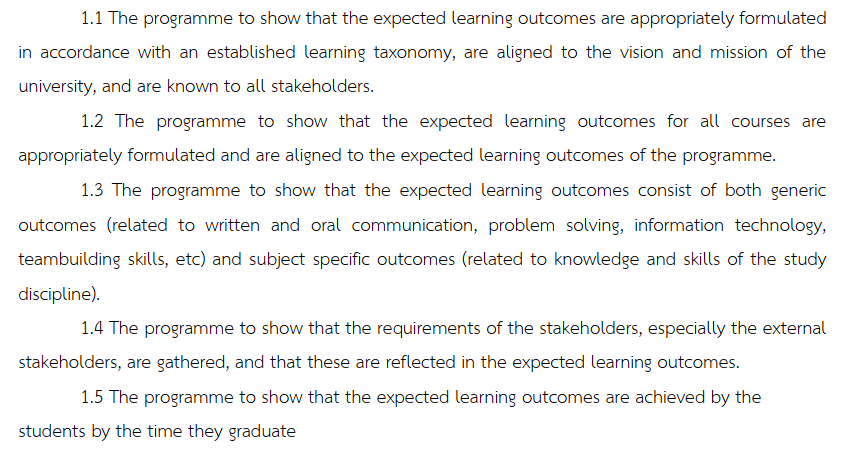
1.1 The programme to show that the expected learning outcomes are appropriately formulated in accordance with an established learning taxonomy, are aligned to the vision and mission of the university, and are known to all stakeholders.
Operational Result
The Bachelor of Business Administration (BBA) International Programme at St Teresa International University demonstrates that its expected learning outcomes are appropriately formulated using an established learning taxonomy, aligned with the vision and mission of the university, and communicated to all relevant stakeholders.
The BBA Programme offers three specialisations:
– International Business
– Logistics Management
– Tourism and Hotel Management
1. Formulation of Programme Learning Outcomes
Programme Learning Outcomes (PLOs) are formulated through a systematic and consultative process, guided by the Plan-Do-Check-Improve (PDCI) cycle, to ensure that they reflect institutional goals, national higher education standards, stakeholder needs, and industry expectations. The programme uses Revised Bloom’s Taxonomy as the established learning taxonomy to determine the appropriate level of learning achievement expected of graduates.
Plan
The BBA Programme begins PLO formulation through a structured planning process involving key internal and external stakeholders identified in TQF 2, including university administrators, faculty members, academic and non-academic staff, students, alumni, employers, internship supervisors, and industry representatives. The university vision and mission, the Thai Qualifications Framework for Higher Education (TQF-HEd), national higher education requirements, and the needs of the business sector serve as primary references.
Do
The programme conducts structured meetings, consultations, and working group discussions with relevant stakeholders to develop the PLOs. Revised Bloom’s Taxonomy guides the selection of appropriate action verbs and the determination of the level of learning achievement expected at the undergraduate level. PLOs are then distributed across courses through curriculum mapping, and translated into Course Learning Outcomes (CLOs) to ensure constructive alignment among programme outcomes, course outcomes, teaching and learning activities, and assessment methods.
Check
The curriculum committee reviews the drafted PLOs to ensure they are clearly stated, measurable, attainable, relevant, and aligned with institutional, national, and professional requirements. The review verifies consistency with the university’s vision and mission, and confirms that the expected levels of learning are appropriate based on Revised Bloom’s Taxonomy. Stakeholder feedback, employer expectations, internship evaluations, and national academic standards are all considered in this review.
Improve
Based on review findings and stakeholder feedback, PLOs are refined and updated. The most significant outcome of this continuous improvement process was the development and formal approval of the Revised Curriculum B.E. 2568 (2025), registered with the Office of the Higher Education Commission (สป.อว.) in May 2025. This revision introduced a restructured set of 13 PLOs spanning four outcome domains, replacing the previous five-domain TQF framework, to better reflect contemporary business competencies, Thailand’s Higher Education Standards B.E. 2565 (2022), and AUN-QA Version 4.0 expectations.
2. Current Programme Learning Outcomes
The BBA Programme currently operates under two concurrently implemented curricula during the transition period:
a) Revised Curriculum B.E. 2563 (2020): followed by Year 2, 3 and 4 students (entry cohorts 2024, 2023 and 2022 respectively), with PLOs structured across five TQF-HEd learning domains.
b) Revised Curriculum B.E. 2568 (2025): followed by Year 1 students (entry cohorts 2025), with PLOs restructured into 13 outcomes across four domains.
Both sets of PLOs are presented below
a) PLOs under the 2020 Curriculum (Year 2, 3 and 4 Students)
The 2020 curriculum PLOs are grouped into five learning domains of the Thai Qualifications Framework for Higher Education (TQF). There are 17 PLOs altogether as follows.
PLO1: Moral and Ethics
The graduates can:
1.1 Resolve conflicts through ethical and moral judgment
1.2 Demonstrate consistency between moral and ethical beliefs and professional behaviour
1.3 Show responsibility, leadership, membership roles, and volunteerism for social development
1.4 Demonstrate self-discipline and uphold acceptable social standards
PLO2: Knowledge
The graduates can:
2.1 Articulate systematic, global, and up-to-date business theories and practices
2.2 Apply business concepts to other relevant subjects and professional contexts
2.3 Demonstrate procedural knowledge in research and professional advancement
PLO3: Cognitive Skills
The graduates can:
3.1 Analyse the causes of problems or conflicts and resolve issues appropriately
3.2 Apply theoretical and practical knowledge in fieldwork, practicum, or actual work settings
3.3 Apply business or technical innovation to enhance professional skills and effectiveness
PLO4: Interpersonal Skills and Responsibility
The graduates can:
4.1 Communicate effectively in English and work collaboratively with others
4.2 Demonstrate leadership, responsibility, service-mindedness, and cross-cultural understanding.
4.3 Participate effectively in team-based and professional environments
4.4 Show responsibility to advance oneself in knowledge and professional skills
PLO5: Numerical Analysis, Communication and Information Technology Skills
The graduates can:
5.1 Use numerical analysis to support business decision-making
5.2 Communicate information effectively in professional contexts
5.3 Use information technology and digital tools in business operations and management
b) PLOs under the 2025 Curriculum (Year 1 Students)
The 2025 curriculum introduces 13 PLOs restructured across four outcome domains, reflecting Thailand’s Higher Education Standards B.E. 2565 (2022), AUN-QA Version 4.0 expectations, and global workforce competency frameworks including the World Economic Forum’s Top 10 Skills for the Future.
| Knowledge PLO (revised program that launched in 2025) | Description (as interpreted by the instructors) |
| PLO1 Comprehend, apply and evaluate concepts and principles of courses and make connection or integrate key concepts to the context of courses studied | Demonstrates foundational business knowledge across core disciplines |
| PLO2 Apply disciplinary knowledge in other contexts than those studied such as developing new skills or improve one’s quality of life | Applies knowledge of specialisation (International Business / Logistics / Tourism & Hotel) |
| PLO3 Use techniques studied to review, combine, extend and apply conceptual understanding to find solutions to the problems analyzed or to initiate a study project | Demonstrates knowledge of research methodologies to support professional advancement |
| Skills PLO (revised program that launched in 2025) | Description (as interpreted by the instructors) |
| PLO4 Analyze fact and circumstance to identify problems and solutions and to evaluate and select appropriate methods for sustainable problem solving | Applies critical thinking and problem-solving in professional contexts |
| PLO5 Communicate information, argument and analysis effectively to specialist and non-specialist audiences using techniques of the discipline | Demonstrates effective communication skills in English and professional settings |
| PLO6 Present, evaluate and interpret qualitative and quantitative data to make theoretically sound and informed decision | Applies digital technology skills in business operations |
| PLO7 Effectively use tools, media and digital technology to study and work collaboratively | Demonstrates creativity and innovation in addressing business challenges |
| Ethics PLO (revised program that launched in 2025) | Description (as interpreted by the instructors) |
| PLO8 Show persistent effort and determination to learn new concepts or undertake unfamiliar tasks | Demonstrates professional integrity and ethical conduct |
| PLO9 Produce or create quality output for assignments by using self effort and commitment without plagiarism or use of others’ ideas | Practises responsible behaviour toward society and the environment |
| PLO10 Show personal conducts that comply with the professional code of ethics, organization culture or social order, and communicate in a good manner in the organization or society | Upholds standards of academic and professional honesty |
| Personal Characters PLO (revised program that launched in 2025) | Description (as interpreted by the instructors) |
| PLO11 Show rational ideas and positive attitude toward the organization and community members | Demonstrates adaptability and lifelong learning disposition |
| PLO12 Take self responsibility for the credit of group work, and accommodate different ideas and cooperate as a group leader or member for a common good | Shows service-mindedness and a positive professional attitude |
| PLO13 Show behaviors that demonstrate service mind and pleasant personality that are liked by group members, colleagues or instructors | Demonstrates cultural sensitivity and global awareness |
All 13 PLOs are formulated using Revised Bloom’s Taxonomy and are fully mapped to courses through the curriculum mapping documented in TQF 2 (B.E. 2568).
3. Alignment of PLOs with the University Vision and Mission
Vision: St Teresa International University aims to be a leading university recognised and accepted nationally and internationally.
Mission:
- Produce graduates with high academic achievement and English language proficiency.
- Develop research and academic works acknowledged and recognised nationally and internationally.
- Establish the centre of professional development in Education, Health and English Language Competency.
- Preserve Thai and International arts and culture to form a coexisting multicultural society.
- Employ an administrative system that achieves excellence in organisational management.
The BBA Program Learning Outcomes align with the university’s vision and mission, as shown below.
The alignment of the 2025 PLOs with the university vision and mission is demonstrated in the following table:
| PLO | Domain | Mission Alignment | Bloom’s Level |
| PLO1 | Knowledge | Mission 1 — foundational business knowledge underpins graduate competence | Understanding / Applying |
| PLO2 | Knowledge | Mission 1 — specialisation knowledge prepares graduates for industry-specific roles | Applying / Analysing |
| PLO3 | Knowledge | Mission 2 — research knowledge supports nationally and internationally recognised academic work | Analysing / Creating |
| PLO4 | Skills | Mission 1, 5 — critical thinking supports academic excellence and organisational problem-solving | Analysing / Evaluating |
| PLO5 | Skills | Mission 1 — English communication proficiency is a core graduate attribute | Applying |
| PLO6 | Skills | Mission 5 — digital skills support effective organisational management | Applying / Analysing |
| PLO7 | Skills | Mission 5 — innovation supports organisational effectiveness and competitiveness | Creating / Evaluating |
| PLO8 | Ethics | Mission 1, 4 — professional integrity underpins responsible conduct and multicultural respect | Valuing / Applying |
| PLO9 | Ethics | Mission 4 — social and environmental responsibility supports a multicultural society | Valuing |
| PLO10 | Ethics | Mission 1 — academic and professional honesty is foundational to graduate achievement | Valuing |
| PLO11 | Character | Mission 1, 3 — lifelong learning supports ongoing professional development | Receiving / Valuing |
| PLO12 | Character | Mission 1, 4 — service-mindedness reflects Thai cultural values and graduate readiness | Receiving / Valuing |
| PLO13 | Character | Mission 4 — cultural sensitivity and global awareness support multicultural coexistence | Valuing / Applying |
4. Communication of Program Learning Outcomes to Stakeholders
The BBA Programme ensures that PLOs are known to all stakeholders through a range of communication channels, as detailed below:
| Stakeholder Group | Communication Channel | Frequency | Evidence |
| Administrative, Academic & Non-Academic Staff | Meetings, presentations, general orientation | Bi-annually | Meeting minutes, presentation materials, orientation documents |
| Faculty of Business Administration | Faculty meetings, curriculum review meetings, academic planning meetings | Bi-annually / Annually | Meeting minutes, curriculum review documents, presentation files |
| Students | Intensive English Programme orientation, general orientation, classroom briefing, post-internship seminar | Every semester | Orientation slides, student handbook, seminar materials, course syllabi |
| Potential Students and Parents | School visits, programme activities, open days, English camps | Annually / as needed | Brochures, programme flyers, activity reports, website information |
| Employers | Internship visits, employer feedback sessions, curriculum review meetings | Every semester / as scheduled | Employer feedback forms, internship visit reports, curriculum review minutes |
| Alumni | Alumni meetings, post-internship presentations, curriculum review consultations | Annually / bi-annually | Alumni feedback forms, meeting records, presentation materials |
| General Public | University website, programme brochures, printed materials, online platforms | Continuous | Website screenshots, brochures, programme catalogue |
Through these communication channels, the programme ensures that all stakeholders are informed of the expected learning outcomes and understand the knowledge, skills, ethical values, and professional competencies expected of BBA graduates.
The BBA Programme demonstrates that its Programme Learning Outcomes are systematically formulated using Revised Bloom’s Taxonomy, comprehensively aligned with the vision and mission of St Teresa International University, and effectively communicated to all relevant stakeholders. The PLOs are regularly reviewed and refined through stakeholder consultation, curriculum review processes, and alignment with national and international standards — most recently evidenced through the 2025 curriculum revision which introduced 13 restructured PLOs across four outcome domains. This process ensures that graduates possess the knowledge, skills, ethical values, and professional competencies required for success in national and international business environments.
Evidence
| ID_Evidence | Name_Evidence |
| 1.1.1 | University Website |
| 1.1.2 | Faculty of Business Administration Page |
| 1.1.3 | Brochure |
| 1.1.4 | Social Media / Online Advertisement |
| 1.1.5 | TQF 2 |
| 1.1.6 | Curriculum Mapping |
| 1.1.7 | Personnel Meeting |
| 1.1.8 | Intensive Summer Program |
| 1.1.9 | General Orientations |
| 1.1.10 | Internship Visit |
1.2 The programme to show that the expected learning outcomes for all courses are appropriately formulated and are aligned to the expected learning outcomes of the programme.
Operational Result
The Bachelor of Business Administration (BBA) International Programme ensures that the learning outcomes for all courses are appropriately formulated and systematically aligned with the Programme Learning Outcomes (PLOs). This alignment is maintained across both the 2020 curriculum (currently followed by Year 3 and Year 4 students) and the 2025 curriculum (currently followed by Year 1 and Year 2 students).
1. Formulation of Course Learning Outcomes
The Programme Learning Outcomes serve as the primary reference for developing Course Learning Outcomes (CLOs) for every course in the curriculum. Each course has its own set of CLOs, which describe the specific knowledge, skills, values, and competencies that students are expected to demonstrate upon completion of that course.
CLOs are formulated to be:
- Clear and specific — expressed using action verbs derived from Revised Bloom’s Taxonomy, indicating the expected cognitive or affective level of achievement.
- Measurable — assessable through course assessments, assignments, projects, and examinations.
- Aligned — connected to one or more PLOs to ensure that each course contributes to the programme’s overall graduate outcomes.
- Appropriate in level — calibrated to the year level and credit weight of the course within the curriculum structure.
The programme applies the principle of constructive alignment to ensure that CLOs, teaching and learning activities, and assessment methods are coherently connected. Faculty members develop CLOs in accordance with the programme’s curriculum framework, and all CLOs are documented in the course syllabus (TQF 3) for each course.
Program Learning Outcomes
The BBA Programme currently operates under two concurrent curricula. The PLO frameworks for both are presented below to demonstrate how CLO-PLO alignment is maintained across all student cohorts.
2A. PLO Framework — 2020 Curriculum (Year 3 and Year 4 Students)
The 2020 curriculum organises PLOs across five TQF-HEd learning domains:
The BBA Program Learning Outcomes are grouped according to the five learning domains as follows:
| Code | Domain | Programme Learning Outcome |
| ME1 | Moral & Ethics | Resolve conflicts through ethical and moral judgment. |
| ME2 | Moral & Ethics | Demonstrate consistency between moral and ethical beliefs and professional behavior. |
| ME3 | Moral & Ethics | Show responsibility, membership roles, leadership, and volunteerism for social development. |
| ME4 | Moral & Ethics | Demonstrate self-discipline and uphold good social standards. |
| K1 | Knowledge | Articulate systematic, global, and up-to-date business theories and practices. |
| K2 | Knowledge | Apply business concepts to other relevant subjects and professional contexts. |
| K3 | Knowledge | Demonstrate research knowledge for professional and knowledge advancement. |
| K4 | Knowledge | Analyse, design, and improve management systems to meet professional requirements. |
| K5 | Knowledge | Integrate business knowledge with knowledge from other fields. |
| CS1 | Cognitive Skills | Analyse the causes of problems or conflicts and resolve issues appropriately. |
| CS2 | Cognitive Skills | Apply theoretical and practical knowledge in fieldwork, practicum, or actual job settings. |
| CS3 | Cognitive Skills | Apply business or technical innovation to enhance professional skills and effectiveness. |
| ISR1 | Interpersonal Skills & Responsibility | Demonstrate responsibility for self-development in knowledge and professional skills. |
| ISR2 | Interpersonal Skills & Responsibility | Accomplish group assignments or tasks efficiently. |
| ISR3 | Interpersonal Skills & Responsibility | Demonstrate teamwork, good human relations, and adaptability to organisational changes. |
| ISR4 | Interpersonal Skills & Responsibility | Demonstrate creativity, leadership, followership, and problem-solving in team settings. |
| NIL1 | Numerical Analysis, Communication & IT | Analyse and interpret data to support decision-making and solve quantitative problems. |
| NIL2 | Numerical Analysis, Communication & IT | Communicate effectively using appropriate methods for different audiences and situations. |
| NIL3 | Numerical Analysis, Communication & IT | Use information technology effectively to store, retrieve, present, and communicate information. |
| NIL4 | Numerical Analysis, Communication & IT | Produce videos or infographics ethically, with respect for intellectual property and copyright. |
2B. PLO Framework — 2025 Curriculum (Year 1 and Year 2 Students)
The 2025 curriculum restructures PLOs into 13 outcomes across four domains aligned with Thailand’s Higher Education Standards B.E. 2565 (2022) and AUN-QA Version 4.0:
| Code | Domain | Programme Learning Outcome |
| PLO1 | Knowledge | Demonstrates foundational business knowledge across core disciplines. |
| PLO2 | Knowledge | Applies knowledge of specialisation (International Business / Logistics / Tourism & Hotel). |
| PLO3 | Knowledge | Demonstrates knowledge of research methodologies to support professional advancement. |
| PLO4 | Skills | Applies critical thinking and problem-solving in professional contexts. |
| PLO5 | Skills | Demonstrates effective communication skills in English and professional settings. |
| PLO6 | Skills | Applies digital technology skills in business operations. |
| PLO7 | Skills | Demonstrates creativity and innovation in addressing business challenges. |
| PLO8 | Ethics | Demonstrates professional integrity and ethical conduct. |
| PLO9 | Ethics | Practises responsible behaviour toward society and the environment. |
| PLO10 | Ethics | Upholds standards of academic and professional honesty. |
| PLO11 | Characters | Demonstrates adaptability and lifelong learning disposition. |
| PLO12 | Characters | Shows service-mindedness and a positive professional attitude. |
| PLO13 | Characters | Demonstrates cultural sensitivity and global awareness. |
Full CLO-PLO mapping for the 2025 curriculum is documented in TQF 2 (B.E. 2568) and available as supporting evidence.
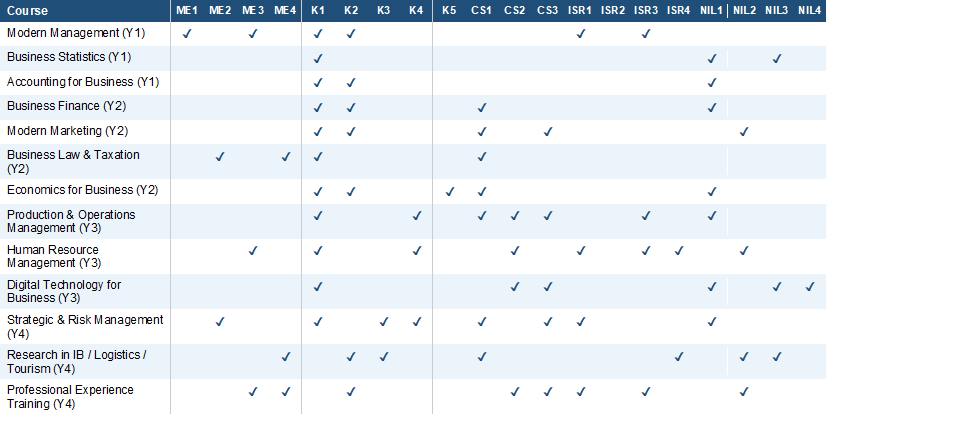
3. Curriculum Mapping — CLO to PLO Alignment (2020 Curriculum)
Curriculum mapping is the primary mechanism for ensuring alignment between Course Learning Outcomes and Programme Learning Outcomes. The following curriculum map shows how selected core and major courses across all year levels contribute to the achievement of the 2020 PLOs. A tick (✓) indicates that the course addresses and assesses the corresponding PLO through its CLOs.
Note: The complete curriculum map covering all courses is documented in TQF 2 (B.E. 2563) and is available as a supporting evidence document for this assessment. It can be viewed here.
4. Sample CLO-PLO Alignment Analysis
The following table presents a detailed illustration of CLO-PLO alignment for two representative courses, demonstrating how individual Course Learning Outcomes are derived from and connected to the Programme Learning Outcomes.
| Course Code | Course Name | Course Learning Outcome | Aligned PLO |
| 214409 | Strategic Management | Demonstrate understanding and practical application of ethical standards in learning, uphold academic integrity, and truthfully present findings and conclusions. | ME2 |
| 214409 | Strategic Management | Demonstrate research knowledge by using various sources of information to understand and solve business case problems, particularly in applying appropriate business strategies. | K3 |
| 214409 | Strategic Management | Analyse case materials requiring strategic management and apply learning in solving business cases and experiential strategic management activities. | CS1 |
| 214409 | Strategic Management | Demonstrate responsibility for self-advancement by using updated information from relevant sources to develop a group term paper on strategic planning. | ISR1 |
| 214409 | Strategic Management | Apply quantitative strategic management tools (SPACE, BCG, TOWS, IE, and Grand Strategy matrices) to position a business unit and identify applicable strategies. | NIL1 |
| 214497 | Research in IB / Logistics / Tourism | Demonstrate disciplined behaviour consistent with social standards and uphold academic integrity by practising the code of conduct inside and outside the classroom. | ME4 |
| 214497 | Research in IB / Logistics / Tourism | Apply research knowledge with concern for social development and conduct research using business and marketing concepts through a multidisciplinary approach. | K2 |
| 214497 | Research in IB / Logistics / Tourism | Analyse the causes of problems or conflicts in order to prevent or resolve issues appropriately. | CS1 |
| 214497 | Research in IB / Logistics / Tourism | Demonstrate leadership by assigning tasks to group members and facilitating the resolution of problems encountered in completing group outputs. | ISR4 |
| 214497 | Research in IB / Logistics / Tourism | Demonstrate communication skills in carrying out professional activities effectively in diverse environments, particularly in relation to globalisation, technology, and the changing nature of work. | NIL2 |
| 214497 | Research in IB / Logistics / Tourism | Use information technology in research operations and demonstrate understanding of software tools that support data analysis and operations management. | NIL3 |
5. Analysis of Alignment
The curriculum map and CLO-PLO alignment examples demonstrate that Course Learning Outcomes across the BBA Programme are not developed independently, but are systematically derived from and connected to the Programme Learning Outcomes. The following observations confirm the comprehensiveness of this alignment:
- Coverage across all PLO domains: The curriculum map confirms that all five learning domains of the 2020 TQF framework — Moral & Ethics, Knowledge, Cognitive Skills, Interpersonal Skills & Responsibility, and Numerical Analysis, Communication & IT — are addressed across multiple courses at all year levels, ensuring progressive and reinforced development of graduate competencies.
- Progressive development: Core courses in Years 1 and 2 focus primarily on foundational knowledge and cognitive skills, while Year 3 and Year 4 courses emphasise application, synthesis, and professional practice — reflecting a deliberate scaffolding of learning aligned with Revised Bloom’s Taxonomy.
- Specialisation alignment: Major specialisation courses in International Business, Logistics Management, and Tourism & Hotel Management address PLOs specific to each field, ensuring that graduates of each specialisation achieve the relevant discipline-specific outcomes in addition to the common programme outcomes.
- 2025 curriculum alignment: For Year 1 and Year 2 students following the 2025 curriculum, CLO-PLO alignment is documented in full in TQF 2 (B.E. 2568), with all 13 PLOs mapped to courses across the revised curriculum structure. This documentation is available as supporting evidence.
Summary
The BBA Programme ensures that Course Learning Outcomes for all courses are appropriately formulated using Revised Bloom’s Taxonomy, clearly aligned with the Programme Learning Outcomes, and systematically monitored through curriculum mapping across both the 2020 and 2025 curricula. The constructive alignment of CLOs with PLOs, teaching and learning activities, and assessment methods ensures that all courses contribute meaningfully to the achievement of the programme’s graduate outcomes, producing graduates equipped with the knowledge, skills, ethical values, and character required for professional success in national and international business environments.
Evidence
| ID_Evidence | Name_Evidence |
| 1.2.1 | Sample TQF 3 and TQF 5 |
| 1.2.2 | TQF 2 |
1.3 The programme to show that the expected learning outcomes consist of both generic outcomes (related to written and oral communication, problem solving, information technology, teambuilding skills, etc) and subject specific outcomes (related to knowledge and skills of the study discipline).
Operational Result
The Bachelor of Business Administration (BBA) International Programme ensures that its Programme Learning Outcomes (PLOs) comprise both generic outcomes – transferable knowledge, skills, attitudes, and values applicable across professional and social contexts — and subject-specific outcomes – knowledge and skills directly related to the discipline of business administration and each of the programme’s three specialisations. This balance is maintained across both the 2020 curriculum (currently followed by Year 3 and Year 4 students) and the 2025 curriculum (currently followed by Year 1 and Year 2 students).
Generic and Subject-Specific Outcomes
Generic outcomes are broad, transferable competencies that graduates can apply across diverse professional, academic, and social contexts, regardless of their field of specialisation. These include:
- Written and oral communication in English and professional settings
- Critical thinking, analytical reasoning, and problem-solving
- Information literacy and digital technology skills
- Teamwork, collaboration, leadership, and interpersonal skills
- Ethical reasoning, integrity, and social responsibility
- Lifelong learning, self-development, and adaptability
- Quantitative reasoning and data interpretation
Subject-specific outcomes are the discipline-based knowledge and skills that define competence in business administration and its specialisation areas. These include:
- Business theories, models, and practices across core functional areas (management, marketing, finance, operations, HR)
- Strategic management and business analysis tools
- Research methodology and evidence-based decision-making in business contexts
- Specialisation-specific knowledge and technical skills in International Business, Logistics Management, and Tourism & Hotel Management
2. Generic and Subject-Specific Outcomes — 2020 Curriculum (Year 3 & 4 Students)
Under the 2020 curriculum, PLOs are grouped across five TQF-HEd learning domains. Each domain integrates both generic and subject-specific dimensions, as shown below:
| PLO Domain | Generic Outcomes | Subject-Specific Outcomes |
| Moral and Ethics | Ethical reasoning, integrity, honesty, self-discipline, punctuality, social responsibility, respect for rules and regulations, academic integrity | Professional ethics in business operations and decision-making, ethical conduct in business research and reporting, adherence to professional codes of conduct |
| Knowledge | General knowledge, lifelong learning, ability to integrate knowledge from different fields, awareness of social, economic, cultural, and technological changes | Business theories and practices, international business knowledge, logistics and supply chain management, tourism and hotel management, strategic management, business research, marketing, finance, and operations management |
| Cognitive Skills | Critical thinking, analytical reasoning, problem-solving, creative thinking, evidence-based decision-making | Business problem analysis, strategic analysis, application of business concepts to industry issues, development of business solutions, application of research findings to professional practice |
| Interpersonal Skills & Responsibility | Teamwork, leadership, communication, responsibility, adaptability, collaboration, human relations, cross-cultural competence | Leadership in business projects, teamwork in case analysis, professional conduct during internship, coordination with business stakeholders, service-mindedness in tourism and hotel contexts |
| Numerical Analysis, Communication & IT | Written and oral communication, information literacy, digital literacy, quantitative reasoning, presentation skills, responsible use of technology | Business data analysis, use of business software (MS Excel, SPSS, Zotero), preparation of business reports and presentations, use of strategic matrices and infographics, digital tools for business operations |
3. Generic and Subject-Specific Outcomes — 2025 Curriculum (Year 1 & 2 Students)eneric and Subject-Specific Learning Outcomes of the BBA Program
The 2025 curriculum restructures PLOs into four domains. Each PLO is explicitly categorised as primarily generic, primarily subject-specific, or integrated (combining both dimensions):
| PLO (2025) | Generic Dimension | Subject-Specific Dimension |
| PLO1 — Knowledge: Business Foundations | Ability to understand and apply theoretical frameworks across disciplines | Core business knowledge: management, marketing, finance, accounting, operations, economics |
| PLO2 — Knowledge: Specialisation | Discipline-specific learning and professional development | IB: international trade, cross-border management Logistics: supply chain, procurement, transportation Tourism & Hotel: hospitality operations, tour management |
| PLO3 — Knowledge: Research | Evidence-based reasoning, information literacy, academic integrity | Business research methodology, data collection and analysis, professional report writing |
| PLO4 — Skills: Critical Thinking | Analytical reasoning, problem-solving, decision-making under uncertainty | Strategic analysis, business case evaluation, application of management frameworks |
| PLO5 — Skills: Communication | Written and oral communication in English, cross-cultural communication | Professional business communication, presentation of business findings, stakeholder reporting |
| PLO6 — Skills: Digital Technology | Digital literacy, responsible use of technology, information management | Business software (Excel, SPSS, Zotero), digital tools for logistics/tourism/IB operations |
| PLO7 — Skills: Creativity & Innovation | Creative thinking, entrepreneurial mindset, adaptability to change | Business innovation, development of value-added solutions in specialisation contexts |
| PLO8 — Ethics: Professional Integrity | Ethical reasoning, honesty, academic integrity | Business ethics, professional codes of conduct, ethical decision-making in business |
| PLO9 — Ethics: Social Responsibility | Environmental awareness, community responsibility, sustainability mindset | Corporate social responsibility, sustainable business practices, ESG considerations |
| PLO10 — Ethics: Academic Honesty | Intellectual integrity, respect for intellectual property | Ethical use of research sources, academic citation, copyright compliance |
| PLO11 — Character: Lifelong Learning | Self-directed learning, adaptability, continuous professional development | Keeping current with business trends, industry developments, and professional standards |
| PLO12 — Character: Service-Mindedness | Positive professional attitude, service orientation, empathy | Customer service in tourism/hotel contexts, stakeholder management in business |
| PLO13 — Character: Global Awareness | Cultural sensitivity, cross-cultural collaboration, global citizenship | International business culture, multicultural team dynamics, global market awareness |
4. Subject-Specific Outcomes by Specialisation
In addition to the common programme outcomes, each specialisation develops distinct subject-specific outcomes that reflect the knowledge and technical competencies required in that field. These are summarised below:
| Specialisation | Key Subject-Specific Outcomes | Representative Courses |
| International Business | Global trade dynamics and international finance; cross-border business management and regulatory frameworks; multinational corporation strategies; export-import operations; foreign investment analysis; international marketing; cross-cultural business negotiation | International Trade, International Finance & Banking, Cross-Cultural Management, Export-Import Management, International Marketing, Global Business Strategy |
| Logistics Management | Supply chain design and management; procurement and sourcing strategies; transportation and distribution systems; inventory and warehouse management; multimodal and shipping operations; logistics data analysis; international trade law and documentation | Logistics & Supply Chain Management, Procurement Management, Transportation & Distribution, Inventory Planning, Warehouse Management, Shipping Business, Legal Aspects of Logistics |
| Tourism & Hotel Management | Hospitality operations management; front office and accommodation management; food and beverage management; MICE planning and coordination; tour business and travel agency operations; tourism marketing; cruise and airline operations; sustainable tourism | Hotel Operations Management, Food & Beverage Management, MICE Management, Tour Business Management, Tourism Marketing, Sustainable Tourism, Cruise & Airline Business |
Through curriculum mapping, the program verifies that each course contributes to the development of both generic and subject-specific competencies. The generic outcomes prepare students to become responsible, ethical, communicative, technologically competent, and collaborative graduates. The subject-specific outcomes prepare students with the required knowledge and skills in business administration and their chosen specialization.
Examples of Generic and Subject-Specific Outcomes in Selected Courses
The following examples show how selected courses integrate both generic and subject-specific learning outcomes.
| Course Code | Course | Course Learning Outcomes | Generic Skills | Subject-Specific Skills |
| 214409 | Strategic Management | Demonstrate understanding and practical application of ethical standards in learning, uphold academic integrity, acknowledge others’ ideas properly, and present findings truthfully. | Ethical reasoning, integrity | Professional ethics in business research and reporting |
| 214409 | Strategic Management | Use various sources of information to advance understanding and solve business case problems by applying appropriate business strategies. | Critical thinking, information literacy | Strategic management, business case analysis |
| 214409 | Strategic Management | Analyze strategic management case materials and apply learning in solving business cases and experiential strategic management activities. | Problem-solving, analytical thinking | Strategic analysis, business decision-making |
| 214409 | Strategic Management | Use updated information from electronic sources and recent references to develop a group term paper on strategic planning. | Communication, self-directed learning, teamwork | Strategic planning, business research |
| 214409 | Strategic Management | Apply quantitative strategic management tools such as SPACE, BCG, TOWS, IE, and Grand Strategy matrices to position a business unit and identify appropriate strategies. | Quantitative analysis, decision-making | Strategic analysis, business portfolio analysis |
| 214497 | Research in International Business / Tourism and Hotel / Logistics Management | Demonstrate disciplined behavior consistent with social standards and uphold academic integrity inside and outside the classroom. | Self-discipline, professionalism, integrity | Professional conduct in business research |
| 214497 | Research in International Business / Tourism and Hotel / Logistics Management | Apply research knowledge with concern for social development and conduct research using business and marketing concepts through a multidisciplinary approach. | Social responsibility, critical thinking | Business research, marketing research, specialization-based research |
| 214497 | Research in International Business / Tourism and Hotel / Logistics Management | Analyze the causes of problems or conflicts in order to prevent or resolve issues appropriately. | Problem-solving, analytical thinking | Business problem analysis |
| 214497 | Research in International Business / Tourism and Hotel / Logistics Management | Demonstrate leadership by assigning tasks to group members and facilitating the resolution of problems encountered in completing group outputs. | Leadership, teamwork, collaboration | Project management, research team management |
| 214497 | Research in International Business / Tourism and Hotel / Logistics Management | Communicate effectively in carrying out professional activities in diverse environments, particularly in relation to globalization, technology, and the changing nature of work. | Oral and written communication, cross-cultural communication | Professional communication in international business, logistics, tourism, and hotel contexts |
| 214497 | Research in International Business / Tourism and Hotel / Logistics Management | Use information technology in research operations and apply software tools to support research, data analysis, and operations management. | Information literacy, digital literacy | Use of MS Excel, Zotero, SPSS, and other research-related tools |
6. Monitoring and Quality Assurance
The programme ensures that both generic and subject-specific outcomes are properly integrated, practised, and assessed through the following monitoring mechanisms:
- TQF 3 Preparation and Review: At the start of each semester, all faculty members prepare TQF 3 course specifications documenting the CLOs, teaching and learning activities, and assessment methods for their assigned courses. The Department Head and designated course checkers review TQF 3 documents to verify that CLOs appropriately reflect both generic and subject-specific dimensions and are aligned with the corresponding PLOs.
- Curriculum Mapping Review: The curriculum committee conducts an annual review of the curriculum map to verify that all PLOs — both generic and subject-specific — receive adequate coverage and progressive development across courses. Any gaps identified in generic or subject-specific outcome coverage are addressed through CLO revision or curriculum adjustment.
- Stakeholder Feedback Integration: Employer satisfaction surveys, internship supervisor evaluations, and alumni feedback are collected and analysed annually. Results are used to assess whether the balance between generic and subject-specific outcomes meets industry expectations. For example, employer feedback indicating that graduates need stronger English communication skills or digital competencies has informed targeted enhancements to generic outcome development in the 2025 curriculum.
- Outcome Achievement Monitoring: Student performance data, including course pass rates, internship supervisor ratings, and capstone project results, are reviewed each semester to assess the extent to which both types of outcomes are being achieved. This data is presented in the programme’s annual quality assurance report and informs the next planning cycle.
7. Analysis
The BBA Programme’s PLO framework — across both the 2020 and 2025 curricula — demonstrates a deliberate and balanced integration of generic and subject-specific outcomes. Several key observations support this conclusion:
- Comprehensiveness: Every PLO domain addresses both generic transferable competencies and discipline-specific knowledge, ensuring that graduates are both broadly capable and professionally specialised.
- Progressive development: Generic outcomes such as communication, teamwork, and critical thinking are introduced in Year 1 foundation courses and progressively developed through Year 4 capstone experiences, including the Professional Experience Training (internship). Subject-specific outcomes deepen progressively from introductory business concepts in Year 1 to advanced specialisation courses and applied research in Years 3 and 4.
- Specialisation differentiation: Each specialisation track develops distinct subject-specific outcomes while maintaining the common generic outcomes required of all BBA graduates, ensuring both breadth and depth of graduate competency.
- Evidence of achievement: Results from the Employer Satisfaction Survey confirm that graduates are rated above 4.0/5.0 across both generic dimensions (e.g., teamwork, ethics, communication) and subject-specific dimensions (e.g., business knowledge application, use of technology), with particular strength in ethical conduct and digital skills.
Evidence
| ID_Evidence | Name_Evidence |
| 1.3.1 | Capstone |
| 1.3.2 | Students’ Research Presentation |
| 1.3.3 | Business Planning and Investment Output |
| 1.3.4 | Food and Beverage Output |
| 1.3.5 | Research Symposium |
| 1.3.6 | Students’ Creative Outputs |
1.4 The programme to show that the requirements of the stakeholders, especially the external stakeholders, are gathered, and that these are reflected in the expected learning outcomes.
Operational Result
The Bachelor of Business Administration (BBA) International Program at St Teresa International University ensures that the requirements and feedback of stakeholders, particularly external stakeholders, are systematically gathered, analyzed, and reflected in the Program Learning Outcomes (PLOs). Stakeholder input informs the formulation, review, and updating of PLOs, Course Learning Outcomes (CLOs), course content, teaching and learning strategies, and student development activities.
1. Stakeholder Identification and Engagement Mechanisms
| Stakeholder Category | Stakeholder Groups | Engagement Mechanisms |
| Internal Stakeholders | Students, faculty members, program administrators, academic and non-academic staff | Student feedback surveys, faculty meetings, curriculum review meetings, program planning sessions, orientation activities |
| External Stakeholders | Employers, internship providers, alumni, industry representatives, parents, professional and government bodies | Employer satisfaction surveys, internship provider feedback forms, alumni consultations, curriculum review meetings with industry representatives, school visits, advisory board discussions |
External stakeholder feedback is given particular emphasis in the program’s quality assurance cycle, as it provides direct evidence of whether graduates meet workplace expectations and industry requirements. The program collects this feedback through structured instruments administered at regular intervals throughout the academic year.
2. Stakeholder Feedback Collection
2.1 Employer Satisfaction Survey
The program conducts an annual Employer Satisfaction Survey to assess the performance of BBA students and graduates against expected learning outcomes. The survey results are presented below. The survey covers three assessment dimensions:
- Five TQF-HEd Learning Outcome Domains: Moral and Ethics, Knowledge, Cognitive Skills, Interpersonal Skills and Responsibility, and Numerical Analysis, Communication and Information Technology Skills.
- Three ONESQA Learner Outcomes: (1) Learner Person, referring to graduates who are self-directed, curious, and committed to lifelong learning; (2) Co-creator, referring to graduates who collaborate effectively with others to generate value and solve problems; and (3) Active Global Citizen, referring to graduates who demonstrate responsibility toward society, culture, and the global community.
- English Proficiency and 21st-Century Skills: Communication in English, digital literacy, critical thinking, creativity, collaboration, and adaptability..
| Specialization | 5 TQF Learning Outcomes (Mean score of 5) | 3 Desirable Outcomes of Education (Mean Score of 5) | English and 21st-Century Skills (Mean Score of 5) |
| Tourism and Hotel Management | 4.27 | 4.12 | 4.11 |
| International Business | 3.90 | 4.08 | 4.00 |
| Logistics Management | 4.19 | 4.24 | 4.33 |
| Overall Average | 4.13 | 4.15 | 4.18 |
Note: Scores above 3.51 are classified as Very Good. All scores in the Employer Satisfaction Survey exceed this threshold, indicating that employers are generally satisfied with BBA graduates across all specializations and all assessment dimensions. Green shading indicates scores at or above 4.20 (Excellent range); blue shading indicates scores between 4.00 and 4.19 (Very Good, upper range).
2.2 Internship Provider Feedback
Internship providers directly observe students’ performance in real workplace settings and provide feedback through structured evaluation forms completed at the end of each internship cycle. Their ratings and comments are reviewed by the program coordinator and used to identify both strengths and areas for improvement in student preparation.
Internship supervisor ratings consistently confirm that BBA students demonstrate competence in professional conduct, teamwork, and task completion. At the same time, supervisors across all three specializations have consistently identified the following areas requiring further development:
- English language proficiency and confidence in workplace communication
- Self-confidence in initiating communication with supervisors and colleagues
- Readiness for job applications, including resume writing and interview preparation
- Familiarity with workplace expectations and professional norms
2.3 Alumni Feedback
Alumni are consulted through annual alumni meetings, post-graduation surveys, and participation in curriculum review activities. Alumni feedback provides a retrospective perspective on the relevance and adequacy of the program’s learning outcomes in preparing them for their careers. Common themes from alumni feedback include the value of the internship experience, the importance of English communication competency in their professional roles, and the relevance of business knowledge and analytical skills developed during the program. Alumni have also recommended strengthening digital skills and professional networking preparation, feedback that has been incorporated into the 2025 curriculum revision.
2.4 Curriculum Review Consultations
Industry representatives, employers, and professional body contacts are invited to participate in curriculum review meetings held as part of the five-year curriculum revision cycle. During the most recent review leading to the 2025 curriculum, external stakeholders provided recommendations on course content updates, emerging competency areas, and the relevance of PLOs to current industry needs. These recommendations directly informed the restructuring of the PLO framework from five TQF domains to four outcome domains (Knowledge, Skills, Ethics, and Character) and the introduction of 13 explicitly defined PLOs in the Revised Curriculum B.E. 2568 (2025).
3. Reflection of Stakeholder Requirements in Program Learning Outcomes
The following table shows how specific stakeholder requirements gathered from employers, internship providers, and alumni are reflected in the BBA Program Learning Outcomes under both the 2020 and 2025 curricula:
| Stakeholder Requirement | Source | Reflected in 2020 PLOs | Reflected in 2025 PLOs |
| Ethical and professional conduct in the workplace | Employers, internship providers | Moral and Ethics (ME1-ME4) | PLO8: Professional Integrity PLO9: Social Responsibility PLO10: Academic Honesty |
| Strong business knowledge and professional competence | Employers, curriculum review | Knowledge (K1-K5) | PLO1: Business Foundations PLO2: Specialization Knowledge |
| Critical thinking and problem-solving in workplace situations | Employers, internship providers | Cognitive Skills (CS1-CS3) | PLO4: Critical Thinking and Problem-Solving |
| Teamwork, leadership, and responsibility | Employers, internship providers | Interpersonal Skills and Responsibility (ISR1-ISR4) | PLO7: Creativity and Innovation PLO12: Service-Mindedness |
| English communication proficiency | Employers, internship providers, alumni | Numerical Analysis, Communication and IT (NIL2) | PLO5: Communication Skills (English and professional) |
| Digital literacy and IT skills for business | Employers, curriculum review | Numerical Analysis, Communication and IT (NIL3-NIL4) | PLO6: Digital Technology Skills |
| Research and analytical capability | Employers, alumni | Knowledge (K3), Cognitive Skills (CS1) | PLO3: Research Knowledge PLO4: Critical Thinking |
| Global awareness and cross-cultural competence | Employers, industry representatives | Interpersonal Skills (ISR3) | PLO13: Cultural Sensitivity and Global Awareness |
| Lifelong learning and adaptability | Alumni, curriculum review | Knowledge (K2), Interpersonal Skills (ISR1) | PLO11: Lifelong Learning Disposition |
| Industry readiness and employability | Employers, internship providers, alumni | All five TQF domains | All 13 PLOs collectively |
4. Program Responses to Stakeholder Feedback
The BBA Program treats stakeholder feedback not merely as information to be recorded, but as actionable input that drives program improvement. The following table documents the specific responses implemented in response to external stakeholder feedback, together with the related PLOs and evidence of implementation:
| Stakeholder Feedback | Program Response | Year Implemented | Related PLOs | Evidence |
| Students need stronger English communication skills | TOEIC practice sessions scheduled in coordination with the Office of Registration | AY 2023-2024 | PLO5 (2025) / NIL2 (2020) | TOEIC session schedules, attendance records, pre/post score comparison |
| Students need greater confidence in workplace communication | Seminars organized for Year 4 students on employment preparation and internship readiness | AY 2023-2024 | PLO5, PLO12 (2025) / ISR1, NIL2 (2020) | Seminar programs, attendance records, student feedback forms |
| Students need better preparation for job applications | Mock job interviews and resume writing workshops conducted | AY 2024-2025 | PLO5, PLO11 (2025) / ISR1, NIL2 (2020) | Workshop materials, attendance records, participant evaluations |
| Students need stronger workplace readiness and professional norms | Career preparation activities and workplace readiness seminars conducted | AY 2024-2025 | PLO8, PLO12 (2025) / ME1, ISR3 (2020) | Activity reports, seminar materials, internship supervisor ratings |
| Alumni recommend stronger digital skills | Enhanced digital tools content integrated into the 2025 curriculum revision | AY 2025-2026 | PLO6 (2025) | 2025 TQF 2, course syllabi for Digital Technology for Business |
| Industry recommends updated PLO framework aligned with global competency standards | 2025 curriculum revision introduced 13 PLOs across four domains aligned with Thailand Higher Education Standards B.E. 2565 and AUN-QA V4.0 | AY 2025-2026 | All 13 PLOs (2025) | Approved TQF 2 (B.E. 2568), registration letter from สป.อว. |
5. Curriculum Review Cycle and Stakeholder Participation
To ensure the curriculum remains responsive to industry requirements and stakeholder expectations, the BBA Program undergoes a comprehensive curriculum review every five years. This review is conducted with active participation from both internal and external stakeholders.
The most recent review cycle culminated in the Revised Curriculum B.E. 2568 (2025), which was formally approved and registered with the Office of the Higher Education Commission (สป.อว.) in May 2025. Key outcomes of this stakeholder-informed revision include:
- Restructuring of the PLO framework from five TQF-HEd domains to four outcome domains (Knowledge, Skills, Ethics, and Character), better reflecting current industry competency expectations.
- Introduction of 13 explicitly defined and measurable PLOs replacing the previous six broadly stated outcomes.
- Strengthened emphasis on English communication (PLO5), digital technology (PLO6), and global awareness (PLO13) in direct response to employer and alumni feedback.
- Integration of character development outcomes (PLO11-PLO13) reflecting both Thai educational values and international graduate attributes.
- Updated specialization content across International Business, Logistics Management, and Tourism and Hotel Management to reflect current industry developments.
The next scheduled curriculum review will take place in 2030 (B.E. 2573), with interim annual reviews of CLOs and course content conducted through the program’s regular quality assurance cycle.
The BBA Program at St Teresa International University demonstrates a systematic and evidence-based approach to gathering and incorporating stakeholder requirements into its expected learning outcomes. External stakeholder feedback is collected through annual employer satisfaction surveys, internship provider evaluations, alumni consultations, and curriculum review meetings with industry representatives. The 2024 Employer Satisfaction Survey results confirm a Very Good level of satisfaction across all specializations, with overall mean scores of 4.13 for TQF learning outcomes, 4.15 for ONESQA learner outcomes, and 4.18 for English and 21st-century skills. Areas for improvement identified by stakeholders have been addressed through targeted interventions and, most significantly, through the 2025 curriculum revision, which restructured the PLO framework and introduced 13 outcomes explicitly aligned with current industry, national, and international quality standards.
Evidence
| ID_Evidence | Name_Evidence |
| 1.4.1 | BBA Performance |
| 1.4.2 | Internship Visit |
| 1.4.3 | Students’ Comments on the Achievement of the Learning Outcomes |
1.5 The programme to show that the expected learning outcomes are achieved by the students by the time they graduate
Operational Result
The Bachelor of Business Administration (BBA) International Program at St Teresa International University ensures that students achieve the expected learning outcomes by the time they graduate through a multi-layered system of academic monitoring, course-level assessment, internship evaluation, post-internship verification, and graduation screening. Evidence of learning outcome achievement is collected throughout the program and reviewed systematically at key milestones.
Academic Monitoring and Graduation Requirements
Student academic progress is monitored every semester to ensure that all required courses and credits are completed in accordance with the TQF 2 curriculum. The following minimum requirements must be met before a student is eligible to proceed to the Professional Experience Training (internship) and to graduate:
| Requirement | Standard | Purpose |
| Minimum Cumulative GPA | 2.00 or above | Confirms satisfactory academic achievement across all courses |
| No Failing Grades | No grade of F in required courses | Ensures all core competencies have been demonstrated |
| Credit Completion | All required credits completed per TQF 2 | Confirms full curriculum coverage |
| Pre-Internship Requirements | Seminar participation, research completion, presentation requirements met | Confirms readiness for workplace application of learning |
| Internship Evaluation | Satisfactory rating from workplace supervisor | Confirms application of PLOs in a real work context |
| Post-Internship Review | Satisfactory post-internship interview and presentation | Final verification of PLO achievement before graduation |
Academic Performance Data
The following table summarizes key academic performance indicators for the BBA Program in AY :
| Performance Indicator | Result | Benchmark |
| Students maintaining cumulative GPA of 2.00 or above | Above 95% | Minimum 80% |
| Core course pass rate | Above 90% | Minimum 80% |
| Students completing internship requirements on schedule | Above 90% | Minimum 85% |
| Graduation rate (students completing within standard duration) | To be updated with final AY data | Minimum 80% |
Internship as Evidence of Learning Outcome Achievement
The internship is an important mechanism used by the BBA Program to verify whether students can demonstrate the expected learning outcomes in real-world workplace settings. During the internship period, the Head of Program or internship coordinator conducts internship visitations to monitor student performance and gather feedback from internship providers. If any issues regarding student performance are identified, the program takes appropriate action.
After completing the internship, students are required to submit weekly reports and present their internship learning experiences to the Faculty of Business Administration. Each report must be verified and signed by the designated workplace supervisor. In addition, the program uses an internship evaluation tool completed by the workplace supervisor or the organization’s head. The evaluation document is submitted confidentially to the Head of Department or internship coordinator in a sealed envelope.
The Head of Department also conducts a post-internship interview to verify the students’ internship experience, supervisor feedback, internship presentation, and evaluation results. This process confirms whether students have achieved the expected learning outcomes before graduation.
Assessment Results of Student Achievement of Learning Outcomes
Internship supervisor evaluations were completed for BBA students across all three specializations during AY 2024-2025. The evaluation instrument assesses student performance across the five learning outcome domains of the 2020 curriculum. Results are summarized below.
Rating scale: 5.00 = Excellent, 4.51-5.00 = Outstanding, 3.51-4.50 = Very Good, 2.51-3.50 = Good, below 2.51 = Needs Improvement. Color coding: Green = 4.50 and above; Blue = 4.00-4.49; Yellow = 3.51-3.99.
| PLO Domain | Average Rating (/ 5.0) | Performance Level |
| LO1: Moral and Ethics | 4.66 | Outstanding |
| LO2: Knowledge | 4.31 | Very Good |
| LO3: Cognitive Skills | 4.31 | Very Good |
| LO4: Interpersonal Skills and Responsibility | 4.46 | Very Good |
| LO5: Numerical Skills and Information Technology | 4.37 | Very Good |
| Overall Average | 4.42 | Very Good |
The results show that all five learning outcome domains received average ratings above 3.51, indicating a Very Good level of achievement. The highest-rated domains were Moral and Ethics (4.66), Interpersonal Skills (4.46) and Numerical Skills and Information Technology (4.37). This shows that students can demonstrate teamwork, communication, leadership, responsibility, data analysis, presentation, and information technology skills in the workplace.
The results also show strong performance in both Knowledge and Cognitive Skills (4.31) indicating that students can demonstrate discipline, honesty, professional ethics, systematic thinking, problem-solving, planning, and decision-making.
Detailed Internship Evaluation Results
LO1 Moral and Ethics
| Indicator | Rating |
| Complete required tasks and fulfill obligations on time | 4.56 |
| Adhere to facts and remain truthful in assigned work | 5.00 |
| Demonstrate academic and professional ethics | 4.44 |
| Show appropriate and suitable behavior | 4.72 |
| Abide by the rules and regulations of the organization and society | 4.56 |
| Average | 4.66 |
The results indicate that students demonstrate strong moral and ethical behavior. Adhering to facts and remaining truthful in assigned work scored the highest (5.00), followed by showing appropriate and suitable behavior (4.72), completing required tasks and fulfilling obligations on time (4.56), and abiding by the rules and regulations of the organization and society (4.56). Demonstrating academic and professional ethics scored the lowest (4.44), which remains satisfactory but could be improved through workplace etiquette training and professional behavior seminars. Overall, the average rating of 4.66 reflects consistent and commendable ethical conduct among students.
LO2 Knowledge
| Indicator | Rating |
| Know the theory and principles related to the work assignment | 4.44 |
| Possess skills and abilities in using tools | 4.17 |
| Apply knowledge in the field of work | 4.5 |
| Communicate, transfer, and summarize work reports | 4.28 |
| Use data from reports to develop and improve work | 4.17 |
| Average | 4.31 |
The results indicate that students are able to apply knowledge effectively in the workplace. Applying knowledge in the field of work received the highest rating (4.50), followed by communicating, transferring, and summarizing work reports (4.28), knowing the theory and principles related to the work assignment (4.44), and possessing skills and abilities in using tools (4.17), which is tied with using data from reports to develop and improve work (4.17). The lowest item suggests that students may benefit from strengthened connections between classroom theories and actual work assignments. Overall, the average rating of 4.31 reflects satisfactory competence in workplace application, with room for improvement in theoretical understanding.
LO3 Cognitive Skills
| Indicator | Rating |
| Analyze work systematically | 4.61 |
| Plan and solve problems systematically | 4.17 |
| Apply knowledge and skills to solve problems appropriately | 4.44 |
| Use analytical and synthetic data in work correctly | 4.17 |
| Propose reasons and suggestions for work improvement | 4.17 |
| Average | 4.31 |
The results indicate that students demonstrate strong cognitive skills. Analyzing work systematically received the highest rating (4.61), followed by applying knowledge and skills to solve problems appropriately (4.44). Planning and solving problems systematically (4.17), using analytical and synthetic data correctly (4.17), and proposing reasons and suggestions for work improvement (4.17) are tied for the lower ratings. These results suggest that the program may continue strengthening planning and problem-solving skills through case analyses, research tasks, and workplace-based projects. Overall, the average rating of 4.31 reflects satisfactory cognitive performance with room for targeted improvement.
LO4 Interpersonal Skills
| Indicator | Rating |
| Show the ability to be a leader and follower | 4.44 |
| Work in a team and solve conflicts within the team | 4.44 |
| Build good relationships with internal and external persons | 4.72 |
| Complete assigned duties within the time limit | 4.56 |
| Take responsibility for work results and correct mistakes | 4.44 |
| Average | 4.46 |
The results indicate that students demonstrate strong interpersonal and professional skills. Building good relationships with internal and external persons received the highest rating (4.72), followed by completing assigned duties within the time limit (4.56). Showing the ability to be a leader and follower (4.44), working in a team and solving conflicts within the team (4.44), and taking responsibility for work results and correcting mistakes (4.44) are tied for the lower ratings. Overall, this is the highest-rated domain, with an average of 4.46, reflecting students’ strong teamwork, leadership, responsibility, and relationship-building abilities in the workplace.
LO5 Numerical Skills and Information Technology
| Indicator | Rating |
| Analyze data comparatively to develop work | 4.17 |
| Communicate with others correctly and appropriately | 4.78 |
| Communicate and obtain cooperation | 4.61 |
| Present data correctly | 4.0 |
| Apply information technology for self-development | 4.28 |
| Average | 4.37 |
The results indicate that students demonstrate strong communication and information-handling skills. Communicating with others correctly and appropriately received the highest rating (4.78), followed by communicating and obtaining cooperation (4.61), applying information technology for self-development (4.28), analyzing data comparatively to develop work (4.17), and presenting data correctly (4.00). Overall, the average rating of 4.37 reflects satisfactory competence in communication, collaboration, and data application, with opportunities to further improve data presentation skills.
4. Post-Internship Seminar
Following the internship period, the Faculty of Business Administration conducts a post-internship seminar for all graduating students. The seminar serves two purposes: first, to allow students to reflect on their internship experiences, identify personal strengths and skill gaps, and consolidate their professional learning; and second, to provide a structured opportunity for students to interact with industry partners, alumni, and professional stakeholders who are invited to participate.
The post-internship seminar contributes to PLO achievement by:
- Providing students with peer and professional feedback on their internship performance and presentations.
- Allowing students to identify and address remaining skill gaps before graduation.
- Connecting graduating students with potential employers and professional networks.
- Gathering feedback from industry participants that informs the next planning cycle for internship preparation and curriculum improvement.
Continuous Improvement through PDCA
The BBA Program uses the PDCA process to ensure that expected learning outcomes are achieved and continuously improved.
Plan:
The program identifies clear criteria for achieving quality learning outcomes. These criteria are based on industry requirements, new business trends, institutional vision and mission, national standards, and global practices.
Do:
The program implements the curriculum through aligned courses, modules, teaching methods, learning activities, and assessments. Curriculum mapping ensures that courses contribute to achieving the Program Learning Outcomes. The program also conducts workshops and meetings with lecturers to align course content, teaching methods, and assessment techniques with the learning outcomes.
Check:
The program regularly assesses learning outcomes through course assessments, examinations, student performance monitoring, internship evaluations, supervisor feedback, post-internship presentations, research outputs, and graduation screening.
Improve:
The results of student assessments, internship evaluations, employer feedback, alum feedback, and stakeholder comments are used to improve teaching and learning strategies, assessment methods, student development activities, and curriculum content. These data are also considered during the five-year curriculum review process.
Evidence
| ID_Evidence | Name_Evidence |
| 1.5.1 | Sample Evaluation and Feedback from the Employers |
| 1.5.2 | Graduates’ Job Status |
| 1.5.3 | Testimonials from Graduates |
| 1.5.4 | Students’ Rating on the Achievement of the Learning Outcomes |
Self-Assessment
| Requirements | Result | Score |
| 1.1 The programme to show that the expected learning outcomes are appropriately formulated in accordance with an established learning taxonomy, are aligned to the vision and mission of the university, and are known to all stakeholders. | / | 1 |
| 1.2 The programme to show that the expected learning outcomes for all courses are appropriately formulated and are aligned to the expected learning outcomes of the programme. | / | 1 |
| 1.3 The programme to show that the expected learning outcomes consist of both generic outcomes and subject specific outcomes. | / | 1 |
| 1.4 The programme to show that the requirements of the stakeholders, especially the external stakeholders, are gathered, and that these are reflected in the expected learning outcomes. | / | 1 |
| 1.5 The programme to show that the expected learning outcomes are achieved by the students by the time they graduate | / | 1 |
| Overall | 5 | |