Criterion 2 – Programme Structure and Content
Criterion
Requirements
Quality level assessment

Result
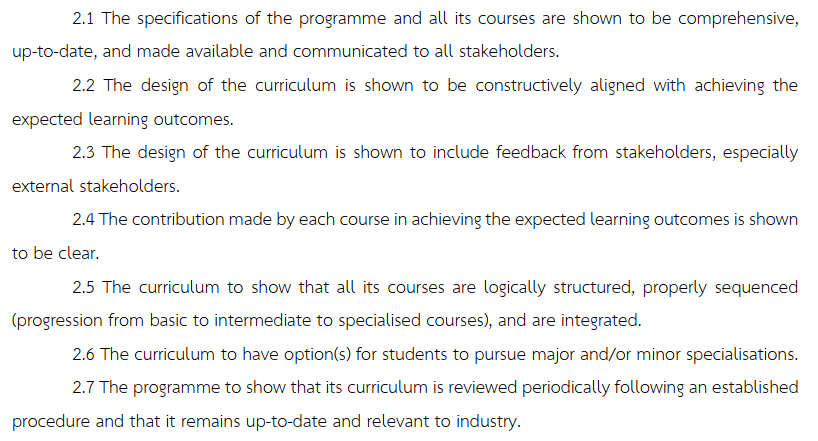
2.1 The specifications of the programme and all its courses are shown to be comprehensive, up-to-date, and made available and communicated to all stakeholders.
Operational Result
Performance
The Bachelor of Business Administration program of St. Teresa International University is committed to producing quality graduates equipped with moral values and integrity, relevant business knowledge and skills, professional competencies, and English language proficiency. The program specifications and course specifications are designed to support the university’s philosophy, vision, mission, and commitment to quality education.
Comprehensive Program and Course Specifications
The BBA program specifications are comprehensive and include essential information such as the program philosophy, objectives, Program Learning Outcomes, curriculum structure, course descriptions, credit requirements, study plan, teaching and learning strategies, assessment methods, internship or cooperative education requirements, and graduation requirements. These specifications provide clear guidance to students, lecturers, administrators, and external stakeholders on the program’s purpose, structure, delivery, and expected outcomes.
Each course in the BBA program is developed with clear Course Learning Outcomes that are aligned with the Program Learning Outcomes. The CLOs are designed using outcomes-based education principles and are guided by Bloom’s Taxonomy to ensure appropriate learning levels. The course specifications also reflect the expected knowledge, skills, and attitudes that students must develop.
| Component of Course Specification | Description |
| Course Title and Code | Identifies the official course name and classification within the curriculum |
| Course Description | Provides the scope, focus, and content of the course |
| Credit Requirements | Indicates the number of credits and learning hours required |
| Course Learning Outcomes | Defines the expected knowledge, skills, attitudes, and competencies students should achieve |
| Teaching and Learning Strategies | Identifies the methods used to deliver the course, such as lectures, discussions, case studies, projects, presentations, research, and practical activities |
| Assessment Methods | Specifies how student achievement will be measured through exams, assignments, presentations, projects, research, internship, or other outputs |
| Course Topics and Schedule | Provides the sequence of lessons, topics, and learning activities |
| Learning Resources | Identifies textbooks, references, digital materials, research resources, and other learning support materials |
| Alignment with PLOs | Shows how the course contributes to the achievement of program outcomes |
Up-to-Date Program and Course Specifications
The BBA program undergoes regular review and revision to ensure its specifications remain current, relevant, and responsive to stakeholder needs and the changing demands of the industry. The program follows the regular five-year curriculum revision cycle. The most recent comprehensive revision was conducted in 2020, during which the program adopted outcomes-based education principles and updated its course descriptions, course content, learning outcomes, teaching and learning strategies, and assessment methods.
The revision process involves reviewing stakeholder needs, industry expectations, institutional priorities, and program outcomes. Inputs from stakeholders are considered in formulating and improving the Program Learning Outcomes and ensuring alignment with the vision and mission of the college and university.
Course specifications are also reviewed every semester through course review processes. Course coordinators and academic staff review feedback, course implementation outcomes, student performance, and stakeholder suggestions. Necessary adjustments are made to improve course content, teaching strategies, assessment methods, learning resources, and alignment with the Program Learning Outcomes.
Availability and Communication to Stakeholders
The program specifications and course information are made available and communicated to stakeholders through various platforms and activities. These ensure that students, lecturers, parents, employers, internship providers, university personnel, and other stakeholders are properly informed about the program structure, expected outcomes, learning requirements, and academic processes.
| Stakeholder Communication Mode | Stakeholders Reached | Purpose |
| Institutional Website | Prospective students, current students, parents, employers, public stakeholders | Provides information on program offerings, curriculum, admission, and academic information |
| Social Media Accounts | Prospective students, current students, parents, alumni, public stakeholders | Communicates updates, activities, announcements, and program-related information |
| Faculty Orientation | Academic staff and lecturers | Communicates program specifications, course requirements, teaching expectations, assessment practices, and academic policies |
| General Orientation | New students and parents | Introduces the program, curriculum structure, academic rules, student services, and learning expectations |
| Intensive English Program Orientation | Students | Communicates English learning expectations, language support, and preparation for academic success |
| Course Orientation / First Class Meeting | Students | Explains the course outline, CLOs, teaching strategies, assessment methods, requirements, and learning resources |
| Pre-Cooperative Education Orientation | Student interns and internship coordinators | Communicates internship requirements, expectations, assessment tools, workplace conduct, and learning outcomes |
| Post-Internship Seminar | Students, lecturers, internship coordinators, industry partners | Shares internship experiences, evaluates learning outcomes, and gathers feedback for improvement |
| Company Visits and Internship Visitation | Employers, internship providers, students, lecturers | Communicates program expectations, monitors student performance, and gathers industry feedback |
| Marketing Activities | Prospective students, parents, schools, external stakeholders | Provides program information and promotes understanding of the BBA curriculum and career opportunities |
Review and Approval of Specifications
The development, review, and approval of program and course specifications follow institutional procedures. Course specifications are reviewed by the course coordinator, Head of Department, Program Committee, Academic Committee, and Dean. Suggestions, comments, and verification results are considered to ensure that the specifications remain accurate, relevant, and aligned with the Program Learning Outcomes.
The program continuously improves its specifications by integrating updated information, learning technologies, teaching strategies, assessment practices, and stakeholder feedback. These processes help ensure that the BBA program remains responsive to academic standards, industry needs, and the expectations of students and other stakeholders.
Overall Result:
The program and course specifications of the Bachelor of Business Administration program are comprehensive, up-to-date, and communicated to stakeholders through multiple platforms and activities. The specifications clearly define the curriculum structure, learning outcomes, course content, teaching and learning strategies, assessment methods, learning resources, and academic requirements. Through regular curriculum review, semester-based course review, stakeholder feedback, and institutional approval processes, the program ensures its specifications remain relevant, accessible, and aligned with the expected learning outcomes and stakeholder needs.
Evidence
2.2 The design of the curriculum is shown to be constructively aligned with achieving the expected learning outcomes.
Operational Result
Performance
The Bachelor of Business Administration program ensures that its curriculum is constructively aligned with the expected learning outcomes. The curriculum design follows outcomes-based education principles, aligning the Program Learning Outcomes, Course Learning Outcomes, teaching and learning strategies, assessment methods, and course content to ensure that students progressively develop the expected knowledge, skills, values, professional competencies, communication abilities, and practical business capabilities.
The curriculum is designed to support the university’s vision and mission and to respond to the needs of stakeholders, the labor market, and the business industry, particularly in the areas of International Business, Logistics Management, Tourism, and Hotel Management. The alignment of the curriculum is reviewed through TQF 2 and TQF 3, course reviews, curriculum meetings, and stakeholder feedback.
System and Mechanism for Curriculum Alignment
| Process | Implementation |
| Curriculum Planning and Review | The Program Coordinator organizes meetings with full-time lecturers to assess the achievement of the objectives of the current curriculum and identify areas for improvement. |
| Curriculum Development or Revision | The program prepares plans for new curriculum development or revision of the existing curriculum based on institutional requirements, government regulations, stakeholder feedback, market needs, and industry trends. |
| Review of TQF 3 | An appointed committee reviews the teaching plan and assessment plan of lecturers through the TQF 3 to ensure that course delivery is aligned with the Course Learning Outcomes and Program Learning Outcomes. |
| Alignment of Teaching and Learning Activities | The TQF 3 clearly states the learning outcomes, course content, teaching strategies, learning activities, and assessment methods used to achieve the intended outcomes. |
| Use of TQF 2 as Curriculum Guide | The TQF 2 serves as the main reference for evaluating whether all courses are delivered in accordance with the approved curriculum structure and expected outcomes. |
| Continuous Course Improvement | Improvements identified from course implementation, stakeholder feedback, student performance, and TQF 5 results are incorporated into the next offering of the same course. |
| Stakeholder and Market Responsiveness | The delivery of courses is continuously improved based on the needs of the market, stakeholders, logistics industry, tourism and hotel industry, and available institutional resources. |
Constructive Alignment of Curriculum Components
| Curriculum Component | Constructive Alignment |
| Program Learning Outcomes | Define the expected competencies of BBA graduates in ethics, knowledge, cognitive skills, interpersonal skills, responsibility, numerical analysis, communication, and information technology. |
| Course Learning Outcomes | Each course has specific CLOs that are derived from and aligned with the Program Learning Outcomes. |
| Course Content | Course topics and learning materials are selected to support the achievement of the CLOs and PLOs. |
| Teaching and Learning Strategies | Teaching methods such as lectures, discussions, case studies, simulations, research activities, business plans, presentations, practical activities, and internship are selected based on the intended outcomes. |
| Assessment Methods | Examinations, assignments, case analyses, projects, presentations, research outputs, capstone activities, internship reports, and performance-based assessments are used to measure students’ achievement of the learning outcomes. |
| Course Review and Improvement | TQF 5 results, lecturer reflections, student performance, and stakeholder feedback are used to improve course delivery and curriculum alignment. |
Alignment of Learning Outcome Domains with Curriculum Design
| Learning Outcome Domain | Expected Learning Outcomes | Curriculum Design and Delivery |
| Group 1: Moral and Ethics | Students are expected to demonstrate personal integrity, professional ethics, self-discipline, responsibility, leadership, volunteerism, and respect for social standards. | The curriculum integrates ethics-related topics, classroom discipline, group work, case analysis, role-playing, community-related activities, and professional conduct expectations. These help students develop moral values, responsibility, honesty, and ethical behavior in academic and professional settings. |
| Group 2: Knowledge | Students are expected to acquire systematic, global, and up-to-date knowledge of business theories and practices. They are also expected to apply knowledge in accounting, finance, business law, taxation, management, economics, statistics, international business, logistics, tourism, and hospitality. | The curriculum includes general education, core business courses, major courses, research-related courses, and professional courses. These courses develop students’ business knowledge, analytical ability, research capability, and understanding of current business and industry practices. |
| Group 3: Cognitive Skills | Students are expected to analyze problems, apply theoretical and practical knowledge, solve business issues, conduct research, use statistical data, and create innovative solutions. | The curriculum uses case studies, research activities, capstone projects, business plans, simulations, data analysis tasks, problem-solving exercises, and field-based learning to develop critical thinking and problem-solving skills. |
| Group 4: Interpersonal Skills and Responsibilities | Students are expected to communicate with different groups of people, work as leaders and team members, demonstrate responsibility, and apply knowledge to support society. | The curriculum includes group projects, presentations, collaborative learning activities, internship, advisory activities, and classroom discussions. These activities develop teamwork, leadership, responsibility, communication skills, and professional behavior. |
| Group 5: Numerical Analysis, Communication, and Information Technology Skills | Students are expected to use statistical and mathematical techniques, communicate effectively in oral and written forms, use appropriate presentation formats, apply information technology, and produce original digital outputs with respect for copyright. | The curriculum includes data analysis, research, business communication, English language development, IT-based learning activities, multimedia presentations, video or infographic production, and technology-supported assignments. |
Mapping of Course Learning Outcomes to Program Learning Outcomes
| CLO Group | Course Learning Outcomes | Related Program Learning Outcomes |
| E1: Personal Integrity | Resolve conflicts using ethical and moral judgment. | Exhibit moral values and integrity; demonstrate responsibility toward oneself and society. |
| E2: Professional Ethics | Show consistency between moral and ethical beliefs and behavior. | Exhibit academic and professional ethics; respect institutional and organizational rules. |
| E3: Fellowship of Society | Demonstrate self-responsibility, leadership, membership roles, and volunteerism for social development. | Possess self-discipline, responsibility, and positive personality traits. |
| E4: Self-Actualization and Discipline | Demonstrate self-discipline consistent with good social standards. | Exhibit discipline in studies and personal life. |
| K1: Professional Knowledge | Explain systematic, global, and up-to-date business theories and practices. | Possess business, economics, statistics, accounting, finance, law, taxation, management, and major-specific knowledge. |
| K2: Application of Knowledge | Apply business concepts to other relevant fields. | Apply basic knowledge in business management, production management, and management information technology. |
| K3: Research Know-How | Demonstrate procedural knowledge in research for professional and knowledge advancement. | Research, analyze, and synthesize information for business presentations and communication. |
| K4: System Analysis and Improvement | Analyze, design, and improve management systems to meet professional requirements. | Apply professional knowledge in International Business, Logistics Management, Tourism, and Hospitality. |
| C1: Problem Solving | Analyze causes of problems or conflicts and propose appropriate solutions. | Demonstrate critical thinking, business research skills, and problem-solving ability. |
| C2: Knowledge Application | Apply theoretical and practical knowledge in field work, practicum, or actual jobs. | Use professional knowledge and skills in real business or workplace contexts. |
| C3: Professional and Personal Development | Apply business or technical innovation to improve professional effectiveness. | Extend ideas to create innovation and prepare for higher-level study or professional development. |
| I1: Communication | Communicate effectively with different groups of people in Thai and foreign languages. | Demonstrate English language skills and effective communication in academic and professional settings. |
| I2: Teamwork and Leadership | Assist and facilitate group situations as both leader and team member. | Demonstrate good human relations, teamwork, responsibility, and leadership. |
| I3: Social Guidance | Use knowledge to guide society on appropriate issues. | Apply knowledge responsibly in social and professional contexts. |
| I4: Responsibility | Be responsible for one’s own actions and group work. | Demonstrate responsibility, professional ethics, and accountability. |
| N1: Numerical Analysis | Use statistical or mathematical techniques to interpret information and solve problems. | Analyze data and use quantitative tools for business decision-making. |
| N2: Communication | Communicate effectively in oral and written forms using suitable presentation styles. | Possess English proficiency and communicate effectively in business contexts. |
| N3: Information Technology | Select appropriate information technology and communication techniques for collecting, interpreting, and communicating information. | Search for information and use technology responsibly and effectively. |
| N4: Digital Output and Copyright Awareness | Produce videos or infographics without copying others’ work and with respect for copyright. | Demonstrate digital literacy, originality, and ethical use of information. |
Result
The Bachelor of Business Administration curriculum is constructively aligned with the expected learning outcomes through the systematic connection of PLOs, CLOs, course content, teaching and learning activities, assessment methods, and continuous course improvement. The program remains responsive to the demands of International Business, Logistics Management, Tourism, and Hotel Management through curriculum review, stakeholder consultation, and alignment with government and institutional standards.
Through the use of TQF 2, TQF 3, course review, committee evaluation, stakeholder feedback, and continuous improvement mechanisms, the program ensures that students receive relevant learning experiences and appropriate assessment methods that support the achievement of the expected learning outcomes. The curriculum design supports quality education, professional readiness, ethical development, communication competence, research capability, and practical business application.
Evidence
| ID_Evidence | Name_Evidence |
| 2.2.1 | Committee for curriculum review |
| 2.2.2 | TQF 2 |
| 2.2.3 | University Website |
| 2.2.4 | Brochures |
| 2.2.5 | Employers’ Feedback/Comments |
| 2.2.6 | Students’ Feedback |
2.3 The design of the curriculum is shown to include feedback from stakeholders, especially external stakeholders.
Operational Result
Performance
The Bachelor of Business Administration (BBA) program introduces the curriculum to first-year students during both the English Intensive Program General Orientation and the First Semester General Orientation. In addition, the university website provides detailed curriculum information, enabling stakeholders to easily access and understand the program structure, course specifications, and expected learning outcomes.
Furthermore, St Teresa International University conducts annual enrollment consultations, during which the Faculty of Business Administration presents the BBA program to high school students and parents nationwide. These activities strengthen stakeholder awareness and engagement regarding the program offerings and educational objectives.
At the beginning of each semester, lecturers provide students with comprehensive course orientations that include discussions on course objectives, curriculum content, teaching and learning strategies, assessment methods, and expected learning outcomes. Lecturers are also encouraged to upload learning materials, references, and other relevant resources to Google Classroom to ensure accessibility and continuous student support throughout the semester.
Systems and Mechanisms
To ensure that the curriculum remains relevant, responsive, and aligned with industry standards, the program implements the following systems and mechanisms:
- A curriculum review committee is established, comprising program lecturers, industry partners, practitioners, internship providers, students, and alums. The committee facilitates the curriculum review and revision process and identifies relevant stakeholders for participation.
- Formal communication is initiated with identified stakeholders to request their professional expertise and valuable insights in reviewing and improving the curriculum.
- Stakeholders are provided with previous curriculum documents and related materials to support informed evaluation and recommendations.
- Stakeholders are invited to participate in formal consultations, meetings, and discussions to provide feedback and recommendations.
- The committee carefully deliberates stakeholder feedback to determine appropriate revisions and to integrate emerging industry practices, professional standards, and market demands into the curriculum.
Assessment of the Process
The curriculum review and feedback process ensures the program maintains high academic standards and industry relevance. It also enhances graduate employability by continuously improving course descriptions, learning outcomes, teaching and learning strategies, assessment methods, and learning content.
The program implements the following assessment procedures:
- The program organizes meetings to discuss the significance of data and evidence in measuring the attainment of curriculum objectives and program outcomes.
- Survey questionnaires are administered to stakeholders, particularly at the end of each academic year, to evaluate the curriculum’s effectiveness and relevance.
- The program analyzes survey findings and formulates recommendations for curriculum enhancement and development.
- A revised curriculum draft is prepared and presented to the College Council for review and approval.
- The finalized curriculum is submitted to the college and subsequently endorsed to the Ministry of Higher Education, Research and Innovation for final approval.
- Faculty members implement the approved curriculum each semester and provide recommendations through TQF5 reports to further improve course plans, instructional strategies, and assessment practices.
Improvement
The BBA curriculum is continuously reviewed and improved to ensure alignment with assessment criteria, institutional goals, and stakeholder expectations. Regular meetings are held among lecturers, the program head, and the dean to evaluate program implementation, identify areas for improvement, and develop appropriate action plans for unresolved concerns or unmet objectives.
Results
The BBA program continuously identifies its strengths and opportunities and maintains effective practices that contribute to high-quality educational standards and student development. At the same time, identified weaknesses and potential threats are carefully analyzed to minimize risks and improve program effectiveness.
Assessment results and recommendations are presented to the university administration and University Council for further discussion, decision-making, and implementation of appropriate solutions and continuous quality improvement initiatives.
Evidence
| ID_Evidence | Name_Evidence |
| 2.3.1 | University Website |
| 2.3.2 | Brochures |
| 2.3.3 | Curriculum Committee Review |
| 2.3.4 | Students’ Feedback |
| 2.3.5 | Employers’ Feedback/Comments |
| 2.3.6 | Teachers’ Feedback |
2.4 The contribution made by each course in achieving the expected learning outcomes is shown to be clear.
Operational Result
Performance
The Bachelor of Business Administration program ensures that the contribution of each course to the achievement of the expected learning outcomes is clearly identified and documented. Each course in the curriculum is designed to support specific Program Learning Outcomes and Course Learning Outcomes, ensuring that students progressively develop the required knowledge, skills, values, attitudes, and professional competencies expected of BBA graduates.
The contribution of each course is clearly shown through the curriculum mapping stipulated in the TQF 2, which the government duly approves. The curriculum map identifies how general education courses, core business courses, major courses, elective courses, internship, research, and capstone-related activities contribute to the achievement of the expected learning outcomes. This mapping enables the program to determine whether each course introduces, reinforces, or develops the specific competencies students need.
Stakeholder insights, feedback, expertise, and industry experience inform the design and alignment of the courses. Inputs from lecturers, students, alums, employers, internship providers, and other stakeholders are considered in improving the implementation and delivery of the curriculum. These inputs help ensure that each course remains relevant, outcome-based, and responsive to academic and industry needs.
The contribution of each course is further reflected in the TQF 3, where the Course Learning Outcomes, course content, teaching and learning strategies, and assessment methods are aligned with the Program Learning Outcomes. Through this alignment, lecturers are guided in delivering each course in line with its intended contribution to the overall achievement of the program outcomes.
| Evidence of Course Contribution | Description |
| Curriculum Mapping in TQF 2 | Shows the relationship between courses and Program Learning Outcomes and identifies how each course contributes to the expected learning outcomes. |
| Course Learning Outcomes in TQF 3 | Defines the specific outcomes that students are expected to achieve in each course. |
| Alignment of CLOs and PLOs | Ensures that each course supports one or more Program Learning Outcomes. |
| Teaching and Learning Strategies | Shows how course activities are designed to help students achieve the intended outcomes. |
| Assessment Methods | Measures whether students have achieved the Course Learning Outcomes and their related Program Learning Outcomes. |
| Stakeholder Feedback | Provides input for improving course relevance, delivery, and contribution to graduate competencies. |
Overall Result:
The contribution of each course in achieving the expected learning outcomes is clear, documented, and systematically aligned through the TQF 2 curriculum mapping and TQF 3 course specifications. This ensures that every course has a defined role in developing BBA students’ competencies and contributes to the overall attainment of the Program Learning Outcomes.
Evidence
| ID_Evidence | Name_Evidence |
| 2.4.1 | Curriculum Mapping |
| 2.4.2 | PLO-CLO-ULO Mapping |
2.5 The curriculum to show that all its courses are logically structured, properly sequenced (progression from basic to intermediate to specialised courses), and are integrated.
Operational Result
Performance
The Bachelor of Business Administration program has established a logical, progressive course sequence that guides students from foundational learning to intermediate business knowledge and, finally, to specialized, applied professional courses. The curriculum is structured to ensure that students acquire the necessary knowledge, skills, values, and competencies gradually throughout the program.
The Head of the Program is responsible for managing the appropriate semester offering of courses and ensuring that students enroll in subjects suitable to their year level and academic progression. This process helps ensure that students take the required courses at the proper time and are adequately prepared before moving to more advanced and specialized subjects.
Curriculum Progression and Course Sequencing
| Year Level / Stage | Course Focus | Description of Progression |
| Intensive English Program | English language preparation | New students are provided with basic English communication training focusing on the four language skills: reading, writing, speaking, and listening. This prepares students for English-medium instruction and academic communication. |
| Year 1: Foundational Stage | General education and basic business foundation | Students take general education courses that strengthen communication skills, interpersonal skills, personality development, and basic academic competencies. They are also introduced to foundational business courses such as Modern Management, Principles of Accounting, Marketing, and Economics. |
| Years 2–3: Intermediate and Core Business Stage | Core business and professional knowledge | Students take core and professional courses in areas such as accounting, taxation, finance, management, marketing, logistics, international business, tourism, and hotel management. These courses develop students’ analytical skills, decision-making ability, technical knowledge, and understanding of business operations. |
| Year 4, Term 1: Advanced and Integrative Stage | Strategic management, research, and internship preparation | Students take advanced and integrative courses such as Strategic Management and Basic Research. These courses serve as culminating academic experiences where students integrate knowledge gained from previous courses. Students also take Pre-Cooperative Education, which provides seminars, lectures, professional development activities, and preparation for internship. |
| Year 4, Term 2: Applied Professional Stage | Internship / cooperative education | Students undertake internship or cooperative education in actual workplace settings. This allows them to apply classroom learning to real industry situations and develop professional competencies, workplace ethics, communication skills, and practical business experience. |
Logical Structure of the Curriculum
The curriculum is organized to support a clear progression from basic to advanced learning. Students first develop general education competencies and basic business knowledge before moving to core business subjects and major-specific professional courses. In the later years, students engage in integrative and applied learning activities, including research, strategic management, capstone-related outputs, pre-cooperative education, and internship.
| Curriculum Level | Learning Emphasis | Examples of Course / Activity Areas |
| Basic Level | Communication, general education, personal development, and business foundation | Intensive English, general education, modern management, accounting, marketing, economics |
| Intermediate Level | Core business knowledge, technical skills, and analytical thinking | Finance, taxation, business law, management, logistics, tourism, hospitality, business communication |
| Specialized Level | Major-specific knowledge and professional competencies | International business, logistics management, tourism and hotel management specialization courses |
| Integrative Level | Application, synthesis, and strategic thinking | Strategic management, basic research, case analysis, business projects, capstone-related activities |
| Applied Level | Workplace application and professional practice | Pre-cooperative education, internship, internship report, industry-based learning |
Integration of Courses
The curriculum is integrated through the alignment of general education courses, core business courses, major courses, research, strategic management, and internship. Earlier courses provide the foundation for more advanced courses, while later courses require students to apply and synthesize knowledge gained from previous learning experiences. For example, students use communication skills from general education courses in presentations, apply accounting and finance knowledge in business planning, use research skills in basic research, and integrate management concepts in Strategic Management and an internship.
The inclusion of Pre-Cooperative Education before the internship ensures that students are professionally, academically, and personally prepared before entering the workplace. The internship then serves as the final applied learning experience in which students demonstrate the integration of knowledge, skills, ethics, communication abilities, and professional behavior.
Overall Result:
The Bachelor of Business Administration curriculum is logically structured, properly sequenced, and integrated. It provides students with a clear progression from foundational courses to intermediate core business courses, specialized professional courses, integrative academic experiences, and applied workplace learning. This sequencing supports students’ academic development, professional readiness, and achievement of the program’s expected learning outcomes.
Evidence
| ID_Evidence | Name_Evidence |
| 2.5.1 | TQF 2 |
| 2.5.2 | Study Plan |
2.6 The curriculum to have option(s) for students to pursue major and/or minor specialisations.
Operational Result
Performance
The Bachelor of Business Administration program provides students with opportunities to pursue major specializations based on their academic interests, career goals, and industry needs. The program offers three international major specializations: International Business, Logistics Management, and Tourism and Hotel Management. These specializations are approved by the government and are stipulated in the TQF 2.
Each major specialization requires students to complete a minimum of 126 credits, which are structured to ensure that students acquire general education competencies, foundational business knowledge, specialized professional skills, and broader learning experiences through elective and free elective courses.
Curriculum Structure by Credit Distribution
| Course Category | Credits | Description |
| General Education Courses | 30 credits | These courses provide students with a well-rounded education and develop competencies in communication, critical thinking, ethics, social responsibility, technology, and other general academic disciplines. |
| Business Basic Courses | 42 credits | These foundational business courses equip students with core knowledge and skills in business areas such as management, accounting, economics, marketing, finance, business law, taxation, and related fields. |
| Required Courses / Major Specialization Courses | 39 credits | These industry-based courses develop specific knowledge and professional competencies in the student’s chosen specialization, such as International Business, Logistics Management, or Tourism and Hotel Management. |
| Elective Courses | 9 credits | These courses support and enhance the knowledge and skills gained in the major specialization and allow students to deepen their learning in related areas. |
| Free Elective Courses | 6 credits | These courses allow students to pursue personal interests, broaden their academic experience, and support individual learning goals. |
| Total | 126 credits | Minimum credit requirement for completion of the Bachelor of Business Administration program. |
Available Major Specializations
| Major Specialization | Focus of Study | Expected Competency Development |
| International Business | International trade, global business operations, cross-cultural business practices, international marketing, and global management | Develops students’ ability to understand and operate in international business environments and respond to global market demands |
| Logistics Management | Supply chain management, transportation, warehousing, distribution, logistics systems, and operations management | Prepares students to manage logistics processes, analyze supply chain operations, and support efficient business movement and distribution |
| Tourism and Hotel Management | Tourism operations, hospitality management, hotel services, food and beverage operations, service quality, and customer experience | Develops students’ professional skills for tourism, hospitality, service operations, and customer-centered management |
Through these specialization options, students can select a field that aligns with their interests and future career plans. The required courses provide depth in the chosen major. In contrast, elective courses offer students flexibility to strengthen related skills, explore additional areas of interest, and support their academic and professional development.
Overall Result:
The Bachelor of Business Administration curriculum offers clear major specialization options through its three approved international programs: International Business, Logistics Management, and Tourism and Hotel Management. The curriculum structure, comprising general education, business basics, required specialization courses, elective courses, and free elective courses, ensures that students receive both broad-based business education and focused professional preparation in their chosen field.
Evidence
| ID_Evidence | Name_Evidence |
| 2.6.1 | TQF 2 |
2.7 The programme to show that its curriculum is reviewed periodically following an established procedure and that it remains up-to-date and relevant to industry.
Operational Result
Performance
The Bachelor of Business Administration program ensures its curriculum is periodically reviewed through an established procedure to maintain relevance, currency, and responsiveness to industry needs. The curriculum review is conducted every five years, in accordance with government requirements, to ensure the program remains aligned with technological developments, industry trends, labor market expectations, stakeholder feedback, and the institution’s vision and mission.
The program recognizes the important role of industry partners, internship providers, employers, alums, students, lecturers, and other stakeholders in curriculum development and improvement. Their inputs help ensure that the curriculum prepares students to become globally competitive, socially responsible, and professionally competent graduates equipped with the necessary knowledge, skills, values, attitudes, and competencies required by the business, logistics, tourism, and hospitality industries.
System and Mechanism for Curriculum Review
| Process | Implementation |
| Periodic Curriculum Review | The BBA curriculum is reviewed every five years as mandated by government regulations to ensure that it remains updated, relevant, and responsive to technological advancement and industry standards. |
| Current Curriculum Approval | The current TQF 2 of the Bachelor of Business Administration program was approved in 2020. The revision of the new curriculum is ongoing and intended for implementation in 2025. |
| Appointment of Curriculum Review Committee | The program and the Faculty of Business Administration appoint internal and external committee members to review and enhance the curriculum. This ensures that both academic and industry perspectives are considered. |
| Stakeholder Consultation | Feedback is gathered from lecturers, students, alumni, employers, internship providers, industry partners, and other stakeholders to identify strengths, gaps, and areas for improvement. |
| Review of Curriculum Components | The committee reviews the course descriptions, learning objectives, Program Learning Outcomes, Course Learning Outcomes, course content, assessment methods, teaching and learning strategies, learning resources, and industry relevance. |
| Analysis of Feedback | The program and faculty analyze consolidated stakeholder feedback for discussion and consideration in curriculum revision. |
| Curriculum Enhancement | Necessary changes and updates are incorporated into the curriculum to improve relevance, quality, and responsiveness to industry needs. |
| Communication of Changes | Approved curriculum changes are communicated to faculty members, students, and relevant stakeholders to ensure transparency, preparedness, and proper implementation. |
Assessment of the Curriculum Review Process
The curriculum review process is assessed through regular monitoring, stakeholder feedback, course review, and academic documentation. Lecturers regularly update the courses they teach based on their academic expertise, industry experience, course implementation results, and student performance. Recommendations from students during the final presentation in Cooperative Education are also consolidated and communicated to the program faculty for discussion and possible integration.
Improvements identified from these reviews are reflected in the TQF 3 in the succeeding semester, subject to checking and approval. This ensures that course-level improvements are implemented continuously, even within the five-year curriculum review cycle.
| Review Area | Assessment Process | Use of Results |
| Government-Mandated Curriculum Review | The curriculum is reviewed every five years to comply with government standards and requirements. | Ensures that the program remains officially compliant, updated, and aligned with national higher education standards. |
| Industry Relevance | Inputs from industry partners, internship providers, and employers are reviewed. | Helps align course content, skills development, and professional preparation with industry expectations. |
| Stakeholder Feedback | Feedback from students, lecturers, alumni, employers, and internship providers is consolidated and analyzed. | Used to identify curriculum gaps, strengthen course content, and improve teaching and learning strategies. |
| Course-Level Review | Lecturers review course implementation and update the TQF 3 based on previous findings and recommendations. | Ensures continuous improvement of course content, learning activities, assessment methods, and learning resources. |
| Cooperative Education Feedback | Recommendations from student final presentations and internship experiences are gathered and discussed. | Used to improve internship preparation, professional competencies, and curriculum relevance to workplace needs. |
| Curriculum Committee Review | Internal and external committee members evaluate the curriculum structure, learning outcomes, course descriptions, and assessment approaches. | Ensures that the curriculum reflects both academic standards and current industry practices. |
| Communication of Revisions | Curriculum changes are communicated to faculty, students, and stakeholders. | Promotes transparency, readiness, and consistent implementation of curriculum updates. |
Results of the Curriculum Review Process
The established curriculum review process has resulted in a more relevant, updated, and industry-responsive Bachelor of Business Administration curriculum. The review process supports continuous curriculum enhancement and ensures that the program remains aligned with industry needs, technological advancement, academic standards, and stakeholder expectations.
| Result Area | Outcome |
| Updated Curriculum | The curriculum reflects current industry needs, practices, technological developments, and professional standards. |
| Improved Student Learning Experience | Students benefit from updated course content, relevant learning activities, and industry-based learning experiences. |
| Graduate Competency Development | Graduates are expected to possess the knowledge, skills, attitudes, competencies, and professional values desired by employers. |
| Industry Linkages | Industry partners view the program more favorably through internships, employment opportunities, seminars, company visits, and collaborations. |
| Faculty Development | Faculty members improve their teaching methods, update course content, and participate in professional development aligned with curriculum enhancement. |
| Regulatory Compliance | The curriculum remains compliant with government requirements and institutional standards. |
| Student Retention and Satisfaction | A relevant and career-oriented curriculum supports student satisfaction and may contribute to improved student retention. |
Overall Result:
The Bachelor of Business Administration program follows an established, periodic curriculum review process to ensure the curriculum remains up-to-date, relevant, and responsive to industry needs. Through the five-year curriculum revision cycle, stakeholder consultation, curriculum committee review, course-level updates, Cooperative Education feedback, and communication of approved changes, the program continuously enhances its curriculum to support student development, graduate employability, industry relevance, and compliance with government standards.
Evidence
| ID_Evidence | Name_Evidence |
| 2.7.1 | TQF 2 |
| 2.7.2 | Curriculum Committee Review |
| 2.7.3 | Students’ Feedback |
| 2.7.4 | Alumni Feedback |
| 2.7.5 | Stakeholders’ Feedback |
| 2.7.6 | Employers’ Comments/Feedback |
| 2.7.7 | Students’ Internship |
Self-Assessment
| Requirements | Result | Score |
| 2.1 The specifications of the programme and all its courses are shown to be comprehensive, up-to-date, and made available and communicated to all stakeholders. | / | 1 |
| 2.4 The contribution made by each course in achieving the expected learning outcomes is shown to be clear. | / | |
| 2.2 The design of the curriculum is shown to be constructively aligned with achieving the expected learning outcomes. | / | 1 |
| 2.3 The design of the curriculum is shown to include feedback from stakeholders, especially external stakeholders. | / | |
| 2.5 The curriculum to show that all its courses are logically structured, properly sequenced and integrated. | / | 1 |
| 2.6 The curriculum to have option(s) for students to pursue major and/or minor specialisations. | / | 1 |
| 2.7 The programme to show that its curriculum is reviewed periodically following an established procedure and that it remains up-to-date and relevant to industry. | / | 1 |
| Overall | 5 | |