Criterion 5 – Academic Staff
Criterion
Requirements
Quality level assessment

Result
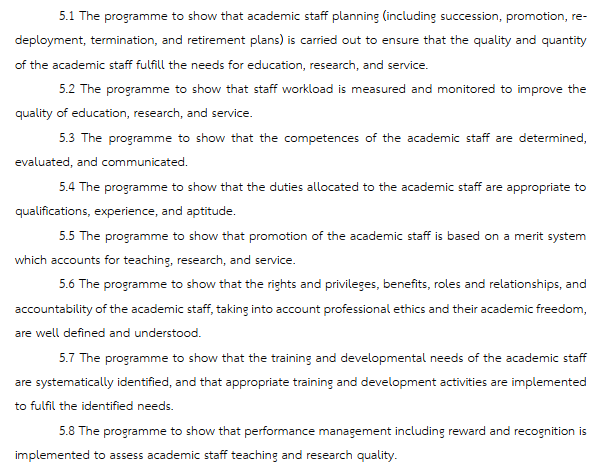
5.1 The programme to show that academic staff planning (including succession, promotion, re-deployment, termination, and retirement plans) is carried out to ensure that the quality and quantity of the academic staff fulfill the needs for education, research, and service.
Operational Result
Performance
The Faculty of Business Administration, which oversees the Bachelor of Business Administration program, prioritizes academic staff planning to ensure that the program has a sufficient number of qualified faculty members to support teaching, research, academic service, student advising, internship supervision, and program development. Academic staff planning is carried out based on the needs of the curriculum, number of course offerings, faculty specialization, workload distribution, research requirements, student support needs, and institutional objectives.
For lecturers specializing in International Business, Logistics Management, and Tourism and Hospitality Management, a comprehensive faculty assignment and development plan was developed and communicated during the Faculty Meeting for Academic Year 2023–2024. This plan identified the responsibilities and tasks assigned to each lecturer, including teaching assignments, course preparation, student advising, research involvement, quality assurance responsibilities, internship supervision, and participation in faculty or program activities. The lecturers fulfilled these assigned responsibilities, tailored to their expertise and institutional expectations.
The Faculty also implements systems and mechanisms to develop, promote, and support academic staff, ensuring their competencies remain relevant to the needs of education, research, and service. These include training, mentoring, research support, academic title preparation, quality assurance capacity-building, and internship advising development.
| Academic Staff Planning Area | Implementation / Mechanism | Contribution to Education, Research, and Service |
| Staff Requirement and Workload Planning | Teaching assignments and responsibilities are planned based on course offerings, faculty specialization, academic workload, and program needs. | Ensures that courses are handled by lecturers with appropriate expertise and that teaching, advising, research, and service duties are distributed properly. |
| Succession Planning | Senior and experienced lecturers provide guidance to new or junior faculty members through mentoring and participation in program activities. Potential faculty members are prepared for future roles such as course coordinator, adviser, committee member, or internship supervisor. | Supports continuity in teaching, program operations, academic advising, research supervision, and leadership responsibilities. |
| Promotion and Career Development | The Faculty organized “The Academic Title Workshop for Academic Staff” to assist lecturers in preparing for academic title application and career advancement. | Encourages faculty professional growth and strengthens academic qualifications, teaching quality, research productivity, and institutional service. |
| Faculty Development and Training | Training sessions and workshops were provided on writing TQF 3 and TQF 5, developing examination papers, and constructing tables of specifications. | Improves lecturers’ ability to prepare course specifications, assessment tools, and learning plans aligned with expected learning outcomes. |
| Mentoring of New Faculty Members | A mentoring program was organized to guide new faculty members on teaching methodologies, research practices, pursuit of academic positions, and other faculty responsibilities. | Helps new lecturers adjust to academic responsibilities and maintain quality in teaching, research, and service. |
| Research Development Support | Lecturers are guided and supported in publishing research papers in academic journals. | Strengthens research productivity and supports the research function of the program. |
| Quality Assurance Training | Training sessions for quality assurance were provided to help faculty members meet program-level and faculty-level requirements. | Ensures that lecturers understand QA standards and contribute to continuous program improvement. |
| Internship Supervision Capacity-Building | The Faculty organized capacity-building on “Internship Duties and Responsibilities of the Internal Advisor.” | Strengthens the ability of lecturers to supervise interns, coordinate with internship providers, and support student professional development. |
| Redeployment / Assignment of Duties | Lecturers may be assigned to courses, committees, advising duties, QA tasks, research supervision, or internship responsibilities based on expertise and program needs. | Ensures effective use of faculty expertise and supports the balanced delivery of education, research, and service. |
| Termination / Non-Renewal and Retirement Planning | The program follows institutional policies and procedures on contract renewal, non-renewal, termination, and retirement. Staffing needs are reviewed to ensure continuity when a faculty member leaves, retires, or is no longer available. | Maintains program stability and ensures that teaching and academic services continue without disruption. |
Overall Result:
The Faculty of Business Administration carries out academic staff planning to ensure that the Bachelor of Business Administration program has sufficient and qualified lecturers to meet the needs of education, research, and service. Through workload planning, faculty assignment, mentoring, training, research support, quality assurance development, academic title preparation, internship advising capacity-building, and institutional procedures for staff movement and continuity, the program maintains both the quality and quantity of academic staff needed to support effective curriculum delivery and program operations.
Evidence
| ID_Evidence | Name_Evidence |
| 5.1.1 | Faculty Meeting |
| 5.1.2 | Academic Title Seminar |
| 5.1.3 | Internship Duties and Responsibilities |
| 5.1.4 | Training Needs Assessment |
| 5.1.5 | Recruitment Criteria / Process |
| 5.1.6 | Faculty Development Plan |
| 5.1.7 | Students’ Feedback on Teachers’ Performance |
| 5.1.8 |
5.2 The programme to show that staff workload is measured and monitored to improve the quality of education, research, and service.
Operational Result
Performance
The program ensures that the workload of lecturers is appropriately balanced to enable efficient job performance in teaching, research, and academic service. Workload distribution among lecturers is carefully managed to ensure fairness and suitability, taking into account individual teaching responsibilities, research duties, and academic service obligations. Data on teaching activities are utilized to calculate faculty workload, serving as a guideline for curriculum management.
| Category | M | F | Total | Percentage of PhD | |
| Headcount | FTEs | ||||
| Professor | |||||
| Associate/Assistant Professors | |||||
| Full-time Lecturers | 6 | 3 | 9 | 0.5 | 33.33% |
| Part-time Lecturers | |||||
| Visiting Professors/Lecturers | |||||
| Total | 6 | 3 | 9 | 0.5 | |
Total hours worked by all employees=20 hours/week
So, with 0.5 FTE, the total workload is maximum to 20 hours of work per week. The program monitors the lecturer-to-student ratio continuously to inform curriculum development and improvement efforts. Notably, in the academic year 2023-2024, the lecturer-to-student ratio is 1:8.
| Category | FTEs of Academic staff | Total FTEs of students | Staff-to-student Ratio |
| AY 2025 – 2026 | 0.5 | 0.93 | 0.1184 or 1 staff is equivalent to 8 students Note: 9 lecturers and 76 students |
Academic Staff FTEs
FTEs = Standard Full-Time Hours / Total Hours Worked
= 20 hours x 9 lecturers / 9 lecturers x 40 hours per week
= 180 hours / 360 hours
= .5
FTE (Students)
| Year 1-3 | Year 4 |
| 46 students* 15 credits x 2 semesters = 1,380 | Semester 1 30 x 15= 450 Semester 2 30 x 6 = 180 Total Credits= 630 |
FTE = Standard Full-Time Student Workload / Total Student Workload
= 2,010 hours / 2,172 total student workload
FTE = .93
Note: This means that the total workload of students is equivalent to the workload of 0.95 full-time students.
| School Year | Number of staff | Number of Publication | Percentage |
| AY 2025-2026 | 9 |
Evidence
| ID_Evidence | Name_Evidence |
| 5.2.1 | Teachers’ Subject Load |
| 5.2.2 | Employment Contract |
| 5.2.3 | Faculty Research |
| 5.2.4 | Lecturers’ Performance Evaluation |
| 5.2.5 | Summary of Students’ Satisfaction on Lecturers |
| 5.2.6 | Training and Development |
5.3 The programme to show that the competences of the academic staff are determined, evaluated, and communicated.
Operational Result
Performance
The Bachelor of Business Administration program, in accordance with the policies and quality assurance practices of St. Teresa International University, ensures that the competencies of academic staff are determined, evaluated, and communicated to support quality education, research, academic service, and continuous improvement. The program recognizes that highly competent and skilled lecturers are essential in delivering effective teaching, conducting research, supporting students, and contributing to institutional development.
Academic staff competencies are identified based on the program’s requirements, the courses lecturers teach, their areas of specialization, research responsibilities, advisory roles, quality assurance duties, and academic service assignments. These competencies include teaching competency, course planning, assessment preparation, student advising, research productivity, knowledge management, communication skills, and professional development.
The results of the competency evaluation are also used to identify the training and developmental needs of academic staff. By assessing and evaluating competencies in teaching, assessment, advising, research, quality assurance, and professional development, the program can identify areas where lecturers require further support. These results are communicated to lecturers and considered in planning appropriate faculty development activities to improve teaching and learning management.
Determination, Evaluation, and Communication of Academic Staff Competencies
| Area | Competency Determined | Responsible Evaluator | Evaluation Mechanism | Communication / Action Taken |
| Teaching Competency | Course content mastery, classroom management, teaching strategies, learning objectives, assessment planning, student engagement | Course Coordinator / Head of Program | Student evaluation, peer evaluation, course audit, annual competency appraisal, review of teaching performance | Feedback is communicated to lecturers for improvement; suggestions are consolidated and used to enhance teaching and learning strategies |
| Course Syllabus / TQF 3 Preparation | Ability to prepare course objectives, CLOs, teaching plan, assessment plan, course content, learning resources, and alignment with PLOs | Course Coordinator / Head of Program | Review of TQF 3 before course implementation | Comments and recommendations are provided to lecturers for revision and alignment with course and program learning outcomes |
| Advisory Competency | Monitoring academic performance of advisees, consultation, guidance, problem identification, and student support | Head of Program | Advising records, student academic performance review, reports on advisee concerns | Issues, improvements, and recommendations are reported and acted upon to strengthen academic advising |
| Examination Writing Competency | Construction of valid exam questions, higher-order thinking skills, grammar, clarity, fairness, and alignment with learning outcomes | Course Coordinator / Dean / Academic Reviewers | Review of midterm and final examination papers by at least three reviewers | Review comments are communicated to lecturers and incorporated into the revised examination papers |
| Research Competency | Research proposal preparation, conduct of research, publication, and contribution to academic journals | Head of Program / Research Office | Research assignment monitoring, proposal submission, publication records, research output review | Lecturers are guided to submit proposals, conduct research in their area of expertise, and seek publication support |
| Knowledge Management Competency | Sharing of new knowledge, critical thinking, performance-based learning, and improvement of teaching practices | Coordinator / Program Committee | Knowledge management activities, sharing sessions, teaching reflections, documentation of good practices | New knowledge and strategies are communicated to faculty members to enhance teaching and learning |
| Professional Development Competency | Continuous improvement in teaching, research, service, QA, and academic responsibilities | Human Resources / College / Program | Annual performance appraisal, training participation, self-evaluation, accomplishment report | Results are submitted to HR and used to identify goals, development needs, and plans for improvement |
Evaluation Mechanisms Used by the Program
The program uses several mechanisms to evaluate academic staff competencies:
| Evaluation Mechanism | Purpose |
| Student Feedback / Evaluation | Assesses teaching effectiveness, availability, mentorship, problem-solving ability, ability to facilitate reflective discussions, subject knowledge, and student engagement |
| Tailor-Fit Student Feedback Questionnaire | Collects detailed qualitative and quantitative feedback from students regarding lecturers’ performance |
| Peer Evaluation | Provides professional feedback from colleagues on teaching practices and classroom performance |
| Course Audit | Reviews course delivery, course materials, assessment plans, and alignment with expected learning outcomes |
| TQF 3 Review | Checks whether course syllabi, teaching plans, and assessment plans are properly aligned with CLOs and PLOs |
| Examination Review | Ensures that midterm and final examination papers are clear, fair, outcome-based, and appropriate to students’ level of learning |
| Research Output Monitoring | Tracks research responsibilities, proposals, publications, and academic contributions |
| Annual Competency Appraisal | Evaluates overall faculty performance, accomplishments, goals, and improvement plans |
Communication of Evaluation Results
The results of the competency evaluation are communicated to academic staff through appropriate and confidential channels. Student feedback is treated confidentially and communicated to the relevant lecturers for reflection and improvement. Course coordinators and the Head of Program provide comments and recommendations on TQF 3, teaching plans, assessment plans, and examination papers. Lecturers are expected to address the feedback and document improvement actions.
At the end of the year, every faculty member submits a performance appraisal report to the Human Resources Department. This report includes accomplishments, self-evaluation, personal goals for the following year, and improvement plans. This process enables lecturers to assess their own performance, identify development needs, and take the necessary actions to improve their teaching, research, and service.
The program also uses the results of competency evaluation to plan faculty development activities, training, mentoring, research support, and quality assurance initiatives. Feedback from students, peers, course coordinators, the Dean, the Head of Program, Research Office, and Human Resources contributes to continuous professional growth.
Overall Result:
The Bachelor of Business Administration Program determines, evaluates, and communicates the competencies of academic staff through systematic mechanisms, including student feedback, peer evaluation, course audit, TQF 3 review, examination review, research monitoring, knowledge management activities, and annual performance appraisal. These processes ensure that academic staff remain competent in teaching, advising, assessment preparation, research, academic service, and professional development. The results are communicated to lecturers and used as a basis for continuous improvement, faculty development, and the identification of training needs that support the improvement of teaching and learning management.
Evidence
| ID_Evidence | Name_Evidence |
| 5.3.1 | Sample Evaluation of Students |
| 5.3.2 | Employment Appraisal |
| 5.3.3 | Advisory and Advisory Reports |
| 5.3.4 | Exam Reviews / Comments |
| 5.3.5 | TQF Checker Assignment |
| 5.3.6 | Knowledge Management |
| 5.3.7 | Faculty Development Plan |
| 5.3.8 | Staff Handbook / HR Policy |
| 5.3.9 | Training Needs |
| 5.3.10 | Performance Feedback |
5.4 The programme to show that the duties allocated to the academic staff are appropriate to qualifications, experience, and aptitude.
Operational Result
Performance
The Bachelor of Business Administration program ensures that academic staff duties are assigned according to their educational qualifications, professional experience, areas of specialization, teaching expertise, research interests, and aptitude. The program maintains an adequate number of academic staff to deliver quality instruction, conduct research, provide academic advising, supervise students, support internship activities, and perform administrative and academic service functions.
At the beginning of the academic year, the program reviews the curriculum requirements, course offerings, faculty qualifications, specialization, and workload before assigning teaching and related duties. This ensures that lecturers are assigned subjects and responsibilities that are appropriate to their academic background and professional competence.
| Name of Lecturer | Qualifications | Subjects / Duties Assigned | Basis of Appropriateness |
| Dr. Juan Rodrigo B. Del Villar | Bachelor of Science in Hotel and Restaurant Management; Master in Management major in Business Management; Doctor in Management major in Leadership and Organization | Food and Beverage; Front Office and Rooms Division; Research in Tourism and Hospitality; Strategic Management | Qualifications and experience are aligned with hospitality management, business management, research, leadership, and strategic management courses. |
| Mr. R. Hazanal Rashid Khan | Bachelor of Computer Science; Master of Computer Application; Master of Business Administration major in Hotel and Tourism | Computer Applications; Management Information System; Information System for Logistics / Hotel; Information Technology Management | Academic background is aligned with computer science, applications, information systems, business administration, and technology-related courses. |
| Mr. Abhishek Tiwaree | Bachelor of Logistics and Supply Chain Management; Master of Logistics and Supply Chain Management | Export-Import Management; International Trade; International Logistics | Qualifications are directly aligned with logistics, supply chain management, international trade, and logistics-related professional courses. |
| Mr. Amarjet Singh Mastana | Bachelor of Commerce; Master of Science in Supply Chain Management; Master of Business Administration major in Tourism Management | Tour Business and Travel Agency Management; Transport Safety and Environment | Academic preparation supports both supply chain/logistics and tourism-related subjects, particularly transport, travel, and safety management. |
In addition to teaching assignments, academic staff may also be assigned duties in research, student advising, curriculum development, quality assurance, internship supervision, committee work, and academic service based on their qualifications, experience, and aptitude. These assignments are reviewed to ensure that staff workload remains appropriate and that program needs are effectively addressed.
Overall Result:
The allocation of duties in the Bachelor of Business Administration program is based on the qualifications, expertise, experience, and aptitude of academic staff. Matching lecturers’ competencies to their assigned subjects and responsibilities improves teaching quality, strengthens student support, enhances research engagement, and enhances academic and administrative operations.
Evidence
| ID_Evidence | Name_Evidence |
| 5.4.1 | Teachers’ Load |
| 5.4.2 | Teachers Qualification |
| 5.4.3 | Published Researches |
| 5.4.4 | Knowledge Management |
| 5.4.5 | Advisory Schedule |
| 5.4.6 | Feedback and Survey |
| 5.4.7 | Performance Evaluation |
| 5.4.8 | Staff Retention and Turnover Rates |
5.5 The programme to show that promotion of the academic staff is based on a merit system which accounts for teaching, research, and service.
Operational Result
Performance
The Bachelor of Business Administration program, in accordance with the policies and guidelines of St Teresa International University, ensures that the promotion and renewal of academic staff are based on merit. The merit system considers the performance and contributions of lecturers in teaching, research, academic service, professional conduct, timely submission of requirements, cooperation with colleagues, and contributions to the institution.
Academic staff members are required to submit an annual performance appraisal report as part of the evaluation process for contract renewal, promotion, and professional development planning. The appraisal report includes their accomplishments, teaching responsibilities, research outputs, service contributions, personal goals, and strategies for improvement. This process allows lecturers to assess their own performance, identify areas for development, and plan actions to improve their academic and professional contributions.
| Merit Area | Basis for Evaluation | Evidence / Indicators |
| Teaching | Teaching effectiveness, course delivery, preparation of TQF 3 and TQF 5, student feedback, assessment preparation, classroom management, mentoring, and timely submission of academic requirements | Student evaluation results, course audit, TQF 3 and TQF 5 documents, examination papers, course materials, advising records |
| Research | Research involvement, research outputs, publications, participation in academic conferences, research proposals, and contribution to knowledge development | Published papers, research reports, Scopus and TCI-indexed publications, conference certificates, research office records |
| Service | Participation in faculty and university committees, quality assurance activities, student activities, academic service, internship supervision, community engagement, and institutional support | Committee appointment records, QA participation, activity reports, internship visitation records, service documentation |
| Professional Conduct and Responsibility | Timely submission of requirements, collaboration with colleagues, attendance in meetings, compliance with institutional policies, and ethical behavior | Performance appraisal report, meeting attendance, submission records, supervisor feedback |
| Professional Development | Participation in training, workshops, seminars, academic title preparation, and capacity-building activities | Training certificates, workshop attendance, professional development records |
The program uses the results of the merit-based evaluation to inform decisions on promotion, contract renewal, workload assignment, faculty development, and recognition. This ensures that academic staff are encouraged to continuously improve their teaching performance, strengthen research productivity, and contribute meaningfully to academic service and institutional development.
Overall Result:
The promotion and evaluation of academic staff in the Bachelor of Business Administration program are based on a merit system that considers teaching, research, service, professional conduct, and institutional contribution. Through annual performance appraisal, documentation of accomplishments, review of teaching effectiveness, monitoring of research outputs, and recognition of service contributions, the program promotes accountability, continuous improvement, professional growth, and academic excellence among faculty members.
Evidence
| ID_Evidence | Name_Evidence |
| 5.5.1 | Appraisal Report |
| 5.5.2 | HR Policy |
| 5.5.3 | Staff Handbook |
| 5.5.4 | Job Description |
| 5.5.1 | Employment Contract |
5.6 The programme to show that the rights and privileges, benefits, roles and relationships, and accountability of the academic staff, taking into account professional ethics and their academic freedom, are well defined and understood.
Operational Result
Performance
The Bachelor of Business Administration program, in coordination with St. Teresa International University and the Human Resource Department, ensures that the rights, privileges, benefits, roles, responsibilities, professional relationships, and accountability of academic staff are clearly defined, communicated, and understood. Institutional policies, national laws and regulations, professional ethics, academic integrity, and the principles of academic freedom guide these.
Academic staff are informed of their rights, duties, expected performance outcomes, ethical responsibilities, and institutional privileges through general orientation, faculty meetings, personnel briefings, official announcements, and communication from the Human Resource Department. These mechanisms help ensure that lecturers understand their roles in teaching, research, academic service, student advising, quality assurance, curriculum implementation, and professional conduct.
| Area | Definition / Coverage | Communication and Implementation |
| Rights and Privileges | Academic staff are entitled to fair treatment, academic participation, access to institutional resources, professional development opportunities, and participation in academic activities. | Communicated through orientation, faculty meetings, institutional policies, and HR announcements. |
| Benefits | Benefits may include institutional support services, medical check-ups, professional development activities, training, workshops, and other employee-related benefits provided by the university. | Disseminated by the Human Resource Department through announcements, meetings, and official communication channels. |
| Roles and Responsibilities | Academic staff are responsible for teaching, preparing TQF 3 and TQF 5, assessing students, advising students, conducting research, participating in program activities, supporting quality assurance, and rendering academic service. | Explained during faculty meetings, workload assignment, program planning, and academic coordination meetings. |
| Professional Relationships | Academic staff are expected to maintain respectful, collaborative, and professional relationships with students, colleagues, administrators, support staff, industry partners, and other stakeholders. | Reinforced through faculty meetings, committee work, advising, internship coordination, and institutional activities. |
| Accountability | Lecturers are accountable for the quality of teaching, fairness in assessment, timely submission of requirements, student support, research participation, compliance with academic policies, and contribution to program improvement. | Monitored through performance appraisal, submission of academic documents, student feedback, course review, and program-level evaluation. |
| Professional Ethics and Academic Integrity | Academic staff are expected to demonstrate honesty, fairness, confidentiality, respect, responsibility, objectivity in assessment, and ethical conduct in teaching, research, and service. | Communicated through institutional policies, academic guidelines, faculty meetings, and quality assurance practices. |
| Academic Freedom | Lecturers are given academic freedom to select appropriate teaching strategies, learning activities, references, examples, and assessment approaches, provided these are aligned with the TQF 3, CLOs, PLOs, and institutional standards. | Practiced through course preparation, classroom delivery, research engagement, and academic discussions, while maintaining responsibility and compliance with program requirements. |
The program also ensures that academic staff understand their accountability in maintaining professional ethics and academic standards. Lecturers are expected to exercise academic freedom responsibly by ensuring that their teaching methods, course materials, assessments, and classroom practices remain aligned with the approved curriculum, expected learning outcomes, and institutional policies.
In coordination with the Human Resource Department, the program supports the dissemination of accurate information on institutional policies, faculty responsibilities, employee benefits, medical check-ups, meetings, professional development activities, and other university initiatives. This helps ensure that academic staff are aware of their rights, privileges, benefits, obligations, and expected contributions to the university.
Overall Result:
The rights and privileges, benefits, roles and relationships, and accountability of academic staff in the Bachelor of Business Administration program are clearly defined and communicated through institutional policies, HR coordination, general orientation, faculty meetings, workload assignments, and official announcements. These practices ensure that academic staff understand their professional responsibilities, ethical obligations, academic freedom, and accountability in supporting teaching, research, academic service, and program development.
Evidence
| ID_Evidence | Name_Evidence |
| 5.6.1 | Employment Contract |
| 5.6.2 | Academic Title Seminar |
| 5.6.3 | Annual Personnel Meeting |
| 5.6.4 | Sample Commitment Form |
5.7 The programme to show that the training and developmental needs of the academic staff are systematically identified, and that appropriate training and development activities are implemented to fulfil the identified needs.
Operational Result
Performance
The Bachelor of Business Administration program systematically identifies and addresses the training and developmental needs of academic staff to ensure that lecturers possess the necessary knowledge, skills, competencies, and professional abilities to effectively perform their duties in teaching, research, academic service, quality assurance, and program development.
The program identifies training needs through the annual job appraisal submitted to the Human Resource Department, faculty meetings, course review results, quality assurance requirements, curriculum development needs, student feedback, research expectations, and institutional priorities. This process enables the program to identify areas where academic staff require further support, improvement, or professional development.
| Source of Training Needs Identification | Purpose |
| Annual Job Appraisal submitted to Human Resource Department | Identifies lecturers’ accomplishments, challenges, goals, and areas for professional development |
| Faculty and Program Meetings | Determines common training needs related to teaching, assessment, curriculum implementation, and academic responsibilities |
| Course Review / TQF 5 Recommendations | Identifies areas for improvement in course delivery, teaching strategies, assessment methods, and student learning outcomes |
| Quality Assurance Requirements | Determines training needs related to program-level and faculty-level QA standards, documentation, and reporting |
| Curriculum Review and Revision Activities | Identifies development needs related to curriculum design, CLO-PLO alignment, and outcomes-based education |
| Research and Publication Expectations | Identifies the need for research writing, publication support, and academic output development |
| Student Feedback and Evaluation | Provides input on teaching effectiveness, classroom management, communication, and student engagement |
Based on identified needs, the program implements appropriate training and development activities to strengthen academic staff’s competencies. These activities include training on TQF 3 and TQF 5 preparation, construction of examination papers aligned with learning outcomes, research writing, academic title preparation, curriculum revision, and quality assurance. The program also conducts knowledge management activities each semester to promote the sharing of best practices, enhance teaching methodologies, and support continuous professional development.
| Identified Development Need | Training / Development Activity Implemented | Expected Result |
| Preparation of TQF 3 and TQF 5 | Training and workshops on writing TQF 3 and TQF 5 | Improved ability to prepare course specifications, course reports, teaching plans, and improvement plans |
| Assessment and Examination Quality | Training on construction of examination papers and alignment with Program Learning Outcomes | Improved quality of exams, assessment validity, and alignment with expected learning outcomes |
| Research Competency | Research writing training and support for publication | Strengthened research productivity and publication capability of academic staff |
| Academic Career Advancement | Academic title workshop | Assisted lecturers in preparing for academic title application and career development |
| Curriculum Development and Revision | Curriculum revision workshops and committee participation | Improved understanding of curriculum design, outcomes-based education, industry relevance, and course alignment |
| Quality Assurance Competency | QA training for program-level and faculty-level requirements | Improved compliance with quality assurance standards and documentation requirements |
| Teaching Methodology and Knowledge Sharing | Knowledge management activities conducted every semester | Enhanced teaching strategies, sharing of best practices, and continuous improvement in instruction |
| Internship Supervision | Training on internship duties and responsibilities of internal advisers | Improved supervision, monitoring, and evaluation of student interns |
| Monitoring of Faculty Development Activities | Follow-up through faculty meetings, annual job appraisal, TQF 5 review, and QA monitoring | Ensures that training and development activities respond to actual faculty needs and contribute to the improvement of teaching and learning management |
Through these activities, the program promotes a culture of lifelong learning among academic staff. Lecturers are encouraged to continuously improve their teaching practices, update their knowledge, strengthen their research capability, participate in curriculum development, and contribute to quality assurance and academic service.
The program also monitors the implementation and effectiveness of training and development activities through faculty meetings, follow-up discussions, annual job appraisal results, course review findings, TQF 5 recommendations, and quality assurance monitoring. Feedback from lecturers is considered in planning future professional development activities to ensure that training programs remain relevant to their actual needs in teaching, research, curriculum development, quality assurance, and student support.
Overall Result:
The Bachelor of Business Administration Program systematically identifies academic staff training and development needs through appraisal reports, HR coordination, faculty meetings, course review, quality assurance requirements, curriculum review, student feedback, and research expectations. Appropriate training and development activities are implemented to address these identified needs. The program also monitors the implementation and effectiveness of these activities through follow-up discussions, TQF 5 review, annual appraisal results, and quality assurance monitoring. These mechanisms ensure that academic staff remain competent, up to date, and responsive to student needs, curriculum requirements, institutional priorities, industry expectations, and the continuous improvement of teaching and learning management.
Evidence
| ID_Evidence | Name_Evidence |
| 5.7.1 | Faculty Meeting |
| 5.7.2 | Knowledge Management |
| 5.7.3 | Job Appraisal |
| 5.7.4 | Academic Title Seminar |
| 5.7.5 | Annual Personnel Meeting |
| 5.7.6 | TQF Writing Training and Workshop |
| 5.7.7 | Training Needs Analysis |
| 5.7.8 | FBA Budget Plan |
| 5.7.9 | Faculty Development Plan |
| 5.7.10 |
5.8 The programme to show that performance management including reward and recognition is implemented to assess academic staff teaching and research quality.
Operational Result
Performance
The Bachelor of Business Administration program, in coordination with St. Teresa International University, implements performance management mechanisms to assess the teaching and research quality of academic staff. These mechanisms include student evaluation, course review, TQF 5 reporting, research output monitoring, publication requirements, contract renewal evaluation, research funding, and reward or recognition for academic productivity.
At the end of every semester, lecturers are evaluated by students through the Management Information System. The evaluation results remain confidential until grades are officially released. The results are then reflected in the TQF 5 and used to analyze teaching effectiveness, course delivery, student engagement, learning support, and areas for improvement. This process provides valuable feedback that helps lecturers improve their teaching strategies and enhance the overall student learning experience.
| Area | Performance Management Mechanism | Purpose / Result |
| Teaching Quality | Student evaluation through the MIS at the end of every semester | Assesses teaching effectiveness, classroom delivery, student engagement, communication, and learning support |
| Course Improvement | Evaluation results are reflected in the TQF 5 | Helps lecturers identify strengths, concerns, and areas for improvement in course delivery |
| Confidentiality of Evaluation | Student ratings remain confidential until grades are released | Promotes fairness, honesty, and objectivity in student feedback |
| Teaching Enhancement | Lecturers use feedback to improve teaching methods, course delivery, learning activities, and student support | Supports continuous improvement of teaching and learning quality |
| Research Quality | Lecturers are evaluated through research submissions and publication outputs as stated in their contract | Ensures that academic staff contribute to research productivity and knowledge development |
| Publication Requirement | Each lecturer is required to publish research in a TCI-indexed journal or Scopus-indexed journal as part of contract renewal requirements | Encourages research productivity and strengthens academic quality |
| Research Proposal Review | Research topics are submitted according to the institutional research schedule and reviewed by a committee approved by the Office of Research and Planning | Ensures clarity of research objectives, alignment with institutional research agenda, ethical considerations, and peer review |
| Research Funding Support | Approved research publications may receive institutional funding support | Encourages faculty members to conduct and complete quality research |
| Reward and Recognition | Researchers receive a one-time payment of 20,000 THB upon submission of the full research paper, based on contract provisions | Provides financial recognition for research completion and academic contribution |
| Contract Renewal Evaluation | Teaching performance, research output, and compliance with institutional requirements are considered in contract renewal | Promotes accountability and sustained academic performance |
Research Performance and Recognition
The program follows the institutional research process for the submission and approval of research topics. Research proposals are reviewed by a committee composed of experts approved by the Office of Research and Planning. The review process ensures that research outputs have clear objectives, align with institutional research priorities, adhere to ethical considerations, and undergo appropriate academic review.
Once the research proposal or publication is approved, the lecturer may receive funding support. In addition, the contract provides a research incentive: a one-time payment of 20,000 THB upon submission of the full research paper. This serves as a reward and recognition mechanism that encourages lecturers to produce quality research outputs and publish in recognized academic journals.
Continuous Improvement
The BBA program uses performance evaluation results to support continuous improvement in teaching and research. Student feedback, TQF 5 findings, research submissions, publication records, and contract renewal requirements provide important information for identifying areas of concern and planning faculty development. These processes help the program remain responsive to changes in higher education, industry expectations, and institutional quality assurance requirements.
The results of performance management are also used as input in identifying academic staff development needs. Teaching evaluation results, TQF 5 findings, research output monitoring, and contract renewal evaluation help the program determine areas where lecturers may need additional training, mentoring, or support. These results are considered in planning faculty development activities that improve teaching and learning management, research productivity, and academic performance.
Overall Result:
The Bachelor of Business Administration Program implements performance management mechanisms to assess academic staff’s teaching and research quality. Through semester-based student evaluation, TQF 5 analysis, research monitoring, publication requirements, research proposal review, funding support, contract renewal evaluation, and research incentives, the program promotes accountability, continuous improvement, academic productivity, and recognition of faculty performance. The results of these mechanisms also serve as input in identifying faculty development needs and planning appropriate support activities to enhance teaching, research, and learning management.
Evidence
| ID_Evidence | Name_Evidence |
| 5.8.1 | Research Outputs |
| 5.8.2 | Sample TQF 3 and 5 |
| 5.8.3 | Sample Employment Contract |
Self-Assessment
| Requirements | Result | Score |
| 5.1 The programme to show that academic staff planning (including succession, promotion, re-deployment, termination, and retirement plans) is carried out to ensure that the quality and quantity of the academic staff fulfill the needs for education, research, and service. | / | 1 |
| 5.3 The programme to show that the competences of the academic staff are determined, evaluated, and communicated. | / | |
| 5.2 The programme to show that staff workload is measured and monitored to improve the quality of education, research, and service. | / | 1 |
| 5.4 The programme to show that the duties allocated to the academic staff are appropriate to qualifications, experience, and aptitude. | / | |
| 5.5 The programme to show that promotion of the academic staff is based on a merit system which accounts for teaching, research, and service. | / | 1 |
| 5.6 The programme to show that the rights and privileges, benefits, roles and relationships, and accountability of the academic staff, taking into account professional ethics and their academic freedom, are well defined and understood. | / | |
| 5.7 The programme to show that the training and developmental needs of the academic staff are systematically identified, and that appropriate training and development activities are implemented to fulfil the identified needs. | / | 1 |
| 5.8 The programme to show that performance management including reward and recognition is implemented to assess academic staff teaching and research quality. | / | 1 |
| Overall | 5 | |