Criterion 8 – Output and Outcomes
Criterion
Requirements
Quality level assessment

Result
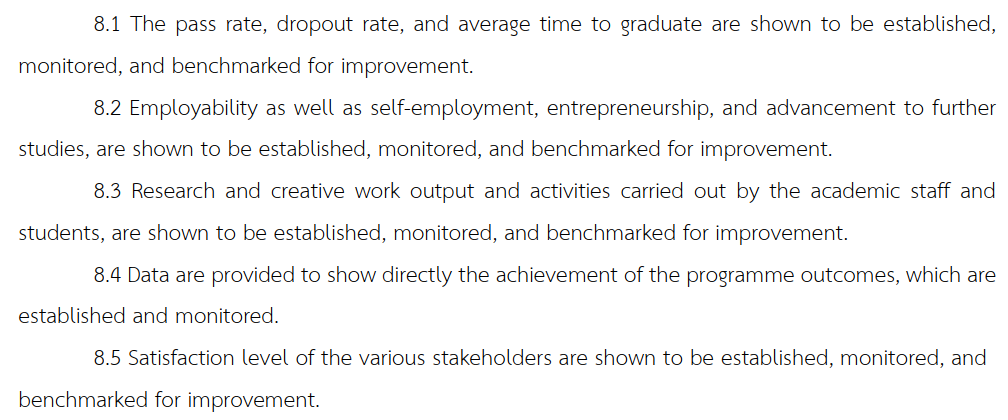
8.1 The pass rate, dropout rate, and average time to graduate are shown to be established, monitored, and benchmarked for improvement.
Operational Result
Performance
Performance
The Bachelor of Business Administration Program systematically monitors student progression and completion through key performance indicators such as enrollment, retention, graduation, dropout rate, pass rate, and average time to graduate. The BBA Program Committee uses these indicators to assess student performance, identify student retention concerns, and develop appropriate improvement actions.
The program has established an internal benchmark that the dropout rate should not exceed 10%. This benchmark serves as the basis for determining whether student retention is within an acceptable level. Monitoring results are reviewed by the BBA Program Committee and used to guide decisions on academic advising, student support, retention planning, and curriculum improvement.
Based on the available data, the dropout rate in several admission cohorts exceeded the established benchmark. This indicates that student retention remains a concern and requires continuous monitoring and intervention. The data also show that dropout rates vary across majors, indicating the need for targeted support for specific student groups.
Table 8.1. Retention/Graduation and Dropout Rate of BBA Students
| Admission Year | Major | Enrolled Students | Retained/Graduated Students | Retention/Graduation Rate | Dropout Rate | Benchmark | Status |
| 2025 | International Business | 4 | 2 | 50.00% | 50.00% | <=10% | Not Met |
| 2025 | Logistic Management | 4 | 1 | 25.00% | 75.00% | <=10% | Not Met |
| 2025 | Tourism and Hotel | 5 | 5 | 100.00% | 0.00% | <=10% | Met |
| 2025 Total | – | 13 | 8 | 61.54% | 38.46% | <=10% | Not Met |
| 2024 | International Business | 8 | 2 | 25.00% | 75.00% | <=10% | Not Met |
| 2024 | Logistic Management | 7 | 6 | 85.71% | 14.29% | <=10% | Not Met |
| 2024 | Tourism and Hotel | 8 | 1 | 12.50% | 87.50% | <=10% | Not Met |
| 2024 Total | – | 23 | 9 | 39.13% | 60.87% | <=10% | Not Met |
| 2023 | International Business | 20 | 15 | 75.00% | 25.00% | <=10% | Not Met |
| 2023 | Logistic Management | 16 | 11 | 68.75% | 31.25% | <=10% | Not Met |
| 2023 | Tourism and Hotel | 33 | 10 | 30.30% | 69.70% | <=10% | Not Met |
| 2023 Total | – | 69 | 36 | 52.17% | 47.83% | <=10% | Not Met |
As shown in Table 8.1, the BBA Program dropout rate exceeded the established 10% benchmark in most admission years and program majors. For the 2025 admission cohort, 8 out of 13 enrolled students were retained or graduated, resulting in an overall retention/graduation rate of 61.54% and a dropout rate of 38.46%. Among the three majors, Tourism and Hotel recorded the strongest performance, with all 5 enrolled students retained or graduated, achieving a 100% retention/graduation rate and a 0% dropout rate. This was the only major in 2025 that met the benchmark. In contrast, International Business and Logistic Management recorded dropout rates of 50.00% and 75.00%, respectively, which were above the allowable 10% benchmark.
For the 2024 admission cohort, the overall retention/graduation rate was 39.13%, with only 9 out of 23 students retained or graduated. This resulted in a dropout rate of 60.87%, indicating that the benchmark was not met. Logistic Management had the highest retention/graduation rate among the majors at 85.71%; however, its dropout rate of 14.29% still exceeded the 10% benchmark. International Business and Tourism and Hotel recorded lower retention/graduation rates of 25.00% and 12.50%, respectively, underscoring the need for stronger retention support in these majors.
For the 2023 admission cohort, 36 out of 69 students were retained or graduated, resulting in an overall retention/graduation rate of 52.17% and a dropout rate of 47.83%. International Business recorded the highest retention/graduation rate at 75.00%, followed by Logistic Management at 68.75%. However, both majors still exceeded the dropout benchmark. Tourism and Hotel recorded the lowest retention/graduation rate in 2023 at 30.30%, with a dropout rate of 69.70%, indicating a major area of concern.
Overall, the results show that student retention remains an important concern for the BBA Program. The data indicate that dropout rates differ by admission year and major. While some majors showed relatively stronger retention in certain years, most dropout rates remained above the program target of 10% or below. These findings support the need for continuous monitoring of student concerns by major or specialization so that interventions can be specific, timely, and responsive.
Based on individual interviews conducted with students, most dropout cases occurred during the first or second semester of the first year. The common reasons identified include students realizing that they preferred pursuing other professional fields and financial difficulties that affected their ability to continue in the program. These findings indicate that academic adjustment, career preference, and financial concerns are major factors affecting student retention.
To address these concerns, the program established a 3-way Advisory Team to provide academic and personal support to students. The Advisory Team meets with students in assigned classrooms every week to discuss academic concerns, adjustment issues, and other matters that may affect their studies. In addition, students may communicate with the Advisory Team through the program Facebook page and Line chat. These communication channels enable the program to respond to student concerns more quickly and provide timely guidance before they lead to withdrawal or dropout.
Pass Rate Monitoring
In addition to monitoring dropout and graduation data, the program recognizes the importance of monitoring students’ pass rates. Pass rate data provide information on academic performance and help the program identify courses or year levels where students may need additional support. The pass rate is monitored every semester or academic year based on the number of students who successfully pass their enrolled courses. The BBA Program Committee reviews results to identify subjects with low pass rates, recurring academic difficulties, or areas where teaching and learning support need strengthening.
The monitoring of pass rates serves as a basis for academic interventions such as remedial activities, tutorial support, consultation hours, review of teaching strategies, and curriculum improvement. Through this process, the program ensures that student academic performance is regularly assessed and used for continuous improvement. Complete course-level pass rate data should be consolidated in the annual program review to strengthen evidence for benchmarking and improvement planning.
Average Time to Graduate Monitoring
The BBA Program also monitors the average time to graduation to determine whether students complete the program within the prescribed period. This indicator is important because delays in graduation may reflect academic, financial, personal, or institutional factors that affect student completion. Results from monitoring average time to graduate are used to improve academic advising, course scheduling, curriculum planning, and student progression monitoring.
Table 8.2. Average Time to Graduate Monitoring of BBA Students
| Admission Year | Expected Time to Graduate | Actual Average Time to Graduate | Benchmark | Status |
| 2025 | 4 years | Not yet applicable | 4 years | Ongoing |
| 2024 | 4 years | Not yet applicable | 4 years | Ongoing |
| 2023 | 4 years | Not yet applicable | 4 years | Ongoing |
For active cohorts that have not yet reached the expected graduation period, the average time to graduate is recorded as ongoing or not yet applicable. Once cohorts become eligible for graduation, actual completion time will be computed and benchmarked against the four-year expected completion period and previous cohort results.
Benchmarking and Improvement Actions
The BBA Program benchmarks its dropout rate against the internal program target of not more than 10%. In addition, the program will strengthen its benchmarking process by comparing pass rate, dropout rate, average time to graduate, and retention data with previous year results, institutional targets, and comparable or higher-performing programs to support continuous improvement.
The results show that most cohorts did not meet the dropout benchmark, which prompted the program to implement student support measures. Establishing the 3-way Advisory Team is one of the program improvement actions in response to observed dropout trends. The Advisory Team supports students through regular classroom meetings, online communication, and consultation. The program also uses student interview results to understand reasons for dropout and develop more appropriate interventions.
Based on the results, the program may further strengthen the following improvement actions:
- Conduct early orientation and career guidance for first-year students to help them understand the nature of the BBA Program before enrollment and during their first semester.
- Strengthen academic advising for students who show signs of academic difficulty or poor attendance.
- Identify financially challenged students and refer them to available scholarship or financial assistance opportunities.
- Monitor students during the first and second semesters, since these are the periods when most dropout cases occur.
- Review major-specific dropout trends and develop targeted interventions for majors with high dropout rates.
- Monitor pass rates per course to identify subjects that may need additional instructional support.
- Monitor the average time to graduate to determine whether students are completing the program within the expected period.
- Use annual data review as a basis for curriculum review, student support planning, and retention improvement.
Conclusion
Overall, the BBA Program has established and monitored student progression indicators, particularly enrollment, retention, graduation, and dropout rates. The program has also set an internal benchmark that the dropout rate should not exceed 10%. Based on the available data, the dropout rate exceeded the established benchmark in most admission years and majors, indicating the need for continuous improvement in student retention and completion.
The program responded to these findings by establishing a 3-way Advisory Team that provides regular academic and personal support to students through weekly classroom meetings, Facebook communication, and the Line chat application. These interventions demonstrate that the program uses student performance data to guide improvement actions. The program also recognizes the need to strengthen the monitoring of pass rates and average time to graduate as part of its continuous improvement process. These indicators will be reviewed together with dropout and retention data to provide a more comprehensive basis for academic advising, curriculum review, student support planning, and benchmarking.
Evidence
| ID_Evidence | Name_Evidence |
| 8.1.1 | BBA Admission and Graduation |
| 8.1.2 | Advisory System |
| 8.1.3 | Retention and Improvement Interventions |
8.2 Employability as well as self-employment, entrepreneurship, and advancement to further studies, are shown to be established, monitored, and benchmarked for improvement.
Operational Result
Performance
The Bachelor of Business Administration Program establishes and supports graduate employability, self-employment, entrepreneurship, and advancement to further studies through curriculum implementation, industry partnerships, internship programs, career development initiatives, and continuous monitoring of graduate outcomes. These initiatives align with the institutional mission of producing competent, industry-responsive, and globally competitive graduates in International Business, Logistic Management, Tourism, and Hotel Management.
The employability and career progression of graduates are monitored through alumni tracer studies, employer feedback, internship evaluations, graduate surveys, and communication with alumni networks. The gathered information is used for benchmarking and continuous improvement of the curriculum, student support services, internship preparation, and career development programs.
Employability and Career Advancement
The BBA Program prepares students for employment in the fields of business administration, tourism and hospitality, logistics management, and international business. Through academic coursework, internship programs, practical activities, and industry exposure, students develop professional competencies, leadership skills, communication abilities, and entrepreneurial knowledge necessary for career readiness and lifelong learning.
The internship program provides students with actual industry experience and opportunities to develop workplace competencies relevant to their chosen specialization. Employer evaluations and internship assessments are conducted to monitor students’ performance and readiness for employment. Feedback from employers and industry partners is used to improve curriculum delivery and align learning outcomes with industry demands.
Graduates of the program are employed by both local and international organizations, while others pursue entrepreneurial ventures, self-employment, postgraduate studies, and professional development programs to further enhance their competencies and career opportunities. The program regularly conducts alumni tracer studies and maintains communication with graduates to monitor employment status, entrepreneurial engagement, and further academic advancement. The results are analyzed and compared with previous academic years and institutional targets to identify trends, strengths, and areas requiring improvement.
Table 8.3. Graduate Employability and Career Outcomes
| Academic Year | Total Graduates | Employed Graduates | Self-Employed / Entrepreneurs | Pursued Further Studies | Employment Rate | Overall Career Progression Rate |
| 2025-2026 | 15 | 13 | 2 | Not yet available | 86.67% | 100.00% based on available categories |
| 2024-2025 | 9 | 6 | 2 | 1 | 66.67% | 100.00% |
| 2023-2024 | 36 | 30 | 3 | 3 | 83.33% | 100.00% |
The employment rate represents the proportion of graduates who obtained employment. The overall career progression rate includes graduates who are employed, self-employed or entrepreneurs, or pursuing further studies, based on the available monitoring data.
Table 8.4. Monitoring and Benchmarking Mechanisms
| Area | Monitoring Mechanism | Frequency | Benchmark Basis | Responsible Office/Personnel |
| Graduate Employability | Alumni tracer study | Annual | Institutional employability target, previous year results, and comparable or higher-performing programs | Program Head / Alumni Office |
| Internship Performance | Employer and internship evaluation | Every term | Industry expectations and previous results | Internship Coordinator |
| Entrepreneurship Engagement | Graduate surveys and alumni feedback | Annual | Graduate entrepreneurial participation and previous year results | Faculty / Program Head |
| Further Studies | Alumni monitoring and graduate records | Annual | Postgraduate enrollment trends and institutional targets | Program Head |
Benchmarking and Continuous Improvement
The BBA Program benchmarks graduate employability, entrepreneurship, and further studies against institutional targets, previous years’ graduate outcomes, employer expectations, accreditation standards, and comparable or higher-performing programs. The analysis of tracer study results and employer feedback enables the program to identify strengths and opportunities for enhancement in curriculum delivery, internship implementation, and student career preparation.
The results of monitoring and benchmarking activities are discussed during faculty and quality assurance meetings to formulate improvement plans and strengthen career support services, industry partnerships, entrepreneurial initiatives, and academic advising. These continuous improvement efforts ensure that the program remains responsive to industry trends, labor market demands, and graduates’ professional aspirations.
Evidence
| ID_Evidence | Name_Evidence |
| 8.2.1 | Employment Data |
| 8.2.2 | Employability Monitoring and Benchmarking |
| 8.2.3 | Benchmarking for Continuous Improvement |
8.3 Research and creative work output and activities carried out by the academic staff and students, are shown to be established, monitored, and benchmarked for improvement.
Operational Result
Performance
The Bachelor of Business Administration Program, in coordination with St. Teresa International University, establishes research and creative work outputs and activities for both academic staff and students. These outputs align with the program objectives, institutional research agenda, curriculum requirements, and the professional fields of International Business, Logistic Management, Tourism, and Hotel Management.
Research and creative activities are monitored through documentation, progress tracking, faculty and student accomplishment reports, research presentations, and institutional review processes. The results are used for benchmarking and continuous improvement of research productivity, quality, relevance, and stakeholder impact.
Research Outputs
As part of the academic program requirements, all students enroll in a research course during their fourth year of study. The available research courses include:
- 214 497 Research in International Business
- 215 497 Research in Tourism and Hotel
- 218 497 Research in Logistics Management
Students are expected to complete and defend their research projects within a single term. Before conducting the study, lecturers provide guidance on refining research topics, conducting literature reviews, selecting appropriate methodologies, analyzing results, drawing conclusions, and preparing research proposals. Qualified lecturers are assigned to supervise and monitor students throughout the research process to ensure the quality and relevance of research outputs.
Completed research outputs are endorsed to the university library for future academic reference and utilization by students and researchers. The progress and completion of student research are monitored through proposal defenses, manuscript evaluations, adviser consultations, and final presentations. The results are reviewed and compared with previous academic years and institutional expectations to identify areas for improvement in research instruction and student support mechanisms. Additionally, students showcased their research outputs at the Education Expo, engaging a diverse audience from various schools and universities, fostering knowledge sharing, and highlighting the practical relevance and academic contributions of their work.
Furthermore, lecturers actively conduct research each year within their respective disciplines under the BBA Program. These research activities are integrated into classroom instruction to provide students with updated knowledge, practical insights, and industry-relevant applications. Faculty research productivity is monitored through publication records, research presentations, accomplishment reports, and participation in academic conferences and seminars.
As part of the program’s effort to strengthen creative and practical skills, BBA students showcased their talents through Business Investment projects and Production and Operations Management activities. They applied critical thinking and decision-making to simulate real-world business scenarios, gaining hands-on experience in planning, resource management, and problem-solving. These activities not only deepened their understanding of business concepts but also honed their ability to translate theory into practice, preparing them for future professional challenges.
Table 8.5. Faculty Research Publication Outputs
| Academic Year | In-house / Institutional | National | Regional | International | Total Publications |
| 2025-2026 | 4 | – | 8 | 1 | 13 |
| 2024-2025 | – | 7 | – | 2 | 9 |
Faculty research outputs are benchmarked against institutional research targets, previous years’ accomplishments, and accreditation standards. The program will further strengthen benchmarking by comparing research productivity and publication outcomes with comparable or higher-performing programs.
Table 8.6. Student Research and Creative Work Outputs
| Academic Year | No. of Student Research Projects | Completed Researches | Completion Rate | Research Presentations | Benchmark / Target | Improvement Action |
| 2025-2026 | 20 | 18 | 90.00% | 5 | 90% completion rate | Strengthened adviser consultations |
| 2024-2025 | 25 | 22 | 88.00% | 7 | Increased research participation and completion | Conducted research enhancement activities |
Creative Learning Outputs
As part of the program commitment to enhancing teaching and learning through creative academic outputs, Dr. Juan Rodrigo B. Del Villar collaborated with a former lecturer from the Faculty of Business Administration to develop comprehensive learning materials for Research subjects in the BBA Program. These materials serve as guidebooks that help students prepare in advance for coursework requirements and other related academic activities. The Research learning guide includes the required research formats, templates, and forms to promote consistency, clarity, and quality in students’ research submissions. These creative learning outputs enhance the student learning experience by providing structured academic guidance and clear expectations for completing research and capstone requirements.
Monitoring, Benchmarking, and Continuous Improvement
To strengthen the culture of research and innovation, the BBA Program regularly monitors research and creative work outputs through accomplishment reports, publication tracking, adviser monitoring, research presentations, and institutional review mechanisms. The collected data are benchmarked against institutional research targets, previous academic year performance, accreditation standards, and comparable or higher-performing programs to assess the effectiveness and impact of research initiatives.
The evaluation results are discussed during faculty meetings and quality assurance reviews to identify areas for improvement and formulate appropriate interventions. As part of its commitment to continuous improvement, the program has developed a Research Improvement Plan that includes strategic measures to enhance the research capabilities and productivity of lecturers and students. The plan supports research capability-building activities, faculty collaboration, publication initiatives, adviser consultations, and student research enhancement programs to further improve the quality, relevance, and impact of research outputs within the program.
Evidence
| ID_Evidence | Name_Evidence |
| 8.3.1 | BBA Program Research Outputs |
| 8.3.2 | Funding Acquisition |
| 8.3.3 | Dissemination of Research Outputs |
| 8.3.4 | Research Improvement Plans |
| 8.3.5 | Education Expo |
| 8.3.6 | Business Investment and Innovation |
| 8.3.7 | Production and Management Operations |
| 8.3.8 | Citation Index |
8.4 Data are provided to show directly the achievement of the programme outcomes, which are established and monitored.
Operational Result
Performance
The Bachelor of Business Administration Program establishes and monitors the achievement of Programme Outcomes through graduate quality assessments, employer satisfaction surveys, internship performance, and stakeholder feedback. These mechanisms provide evidence that graduates demonstrate the competencies expected by the program and the industry.
The achievement of the Program Learning Outcomes is monitored through employer satisfaction surveys, graduate quality assessment, internship performance, student learning outcome assessment, and feedback from stakeholders. The results are analyzed according to relevant outcome domains, including ethics and morals, knowledge, intellectual skills, interpersonal skills and responsibility, numerical and information technology skills, English language skills, creativity, innovation, and professional competencies. These indicators provide evidence that graduates demonstrate the expected competencies of the BBA Program.
Employer satisfaction survey results regarding students’ workplace performance indicate that the Program Learning Outcomes are being achieved. The faculty conducted surveys to determine employers’ satisfaction with graduates’ performance in the workplace, with feedback from 11 employers. The results show high levels of satisfaction across the assessed graduate quality domains.
Table 8.7. Graduate Quality Assessment Based on Five Learning Outcomes
| Five Learning Outcomes | Tourism and Hotel | International Business | Logistic Management | Mean |
| Ethics and Moral | 4.60 | 4.70 | 4.67 | 4.66 |
| Knowledge | 4.60 | 4.20 | 4.13 | 4.31 |
| Intellectual Skills | 4.50 | 4.29 | 4.13 | 4.31 |
| Interpersonal Skills and Responsibility | 4.30 | 4.60 | 4.47 | 4.46 |
| Numerical and Information Technology Skills | 4.50 | 4.40 | 4.20 | 4.37 |
| Weighted Average | 4.50 | 4.44 | 4.32 | 4.42 |
Table 8.8. Graduate Quality Assessment Based on ONESQA Learning Outcomes
| ONESQA Learning Outcomes | Tourism and Hotel | International Business | Logistic Management | Mean |
| Knowledgeable Person | 4.30 | 4.30 | 4.27 | 4.29 |
| Creativity | 4.10 | 4.10 | 4.07 | 4.09 |
| Strong Citizen | 4.20 | 4.50 | 4.40 | 4.37 |
| Weighted Average | 4.20 | 4.30 | 4.25 | 4.25 |
Table 8.9. Graduate Quality Assessment Based on 21st-Century and English Skills
| 21st-Century and English Skills | Tourism and Hotel | International Business | Logistic Management | Mean |
| English Language | 3.80 | 4.60 | 4.07 | 4.16 |
| Learning Skills and Innovation | 4.10 | 4.30 | 4.20 | 4.20 |
| Achievement of Creative Work and Innovation | 4.10 | 4.20 | 4.33 | 4.21 |
| Skills in Living and Profession | 4.30 | 4.70 | 4.33 | 4.44 |
| Weighted Average | 4.10 | 4.45 | 4.23 | 4.26 |
The results show that the overall weighted averages across the assessed domains are above 4.00, indicating a high level of achievement of graduate outcomes. The five TQF learning outcome domains obtained an overall weighted average of 4.42, the ONESQA learning outcomes obtained 4.25, and the 21st-century and English skills obtained 4.26. These results indicate that graduates demonstrate strong performance in ethics, knowledge, intellectual skills, interpersonal responsibility, numerical and information technology skills, creativity, English communication, innovation, and professional readiness.
The results are reviewed by the program and faculty to identify strengths and areas for improvement. Findings from employer feedback and graduate quality assessment are used to improve curriculum delivery, internship preparation, teaching and learning activities, communication skills development, and professional readiness. This process ensures that programme outcomes are not only established and monitored but also used as evidence for continuous improvement.
Overall Result
Overall, the data show that the BBA Program outcomes are established and monitored through graduate quality assessment and employer satisfaction results. The consistently high mean scores across TQF, ONESQA, and 21st-century skill domains provide evidence that graduates are achieving the expected program outcomes and are prepared to meet professional and industry expectations.
Evidence
| ID_Evidence | Name_Evidence |
| 8.4.1 | Satisfaction Survey on Students |
| 8.4.2 | Summary of Employment Status |
8.5 Satisfaction level of the various stakeholders are shown to be established, monitored, and benchmarked for improvement.
Operational Result
Performance
The Bachelor of Business Administration Program establishes, monitors, and benchmarks the satisfaction levels of various stakeholders through student evaluations, advisory feedback, employer and internship provider evaluations, alumni tracer studies, graduate feedback, and stakeholder communication channels. These mechanisms allow the program to gather evidence on stakeholder satisfaction and use the results for continuous improvement.
The program considers students, employers, internship providers, alumni, graduates, and other relevant stakeholders as important sources of feedback. Their satisfaction levels and comments are reviewed to identify strengths, concerns, and areas for enhancement in teaching and learning, internship preparation, student support services, curriculum relevance, career readiness, and overall program quality.
Table 8.10. Stakeholder Satisfaction Monitoring and Benchmarking Mechanisms
| Stakeholder Group | Satisfaction Monitoring Mechanism | Frequency | Benchmarking Basis | Use for Improvement |
| Students | MIS teaching evaluation, advisory system, Line group, student feedback, and consultation records | Every semester / as needed | Institutional targets, previous evaluation results, and comparable or higher-performing programs | Improvement of teaching methods, advising, student support, communication, and academic services |
| Employers / Internship Providers | Internship evaluation, employer feedback, and workplace performance assessment | Every internship period / annually | Industry expectations, previous results, institutional targets, and comparable programs | Improvement of internship preparation, workplace skills, professional behavior, and curriculum relevance |
| Alumni / Graduates | Alumni tracer study, graduate surveys, and alumni feedback | Annually | Previous alumni feedback, employability trends, institutional targets, and comparable programs | Improvement of curriculum, career preparation, graduate competencies, and industry alignment |
Students as Stakeholders
For students who are currently enrolled in the program, several mechanisms have been established to monitor satisfaction levels. Students evaluate the teaching and learning processes of the courses they are enrolled in through the MIS platform. In cases of concerns or issues, the advisory system and the Program Head promptly address them and provide appropriate interventions. The Line group also serves as a communication platform for students within the Faculty to organize activities and raise matters related to the academic program and department, including grievances, suggestions, and areas of dissatisfaction, subject to the approval of the Program Head and Faculty Dean.
Student feedback is regularly reviewed and analyzed to identify trends and areas for improvement. Results are compared with previous evaluation periods, institutional targets, and comparable or higher-performing programs to support continuous enhancement of teaching, learning, and student support services.
Employers and Internship Providers as Stakeholders
Employer satisfaction with students’ performance is continuously monitored with the assistance of the Faculty. Each year, the Faculty of Business Administration solicits feedback regarding students’ performance and achievement of learning outcomes during internship and related activities. Employers and internship providers provide valuable insights that help improve the internship program by aligning it with current industry needs and expectations.
Their feedback strengthens partnerships with industry while supporting the continuous improvement of the BBA Program in producing graduates who are relevant, competent, and impactful. The results of employer evaluations are analyzed and benchmarked against previous years’ feedback, institutional expectations, industry standards, and comparable programs to ensure that the program remains responsive to industry demands and professional standards.
Alumni / Graduates as Stakeholders
The BBA Program is committed to incorporating feedback from its graduates. Alumni feedback is considered vital for evaluating the program effectiveness and relevance, particularly in terms of employability, professional competencies, entrepreneurial readiness, and industry alignment. The insights gathered from alumni help identify areas for program enhancement and strengthen the reputation of both the program and the university.
Alumni feedback and tracer study results are regularly reviewed and compared with prior years’ data, institutional targets, and comparable or higher-performing programs to monitor graduate outcomes and support continuous quality improvement initiatives.
Benchmarking and Improvement
In response to the Criteria 8 recommendation, the program will further strengthen its benchmarking process by comparing stakeholder satisfaction results with institutional targets, previous year results, accreditation standards, and comparable or higher-performing programs. This benchmarking process will enable the program to identify areas where its performance is strong and areas where improvement is needed.
Overall Result
Overall, the BBA Program establishes, monitors, and benchmarks stakeholder satisfaction through student evaluations, advisory feedback, employer and internship provider evaluations, alumni tracer studies, and graduate feedback. The results are reviewed and compared with institutional targets, previous years’ results, industry expectations, and comparable programs to identify strengths and areas for improvement. These findings are used to enhance teaching and learning, internship preparation, student support services, curriculum relevance, career readiness, and overall program quality.ars’ data to monitor graduate outcomes and support continuous quality improvement initiatives.
Evidence
| ID_Evidence | Name_Evidence |
| 8.5.1 | Employers’ Satisfaction |
| 8.5.2 | Feedback from Stakeholders |
| 8.5.3 | Lecturer’s Satisfaction Survey |
Self-Assessment
| Requirements | Result | Score |
| 8.1 The pass rate, dropout rate, and average time to graduate are shown to be established, monitored, and benchmarked for improvement. | / | 1 |
| 8.2 Employability as well as self-employment, entrepreneurship, and advancement to further studies, are shown to be established, monitored, and benchmarked for improvement. | / | 1 |
| 8.3 Research and creative work output and activities carried out by the academic staff and students, are shown to be established, monitored, and benchmarked for improvement. | / | 1 |
| 8.4 Data are provided to show directly the achievement of the programme outcomes, which are established and monitored. | / | 1 |
| 8.5 Satisfaction level of the various stakeholders are shown to be established, monitored, and benchmarked for improvement. | / | 1 |
| Overall | 5 | |