Criterion 2 – Programme Structure and Content
Criterion
Requirements
Quality level assessment

Result
2.1 The specifications of the programme and all its courses are shown to be comprehensive, up-to-date, and made available and communicated to all stakeholders.
Operational Result
The program specification (TQF2) and course specification (TQF3) contain detailed descriptions of the program specifications. They contain information that is helpful to present and prospective students as well as other stakeholders, and they comply with university guidelines. TQF2 consists of an overview of the program’s objectives and planned learning outcomes, course structure diagrams, a matrix outlining how the courses help students meet the PLOs, and a list of course requirements.
The course coordinator distributes and explains the course syllabus, which includes information on learning objectives, the teaching and learning methodology, assessment techniques, and the contents of each module, to each and every student during the orientation meeting before the course begins.
We conduct regular review of the curriculum. Interviews and stakeholder discussions were done for the most recent revision in 2025. Three external experts in business administration also reviewed the revised program and course specifications, providing detailed recommendations to update them to meet the needs of current stakeholders.
The TRSU website (https://www.stic.ac.th/postgraduate-program/business-administration), Facebook (https://www.facebook.com/sticpage), email, and Line were among the virtual channels used to inform external stakeholders (i.e., employers, undergraduate institutions, prospective students, and alumni) about the program and course specifications. A marketing campaign run by a skilled marketing team in several provinces is also included in the communications. To spread the word, experts are taking part in both domestic and international education expos. Graduates of TRSU’s bachelor’s program are contacted via several channels to enroll in the MBA program.
On the first day of the semester, a current first-year student’s orientation session was arranged, and they receive an orientation booklet that includes program and course specifications. All students are also informed of any modifications to the course content and requirements through online and in-person meetings held throughout the academic year. The program handbook and brochure are also given to the faculty members and program committee, and frequent in-person and virtual meetings are scheduled.
Table: Stakeholders’ Communication Channels
| Stakeholders | Communication Channels | ||
| Meeting | Document | Social media | |
| Academic staff – Academic committee – All academic staff | -Monthly -Annually – Course orientation | Program manual / Course manual Meeting report | Website |
| Instructor of other faculties: – Faculty of Science – Faculty of Art – International School | -Annually | Program manual / Course manual Meeting report | Website |
| Current students | -Biannually – Course orientation | Program manual /Course manual | Website / Facebook |
| Potential students / parents | Annually -Informal discussion | Program manual | Website / Facebook |
| Employers | -Informal discussion | Program manual | Website / Facebook |
| Alumni | -Informal discussion | Program manual | Website / Facebook |
2.2 The design of the curriculum is shown to be constructively aligned with achieving the expected learning outcomes.
Operational Result
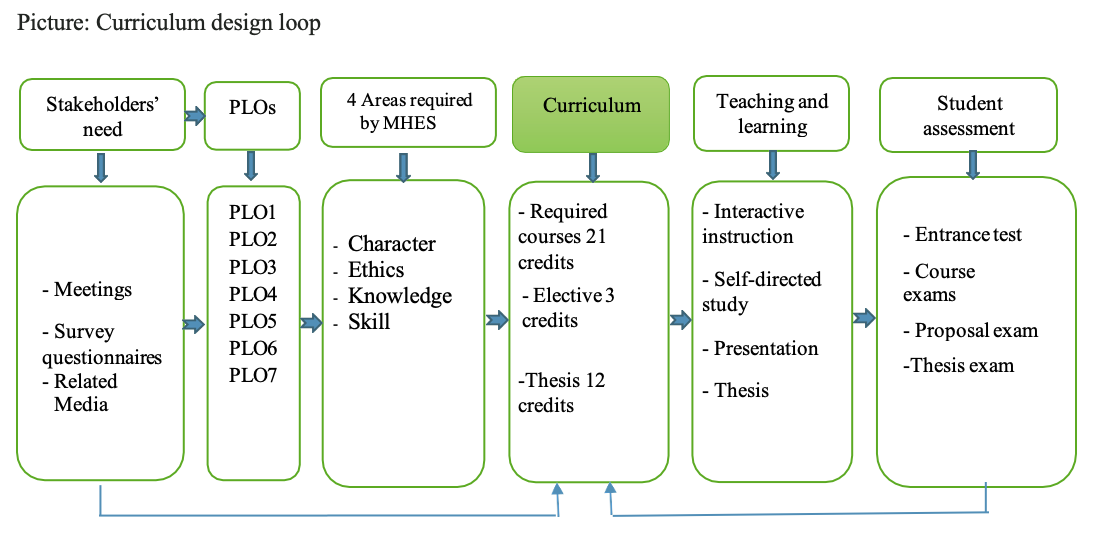
In order to develop business executives, academics, or business researchers with high competency in business research, our MBA program’s curriculum is backwardly planned to be in line with the PLOs. Nine courses totaling 36 credits—24 credits for coursework and 12 credits for thesis work—are required to earn all seven PLOs. The curriculum committee reviewed the PLOs in accordance with the demands of the stakeholders, as seen in the figure, after discussing the comments from the stakeholders during the monthly sessions. Some subjects are designed to achieve generic learning outcomes, some are for subject specific PLOs, and some are designed to achieve both types of PLOs.
Table: Alignment of offered courses with PLOs
| Courses | Subject specific LOs | Generic LOs | ||||||
| PLO2 | PLO3 | PLO4 | PLO7 | PLO1 | PLO5 | PLO6 | ||
| Cognitive / Applying | Cognitive / Applying | Cognitive / Applying | Psychomotor / Articulate | Affective / Valuing | Affective / Valuing | Psychomotor / Articulate | ||
| Foundation Courses | ||||||||
| Foundation in Business Administration | ✓ | ✓ | ✓ | |||||
| Principles of Accounting | ✓ | ✓ | ||||||
| Required Courses | ||||||||
| Business Economics | ✓ | ✓ | ✓ | ✓ | ||||
| Accounting and Financial Management | ✓ | ✓ | ✓ | ✓ | ||||
| Modern Human Resource Management | ✓ | ✓ | ✓ | ✓ | ✓ | |||
| Marketing Management in Digital Age | ✓ | ✓ | ✓ | |||||
| Business Research | ✓ | ✓ | ✓ | ✓ | ✓ | |||
| Competitive Strategy | ✓ | ✓ | ✓ | |||||
| Digital Technology for Business | ✓ | ✓ | ✓ | |||||
| Seminar in Management | ✓ | ✓ | ✓ | ✓ | ||||
| Thesis | ✓ | ✓ | ✓ | ✓ | ✓ | ✓ | ✓ | |
2.3 The design of the curriculum is shown to include feedback from stakeholders, especially external stakeholders.
Operational Result
The program places strong emphasis on obtaining feedback from external stakeholders to ensure that the Programme Learning Outcomes (PLOs) remain relevant to industry expectations and societal needs. External stakeholders, including alumni, employers, industry representatives, and academic experts, are regularly consulted as part of the curriculum review and quality assurance process. Their feedback is considered essential for evaluating whether graduates possess the knowledge, skills, and competencies required in the current business environment.
To systematically gather stakeholder input, the program has established a feedback collection and review procedure coordinated by the curriculum committee. Surveys and consultation activities are conducted periodically, particularly during curriculum review cycles. In the academic year 2025, the program conducted a PLO accomplishment survey involving MBA alumni and employers to assess graduate performance in relation to the seven PLOs. The survey results indicated that graduates generally performed satisfactorily across all intended learning outcomes and demonstrated competencies aligned with workplace expectations.
In addition to formal surveys, the program also obtains feedback through meetings, professional networking activities, employer discussions, and alumni engagement activities. Inputs received from these external stakeholders are analyzed by the curriculum committee and used to identify areas for curriculum enhancement, improvement of teaching and learning strategies, and refinement of assessment methods.
As part of its continuous improvement process, the program has planned another comprehensive stakeholder survey for the academic year 2026. The survey will involve alumni, current students, employers, and industry partners to further evaluate the relevance and effectiveness of the seven PLOs in developing managerial, analytical, communication, ethical, and leadership competencies. The collected feedback will be systematically reviewed and incorporated into future curriculum revisions and quality improvement initiatives to ensure that the program continues to meet stakeholder expectations and industry demands.
2.4 The contribution made by each course in achieving the expected learning outcomes is shown to be clear.
Operational Result
A matrix of CLOs and PLOs, in the following table, illustrates how each course contributed to meeting the PLOs. Every course either entirely or partially contributes to the PLOs. All Master of Business Administration course offerings prepare graduates for positions in academia, business leadership, education, and research that need an understanding of business management and business research techniques. Additionally, students gain useful skills by participation in a research project where they do mock research individually, participating in all stages of the process—including selecting a research topic, drafting a research proposal, exploring data gathering process, evaluation methods and compiling a report—with assistance from experts. One of the primary courses where students can merge their knowledge, attitude, and research abilities is thesis work. We provide proper supervision for the activities this course.
| Courses | Subject specific LOs | Generic LOs | ||||||
| PLO2 | PLO3 | PLO4 | PLO7 | PLO1 | PLO5 | PLO6 | ||
| Cognitive / Applying | Cognitive / Applying | Cognitive / Applying | Psychomotor / Articulate | Affective / Valuing | Affective / Valuing | Psychomotor / Articulate | ||
| Foundation Courses | ||||||||
| Foundation in Business Administration | ✓ | ✓ | ✓ | |||||
| Principles of Accounting | ✓ | ✓ | ||||||
| Required Courses | ||||||||
| Business Economics | ✓ | ✓ | ✓ | ✓ | ||||
| Accounting and Financial Management | ✓ | ✓ | ✓ | ✓ | ||||
| Modern Human Resource Management | ✓ | ✓ | ✓ | ✓ | ✓ | |||
| Marketing Management in Digital Age | ✓ | ✓ | ✓ | |||||
| Business Research | ✓ | ✓ | ✓ | ✓ | ✓ | |||
| Competitive Strategy | ✓ | ✓ | ✓ | |||||
| Digital Technology for Business | ✓ | ✓ | ✓ | |||||
| Seminar in Management | ✓ | ✓ | ✓ | ✓ | ||||
| Thesis | ✓ | ✓ | ✓ | ✓ | ✓ | ✓ | ✓ | |
2.5 The curriculum to show that all its courses are logically structured, properly sequenced (progression from basic to intermediate to specialised courses), and are integrated.
Operational Result
There are 4 categories of courses in the curriculum: foundation courses, core courses, elective courses, and thesis. The curriculum is rationally organized, from basic to advanced course modules, sequenced, and integrated across the program. Before the more difficult courses start in Semester 2, the basic courses begin and end in Semester 1 of the first year. Before joining the first semester of the Master of Business Administration program, non-business students are required to take foundation courses such as Foundation in Business Administration and Principles of Accounting. Those courses make it possible for learners from various backgrounds to acclimate to the program’s teaching and learning methods. After foundation courses, students have to study 7 core courses and one elective course. Core courses are Business Economics, Accounting and Financial Management, Modern Human Resource Management, Marketing Management, Competitive Strategy, and Digital Technology for Business. Students can put the lessons they’ve learned in their core courses into practice in Business Research by creating and carrying out a genuine research project with input from stakeholders and applying their problem-solving skills in real-world scenarios.
Before beginning their thesis in their second year, first-year students must pass all 24 credits of study. The thesis shows that the student is capable of carrying out carefully thought-out, internationally recognized research. Before being presented to the committee, the proposal is discussed and improved in group settings while the coursework advances concurrently. Students typically need two semesters to finish the thesis procedure from start to finish. Particular talents, morality, teamwork, communication, lifelong learning, and job skills are imparted in each course of the curriculum through group projects, field work, oral presentations, and discussions.
| Preparation | Year 1 | Year 2 | ||
| Foundation Courses | Semester 1 | Semester 2 | Semester 1 (Thesis-1) | Semester 2 (Thesis-2) |
| Foundation in Business Administration | Business Economics | Competitive Strategy | Thesis topic (formulation and approval) | Data collection and analysisPublicationFinal report submissionFinal defense |
| Principles of Accounting | Accounting and Financial Management | Digital Technology for Business. | ||
| Modern Human Resource Management | Business Research | Thesis proposal (report and presentation) | ||
| Marketing Management | Elective | |||
2.6 The curriculum to have option(s) for students to pursue major and/or minor specialisations.
Operational Result
The program titled MBA in Modern Business Management; hence, the primary focus of this program is management of modern businesses (both domestic and international). Students utilize the opportunity of researching any area of modern business according to their professional background/interest. Besides, the curriculum also offers a list of elective subjects to choose. Students also study a three-credit course in the area of their interest. The list includes subjects such as Management, Finance, Business Negotiation etc.
Research is the core of the Master of Business Administration program. By creating their own research projects using primary data gathering in their respective areas, managing and analyzing data, and producing theses and publication articles, students gain research skills that are applicable to their future employment. This thesis research project encourages students to specialize in either a major or minor area of study for their future careers.
2.7 The programme to show that its curriculum is reviewed periodically following an established procedure and that it remains up-to-date and relevant to industry.
Operational Result
The program’s curriculum is continuously reviewed and revised if necessary. The curriculum is set to revised completely at least once in 5 years as instructed by The Ministry of Higher Education, Sciences, Research and Innovation (MHESI).
The primary process of revision is as follows:
- Academic staff provides feedback regarding course content, learning outcomes, and course administration in TQF5 using MIS.
- The students provide feedback on the course taught after the final examination and before result publication.
- The program committee compile the comments and discuss the issues in regular meeting.
- The program committee gather information through survey from external stakeholders.
- Once in a year program committee review all available information and comment on correction/addition/subtraction required in the curriculum
Additionally, we discuss course content and teaching-learning strategies in the regular meetings of the academic staff to ensure that they are current and fulfill the needs of stakeholders as well as the demands of the situation. The curriculum committee also keeps an eye on and reviews the programs’ general operations each year, taking into account both the positive and negative aspects. As a result, we are certain that the program curriculum is current and appropriate for the demands of stakeholders. The last formal revision of the curriculum was done in 2021 and another revision is on the process during AY2025.
Evidence
| ID_Evidence | Name_Evidence |
| 2.1-1 | TQF2 |
| 2.1-2 | Course syllabus |
| 2.1-3 | TQF3 |
| 2.1-4 | Orientation program |
| 2.1-5 | TRSU Website |
| 2.2-1 | Curriculum alignment with PLOs |
| 2.2-2 | Curriculum design loop |
| 2.3-1 | Graduate survey |
| 2.3-2 | Graduate user survey |
| 2.5-1 | Course flow |
| 2.6-1 | Student’s research |
| 2.6-2 | Elective Subjects |
| 2.7-1 | TQF2 |
| 2.7-2 | Program Administrator Survey-Other Institute. |
Self-Assessment
| Requirements | Result | Score |
| 2.1 The specifications of the programme and all its courses are shown to be comprehensive, up-to-date, and made available and communicated to all stakeholders. | 1 | 1 |
| 2.4 The contribution made by each course in achieving the expected learning outcomes is shown to be clear. | 1 | |
| 2.2 The design of the curriculum is shown to be constructively aligned with achieving the expected learning outcomes. | 1 | 1 |
| 2.3 The design of the curriculum is shown to include feedback from stakeholders, especially external stakeholders. | 1 | |
| 2.5 The curriculum to show that all its courses are logically structured, properly sequenced and integrated. | 1 | 1 |
| 2.6 The curriculum to have option(s) for students to pursue major and/or minor specialisations. | 1 | 1 |
| 2.7 The programme to show that its curriculum is reviewed periodically following an established procedure and that it remains up-to-date and relevant to industry. | 1 | 1 |
| Overall | 5 | |