Criterion 3 – Teaching and Learning Approach
Criterion
Requirements
Quality level assessment

Result
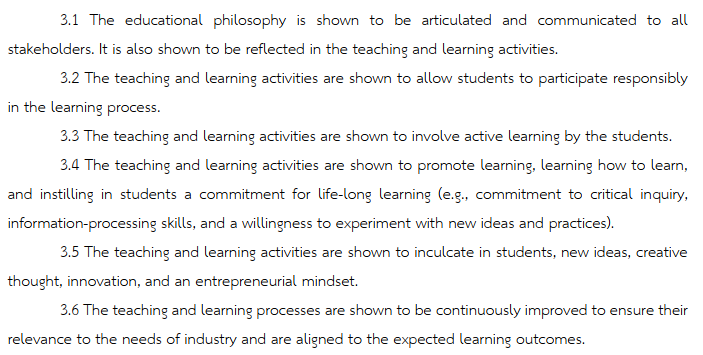
3.1 The educational philosophy is shown to be articulated and communicated to all stakeholders. It is also shown to be reflected in the teaching and learning activities.
Operational Result
Our university’s and our program’s educational philosophies are grounded in progressivism pedagogy. It is made up of problem-based learning, active learning, and outcome-based education. As the university’s motto, “Envision, embrace and excel,” suggests, progressivism can result in lifetime learning and ultimately benefit society.
Philosophy of MBA program:
The Master of Business Administration program of St. Teresa International University is committed to developing a curriculum that is in line with the changing trends of the world entering the digital age. The curriculum will promote business leaders, academics, and professionals to have skills and expertise in business administration through research processes to apply them in their fields of study, which can be utilized to benefit and create maximum efficiency for business organizations. We also instill in graduates’ knowledge along with morality in practicing their profession to help the nation and society at large.
On the foundation of this idea, the program’s content, instruction, and learning activities have been created. Case studies, talks, presentations, and answering questions are all part of the learning activities. Every research project is created with important business-related issues in mind. Students who complete the curriculum with research skills are better equipped to address problems through learning new things for the rest of their lives. The study’s findings are frequently published and make scholarly or practical contributions. In accordance with outcome-based education, each student is thoroughly evaluated for their research, knowledge, and other abilities using a variety of methods. Stakeholders, industry standards, and subject matter experts in each discipline identify the results.
The program’s and university’s websites, as well as an orientation book for all new students, effectively explain and communicate the educational philosophy to all students and stakeholders. Anyone can access it openly, particularly stakeholders, through the program’s brochure and website.
3.2 The teaching and learning activities are shown to allow students to participate responsibly in the learning process.
Operational Result
The program committee meets to examine the teaching and learning strategies and learning activities for each course, which are developed by the course coordinators in compliance with the CLOs in the course specifications. Students receive the course schedule and material at least two weeks before to the start of each semester, and they are invited to provide their thoughts and suggestions during the orientation session. Students will therefore be able to understand their roles and participation in the course learning process.
Students can also listen to remarks from others and share their own with peers and the educational staff at all times. One assessment component of the evaluation is the student’s engagement in the course. Using this method, students can progressively increase their responsibilities for participating in the learning process as they study the program.
The student’s proposed thesis topic is selected using learner-centered principles, taking stakeholder feedback into consideration. Under the supervision of supervisors, students actively choose the research topic for their thesis based on their area of expertise and primary responsibility for knowledge and skill improvement.
3.3 The teaching and learning activities are shown to involve active learning by the students.
Operational Result
The curriculum and activities are created by the teaching team using outcome-based education as a guide. Active learning techniques are the essential concepts of teaching and learning for all courses, with teachers serving as facilitators and session leaders. Problem-based learning, case studies, and paper-based exercises are further ways to incorporate interactive teaching with lecturer-student and student-student engagement. Activity-based learning outcomes also make use of practical examples and experience. To guarantee that every PLO is met, all of these strategies are employed.
Active learning is already included in the program because it is a component of the educational philosophy. For instance, in the Business Economics class, students present their own work and are required to answer questions from faculty members and other students. This course also requires students to participate in business exposition to present their business idea. Students are also required to conduct mock research and present that. Other students are invited to participate as audience members by asking questions and sharing their thoughts with the teachers and other students in all of the classes. Teachers are crucial in leading and facilitating the lesson.
3.4 The teaching and learning activities are shown to promote learning, learning how to learn, and instilling in students a commitment for life-long learning (e.g., commitment to critical inquiry, information-processing skills, and a willingness to experiment with new ideas and practices).
Operational Result
By learning from the coursework, supervision, and other extracurricular activities, students have the chance to develop additional skill sets for lifelong learning, such as proposal writing, project management, partnership building, problem solving, active learning, and leadership abilities.
All the taught courses are designed to make students explore and learn more even after the graduation. For example, during the course Digital Technology for Business has an atmosphere and KM (Knowledge Management) processes which requires all students to learn latest technology and work by themselves. Students were provided an environment of various workplaces to cope with varying business settings.
During the business research course through conducting a mock research they gain practical knowledge of data collection in the real world, data processing and analyzing data using different statistical software (e.g. SPSS). During Business Economics and Human Resource Management courses students are required to make detailed report to solve the real world problem based on their enquiry(data collection), information processing and report/findings presentation skills. Furthermore, During thesis writing, the students are able to explore the existing literature to find the gap, summarize the idea, criticize constructively, suggest to improve the quality and finally develop a mindset to contribute positively.
3.5 The teaching and learning activities are shown to inculcate in students, new ideas, creative thought, innovation, and an entrepreneurial mindset.
Operational Result
Innovation, originality, and creative thinking that appeal to the general audience are necessary for carrying out research and running business. In Digital technology for business, competitive strategy, Business Economics, Human ResourceManagement, and business research, students have the opportunity to showcase their new ventures as well as research concepts and inventions. Under the guidance of their advisers, students ensure that their research concepts and business innovations address gaps in knowledge and are novel. During their courses, students pick up skills including coming up with company concepts, solving modern management difficulties, and producing quality research.
All the graduate courses are designed to conduct thorough investigation to solve business problems and come up with new ideas to fill the gap in the market.
3.6 The teaching and learning processes are shown to be continuously improved to ensure their relevance to the needs of industry and are aligned to the expected learning outcomes.
Operational Result
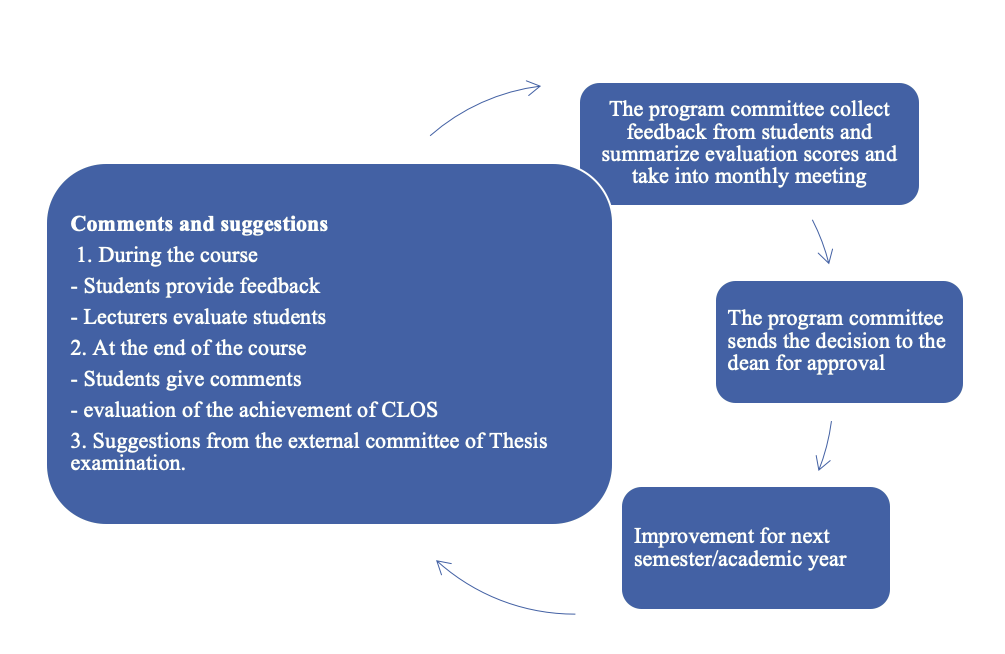
The curriculum design and feedback loop illustrates how the curriculum is evaluated and changed, with agreement from the University Council and the Faculty of Business Administration, at least once in every five years. During its regular meetings, the curriculum committee evaluates all aspects of teaching and learning, including lesson plans, instructional strategies, course evaluation techniques, test questions, grading, and student feedback. Students will assess their progress toward the CLOs at the end of each course and provide suggestions for improvement. Every year, the external committees for the annual program assessment and the thesis assessment provide insightful recommendations for the curriculum. Subsequently, the curriculum committee examines every feedback and provides input. The students participate in the feedback session as well. Student feedback is taken into account for future semesters’ improvements, as the course evaluation process illustrates. In order to enhance the program’s teaching and learning activities and make sure they are in line with the expected learning objectives, the program routinely solicits feedback from stakeholders and updates pertinent data.
Every semester, the existing situation is evaluated using the PDCA method, and adjustments are made to best suit the teaching and learning process in order to meet PLOs.
Evidence
| ID_Evidence | Name_Evidence |
| 3.1-1 | TRSU website |
| 3.1-2 | Orientation book |
| 3.2-1 | Course specification (TQF3) |
| 3.2-2 | Student participation plan in learning process |
| 3.3-1 | Google classroom- course |
| 3.3-2 | LMS |
| 3.3-3 | Student participates in Business Exposition |
| 3.4-1 | Outdoor classroom-Dr. Alfred |
| 3.4-2 | Development of HR policy for a company |
| 3.5-1 | Innovative assignment from Competitive Strategy |
| 3.5-2 | Innovative output of Business Economics Course |
| 3.6-1 | Course evaluation flowchart |
Self-Assessment
| Requirements | Result | Score |
| 3.1 The educational philosophy is shown to be articulated and communicated to all stakeholders. It is also shown to be reflected in the teaching and learning activities. | 1 | 1 |
| 3.2 The teaching and learning activities are shown to allow students to participate responsibly in the learning process. | 1 | 1 |
| 3.3 The teaching and learning activities are shown to involve active learning by the students. | 1 | |
| 3.4 The teaching and learning activities are shown to promote learning, learning how to learn, and instilling in students a commitment for life-long learning. | 1 | 1 |
| 3.5 The teaching and learning activities are shown to inculcate in students, new ideas, creative thought, innovation, and an entrepreneurial mindset. | 1 | 1 |
| 3.6 The teaching and learning processes are shown to be continuously improved to ensure their relevance to the needs of industry and are aligned to the expected learning outcomes. | 1 | 1 |
| Overall | 5 | |