Criterion 4 – Student Assessment
Criterion
Requirements
Quality level assessment

Result
4.1 A variety of assessment methods are shown to be used and are shown to be constructively aligned to achieving the expected learning outcomes and the teaching and learning objectives.
Operational Result
In order to make sure that students can meet the learning outcomes, the program examines them prior to enrollment, during the study, and prior to graduation. Students are interviewed by the instructors to ascertain their commitment, motivation, and attitude.
During study and at the end of each course, students participate in a variety of formative and summative assessments, including performances, quizzes, exercises, assignments, work presentations, and open-book exams. The instructors design the assessment along with the lesson plan and upload it in the TQF3 prior to the course begin. The purpose of these tests is to evaluate their knowledge and abilities in relation to the PLOs and CLOs. Students receive comments and feedback from the instructors to help them to improve. Students who fail the exam have to retake it until they achieve the highest level of proficiency. Prior to continuing with their study, they must show that they can interpret their data in summative exams across many courses (e.g., business research, seminar, etc.).
Students must finish writing their thesis and publish at least one article in an international peer-reviewed publication in order to graduate from the program. The topic, proposal, and final thesis presentation rubric assessment forms are in good alignment with the PLOs and CLOs.
4.2 The assessment and assessment-appeal policies are shown to be explicit, communicated to students, and applied consistently.
Operational Result
Policies for assessments are thoroughly recorded. They outline the what, how, and when of assessment. The assessment data are utilized to enhance student performance as well as the teaching and learning process. The program orientation manual contains information on all official assessments, grading, criteria, passing level, and forms. These are also posted on a regular basis via email, Google Classroom, LMS, and Line. Every semester, the staff makes sure that students are fully aware of the assessments. Additionally, assessments are measured objectively and individually. Students are continuously monitored, evaluated and communicated by the main adviser and co-advisors to ensure that the schedule, procedures, and rules are adhered to.
If students have any formal concerns or objections regarding the study’s evaluations, they may file an appeal with the university and the Faculty of Business Administration. Three options are presented to them by our program, first, they can submit their appeal in person or via email to the program head, the instructors, and their advisor(s); second, students can file a complaint by contacting the registration department and completing the form, finally, students have the option to send an automoted email with their remarks or requests. The support staff regularly check for any appeals and report them to the committee. Staff members respond to appeals by either providing comments right away or during regular meetings, depending on the urgency of the matter, in order to find a way to resolve the issue and communicate the students.
4.3 The assessment standards and procedures for student progression and degree completion, are shown to be explicit, communicated to students, and applied consistently.
Operational Result
During the first week of the course and in the orientation book, all assessments are described in detail. All assessments are applied fair and impartial manner to all students and scores are given. These scores are tools to feedback to all students.
To evaluate students’ participation in each class activity, a rubric assessment is created for coursework that includes a detailed explanation of each score level. The teaching staff who teach each topic are responsible for preparing the exam questions for the midterm or final exams. Before they are utilized, the program committee evaluates the test questions and determines whether they are appropriate in terms of reflecting learning outcomes, level of difficulty, language used, clarity of the questions, and objectivity. The teaching staff who created the question checks the exam paper, and the program committee reviews all of the question scores before assigning grades.
Every semester, thesis advisers are required evaluate each advisee’s thesis credits and provide tailored input following the proposal and final defense. Students at their thesis phase are communicated using various channel including google classroom, email, Line and face to face meeting. Additionally, students must submit and adhere to a progress plan in advance.
Thesis defense usually takes place once the students publish an article related to their thesis in a designated journal.
In every subject, student achievement is evaluated using a criterion-reference system. For every grade level, there is a predetermined minimum passing level, marking scheme, and score range.
4.4 The assessments methods are shown to include rubrics, marking schemes, timelines, and regulations, and these are shown to ensure validity, reliability, and fairness in assessment.
Operational Result
The course syllabus includes and presents the timeline for each assessment. The assessments’ rubrics were created with PLO alignment in mind. Experts in the field, including invited examiners and other teaching staff, also provide qualitative remarks.
Grading scale:
| Grade | Score |
| A | >80 |
| B+ | 70-79 |
| B | 60-69 |
| Fail | <60 |
At the end of the academic year, the program committee often reviews the methods of assessment in order to make improvements. Every year, there is a discussion about the evaluation rubrics and marking methods. Focus group discussions with current students are conducted to get their viewpoints on the assessment methods and scales.
Written examination procedure.
- Two reviewers review examination questions
- Reviewers comment send it back to the lecturer (if there’s any issue)
- Students take an examination.
- Lecturers check examination paper.
- Lecturers grade the papers
- Registrar reviews the result and publish it ontime
- Re-take the course if fail.
- Program committee review exam procedure.
Students get to know the results of the coursework (summative examination + formative assessment) within two weeks of the examination through MIS. The students can appeal against the result in two weeks of result publication. Students who take presentation examinations receive a summary of comments from their advisors. They can also discuss with the examiners in person. Students have to respond to the comments and submit them to their advisors in two weeks.
4.5 The assessment methods are shown to measure the achievement of the expected learning outcomes of the programme and its courses.
Operational Result
During class, instructors always ask questions to evaluate how much students understands the lessons which reflect the CLOs and PLOs. Teachers discuss with them and point them in the right direction. During lectures and exam periods, students are free to express their opinions and ask questions.
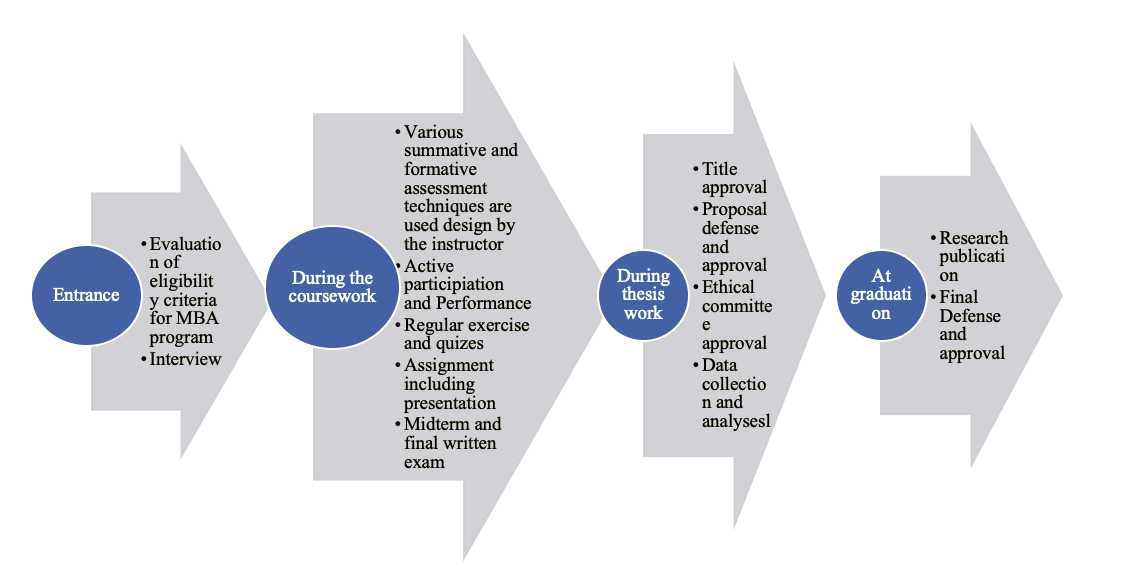
The picture above shows the flow of assessment plan from the entrance to graduation, the 1st year students are assessed during coursework phase according to CLOs by lecturers for all courses. During research proposal development, data collection and analysis, and manuscript and thesis preparation, the 2nd year students (both in semester 1 and 2) are also assessed for their progress and endeavors. The CLOs of all the courses and thesis are developed to achieve the PLOs. Furthermore, the students who successfully complete the thesis defense will assess PLO accomplishments and provide program feedback. The program committee meets regularly to monitor, analyze, and use the results of all feedback, PLOs, and CLOs achievement scores for improvement.
4.6 Feedback of student assessment is shown to be provided in a timely manner.
Operational Result
Regular formative assessments are conducted at the end of each class session and during one-on-one student supervision to ensure that feedback is provided promptly. Feedback is given to students at the end of class or later, if necessary. The registration department release the grade within 2 weeks of final exam date.
Google Classroom and LMS are of the web-based platforms the program has utilized in teaching and learning activities. Using this platform, teaching staff members can give rapid feedback. The program has utilized google classroom as one of the web-based learning platforms for teaching and learning activities. Teaching staff are able to provide immediate feedbacks on this platform.
At the end of the course, lecturers get feedback regarding their instruction. However, the lecturers have an option to response if there are some urgent issues and/or any specific reason for deviation of the performance from expected level.
During the consultation of the student’s proposal development, the thesis adviser offers comments to the advisee in order to assist them to enhance their efforts. If there is a significant delay in the gathering and analysis of data or in the writing of the publication, comments and recommendations will always be provided. Following the thesis presentation, all of the external committees’ comments are compiled and given to the students immediately.
4.7 The student assessment and its processes are shown to be continuously reviewed and improved to ensure their relevance to the needs of industry and alignment to the expected learning outcomes.
Operational Result
Students fill out a survey about the instructor’s instruction after each course. The instructors also provide continuous assessment score for each student’s participation. The student and instructor then receive the scores and comments based on CLOs at the end of the semester. Quizzes and exams are used to evaluate students’ progress in their coursework. During the thesis research process, students are evaluated based on whether they have completed the necessary milestones (e.g., passing the proposal defense, getting ethical approval for the study, finishing data collection, publishing research findings, and passing the thesis defense).
In order to examine the MBA students’ course completion, proposal defense, publication, and thesis defense, we have created a rubric and disclosed the evaluation standards.
Based on PLOs, stakeholder needs, and student achievement, student evaluations are routinely reviewed. All students’ feedbacks are considered by the teaching committee. The course and expected learning outcomes are considered to modify and improved accordingly, if appropriate. The program collects data on PLOs and their assessment from external stakeholders (e.g. alumni, employers, industry leaders) once in a year using a survey. Besides, the program committee also considers opinion from industry experts and external academics on assessment methods (along with other areas) during curriculum revision. We followed the process during our 2021 curriculum revision.
Evidence
| ID_Evidence | Name_Evidence |
| 4.1-1 | Student assessment flow at different levels |
| 4.1-2 | TQF3 |
| 4.1-3 | Assessment sample (Question paper)-Course work |
| 4.1-4 | Thesis assessment tool |
| 4.2-1 | Appeal procedure |
| 4.2-2 | Student Orientation |
| 4.2-3 | Examination appeal form (registration) |
| 4.3-1 | Student Handbook |
| 4.3-2 | Thesis evaluation criteria |
| 4.4-1 | MIS- Exam results |
| 4.4-2 | Scoring rubric |
| 4.4-3 | Timeline |
| 4.5-1 | TQF3 Assessment plan |
| 4.6-1 | Feedback in students’ assignment |
| 4.6-2 | Reason for deviation in TQF5 |
| 4.7-1 | Theses evaluation rubric |
| 4.7-2 | Employer survey |
Self-Assessment
| Requirements | Result | Score |
| 4.1 A variety of assessment methods are shown to be used and are shown to be constructively aligned to achieving the expected learning outcomes and the teaching and learning objectives. | / | 1 |
| 4.2 The assessment and assessment-appeal policies are shown to be explicit, communicated to students, and applied consistently. | / | 1 |
| 4.3 The assessment standards and procedures for student progression and degree completion, are shown to be explicit, communicated to students, and applied consistently. | / | 1 |
| 4.7 The student assessment and its processes are shown to be continuously reviewed and improved to ensure their relevance to the needs of industry and alignment to the expected learning outcomes. | ||
| 4.4 The assessments methods are shown to include rubrics, marking schemes, timelines, and regulations, and these are shown to ensure validity, reliability, and fairness in assessment. | / | 1 |
| 4.5 The assessment methods are shown to measure the achievement of the expected learning outcomes of the programme and its courses. | / | |
| 4.6 Feedback of student assessment is shown to be provided in a timely manner. | / | 1 |
| Overall | 5 | |