Criterion 5 – Academic Staff
Criterion
Requirements
Quality level assessment

Result
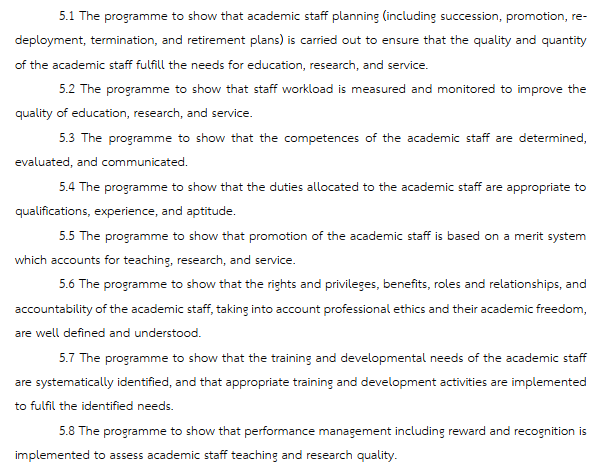
5.1 The programme to show that academic staff planning (including succession, promotion, re-deployment, termination, and retirement plans) is carried out to ensure that the quality and quantity of the academic staff fulfill the needs for education, research, and service.
Operational Result
In order to meet the demands of the Master of Business Administration program, we project that we require three full-time academic staff. The Dean’s office has provided us with staff planning guidance on a regular basis. Every member of our academic team holds a Ph.D. in a relevant discipline.
Although the number of new students has fallen short of the expected each year, we have increased our involvement in other services. This has allowed us to continue serving and supporting the Faculty of Business Administration, the University, and the community. As a result, we will continue to seek for and develop the next generation of academic staff members, and the percentage of work allocated to research and service will only rise to offset the declining percentage of duties connected to instruction. The faculty of Business Administration design staff planning at the beginning of the academic year for all the programs under FBA and then communicate that plan with the head of the programs. Although MBA program has required faculty members for the program, continuous staff development process offers trainings, seminars, research funds, and promotion support so that the faculty members keep themselves updated to fulfill the needs of the students and industry. The Faculty of Business Administration also allocate budget for faculty development every academic year to develop and promote our instructors.
5.2 The programme to show that staff workload is measured and monitored to improve the quality of education, research, and service.
Operational Result
The program follows the instructors-to-student ratio according to Thai Qualifications Framework for Higher Education 2015. For the purpose of improving and ensuring quality, the ratio has always been monitored. The Faculty of Business Administration’s Master and Bachelor programs are run concurrently by academic staff, which means that the workload and staff-to-student ratio for both programs are integrated. Our staff-to-student ratio has lowered due to the smaller number of students for the academic year 2025, allowing us to provide more attentive supervision to our students. Furthermore, we are constantly assisted by specialists from external institutes in the capacity of co-supervisors or committee members for the student theses.
Teaching, research, and academic service are the three primary responsibilities of teaching faculty. Faculty members have a 30:60:10 task allocation ratio to perform above mentioned tasks. Teaching duty includes lecture to graduate students and thesis supervision. Research work includes development of proposal, research fund seeking, research execution and publication. Academic service includes services to the program, faculty, university and local community. All teaching staff are required to report their daily activities to the head of program, who will forward the information to the Dean.
5.3 The programme to show that the competences of the academic staff are determined, evaluated, and communicated.
Operational Result
The Program Committee and each member of the academic staff agree on the term of reference (TOR) for professional development and workload at the start of each academic year. Additionally, each academic staff member’s minimum expected workload for teaching, research, and service is specified in the TOR. This workload is measured by converting regular reports of work-related activities into pre-established Load Units (LUs), which are then used to determine if the staff member has completed the required amount of work. Additionally, staff members undergo an integrated competency review every year in accordance with the standards of St. Teresa International University.
In 2025, there were nine elements in the evaluation criteria. Since the planned staff recruitment, these competencies have been taken into account. Each new academic staff member is given a mentor to help with training and development, promotion, and performance in relation to teaching, research, and services. New academic staff members are also informed about the evaluation criteria and necessary competencies at the outset. Similarly, all academic staff members who are involved in promotions and awards are aware of these competencies and evaluation standards
5.4 The programme to show that the duties allocated to the academic staff are appropriate to qualifications, experience, and aptitude.
Operational Result
Academic staff are expected to maintain three main competencies in education, research, and academic service. Teaching competencies are based on criteria in St. Teresa International University’s Teaching Professional Standard Framework (TRSU-TPSF), differentiated by level of complexity, degree of autonomy, leadership requirements of the position, and the staff’s level of achievement. Research competencies are based on performance indicator established by the Faculty of Business Administration, and generally measured by number of publications of each academic staff, the average number of publications of all academic staffs combined, and research proposals or projects funded by internal, national, or international grants. Service competencies are based on the involvement of each academic staff in various internal and external services provided to the students, university and community beyond the assigned teaching and research tasks. All these three competencies allocated depend on academic staff’s qualifications, experiences, and aptitude.
5.5 The programme to show that promotion of the academic staff is based on a merit system which accounts for teaching, research, and service.
Operational Result
Criteria for academic promotion are directly managed by the university. The program’s senior teaching staff guides the junior to succeed in the three pillars of TRSU: research, teaching, and service. Since all of these dimensions of our program have built-in staff monitoring methods, the assessment could be carried out regularly and objectively. The foundational elements are teaching load and quality, then services. Teaching and advising workload in terms of working hours and load units are regularly recorded in working calendar of the faculty and they are used for load unit’s calculation for teaching and service, respectively. The other crucial parts for research are the publication in peer-reviewed journals and research grants received which are regularly recorded in the Research Information System and transferred to load units for research.
Academic staff members’ TORs and competency scores are computed to represent the merit system and subsequent promotion. Once all of these works have passed the criteria for promotion, the program committee forwards the promotion, award and/or increment suggestion to the Dean. For merit system, the assessments are compiled and used by the academic committee to decide whether the candidate can get the promotion requested by the program before final approval by the University Council.
5.6 The programme to show that the rights and privileges, benefits, roles and relationships, and accountability of the academic staff, taking into account professional ethics and their academic freedom, are well defined and understood.
Operational Result
Before signing a work contract, all newly hired academic staff members at the faculty level are given orientation regarding their rights, which include those for health insurance, personal and sick leaves, and other privileges like housing. Their responsibilities are outlined and documented, as is the achievement evaluation process. All responsibilities and benefits of the academic staffs are documented in staff handbook, which is provided to the newly appointed instructors during their appointment.
We further hone the responsibilities and interactions between staff members at various levels at the program level. The regular meeting specifies each employee’s accountability. Time table to hand in the exam papers and results are scheduled and reminded by responsible supporting staff. Staff are guaranteed on the academic freedom to express their views based on scientific evidence, professional ethics and social responsibility. We have a social media forum (LINE) where academic and supporting staff to exchange information and viewpoints freely and constructively.
5.7 The programme to show that the training and developmental needs of the academic staff are systematically identified, and that appropriate training and development activities are implemented to fulfil the identified needs.
Operational Result
Newly hired faculty members must attend a series of orientation sessions and mandatory training sessions hosted by the Faculty of Business Administration at TRSU. In order to extend their experience, the newly hired faculty members will also have the chance to participate in a variety of academic seminars.
Regular training and development opportunities are offered to senior academic staff, including seminars on many key problems. The purpose of these mechanisms is to ensure that academic staff members are competent to support students in achieving PLOs.
The Faculty of Business Administration supports the proposed budgets for academic staff training and development. First the program conducts a need assessment analysis using various tools (including survey) to explore the training and development need of the program. Then the findings of need assessment and proposed training and development plans and activities are discussed among the program committee during the meeting, where decisions will be made with regard to course of action to achieve the plan. The requirements are sent to the Dean for approval and budget allocation.
In order to fulfill the program’s goal and vision as well as the staff members’ individual situations, customized training and development plans can be created.
5.8 The programme to show that performance management including reward and recognition is implemented to assess academic staff teaching and research quality.
Operational Result
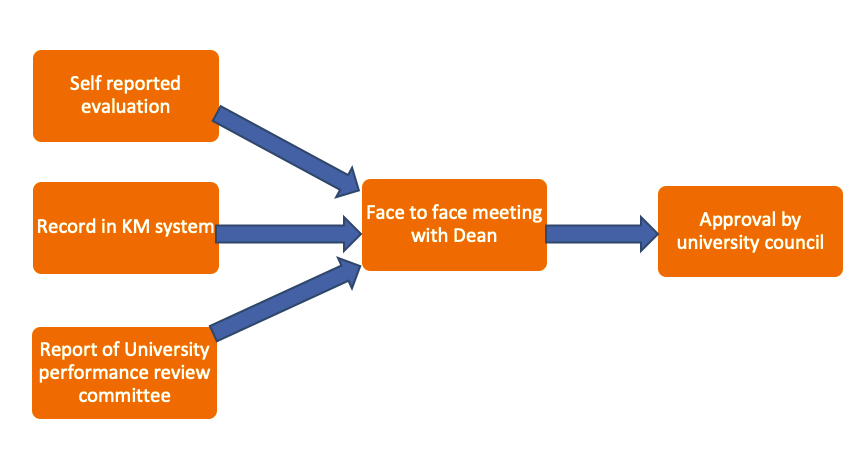
There is a well-established performance management system in place in MBA program. By the end of each academic year every faculty member has to go through a formal evaluation process. First the academic staff submit a self-reported performance evaluation to the Dean, then the dean considers the performance evaluation report, KM system (online knowledge management archive of TRSU), and university performance review committee’s report on the faculty member’s performance. At the final stage the dean conducts a face to face meeting with the faculty member. The report of all the faculty members belong to FBA (including academic staffs of MBA) sent to the university council for reward and recognition.
Our teaching team frequently receives excellent researcher or professional awards from the University or other agencies each year, based on their achievement in education, research, and services. Every year, during the annual staff meeting, the awards are announced.
Evidence
| ID_Evidence | Name_Evidence |
| 5.1-1 | Faculty staffing plan |
| 5.1-2 | Current faculty members |
| 5.1-3 | Faculty development budget |
| 5.2-1 | Calculation of Load Units and requirements |
| 5.3-1 | TOR for academic staff-TRSU |
| 5.3-2 | Competency rubric for academic staff |
| 5.4-1 | TRSU Teaching Professional Standard Framework |
| 5.5-1 | Promotion criteria |
| 5.6-1 | TRSU academic staff handbook |
| 5.6-2 | LINE group (FBA-TRSU lecturer) |
| 5.6-3 | Annual Staff meeting |
| 5.7-1 | Training need assessment analysis |
| 5.7-2 | Faculty training budget |
| 5.8-1 | Performance Management System |
| 5.8-2 | 2025 awards received by MBA faculty members |
| 5.8-3 | 2025 awards received by MBA faculty members |
| 5.8-4 | Online KM archive (IR) |
Self-Assessment
| Requirements | Result | Score |
| 5.1 The programme to show that academic staff planning (including succession, promotion, re-deployment, termination, and retirement plans) is carried out to ensure that the quality and quantity of the academic staff fulfill the needs for education, research, and service. | / | 1 |
| 5.3 The programme to show that the competences of the academic staff are determined, evaluated, and communicated. | / | |
| 5.2 The programme to show that staff workload is measured and monitored to improve the quality of education, research, and service. | / | 1 |
| 5.4 The programme to show that the duties allocated to the academic staff are appropriate to qualifications, experience, and aptitude. | / | |
| 5.5 The programme to show that promotion of the academic staff is based on a merit system which accounts for teaching, research, and service. | / | 1 |
| 5.6 The programme to show that the rights and privileges, benefits, roles and relationships, and accountability of the academic staff, taking into account professional ethics and their academic freedom, are well defined and understood. | / | |
| 5.7 The programme to show that the training and developmental needs of the academic staff are systematically identified, and that appropriate training and development activities are implemented to fulfil the identified needs. | / | 1 |
| 5.8 The programme to show that performance management including reward and recognition is implemented to assess academic staff teaching and research quality. | / | 1 |
| Overall | 5 | |