Criterion 6 – Student Support Services
Criterion
Requirements
Quality level assessment

Result
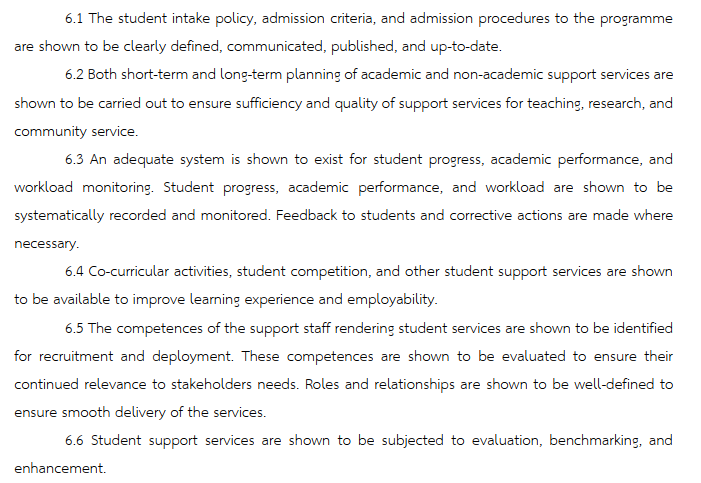
6.1 The student intake policy, admission criteria, and admission procedures to the programme are shown to be clearly defined, communicated, published, and up-to-date.
Operational Result
The prospective potential candidates of the program have been identified and recruited via 4 approaches: 1) Different bachelor programs’ alumni of the university, 2) online announcement via the Department’s website and social media (e.g., Facebook), 3) Marketing team’s visit to difference provinces to recruit students (for both bachelor and master level), and 4) National and International Education Expo.
The criteria for the selection of students are determined and published in the online admission announcement and the brochure of Master of Business Administration program. The student intake policy, admission, and selection criteria are reviewed and updated every 5 years.
Instructions for application and links to the application form and the submission system are on the University’s website. Prospective applicants are instructed to fill out application for admissions. After submission, the registration department forward the details to the program committee. Applicants who meet the admission requirements are then evaluated by interview.
The number of student intake, performance of students, teaching and learning approach and fulfilment of expected learning outcomes are also considered for deciding the level of achievement of entering students.
6.2 Both short-term and long-term planning of academic and non-academic support services are shown to be carried out to ensure sufficiency and quality of support services for teaching, research, and community service.
Operational Result
The program intends to improve the program’s staff, procedures, resources, and managements to support both short- and long-term academic and non-academic services in order to guarantee the adequacy and quality of support services for teaching, research, and service. Academic officers, IT staff, administrative staff, library staff, and international student affair staff are all necessary for the program’s effective capacity building.
Three academic officers—one for curriculum, one for education, and one for international affairs—assist one another in serving the teaching staff regarding the program and courses as well as all students regarding their studies and university life, including visas, housing, health, and emergency situations that require English communication, such as transporting students to the hospital when they become ill.
Two IT officers’ primary responsibilities include organizing, maintaining, and updating the program’s and faculty’s IT resources, including the internet, server, computer, printer, website, and intranet, as well as assisting all staff members and students in using IT.
As short-term planning, all academic support services are provided to help students complete each course and engage in extracurricular activities throughout the year. Our long-term plans includes supporting students’ PLOs by the time they graduate and to consistently offer technical advice on research and professional matters to graduates and, if appropriate, their organizations.
Table: Short term plan
| No. | Activity | Time Frame | Office | Responsible Person |
| 1. | Registration | April-May | Registration office | Ms. Wirairat |
| 2. | Immigration activities (90 days reporting, 24 hours reporting, visa extension etc.) | Periodically | HR Office | Ms. Natthanan Katekaew |
| 3. | Cultural activities (each year) | During Occasions | Student Affairs office | Mr. Puri |
| 4. | Class, seminar and examination | May and September | Registration office | Ms. Wilaiwan |
| 5. | Subject allocation and Instructor assignment | May and September | Program Office | Dr. Abdus |
| 6. | Thesis Proposal and Final presentation | When necessary | Program Office | Dr. Abdus |
| 7. | Graduation status assessment | Upon request | Registration office | Ms. Wirairat |
Table: Summary of Long term plan
| No. | Activity | Time Frame | Office | Responsible Person |
| 1. | Marketing policy and activities | 5 years promotion plan | Marketing office | Aj. Amarjeet |
| 2. | Media promotional strategy | 5 years strategic plan | IT office | Mr. Mos |
| 3. | External Stakeholder engagement | 5-year plan | Program office | Dr. Alfredo |
| 4. | Internal Stakeholder engagement | 5-year plan | Program office | Dr. Abdus |
| 5. | Quality Assurance | 5-year plan | Program Office | Dr. Abdus |
| 6. | Curriculum Development | 5-year plan | Program Office | Dr. Abdus |
6.3 An adequate system is shown to exist for student progress, academic performance, and workload monitoring. Student progress, academic performance, and workload are shown to be systematically recorded and monitored. Feedback to students and corrective actions are made where necessary.
Operational Result
The program maintains a schedule for academic activities and monitoring the progress of the students. Before the thesis adviser is selected, each student has a general advisor given to them at the beginning of the first semester to help both academic and extracurricular activities. The program committee meets to discuss the students’ involvement in each class for the course work. Examination results for every course are reviewed and evaluated.
There are two ways to track a student’s progress and academic performance for a thesis project: the student’s progress report and the thesis supervisor’s progress observation. Every semester, all enrolled students are required to submit a progress report, which is reviewed and discussed by the curriculum committee during a meeting and stored on the recording system. Additionally, the thesis supervisor presents the student’s progress based on information obtained via emails exchanged between the supervisor and the student regarding the status of data collecting or one-on-one discussions during data analysis and manuscript/thesis writing. Students’ progress in this monitoring system, which is used to assess their readiness for study and graduation, can be planned and assessed to see if the performance indicator will be met or if closer observation or further work are required. In addition to assessing themselves, students also give the program feedback and course evaluations.
Study success and academic performance are assessed using the credit point system. The course work is worth 24 credits. The proposal defense and first three chapters receive three credits, data collection and analysis receive three credits, publication receives three credits, and final defense and five-chapter submission (with approval) receives three credits, for a total thesis credit of twelve credits (Plan A2). 24-credit coursework in the first year and 12-credit thesis work in the second year evenly distribute the study load throughout the academic years. According to this plan timeframe, students typically finish the program in two years.
Lecturers frequently discuss how well students are performing in order to come up with a way to inspire them all. Being a good mentor and providing direct care for their advisee is the main advisor’s duty. Students who have issues with course selection, choice changes, or stopping or ending their studies will receive assistance from support professionals in accordance with university policies. As a result, all lecturers are able to know how each student is doing academically. According to university regulations, MBA students (Plan A2) must study for no more than four years; however, they are anticipated to finish in two years if they follow the study plan.
6.4 Co-curricular activities, student competition, and other student support services are shown to be available to improve learning experience and employability.
Operational Result
To improve students’ learning experiences, the faculty allocates budget to support student club activities, industry visit, moral and ethics activities and 21st century skills development for all the programs. A separate budget is allocated for MBA program too. The faculty also supports students to improve employability. Annually, the FBA organizes employment seminar for graduating students. To make the future graduates ready for their workplaces, different skills are taught during that seminar.
During academic year 2025 the program arranged a business innovation exposition to encourage business students to create and present business ideas for evaluation. Both the bachelor and master level business students participated in the activity. Besides, student experienced various models of post-normal workplace environments (remote work, hybrid workplace and on-the-go office) during seminar in management course.
The career prospects of the students are provided to all students in the class during the course work and supervision by the main advisor on thesis works. Further training, scholarship and job opportunity are announced to current students and alumni through e-mail, department website and Facebook. Other extracurricular activities to promote social and cultural exchanges and communication skills are conducted at program, faculty and university level such as New Year festival, teacher day, or celebration, International Cultural Night or Cultural tour.
The university student affair office (SAO) maintains various clubs to run the necessary co-curricular activities. Students can join and actively participate in different activities organized by the clubs. Besides, TOEIC practice sessions and language lab supports students to be a true global graduate.
6.5 The competences of the support staff rendering student services are shown to be identified for recruitment and deployment. These competences are shown to be evaluated to ensure their continued relevance to stakeholders needs. Roles and relationships are shown to be well-defined to ensure smooth delivery of the services.
Operational Result
Every support employee is aware of their responsibilities for the deployment, which are based on standard operating procedures that are relevant to their areas of expertise. In addition to the job opportunities for further education and training are available for the support staffs. Every year, a meeting is arranged for academic and support staff to exchange experiences and obstacles encountered in their work in order to find solutions and ideas. Our program evaluates support workers using the University’s competency criteria, which include revised core and functional competencies. All support employees have the same basic competencies, however their functional competencies vary depending on their role, as explained below.
They are all aware that their performance is assessed every year by peers and based on competency and functional performances. The program committee has also developed a competency assessment rubric approach to standardize the evaluation and identify areas that require program support services.
Table Competency criteria of support staff
| Core Competency | Functional Competency |
| 1. Ethics and social responsibility | 1. Ethical values 2. Information security 3. Respect for others |
| 2. Professionalism | 1. Relevant professional skills in responsible job description 2. Learning ability 3. Problem solving 4. Creative thinking and continuous learning 5. Attention to detail 6. Hardware and software skill 7. Network skill |
| 3. Unity | 1. Liaison ability 2. Team work 3. Cultural diversity orientation 4. Sharing mindset |
Minimum 3 functional competency per employee is required depending on the type of work
6.6 Student support services are shown to be subjected to evaluation, benchmarking, and enhancement.
Operational Result
Students and peers evaluate the Master of Business Administration program’s student support services. The students also evaluated the academic staff’s coaching and teaching abilities every year, as well as the logistics and administration of the curricular activities carried out by the support staff and those related to the teaching staff and students. Participants evaluated extracurricular activities related to special events. All of the activities’ evaluation scores were found to be satisfactory.
Once a year, when the Dean receives one-on-one feedback on competency and functional performance, all support staff members have the chance to share their feelings and satisfaction. The Faculty of Business Administration has been keeping an eye on the evaluation process for support staff. The Master of Business Administration program not only assists current students during their whole academic careers, but it also provides professional counselling and research support to its graduates. Graduate students and individual academic staff currently communicate or coordinate informally, but the program now plans to do so systematically to complement the support services.
Evidence
Self-Assessment
| Requirements | Result | Score |
| 6.1 The student intake policy, admission criteria, and admission procedures to the programme are shown to be clearly defined, communicated, published, and up-to-date. | / | 1 |
| 6.2 Both short-term and long-term planning of academic and non-academic support services are shown to be carried out to ensure sufficiency and quality of support services for teaching, research, and community service. | / | 1 |
| 6.4 Co-curricular activities, student competition, and other student support services are shown to be available to improve learning experience and employability. | / | |
| 6.3 An adequate system is shown to exist for student progress, academic performance, and workload monitoring. Student progress, academic performance, and workload are shown to be systematically recorded and monitored. Feedback to students and corrective actions are made where necessary. | / | 1 |
| 6.5 The competences of the support staff rendering student services are shown to be identified for recruitment and deployment. These competences are shown to be evaluated to ensure their continued relevance to stakeholders needs. Roles and relationships are shown to be well-defined to ensure smooth delivery of the services. | / | 1 |
| 6.6 Student support services are shown to be subjected to evaluation, benchmarking, and enhancement. | / | 1 |
| Overall | 5 | |