Criterion 7 – Facilities and Infrastructure
Criterion
Requirements
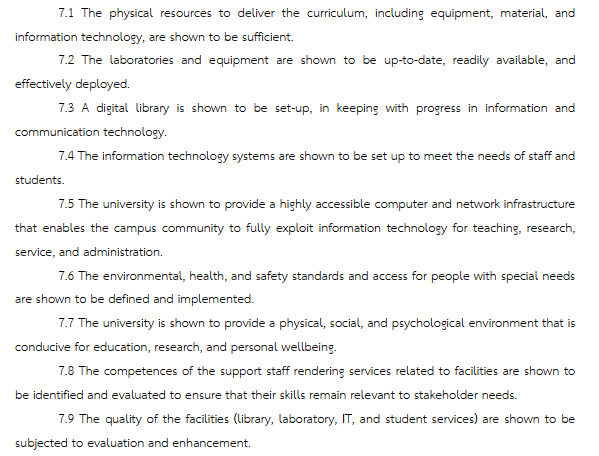
Quality level assessment
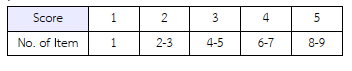
Result
7.1 The physical resources to deliver the curriculum, including equipment, material, and information technology, are shown to be sufficient.
Operational Result
In terms of facilities for didactic instruction and research supervision, the Master of Business Administration program is now self-sufficient; however, St. Teresa International University and the Faculty of Business Administration provide extra facilities and support. The following are the resources and facilities that the program has on hand to help the students:
1) Classrooms: The coursework sessions are held in two classrooms. Monitors and a fast internet connection are provided in the rooms. Every piece of equipment is regularly inspected and maintained.
2) Student Study Rooms and Cubicles: The program also offers private study cubicles and group study spaces. Our students have access to six cubicles and three group study spaces at the TRSU library. There are two large common/co-working spaces for the students in addition to the cubicles and small group study area. It is left to the students to handle the room’s areas independently. By providing regular facilities and assisting with satisfaction surveys, we monitor student satisfaction.
7.2 The laboratories and equipment are shown to be up-to-date, readily available, and effectively deployed.
Operational Result
Since lab-based research is not a part of any Master of Business Administration course, research labs and equipment are not required. Therefore, a student’s workspace typically consists of a desk with a sufficient electrical outlet and a wireless internet connection, both of which the program has set up with IT personnel to support during regular business hours.
However, in order to gather information for their theses from a variety of sources, the students had to work outside of the university. In order to assist fieldwork during coursework and the thesis research process, the program committee assumes responsibility for coordinating with the appropriate authorities and officers. Additionally, the students use the software and research database in the university to find research and analyze collected data.
7.3 A digital library is shown to be set-up, in keeping with progress in information and communication technology.
Operational Result
Students are free to access and borrow books from the library and Learning Resources Center. For instructional support, the Library also offers online resources such as e-books, e-journals, e-databases, and query services. The library’s collection of books and papers is sufficient and up to date to help students with their research and education. Students can borrow the program’s library of alumni theses and proposals, which are available in both hard copy and soft copy.
During orientation, we give the suggested reading list to the students. The program’s faculty members additionally offer a list of pertinent readings to help with coursework and thesis preparation. Almost all of which are accessible through e-resources and physical libraries.
7.4 The information technology systems are shown to be set up to meet the needs of staff and students.
Operational Result
The IT system sufficient to fulfill the need of students and staffs. Internet access is available 24 hours, the students bring their personal devices and can request IT staffs to install necessary software for the study and research.
IT staff are responsible for monitoring IT facilities usage, IT facilities satisfaction survey and report to the curriculum committee at least once a year. Budgets for facilities and infrastructures are planned at the beginning of the fiscal year, and the budget use will be considered by the head of the program according to budget estimation and also submitted to the Faculty of Business.
Students and staff remarked that the WiFi connection speed slowed down when there was a high number of users. We have made modifications to improve the WiFi signal strengths and eliminate blind spots. We keep track of the satisfaction with the IT services with a survey.
IT personnel are in charge of keeping an eye on how the facilities are being used, conducting a survey on how satisfied they are, and reporting to the curriculum committee at least once a year. The head of the program will evaluate the budget utilization based on budget estimations and report it to the Faculty of Business. Facilities and infrastructure budgets are planned at the start of the fiscal year.
Staff and students reported that when there were a lot of people using the WiFi, the connection speed slowed down. After evaluating the issue, IT staffs offered a solution. Blind spots have been removed and WiFi signal levels have been increased, thanks to our IT team.
We use a survey to monitor satisfaction with the IT services. Latest student survey indicates that the present class of students thought the IT infrastructures and facilities were sufficient. The department’s IT staff is assisting with the requirements for Google Classroom course setup. Students can look for information about TRSU and their studies, including registration status, study outcomes, tuition fee payment, attendance, academic calendar, activities, announcements, and important forms, by using the Management Information System (MIS).
7.5 The university is shown to provide a highly accessible computer and network infrastructure that enables the campus community to fully exploit information technology for teaching, research, service, and administration.
Operational Result
To effectively utilize the resources provided by the Faculty and the TRSU for administration, service, research, and teaching, IT personnel built up the network infrastructure. All the courses’ contents and assignments are available on google classroom and LMS, and accessible from anywhere using the internet. The IT team also setup online teaching platform (Jitsi) using LMS for Chinese students accessible from China. From the administrative building to the residence hall, the program’s personnel and students benefit from a well-organized network system across the campus. The program head allocates and proposes the budget for computer and network infrastructure, which is then presented to the faculty. The IT department regularly maintains and upgrades all equipment.
7.6 The environmental, health, and safety standards and access for people with special needs are shown to be defined and implemented.
Operational Result
On the first day of orientation, students receive a written description of our environment, health and safety practice rules. This covers safety, hygiene, etiquettes, and insurance. The issue of staying outside after 10 p.m. (dorm residence), key cards and passwords, computer system and personal credit card hacking, commuting between the dormitory and the classroom, and traveling in Thailand are some of the general safety and security measures that are explained to students. To address present issues and avoid future ones, the program committee must be informed of any significant occurrence.
The university orients to build a green, clean and beautiful campus, planting more trees every year. Classroom and work areas are kept clean. The school imposed a ban on smoking all over the campus except designated smoking zone.
A fire exit plan is in place, and fire drills are conducted on a regular basis. Before lessons begin, at orientation, we will also provide pupils with a briefing on fire. Additionally, staff and students in the Master of Business Administration Program are urged to be on the lookout for any indications of a pest infestation.
Students receive information on mental and physical health care and well-being during their time at TRSU at the orientation session. With the assistance of university personnel, students who are physically ill are referred to SWU Hospital. During the orientation, we also give students information about counseling services. Administrators and staff at the Master of Business Administration keep track of occurrences pertaining to staff and student health and safety. These are evaluated at regular meetings, and future recommendations and backup plans are discussed and documented.
7.7 The university is shown to provide a physical, social, and psychological environment that is conducive for education, research, and personal wellbeing.
Operational Result
All students at St. Teresa International University and the Faculty of Business Administration have access to fitness centers, sports complexes, and recreational spaces.
When necessary, medical attention and treatment are given to students in need. Psychological help is also given when required. Foreign students are always escorted to the SWU hospital by student service support staff for services and translation. At the department level, the welfare of the students is also considered and evaluated.
Our students have the option of choosing from a variety of dorms on campus. Students are often given a list of the dorms and all the information they need to make reservations before they arrive at TRSU by the student assistance staff.
Students have a variety of options when it comes to the campus canteens. Students have a choice between the campus canteen and smaller eateries that serve a variety of dishes, including halal and other options. The cateen’s food quality is regulated by the university. Moreover, students can get advice from their advisors when they are in need. The counsellors are willing to help students overcome psychological pressure due to their study or personal lives.
7.8 The competences of the support staff rendering services related to facilities are shown to be identified and evaluated to ensure that their skills remain relevant to stakeholder needs.
Operational Result
IT and support personnel competencies are documented and evaluated on a regular basis by peers in accordance with Faculty norms. The university and faculty dean strongly support all trainings aimed at enhancing the skills of IT personnel. Every member of the support staff is aware of their duty to assist academic staff with research, education, and program services that are pertinent to the demands of the stakeholders.
The competency of support staffs is evaluated following the university competency criteria for the support staffs. The findings of the evaluation process are then communicated and necessary actions (reward, increment, training etc.) are taken according to the report.
Table Competency criteria of support staff
| Core Competency | Functional Competency |
| 1. Ethics and social responsibility | 1. Ethical values 2. Information security 3. Respect for others |
| 2. Professionalism | 1. Relevant professional skills in responsible job description 2. Learning ability 3. Problem solving 4. Creative thinking and continuous learning 5. Attention to detail 6. Hardware and software skill 7. Network skill |
| 3. Unity | 1. Liaison ability 2. Team work 3. Cultural diversity orientation 4. Sharing mindset |
Support staff members’ feedback and training needs are evaluated at least once a year by the training needs committee, which is made up of the program heads, academic staff, and the personnel officer. Following the discussion, all support workers are informed of the approved training plan.
7.9 The quality of the facilities (library, laboratory, IT, and student services) are shown to be subjected to evaluation and enhancement.
Operational Result
There is a regular survey conducted to evaluate facilities by Faculty of Business Administration. Besides, several dialogues between students and faculty arranged periodically about student satisfaction on services and facilities.
The following is a summary of the program’s support services for students and improvements following evaluation:
(1) Support personnel: We assess the quantity and quality of academic support services provided to our program’s students. One member of the program’s support staff helps students with enrollment, academic and personal concerns during their studies, and after they graduate.
(2) IT personnel and infrastructure: More workers and students may now effectively utilize the more sophisticated IT capabilities that have been created. In addition to the faculty, our program has two IT staff members who assist in providing IT support to the staff and students.
A database of IT users is maintained, and user problem input is accessible. We required our IT personnel to keep a record of all work orders that are requested and executed so that we can evaluate their performance. During online meetings, we occasionally experienced connection outages and internet traffic congestion as a result of the high load. To address the problem of excessive bandwidth requirements, we attempted to modify several offline techniques, such as emails and e-learning modules.
In order to identify areas where IT should be improved, students are also asked to complete the IT facilities satisfaction survey.
Evidence
| ID_Evidence | Name_Evidence |
| 7.1-1 | Group study room and cubicles |
| 7.1-2 | Classrooms |
| 7.2-1 | Individual study cubicles |
| 7.3-1 | e-Library |
| 7.4-1 | IT system |
| 7.4-2 | MIS (students’ interface) |
| 7.4-3 | IT satisfaction survey |
| 7.5-1 | Computer Lab |
| 7.5-2 | IT budget |
| 7.5-3 | LMS Jitsi |
| 7.6-1 | Student orientation handbook |
| 7.6-2 | TRSU EHS policy |
| 7.7-1 | Sport facilities |
| 7.8-1 | Competence of support staff |
| 7.9-1 | Student satisfaction survey (facilities) |
| 7.9-2 | Faculty member satisfaction survey |
Self-Assessment
| Requirements | Result | Score |
| 7.1 The physical resources to deliver the curriculum, including equipment, material, and information technology, are shown to be sufficient. | / | 1 |
| 7.9 The quality of the facilities are shown to be subjected to evaluation and enhancement. | / | |
| 7.2 The laboratories and equipment are shown to be up-to-date, readily available, and effectively deployed. | / | 1 |
| 7.3 A digital library is shown to be set-up, in keeping with progress in information and communication technology. | / | |
| 7.4 The information technology systems are shown to be set up to meet the needs of staff and students. | / | 1 |
| 7.5 The university is shown to provide a highly accessible computer and network infrastructure that enables the campus community to fully exploit information technology for teaching, research, service, and administration. | / | |
| 7.6 The environmental, health, and safety standards and access for people with special needs are shown to be defined and implemented. | / | 1 |
| 7.7 The university is shown to provide a physical, social, and psychological environment that is conducive for education, research, and personal wellbeing. | / | |
| 7.8 The competences of the support staff rendering services related to facilities are shown to be identified and evaluated to ensure that their skills remain relevant to stakeholder needs. | / | 1 |
| Overall | 5 | |