Criterion 2 – Programme Structure and Content
Criterion
Requirements
Quality level assessment

Result
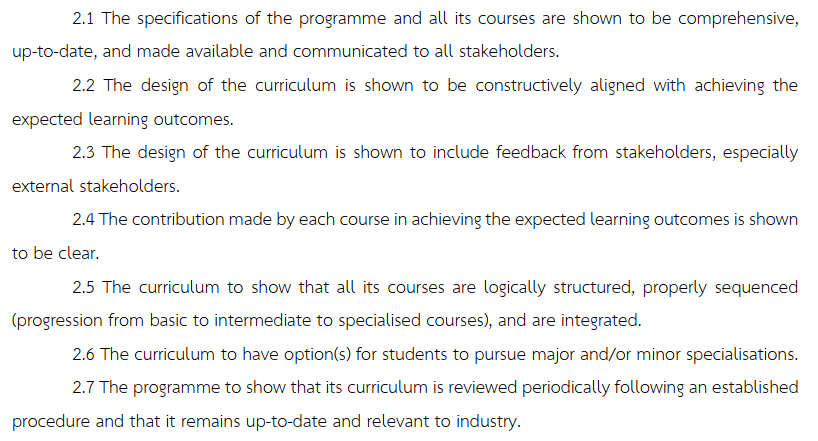
2.1 The specifications of the programme and all its courses are shown to be comprehensive, up-to-date, and made available and communicated to all stakeholders.
Operational Result
a. Programme Specifications and Objectives
This section highlights the programme’s comprehensive and up-to-date curriculum, as well as the structured processes used to communicate these details to all key stakeholders.
– The BBA in Airline Business program is a comprehensive, industry-aligned degree.
– Aviation experts design course specifications to integrate core business fundamentals with specialized airline practices.
– The curriculum remains up-to-date through routine industry reviews and is publicly communicated to stakeholders via program handbooks and official university portals. (Appendix 2.1.1)
The Bachelor of Business Administration (B.B.A.) in Airline Business is designed to develop proactive, internationally competent management professionals for the dynamic aviation sector. The programme integrates core business administration frameworks (such as finance, economics, and marketing) with industry-specific competencies, including:
– Airline Operations & Management: Route revenue management, fleet planning, and budget airline strategies
– Customer Service & Hospitality: In-flight service management and passenger ground handling
– Safety & Compliance: Safety Management Systems (SMS), aviation law, and emergency procedures
- Curriculum Comprehensiveness and Relevance
To ensure graduates are equipped to navigate modern industry challenges, the curriculum is regularly updated through close consultation with industry partners, such as civil aviation authorities and leading airlines. - Practical Training
The integration of laboratory learning via simulated cabin mock-ups and virtual reservation/ticketing systems (e.g., Amadeus or Sabre) bridges the gap between theory and real-world execution. - Course Learning Outcomes (CLOs)
Each course has established CLOs that map directly to the broader Program Learning Outcomes (PLOs), ensuring alignment with industry standards and international business practices. - Continuous Review
Annual curriculum reviews mandate the inclusion of modern topics such as Air Cargo Logistics, Sustainable Business, and Customer Relations Management (Appendix 2.1.2)
b. Communication with Stakeholders
The programme places a strong emphasis on transparency and continuous feedback, utilizing a multi-channel approach to communicate programme specifications to all relevant stakeholders as follows.
- Students:
Programme specifications, course structures, and evaluation criteria are comprehensively documented in the Program Specification TQF2 Guidebook (Appendix 2.1.4)These are disseminated during mandatory student inductions, updated in student handbooks, and posted on the Faculty of Business Administration portal. - Industry Partners & Employers:
Course syllabi and graduate profiles are regularly presented at industry advisory board meetings and communicated via the official Airline Business programme page. This ensures employer expectations regarding skills and certifications are integrated into the syllabus. (Appendix 2.1.3) - Academic Staff & Assessors:
Comprehensive module descriptors, learning materials, and assessment rubrics are hosted on the university’s internal Learning Management System (LMS). Faculty meetings and peer-review sessions are routinely held to communicate updates and discuss student feedback (Appendix 2.1.5) - Suggestions to Track Stakeholders
To introduce a digital tracking mechanism for employer feedback, you need a structured workflow that connects industry input directly to curriculum changes. This system creates a clear audit trail for university reviewers and accreditation boards.
1. Digital Feedback Workflow
[Employer Survey / Meeting] ➔ [Central Tracking Log] ➔ [Curriculum Committee Review] ➔ [Syllabus Update]
2. Implementation Framework
Step 1: Input Collection (Google Forms / Microsoft Forms)
Standardize how you capture feedback from Industry Advisory Boards and internship employers.
Key Fields: Stakeholder Name, Organization, Date, Target Course Code/Name
Feedback Type: Dropdown list (e.g., Tool Upgrade, New Industry Regulation, Soft Skill Gap)
Description: Open text box for the specific recommendation
Step 2: Centralized Tracking Log (Excel / SharePoint / Airtable)
Link the form to a centralized spreadsheet. This sheet serves as your primary audit evidence.
Use these exact column headers to organize the data:
| Log ID | Date Received | Stakeholder / Source | Feedback Summary | Target Course | Action Status | Curriculum Modification Made | Approved Date | Version Control (TQF) |
| EMP-01 | 12/02/2026 | Capt. Anan (Thai Airways) | Need familiarity with newer features in Amadeus. | ALN-302: Airline Ticketing | Completed | Added 3 new lab sessions focusing on advanced Amadeus booking. | 22/03/2026 | v2.1 (TQF3) |
| EMP-02 | 05/03/2026 | IATA Training Partner | Update cargo rules to match latest Lithium battery rules. | ALN-405: Air Cargo Logistics | In Progress | Updating Module 4 lecture notes and exam rubric for Next Semester. | Pending | Pending |
Step 3: Closing the Loop (LMS & Syllabus Updates)
Flag Updates: When a syllabus changes, add a “Revision History” table at the bottom of the course syllabus
Note the Source:
Write a brief note in the syllabus: “Updated in April 2026 based on Industry Advisory Board Feedback (Log ID: EMP-01).”
LMS Upload:
Upload the updated syllabus to the Learning Management System (LMS) and tag it as the current audited version
Draft Language for Your Audit Report
You can insert this text directly into Section 4 (Audit Recommendations / Actions Taken) of your report
Action Taken: Deployment of Continuous Feedback Tracker (CFT)
To address feedback tracking, the department launched a digital Continuous Feedback Tracker (CFT) via SharePoint. The system automatically logs employer inputs from advisory meetings and surveys. It assigns tasks directly to Course Coordinators for syllabus updates. This platform closes the loop between industry needs and classroom teaching. It provides a transparent, verifiable audit trail for future program reviews.
2.2 The design of the curriculum is shown to be constructively aligned with achieving the expected learning outcomes.
Operational Result
Introduction
This narrative report evaluates the curriculum design of the Bachelor in Business Administration (BBA) in Airline Business program at St Teresa International University (TRSU). The evaluation utilizes the Constructive Alignment framework to demonstrate that the program’s intended learning outcomes—developed in consultation with airline industry stakeholders—are actively achieved through targeted teaching methods and validated by appropriate, competency-based assessments.
Alignment of Learning Outcomes
The curriculum is designed using an outcomes-based approach. Program Learning Outcomes (PLOs) are categorized into five core domains: (Appendix 2.2.1)
– Cognitive Skills: Ability to analyze global aviation market trends and operational data
– Practical Skills: Proficiency in using industry-standard software (e.g., Amadeus, Sabre) and executing in-flight service protocols
– Professional Ethics: Upholding strict aviation safety regulations and service standards
Case Study: Course-Level Alignment
To verify constructive alignment across the degree, the following table maps the learning journey within the capstone module, Airline Operations and Strategic Management:
| Intended Learning Outcomes (ILOs) | Teaching & Learning Activities (TLAs) | Assessment Tasks (ATs) | Alignment Rationale |
| ILO 1: Analyze and solve complex airport operational bottlenecks. | Active participation in simulation games and data-driven case studies. | Written strategic analysis paper on real-world airline disruption scenarios. | Activities require students to actively solve the exact operational problems they are expected to manage professionally. |
| ILO 2: Apply revenue management and airline pricing strategies. | Guest lectures from industry experts and interactive problem-solving workshops. | Capstone project involving a simulated route profitability and pricing presentation. | Students must actively apply mathematical and economic strategies to scenarios, fulfilling the active learning criteria. |
| ILO 3: Execute crisis management and safety compliance. | Scenario-based role-play and Safety Management System (SMS) group discussions. | Practical examination with an industry-standard crisis communication rubric. | Assessment mirrors the real-world environment, ensuring students achieve practical readiness. |
Continuous Feedback and Industry Integration
To ensure the curriculum remains constructively aligned with the dynamic airline industry, the program utilizes continuous feedback loops. Faculty, students, and industry advisory boards (e.g., from [Example Airline Partner]) regularly review the assessment results. This feedback guarantees that the teaching activities reflect current aviation technologies and that evaluations assess true professional readiness (Appendix 2.2.2)
Conclusion
The BBA in Airline Business demonstrates a high level of constructive alignment. The curriculum ensures that students are not merely receiving theoretical knowledge, but are “trapped” in a carefully designed learning environment where the teaching methods and assessment tasks directly correspond to the expected industry competencies
2.3 The design of the curriculum is shown to include feedback from stakeholders, especially external stakeholders.
Operational Result
The BBA in Airline Business programme is designed to produce highly skilled professionals equipped to navigate the dynamic and globally competitive aviation industry. To ensure alignment with current industry standards and labor market demands, the curriculum design process operates on an iterative, stakeholder-driven framework. This ensures our graduates possess not only strong technical competencies but also the critical soft skills required for career advancement
Engagement of External Stakeholders
A formal Curriculum Review Committee meets biennially to evaluate and refine the syllabus. This committee heavily features external stakeholders from the aviation and service sectors, including:
Industry Executives & Employers: Representatives from major commercial airlines (e.g., Thai Airways, AirAsia, Bangkok Airways) and ground-handling service providers (e.g., AOT Ground Aviation Services)
Alumni: Former graduates currently working in airline operations, revenue management, and passenger service
Regulatory & Safety Experts: Specialists in aviation compliance and safety management systems
Specific Modifications Driven by Feedback
Recent consultations with external stakeholders led to targeted, concrete revisions in the BBA curriculum structure:
Crisis and Safety Management: Following feedback from airline operators regarding the necessity of emergency readiness, the course ABM 517: Safety and Emergency on Board in Action was restructured to include hands-on, simulated cabin scenarios.
Soft Skills and Emotional Intelligence: Employer feedback indicated a need for enhanced leadership and negotiation skills. In response, courses such as Aviation Service Innovation now incorporate team-based, project-driven assessments to boost students’ decision-making capabilities and emotional quotient (EQ) under pressure.
Digital Revenue Management: Industry advisory boards highlighted a growing demand for data-driven airline analytics. As a result, the curriculum was updated to include route revenue analysis and passenger forecasting.
Practical Application and Internships
External stakeholders also play a vital role in our cooperative education and internship framework. Industry partners review student performance during 600-hour practicum programs and provide continuous feedback on student readiness. This real-world exposure bridges the gap between classroom theory and industry practice, ultimately making our graduates highly sought after by local and international aviation companies. (Appendix 2.3.1)
2.4 The contribution made by each course in achieving the expected learning outcomes is shown to be clear.
Operational Result
The Bachelor of Business Administration in Airline Business is designed to equip students with critical management and operational skills tailored for the global aviation industry. The programme’s expected learning outcomes are divided into core competencies: Business Acumen, Aviation Operations, Customer Service & Multicultural Communication, and Strategic Safety Management.
a. Curriculum Mapping & Course Contributions
To ensure students achieve these learning outcomes, the university utilizes a progressive curriculum structure where every course directly supports specific Expected Learning Outcomes (ELOs) (Appendix 2.4.1)
i. Business & Commercial Competencies
Course 1 Aviation Economics and Marketing
Contribution: This course develops commercial acumen. It achieves the expected learning outcome of understanding market forces, revenue management, and pricing strategies unique to the airline sector.
Course 2 Airline Strategic Management
Contribution: Builds leadership and critical thinking capabilities. Students learn how to align organizational goals with long-term industry trends, successfully achieving the ELO of strategic planning. (Appendix 2.4.2) BBA AB Operational Plan
ii. Operational & Safety Expertise
Course 1 Aviation Safety and Human Factors
Contribution: Instills risk management and regulatory compliance protocols. This course fulfills the ELO for understanding and applying dynamic, international aviation safety standards.
Course 2 Airport and Ground Operations
Contribution: Bridges classroom theories with real-world technical execution. It satisfies the ELO of managing the day-to-day logistical flow of passenger, cargo, and ramp operations (Appendix 2.4.3)
iii. Professional Communication & Customer Experience
Course 1 Inflight Service and Passenger Management
Contribution: Focuses on service excellence. This directly achieves the ELO of demonstrating strong interpersonal skills, cultural awareness, and emotional intelligence when dealing with diverse clientele.
Course 2 Business Communication for Aviation
Contribution: Enhances both written and oral proficiency. It achieves the ELO of clear, concise reporting and professional communication within high-stress aviation environments.
iv. Experiential Application
Course: Professional Internship / On-the-Job Training (OJT)
Contribution: Serves as the capstone experience. Students practically apply all prior course learnings—from ticketing systems to airport management—achieving the core ELO of transition-to-workplace readiness. (Appendix 2.4.4) OJT Report
b. Curriculum Matrix (ELOs vs. Courses)
This matrix maps your major courses to the ELOs. Following AUN-QA best practices, it tracks the progression of student learning using three distinct levels of depth:
I = Introduced (Basic concept awareness, introductory assessments)
R = Reinforced (Deeper application, case studies, operational practice)
M = Mastered (High-level competency, capstone projects, professional placement)
| Course Code & Title | ELO 1 (Knowledge) | ELO 2 (Skills) | ELO 3 (Strategy) | ELO 4 (Comm.) | ELO 5 (Safety/Ethics) |
| ALB 101: Introduction to Airline Business | I | I | I | ||
| ALB 203: Aviation Economics & Pricing | R | I | |||
| ALB 305: Passenger Ground Services | R | I | R | ||
| ALB 308: Computer Reservation Systems (GDS) | M | ||||
| ALB 402: Airline Cross-Cultural Communication | R | ||||
| ALB 410: Aviation Safety & Human Factors | R | M | |||
| ALB 415: Strategic Management in Aviation | M | M | R | ||
| ALB 499: Professional Internship (Co-op) | M | M | M | M | M |
Direct and Indirect assessment methods to prove that students are actually achieving the stated ELOs.
Direct Assessment KPIs (Student Performance)
KPI 1 (GDS Mastery): At least 80% of students must score 75% or higher on the practical Amadeus or Sabre simulation exam in ALB 308 (Measures ELO 2).
KPI 2 (Strategic Capability): 85% of graduating seniors must achieve a score of “Proficient” or higher on the standardized rubric for their final capstone defense in ALB 415 (Measures ELO 1 & ELO 3).
KPI 3 (Language Proficiency): 100% of students must hit the university’s target English benchmark score (e.g., TOEIC or equivalent institutional test) prior to registering for their final semester internship (Measures ELO 4).
Indirect Assessment KPIs (Stakeholder Feedback)
KPI 4 (Employer Satisfaction): Maintain an average score of 4.0 out of 5.0 on standard internship evaluation forms regarding students’ professionalism and ethical adherence (Measures ELO 5).
KPI 5 (Graduate Employability): Secure a minimum 80% employment or graduate study placement rate for alumni within 12 months of graduation in aviation, logistics, or related hospitality sectors.
Assessment of Learning Outcomes
The contribution of each course is quantitatively and qualitatively measured to ensure transparency. The programme utilizes:
Rubrics and Portfolios: To evaluate cognitive skills and managerial decision-making.
Managerial Decision-Making Rubric
A robust rubric for decision-making evaluates the entire process—from problem identification to analyzing risks and reflecting on outcomes.
| Criteria | Exemplary (4 Points) | Proficient (3 Points) | Developing (2 Points) | Beginning (1 Point) |
| Problem Framing | Accurately defines the core problem, isolating it from peripheral symptoms. | Defines the core problem but may miss minor contextual factors. | Misinterprets the core problem, focusing on symptoms rather than causes. | Fails to identify the actual problem; focuses on irrelevant issues. |
| Data Analysis | Leverages comprehensive, high-quality data to weigh alternatives; spots trends easily. | Uses relevant data to evaluate choices but may overlook minor details. | Relies on incomplete data or personal bias; fails to quantify risks. | Ignores available data; makes decisions based purely on intuition. |
| Alternative Generation | Brainstorms multiple, highly creative, and actionable solutions. | Generates several practical and viable alternatives. | Offers limited or standard solutions that lack innovation. | Provides only one unworkable or obvious solution. |
| Risk & Consequence | Conducts a rigorous cost-benefit analysis and provides proactive mitigation plans. | Identifies primary risks and outlines basic contingency plans. | Identifies few risks; contingency plans are vague or unrealistic. | Fails to consider potential risks or unintended consequences. |
2. Cognitive Skills Portfolio
A cognitive portfolio is a curated collection of a manager’s work that demonstrates growth and high-level reasoning. Effective portfolio artifacts for cognitive assessment include:
Decision Logs: A structured write-up of a high-stakes business decision. It should include the initial problem, the data gathered, the decision made, and a post-mortem analysis of the outcome.
Strategic Playbooks: Documents or presentations where the manager maps out how to navigate a complex, ambiguous scenario (e.g., entering a new market or handling a PR crisis).
Reflective Memos: Short essays where the manager critiques their own past decisions, identifying cognitive biases (like confirmation bias or sunk cost fallacy) that influenced their thinking.
Simulations & Case Analyses: Completed executive case studies or performance metrics from digital business simulations that track strategic alignment and resource allocation.
Simulations & Live Projects: Testing students’ abilities in real-time airline operations and route planning.
Supervisor Feedback Forms: Collected during industry internships to assess interpersonal skills and professional competency in a real-world setting.
2.5 The curriculum to show that all its courses are logically structured, properly sequenced (progression from basic to intermediate to specialised courses), and are integrated.
Operational Result
Executive Summary
The BBA in Airline Business program at St Teresa International University is an international degree structured to meet the global demands of the aviation industry. The 120-credit curriculum is explicitly organized to guarantee that course sequences match student cognitive growth. This design systematically guides students through foundational business theories, intermediate operational concepts, and highly specialized airline modules. It concludes with intensive experiential field training.
Curriculum Structure & Logical Progression
The curriculum is designed with a deliberate, inverted-pyramid structure. It ensures that students transition smoothly from foundational business concepts to intermediate management skills, ultimately culminating in highly specialized airline operations. This scaffolding guarantees that students grasp core competencies before applying them to the complex aviation sector.
Foundational Phase (Years 1–2)
During the first two years, students focus on the fundamentals of business administration and introductory aviation. This ensures a broad understanding of corporate environments.
Business Core: General English, Principles of Management, Financial Accounting, Business Economics, and Business Communication.
Aviation Fundamentals: Advanced English, Introduction to the Air Transport System and Aviation Safety & Security.
Outcome: Students master the broad terminology of business and the basic socio-economic and regulatory frameworks of the global aviation industry.
Intermediate Phase (Year 3)
In the third year, the curriculum bridges general business administration with specific functional areas of airline and airport management. Courses become more application-based.
Intermediate Business: Corporate Finance, Organizational Behavior, and Operations Management.
Specialized Airline Core: Airport Operations and Management, Ground Passenger Service, IT for Airline Reservations, and In-Flight Passenger Service.
Outcome: Students apply theoretical business knowledge directly to airline-specific scenarios, such as passenger forecasting and ground handling logistics.
Specialized Phase (Year 4)
The final year focuses on high-level strategic management, problem-solving, and practical field experience.
Specialized Strategy: Airline Financial Management, Air Cargo Management, Customer Relations Management in Aviation, and Budget Airline Service Management.
Experiential Learning: The program culminates in a mandatory On-the-Job Training (OJT) / Capstone Project.
Outcome: Students synthesize their prior knowledge to create strategic, data-driven solutions for real-world airline business problems.
Integration of Courses
The integration of courses is a hallmark of this curriculum. Theoretical concepts taught in early business modules are actively utilized in subsequent aviation classes:
Financial Accounting and Airline Financial Management: Principles of cost accounting are integrated into analyzing airline profitability, seat load factors, and route revenue analysis.
Operations Management and Airport Operations & Ground Handling: Foundational supply chain and logistics theories are directly applied to turnaround times, ramp control, and baggage sorting.
Principles of Marketing and Sales Airline Marketing & Branding: General consumer behavior theories are specialized to address frequent flyer programs, airline loyalty strategies, and budget carrier branding.
Capstone Integration: Field Experience
The program concludes with a mandatory 1-credit preparatory module and a 6-credit Field Experience (001 499) internship with industry partners, allowing students to apply classroom theory and cabin simulation practice in professional environments.
2.6 The curriculum to have option(s) for students to pursue major and/or minor specialisations.
Operational Result
Executive Summary
This report outlines the academic structure of the Bachelor of Business Administration (BBA) in Airline Business programme. The curriculum is designed to bridge foundational business administration principles with specialized, industry-specific skills. Its modular design allows students to tailor their degrees through targeted major and minor specialisations, ensuring career readiness for the competitive global aviation sector (Appendix 2.6.1)
II. Programme Structure & Foundational Competencies
The programme is structured to require a common core of business and management courses. Before choosing a specialisation, all students undertake foundational coursework including (Appendix 2.6.2) Study Program
Business Finance & Accounting
Managerial Economics
Airline Marketing & Service Strategy
Business Law and Aviation Regulations
III. Major and Minor Specialisations
To adapt to dynamic industry demands and individual student career aspirations, the programme requires students to declare a specialized Major and allows the option to add a Minor or take free electives.
1. Major Concentrations
Students select a major concentration that dictates their advanced coursework, simulated practicums, and capstone research. Popular major options in Airline Business include:
Airport Management: Focuses on terminal operations, passenger forecasting, gate management, and ramp operations.
In-Flight Services & Cabin Management: Equips students with safety, crew resource management, emergency procedures, and premium service management.
Air Cargo Management: Concentrates on logistics, freight documentation, air cargo marketing, and supply chain strategies.
2. Minor Specialisations
To increase their cross-functional employability, students have the option to pursue a Minor outside their primary aviation focus. Typical minor options that complement an airline business degree include:
Digital Service & Innovations: Focusing on aviation technologies and e-commerce.
Hospitality & Tourism Management: Broadening expertise to include hotels, resorts, and international leisure travel.
Human Resource Management: Developing specialized skills for managing large, diverse workforces like cabin crew and ground staff.
Practical Application and Experiential Learning
The curriculum seamlessly integrates academic major/minor coursework with experiential learning. Students participate in industry-partnered Cooperative Education (Co-op) or practicums at major aviation hubs (such as Thai Cargo/Thailand Flight Training Center or St Teresa International University programmes). This practical training allows students to directly apply their specific major and minor specialisations to real-world flight or ground operations.
Conclusion
The BBA in Airline Business programme successfully balances a broad-based business administration curriculum with robust, industry-specific pathways. The flexibility of choosing a major and/or minor ensures that graduates possess both the general management acumen and the specialized technical skills necessary to thrive in the dynamic aviation industry.
2.7 The programme to show that its curriculum is reviewed periodically following an established procedure and that it remains up-to-date and relevant to industry.
Operational Result
Overview
The Bachelor of Business Administration in Airline Business program maintains an up-to-date and industry-relevant curriculum. It outlines an established four-phase review procedure—encompassing needs assessment, stakeholder consultation, curriculum mapping, and formal approval—to ensure the degree continuously aligns with global aviation standards.
The BBA in Airline Business program is designed to produce highly competent professionals equipped to navigate the dynamic and fast-paced aviation sector. To maintain academic excellence and industry relevance, the Department of Airline Business conducts periodic, systematic evaluations of its curriculum. This report documents the established policies and procedures used to ensure that the program’s learning outcomes, course content, and pedagogical approaches remain aligned with the evolving demands of the global aviation industry
Established Curriculum Review Procedure
The university operates under a strict Continuous Quality Improvement (CQI) cycle for all academic programs. The established procedure for reviewing the BBA in Airline Business curriculum is executed in four distinct phases:
Phase 1: Industry Needs Assessment and Environmental Scanning
The department continuously monitors global aviation trends, such as digital transformation in airline operations, dynamic low-cost carrier models, and sustainability initiatives. Faculty members and academic researchers analyze industry reports from leading authorities to identify emerging skill gaps and market trends
Phase 2: Stakeholder Consultation
Relevance to the industry is validated through active engagement with key stakeholders. The department conducts bi-annual Industry Advisory Board (IAB) meetings. This board comprises:
Senior executives from commercial airlines (e.g., [Insert Airline Partner Names]).
Airport management professionals.
Alumni who have advanced to managerial positions within the aviation sector.
Representatives from civil aviation authorities.
During these consultations, board members evaluate current Program Learning Outcomes (PLOs) and provide feedback on the practical competencies required by entry-level and mid-level airline managers.
Phase 3: Curriculum Evaluation and Mapping
Using feedback from the AB and CQI faculty meetings, the curriculum committee maps existing courses against current industry needs. This ensures that new competencies—such as yield revenue management, air cargo logistics, and aviation safety protocols—are properly integrated into the syllabus. Out-dated methodologies are routinely identified and replaced with modern simulation software and hands-on case studies.
Phase 4: Formal Approval and Implementation
Proposed curriculum modifications are formally documented and submitted to the university’s Curriculum Committee and the Academic Council for review. Upon approval, the updated syllabus is published, ensuring that incoming and current students are trained using the most current industry standards
Recent Curriculum Updates and Industry Alignment
As a result of the most recent periodic review cycle, the BBA in Airline Business curriculum was updated to include the following industry-aligned modules:
Aviation Data Analytics & Revenue Management: Integrated to meet the increasing reliance on big data in airline passenger forecasting and dynamic pricing.
Sustainable Aviation Operations: Updated to address global aviation mandates regarding carbon offsetting and eco-friendly flight management.
Aviation Safety & Crisis Management: Revised in accordance with the latest protocols to ensure robust risk management and emergency response preparedness.
Conclusion
The BBA in Airline Business program at St Teresa International University demonstrates a steadfast commitment to maintaining a relevant, industry-driven curriculum. By strictly adhering to the established periodic review procedure, the program guarantees that graduates are provided with the cutting-edge business knowledge and operational expertise expected by leading global airlines and aviation enterprises.
Self-Assessment
| Requirements | Result | Score |
| 2.1 The specifications of the programme and all its courses are shown to be comprehensive, up-to-date, and made available and communicated to all stakeholders. | / | 1 |
| 2.4 The contribution made by each course in achieving the expected learning outcomes is shown to be clear. | / | |
| 2.2 The design of the curriculum is shown to be constructively aligned with achieving the expected learning outcomes. | / | 1 |
| 2.3 The design of the curriculum is shown to include feedback from stakeholders, especially external stakeholders. | / | |
| 2.5 The curriculum to show that all its courses are logically structured, properly sequenced and integrated. | / | 1 |
| 2.6 The curriculum to have option(s) for students to pursue major and/or minor specialisations. | / | 1 |
| 2.7 The programme to show that its curriculum is reviewed periodically following an established procedure and that it remains up-to-date and relevant to industry. | / | 1 |
| Overall | 5 | |