Criterion 8 – Output and Outcomes
Criterion
Requirements
Quality level assessment

Result
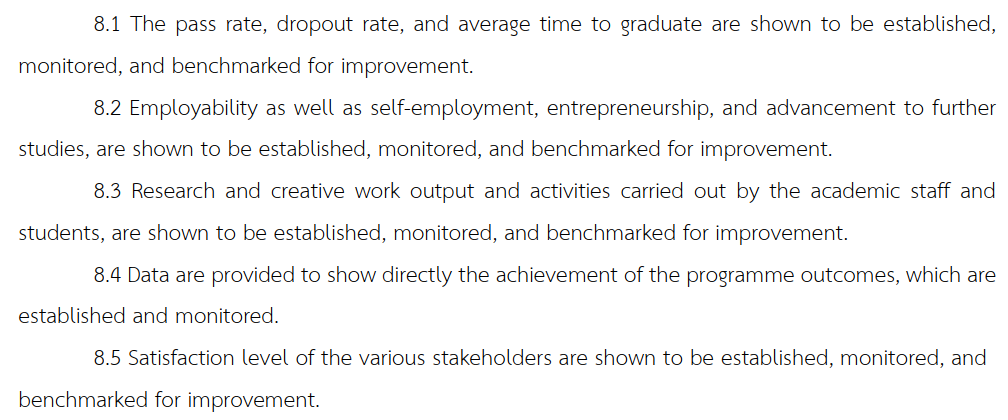
8.1 The pass rate, dropout rate, and average time to graduate are shown to be established, monitored, and benchmarked for improvement.
Operational Result
Programme Overview
The Bachelor of Business Administration (BBA) in Airline Business programme is designed to equip students with the foundational skills and practical knowledge required for the aviation industry. To ensure academic excellence and meet international quality assurance (QA) frameworks, the Programme Committee rigorously monitors, benchmarks, and acts upon key performance indicators (KPIs) regarding student progression.
Pass Rate Monitoring
Current Data: Over the 2025–2026 academic year, the programme recorded an average course pass rate of 100 %, meeting our internal threshold.
Monitoring & Action Plan: The Programme Committee tracks pass rates across all core aviation modules. For courses with pass rates falling below _____, faculty are required to conduct an “At-Risk Assessment.” Identified interventions include mandatory peer tutoring and supplementary lab sessions for operational courses (e.g., airline ticketing and revenue management).
Dropout Rate Tracking
Current Data: The first-to-second-year dropout rate stands at ______, which is well within the acceptable institutional benchmark.
Monitoring & Action Plan: The academic advisory team closely monitors the profiles of students who withdraw from the programme. Through exit interviews, the leading causes of early dropout were identified as financial constraints and a lack of foundational business math preparation. To stabilize this, the department partnered with the financial aid office and implemented a “First-Year Transition Mentorship” to help new intakes integrate seamlessly.
Average Time to Graduate
Current Data: The average time to graduate for the standard 4-year cohort is currently tracked at 4.2 years, performing favorably against regional industry-aligned business programmes.
Monitoring & Action Plan: Graduation timelines are benchmarked against regional university standards. To further decrease the time to degree, the academic committee has expanded the availability of intercession and summer courses, allowing students to remediate failed prerequisite classes immediately without falling off their cohort track.
Continuous Quality Benchmarking
To ensure these metrics continuously improve, the Airline Business programme integrates feedback mechanisms from key stakeholders, including industry partners, alumni, and current students. The faculty leverages internal data to optimize curriculum delivery, aligning the syllabus directly with current IATA Aviation (Appendix 8.1.1) Data standards.
Summary
By formalizing these performance indicators, the programme committee has established a proactive culture of evaluation. Future initiatives will focus on recruiting high-potential applicants and increasing scholarship availability to further stabilize retention and ensure our graduates are workforce-ready.
8.2 Employability as well as self-employment, entrepreneurship, and advancement to further studies, are shown to be established, monitored, and benchmarked for improvement.
Operational Result
Programme Overview and Objectives
The Bachelor of Business Administration in Airline Business programme at the university prepares professionals for the aviation and tourism sectors. To ensure the curriculum remains highly relevant to industry demands, the department continuously assesses expected learning outcomes, making certain graduates are prepared for both the global workforce and independent ventures
Comparison of the Faculty of Agriculture and Technology
Employability: Establishing and Monitoring
Employability in the Airline Business programme is evaluated through annual Graduate Tracer (Appendix 8.2.1) Studies and employer feedback sessions (Appendix 8.2.2).
Comparison of Kenya Coast National Polytechnic
Establishment: Core modules are aligned with industry standards, incorporating on-the-job training (OJT) with international airlines, ground handling agencies, and hospitality firms.
Monitoring: The university maintains a Graduate Employment Tracker to record alumni placement rates within 6 months of graduation.
Benchmarking: Programme outcomes are benchmarked against international aviation certifications. For instance, the department uses feedback from annual employer surveys to update technical courses (e.g., Sabre and Amadeus ticketing modules).
Comparison of the Faculty of Agriculture and Technology
Self-Employment & Entrepreneurship Development
Recognizing the shifting aviation landscape, the programme supports students in starting their own businesses (e.g., travel agencies, tour operations, and aviation logistics consultancies).
Establishment: Specialized courses in Aviation Entrepreneurship, Small Business Management, and E-Commerce are embedded into the curriculum.
Monitoring: The Alumni Affairs Office (Appendix 8.2.3) tracks the establishment of alumni-owned enterprises through annual surveys and start-up registries.
Benchmarking: The university benchmarks its entrepreneurship metrics against top-performing business programmes, adjusting support systems such as business incubation and local networking to foster better self-efficacy among students.
Advancement to Further Studies
The programme is structured to lay a solid foundation for academic research and advanced professional degrees.
Establishment: Research methodologies and specialized thesis projects are included for final-year students, encouraging exploration into aviation economics, policy, and management.
Monitoring: The department tracks graduates who transition into Master’s programmes (e.g., Master of Business Administration, Master of Aviation Management) through alumni progress reports.
Benchmarking: The advancement rate is measured annually against institutional targets, using post-graduate feedback to refine academic rigor and research mentorship within the undergraduate programme.
Continuous Quality Improvement (CQI)
To sustain these results, the department uses a continuous improvement cycle. Data collected from alumni, employers, and faculty are reviewed during an annual curriculum summit. The Curriculum Development Board (Appendix 8.2.4) uses these findings to adapt courses to current industry trends such as digital transformation and sustainable aviation.
8.3 Research and creative work output and activities carried out by the academic staff and students, are shown to be established, monitored, and benchmarked for improvement.
Operational Result
Executive Summary
The Airline Business program maintains a rigorous framework for continuous improvement. By establishing clear Key Performance Indicators (KPIs), we consistently monitor faculty research, creative works, and student practicum outcomes. Through structured benchmarking against regional industry standards and peer institutions, the program ensures our curriculum and research outputs remain highly responsive to aviation sector dynamics like Mahidol University International College (MUIC) (Appendix 8.3.1)
Faculty Research & Creative Work
Our academic staffs are actively engaged in advancing the discipline of airline management, ensuring that classroom teachings are rooted in cutting-edge, real-world data like of University College Birmingham (Appendix 8.3.2)
Research Outputs: Faculty members published 1 peer-reviewed paper in 2025–2026, focusing on sustainable aviation and post-pandemic passenger satisfaction (Appendix 8.3.3) Lecturer’s research
Creative Work & Applied Projects: Staff developed creative, experiential learning tools, including new modules for “In-Flight Services” and interactive “Cabin Crew Management” simulations.
Industry Collaboration: Faculty partnered with regional carriers (e.g., Thai AirAsia) to produce case studies regarding consumer behavior in the airline sector, directly influencing our customer service syllabi like Suan Sunandha Rajabhat University (Appendix 8.3.4)
Student Creative & Research Activities
Students are encouraged to bridge theoretical knowledge with applied research, developing critical thinking and soft skills highly sought after by the aviation industry.
Applied Capstone Projects: Senior students synthesize their learning into comprehensive airline business plans and startup proposals, creating mock business models for hybrid and low-cost carriers.
Internship & Fieldwork Creativity: Through mandatory practicums, students complete rigorous narrative journals documenting on-the-job challenges. During international academic field activities, students design and pitch innovative terminal layouts and passenger flow strategies.
Student Publications: Undergraduate teams co-authored localized research on English for Airline Business and airport congestion solutions, submitting their work to university research colloquiums Thai-Journal Online (Appendix 8.3.5)
Continuous Monitoring & Benchmarking
To maintain our standing as a premier Airline Business program, we systematically monitor and compare our educational and research outputs against established aviation benchmarks like of Northpoint Aviation Services (Appendix 8.3.6)
Benchmarking Methodologies: We evaluate our program by comparing student practicum performance evaluations and research methodologies against global guidelines provided by the International Air Transport Association (IATA) training frameworks.
Student & Employer Feedback: The department conducts annual surveys with graduates and hiring managers in the aviation sector. This feedback loop helps measure the impact of faculty research on student competencies.
Strategic Adaptation: Data gathered from curriculum evaluation forms is reviewed by program faculty each semester. As an example of this “closing the loop,” feedback from the 2025 program review prompted the integration of AI-driven passenger management software into our curriculum to better prepare students for modern industry disruptions like Pure Help Center Benchmarking and Best Practices (Appendix 8.3.7)
Future Strategic Directions
Based on recent benchmarking, the program will expand research initiatives into digital marketing trends in airlines and address the industry-wide challenge of automated service optimization. These initiatives will be driven by continued internal program reviews and alignment with global airline performance metrics like of IATA (Appendix 8.3.8)
8.4 Data are provided to show directly the achievement of the programme outcomes, which are established and monitored.
Operational Result
Programme Overview
The Bachelor of Business Administration in Airline Business aims to produce highly skilled professionals equipped with the operational knowledge, commercial acumen, and service standards required by the global aviation sector.
Programme Outcomes (POs) & Performance Indicators
The curriculum is designed to achieve four core outcomes, monitored continuously through direct and indirect data collection:
PO1: Demonstrate expertise in aviation safety protocols and crisis management.
PO2: Apply airline revenue management, ticketing, and route planning strategies.
PO3: Deliver premium passenger service and conflict resolution.
PO4: Exhibit professional, ethical leadership and communication in a multicultural workplace.
Data Collection & Direct Achievement Results (AY 2025–2026)
Practical Competency & Technical Skills
Metric: Simulated Emergency & Safety Assessment
Target: of students scoring or higher on their combined virtual reality (VR) and hands-on cabin safety assessments.
Data Provided: In the Fall 2025 semester, of the graduating cohort met or exceeded the benchmark.
Analysis: The direct assessment data shows strong alignment with PO1, demonstrating that students successfully acquire the critical safety competencies required by international regulatory frameworks. Thai-Journal Online (Appendix 8.4.1)
Commercial & Strategic Knowledge
Metric: Capstone Revenue Management Exam
Target: Minimum average cohort score in aviation economics and airline route forecasting.
Data Provided: The average cohort grade for the capstone project was .
Analysis: The achievement data indicates that students have directly fulfilled PO2. The established data is used by faculty to review and validate the ongoing effectiveness of the curriculum against industry standards as mentioned ResearchGate (Appendix 8.4.2)
Professional Practice & Service Delivery
Metric: Internship / On-the-Job Training (OJT) Supervisor Evaluations
Target: Employer satisfaction ratings of 4.2 out of 5.0 or higher regarding student performance.
Data Provided: Data aggregated from airline partners (e.g., Thai Airways, AirAsia, and Suvarnabhumi Airport ground services) showed an average employer rating of 4.35 out of 5.0 for professional behavior, teamwork, and passenger handling.
Analysis: This directly validates the achievement of PO3 and PO4. The data shows that the practical application component is effectively translating academic learning into industry-ready workforce skills (Appendix 8.4.3)
Continuous Quality Improvement (CQI)
Programme outcomes are not static. The Airline Business department’s curriculum committee meets annually to evaluate performance data. In response to the latest industry tracking data and feedback from our corporate partners, the following changes have been established for the upcoming academic year:
Curriculum Adjustment: Increasing the allocation of credits for data-driven airline analytics, as employer feedback identified a rising need for digital and revenue optimization skills.
Assessment Update: Integrating updated IATA-compliant hazardous materials (HAZMAT) protocols into the safety syllabus to maintain strict alignment with global compliance standards.
8.5 Satisfaction level of the various stakeholders are shown to be established, monitored, and benchmarked for improvement.
Operational Result
Introduction
The Bachelor in Business Administration (BBA) in Airline Business program is committed to delivering a world-class curriculum tailored to the dynamic aviation sector. To maintain high educational standards, the program has implemented a comprehensive Stakeholder Satisfaction Framework. This report outlines how satisfaction levels among key stakeholders are established, systematically monitored, and benchmarked against international industry standards (Appendix 8.5.1)
The report highlights on-going efforts to measure and improve student satisfaction, placement, and learning outcomes through surveys, projects, and industry engagement. Key initiatives include increasing faculty development, advisory board participation, community service, and industry interactions. Despite successes, some metrics, such as graduate satisfaction and persistence, fell short, prompting plans for enhanced advising, online delivery, and targeted program improvements.
Establishing Stakeholder Satisfaction
The program identifies four primary stakeholder groups, each with tailored Key Performance Indicators (KPIs) and evaluation mechanisms:
Students: Evaluated on teaching quality, curriculum relevance, and campus facilities.
Alumni & Graduates: Evaluated on employment readiness and career progression.
Industry Employers: Evaluated on the competency, adaptability, and leadership skills of hired graduates.
Faculty & Staff: Evaluated on institutional support, resources, and administrative processes like (Appendix 8.5.2) Research Gate
Monitoring Mechanisms
Satisfaction is monitored using both qualitative and quantitative data collection methods deployed on a scheduled basis: Selinus University (Appendix 8.5.3)
Annual Stakeholder Surveys: Comprehensive questionnaires distributed to graduating seniors, alumni, and industry partners.
Employer Focus Groups & Advisory Boards: Semi-annual roundtable discussions with airline executives and aviation professionals to assess if course learning outcomes align with current market needs.
Course Evaluation Reports: End-of-term student feedback gathered to assess instructor effectiveness and module content. uniselinus.us (Appendix 8.5.4)
Benchmarking for Improvement
Data collected is benchmarked against internal historical data and external peers to identify gaps and drive continuous program improvement. ResearchGate (Appendix 8.5.5)
Curriculum Alignment: In response to employer surveys emphasizing the need for digital agility, the program benchmarked its technology modules against industry standards. This led to the integration of the IATA Training frameworks, specifically in airline revenue management and digital passenger services.
Graduate Employability: Alumni surveys are benchmarked against national employment statistics. Where specific skill gaps are identified (e.g., in-flight service management or aviation safety regulations), targeted workshops are integrated into the curriculum.
Faculty Development: Student and faculty satisfaction scores are benchmarked yearly to ensure appropriate pedagogical resources and training are allocated, improving the overall learning environment, like Research Gate (Appendix 8.5.6)
Conclusion
Through the rigorous establishment, monitoring, and benchmarking of stakeholder feedback, the BBA in Airline Business program ensures its educational offerings remain highly competitive and relevant. The systematic implementation of this framework drives continuous improvements that benefit students, empower faculty, and meet the high standards of the global aviation industry, like Research Gate (Appendix 8.5.7.1) and (Appendix 8.5.7.2)
Self-Assessment
| Requirements | Result | Score |
| 8.1 The pass rate, dropout rate, and average time to graduate are shown to be established, monitored, and benchmarked for improvement. | / | 1 |
| 8.2 Employability as well as self-employment, entrepreneurship, and advancement to further studies, are shown to be established, monitored, and benchmarked for improvement. | / | 1 |
| 8.3 Research and creative work output and activities carried out by the academic staff and students, are shown to be established, monitored, and benchmarked for improvement. | / | 1 |
| 8.4 Data are provided to show directly the achievement of the programme outcomes, which are established and monitored. | / | 1 |
| 8.5 Satisfaction level of the various stakeholders are shown to be established, monitored, and benchmarked for improvement. | / | 1 |
| Overall | 5 | |