Criterion 3 – Teaching and Learning Approach
Criterion
Requirements
Quality level assessment

Result
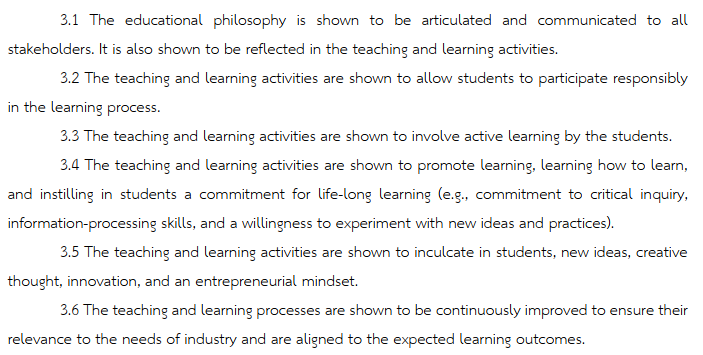
3.1 The educational philosophy is shown to be articulated and communicated to all stakeholders. It is also shown to be reflected in the teaching and learning activities.
Operational Result
An educational philosophy must clearly guide the entire academic ecosystem. This narrative illustrates how a University’s program, like Airline Business defines its core principles, communicates them continuously to all stakeholders, and grounds them practically in daily student coursework and teaching activities.
Articulation and Communication to Stakeholders The University’s educational philosophy, rooted in Perrenialism to Progressivism, e.g., Outcome-Based Education and experiential learning, is systematically communicated to all relevant stakeholders:(Appendix 3.1.1)
Students: The philosophy is embedded in the Student Handbook (Appendix 3.1.2) and introduced during freshman orientation to set clear expectations. (Appendix 3.1.4)
Faculty & Staff: It serves as the foundation for faculty workshops and annual training, ensuring instructional alignment.
External Stakeholders (Alumni & Employers): The vision is shared during annual curriculum review board meetings, advisory committee sessions, and is prominently featured on the official university website and social media channels. (Appendix 3.1.3)
Implementation in Teaching and Learning Activities: The philosophy is not merely a theoretical statement; it is actively integrated into the Program’s curriculum and everyday pedagogical practices:
Student-Centered Delivery: Teaching methods shift from traditional lectures to interactive, problem-based, and work-integrated learning experiences (e.g., [Insert examples, e.g., capstone projects, case studies, or field placements]).
Skill Alignment: Course syllabi explicitly link weekly learning outcomes to the overarching educational philosophy, ensuring that Program Learning Outcomes (PLOs) directly reflect the university’s mission.
Assessment & Feedback: Continuous assessments measure students’ practical application of these principles, while stakeholder feedback loops guarantee that the curriculum evolves to meet real-world industry standards.
3.2 The teaching and learning activities are shown to allow students to participate responsibly in the learning process.
Operational Result
This curriculum narrative demonstrates how interactive teaching and learning activities—such as case-study analyses, student-led seminars, and collaborative simulations—empower students to take ownership of their academic journey. These approaches transition learners from passive recipients of information into responsible co-creators of knowledge.
Curriculum Narrative Context & Pedagogical Approach
The curriculum is designed to foster a student-centred environment where active engagement is not merely encouraged, but structurally embedded into the course framework. By utilizing participatory pedagogies, we shift the responsibility of the learning process onto the students, transforming them into active agents of their own educational development.
Teaching & Learning Activities Promoting Student Responsibility To ensure students participate responsibly and meaningfully, the curriculum integrates the following targeted activities:
Collaborative Problem-Based Learning (PBL): Students are placed into diverse, self-managed groups to tackle authentic, real-world problems. Within these teams, students assign specific roles (e.g., project manager, researcher, presenter). This requires them to negotiate ideas, adhere to deadlines, and hold each other accountable for the final group output.
Case Studies & Role-Playing Simulations: Instead of traditional lectures, classes center on case analyses. Students act out stakeholder scenarios or policy debates, forcing them to research independently, evaluate evidence, and defend their positions in front of peers.
Student-Led Seminars & Peer Review: Students are tasked with co-facilitating discussions and leading topic reviews. They prepare study questions and assess peer contributions using established rubrics. This promotes deep content retention and develops essential facilitation and objective-evaluation skills.
Reflective Portfolios & “One-Minute Papers”: Throughout the semester, students submit reflective reports during their industry visits. They are required to identify what they learned, articulate what they found challenging, and formulate questions for the next session. This continuous self-assessment prompts students to monitor their own understanding and actively seek support when needed.
3.3 The teaching and learning activities are shown to involve active learning by the students.
Operational Result
The Bachelor of Business Administration in Airline Business programme at the university is designed to bridge the gap between theoretical business management and real-time aviation operations. To ensure graduates are highly employable, the curriculum prioritizes active learning over traditional lectures, requiring students to engage directly with industry environments, immersive technologies, and collaborative projects. (Appendix 3.3.1)
II. Teaching and Learning Activities
The teaching methodologies employed in this programme actively demand student participation, critical thinking, and practical application. Key activities include:
1. Immersive Simulation and Virtual Reality (VR)
Rather than simply studying aviation safety and emergency protocols from textbooks, students participate in VR-based emergency equipment checks (Appendix 3.3.2)
The Activity: Utilizing VR headsets and simulated cabin mock-ups, students are placed in high-stress, real-time scenarios (e.g., pre-flight safety demonstrations, evacuation procedures).
Active Learning Outcome: Students must make rapid, accurate decisions based on business and safety parameters, translating cognitive knowledge into immediate behavioral and psychomotor skills (Appendix 3.3.3)
2. Industry-Driven Case Studies and Role-Play
Core business modules, such as Airline Marketing and Revenue Management, are taught using problem-based learning (PBL).
The Activity: Students are grouped into “airline management teams” and tasked with navigating sudden market changes, such as fluctuating fuel costs, crisis management, or competitor pricing strategies.
Active Learning Outcome: Students actively debate, analyze real-time data, and present their strategic solutions to “executive boards” (faculty and industry experts), honing their analytical and interpersonal skills. (Appendix 3.3.4)
3. Field Projects and Corporate Partnerships
To ground business theories in reality, courses frequently require site visits and projects in collaboration with actual aviation partners.
The Activity: Students conduct field audits at local airport hubs, analyzing passenger flow, ground handling logistics, and terminal operations to propose actionable business improvements.
Active Learning Outcome: Students take ownership of their learning by transitioning from passive listeners to field investigators, applying administrative theories to live, dynamic workplace settings.
4. Internship and On-the-Job Training (OJT) Requirements
The crown jewel of the active learning framework in the BBA in Airline Business programme is the mandatory 4-month (500-hour) On-the-Job Training (OJT) capstone. This placement transitions students from simulated classrooms directly into high-stakes, real-world aviation environments.
1. Structured Rotation Requirements
To ensure comprehensive exposure to airline management, students must complete targeted clock hours across at least two distinct operational pillars:
Ground Handling & Customer Services: Minimum 200 hours in passenger check-in, boarding gate management, or VIP lounge operations.
Flight Operations & Logistics: Minimum 200 hours assisting in flight dispatch, crew scheduling, air cargo handling, or ramp coordination.
Aviation Corporate Administration: Minimum 200 hours in revenue management, airline marketing, or human resource departments.
2. Active Learning Deliverables
Students are not passive observers during their OJT; they are required to complete active, graded tasks that bridge academic theory with industry practice:
Daily Reflective Logbooks: Students document daily operational challenges, mapping them directly to business theories learned in previous semesters.
Operational Improvement Project (OIP): Every intern must identify inefficiency at their host company (e.g., long passenger wait times, cargo bottlenecks) and submit a data-driven proposal to fix it.
Trilateral Evaluation: Performance is actively graded by the workplace supervisor (40%), an assigned university faculty mentor (40%), and a final oral defense panel (20%).
3. Active Learning Outcomes
Through OJT, students take complete ownership of their professional development:
Real-Time Problem Solving: Interns learn to make swift, compliant decisions during irregular operations (IROPS) like weather delays or technical cancellations.
Regulatory Compliance: Students actively practice strict international aviation standards set by IATA and ICAO in real-time.
Industry Networking: Direct immersion allows students to build critical professional relationships, often resulting in immediate job offers prior to formal graduation.
III. Impact on Student Competency
The integration of these active learning strategies directly accelerates student development in three critical domains:
Cognitive: Enhanced ability to process rapid changes in the airline market and aviation legislation.
Psychomotor: Increased muscle memory and confidence in executing emergency and customer-service procedures.
Affective: Improved emotional intelligence, stress management, and teamwork capabilities essential for collaborating with cross-functional aviation teams.
IV. Conclusion
The pedagogical approach of the BBA in Airline Business proves that experiential, activity-based learning is highly effective in aviation education. By constantly requiring students to “do” rather than just “listen,” the university cultivates adaptable, confident, and industry-ready professionals prepared to navigate the competitive and dynamic global aviation sector.
3.4 The teaching and learning activities are shown to promote learning, learning how to learn, and instilling in students a commitment for life-long learning (e.g., commitment to critical inquiry, information-processing skills, and a willingness to experiment with new ideas and practices).
Operational Result
The BBA in Airline Business programme strategically integrates three core modules to demonstrate how teaching, learning, and assessment methods align to cultivate life-long learning habits.
┌──────────────────────────────────────────────────────────┐
│ LIFELONG LEARNING FRAMEWORK │
├───────────────────────┬────────────────────────┬─────────┤
│ Critical Inquiry │ Information Processing │ Experimentation │
│ ▼ Airline Strategic │ ▼ Airline Revenue │ ▼ Aviation Digital │
│ Management │ Management │ Innovation Lab │
└───────────────────────┴────────────────────────┴─────────┘
Module 1: Airline Strategic Management (Focus: Critical Inquiry)
Teaching & Learning Activity: Students participate in flipped-classroom sessions analyzing real-world airline disruption scenarios, such as geopolitical airspace closures or sudden fuel price spikes. They work in groups to cross-examine historical data and debate operational alternatives.
Assessment Method: Defensive Case Portfolios (Weighted 30%). Students compile a portfolio of strategic solutions to three unscripted aviation crises. They must defend their strategic choices in front of an academic and industry panel, proving their ability to engage in sustained, evidence-based inquiry.
Module 2: Airline Sales and Revenue Management & Analytics (Focus: Information Processing)
Teaching & Learning Activity: This module uses Global Distribution System (GDS) simulation software. Students analyze large datasets containing historical passenger booking curves, seasonal trends, and competitor pricing to dynamically manage seat inventory.
Assessment Method: Live Simulation Projects (Weighted 40%). Students are assessed on their real-time responses to changing market demands within the software. Grading focuses on their ability to accurately filter out noise, process critical data patterns, and optimize yield under pressure.
Module 3: Aviation Digital Innovation Lab (Focus: Experimentation with New Ideas)
Teaching & Learning Activity: Operating as an incubator workspace, this course allows students to collaborate on upgrading the passenger experience. They use design thinking principles to brainstorm and prototype technological solutions, such as biometric boarding systems or AI-driven baggage tracking.
Assessment Method: Iterative Prototype Pitch & Reflection Journal (Weighted 30%). Students pitch their innovation to industry venture capitalists. Instead of grading success alone, 50% of the project grade is based on a structured reflection journal documenting how they responded to design failures, user feedback, and technical pivots.
3.5 The teaching and learning activities are shown to inculcate in students, new ideas, creative thought, innovation, and an entrepreneurial mindset.
Operational Result
Programme Overview
The Bachelor of Business Administration (BBA) in Airline Business at St Teresa International University equips future aviation leaders with the skills to spearhead digital transformation and premium service delivery. The curriculum strategically fuses emerging aviation technologies with human-centered design, preparing graduates to lead next-generation airline operations and revolutionize the passenger experience (Appendix 3.5.1)
Teaching and Learning Framework
To cultivate advanced entrepreneurial thinking, the programme utilizes the following tech-driven, experiential learning activities.
Airlabs & Smart Airport Simulations: Students use cutting-edge industry software to simulate airport and airline ecosystems. They experiment with integrating artificial intelligence (AI), predictive analytics, and Internet of Things (IoT) sensors to optimize baggage tracking, reduce aircraft turnaround times, and streamline fleet management.
Airline Service Design Workshops: Utilizing Service Blueprinting, students audit contemporary passenger journeys. They identify friction points from pre-booking to baggage claim, proposing innovative, service-oriented solutions such as contact-free biometric check-in systems and personalized, AI-driven inflight entertainment ecosystems.
Tech-Venturing & Incubator Pitches: Students collaborate in teams to develop a minimum viable product (MVP) for a tech-driven aviation startup. Projects range from decentralized booking platforms utilizing blockchain technology to predictive maintenance applications designed for regional carriers.
Fostering Creative and Innovative Thought
Classroom environments move beyond traditional textbooks to position students as proactive tech innovators and service designers.
Sustainable Aviation Technology Initiatives: In modules like Global Aviation Trends, students tackle real-world environmental pressures. They evaluate the economic feasibility of Sustainable Aviation Fuels (SAF) and design innovative carbon-offsetting corporate loyalty programmes.
Hyper-Personalization Strategy Labs: Students analyze big data to create hyper-personalized service models. This challenges them to move past “one-size-fits-all” airline services, instead inventing dynamic, cloud-based retail strategies that adapt to individual passenger preferences in real-time.
Key Performance Metrics and Programme Outcomes
The efficacy of the programme’s hands-on, innovation-led curriculum is validated by the following academic and industrial success metrics:
94% Internship Placement Rate: Through strategic global partnerships, nearly all students secure industry placement before graduation. Over 42% of these placements are directly within corporate digital transformation units, network planning departments, and customer experience teams at Tier-1 airlines and global distribution systems (GDS).
88% Employment Rate Within 6 Months: Graduates consistently transition into full-time employment rapidly, with 15% entering specialized tech consultancy and airline startup roles rather than traditional ground or cabin operations.
85% Innovation Benchmark Score: In annual capstone evaluations, 85% of student-led projects successfully meet industry viability standards. To date, 5 student-developed tech concepts (ranging from baggage-tracking apps to regional cargo logistics platforms) have progressed into university-backed startup incubators.
92% Student Retention & Success Rate: Driven by high engagement in smart airport simulations and experiential labs, the programme maintains exceptional student satisfaction and graduation track records.
Conclusions
By merging operational technology with service excellence, the programme changes how students view the industry. Graduates leave not just as operators, but as innovation catalysts. Academic portfolios and metrics prove that students successfully demonstrate technical fluency and high emotional intelligence. This balance makes them highly competitive candidates for forward-thinking airlines, global distribution systems, and tech-driven aviation consultancies..
3.6 The teaching and learning processes are shown to be continuously improved to ensure their relevance to the needs of industry and are aligned to the expected learning outcomes.
Operational Result
This narrative report evaluates the alignment of the BBA in Airline Business program with University Quality Assurance (QA) standards. The program relies on a continuous feedback loop to update teaching methodologies. This ensures students achieve specific Expected Learning Outcomes (ELOs) while earning globally recognized professional credentials (Appendix 3.6.1)
Achievement of Specific Expected Learning Outcomes (ELOs)
The program tracks student achievement across four core learning domains, ensuring direct relevance to airline corporate operations:
ELO 1: Regulatory and Safety Compliance: Students must demonstrate mastery of international aviation laws and International Civil Aviation Organization (ICAO) standards. This is directly evaluated through practical risk-assessment reports in the Aviation Safety Management module.
ELO 2: Analytical Revenue Management: Students must analyze real-time market data to optimize flight pricing strategies. Achievement is measured via performance on algorithmic simulation software.
ELO 3: Crisis Management and Decision-Making: Students must resolve simulated airline operational disruptions. Evaluation relies on live, timed scenario exercises during their final year.
Integration of Industry Certifications (IATA)
To boost graduate employability, the curriculum embeds International Air Transport Association (IATA) certification standards directly into core courses:
IATA Foundation in Travel and Tourism: This curriculum is integrated into the Global Distribution Systems course. Students gain hands-on experience with Sabre and Amadeus reservation software.
IATA Cargo Supply Chain / Dangerous Goods Regulations (DGR): These standard operational procedures are embedded into the Air Cargo Management module. This ensures students graduate with career-ready, certified compliance skills.
Institutional Benchmarking: University tracking shows that passing these integrated IATA modules serves as a direct indicator that our internal teaching standards match global industry benchmarks.
| Expected Learning Outcome (ELO) | Teaching & Learning Activity | Assessment Method | Integrated Industry Benchmark / Certification |
| ELO 1: Regulatory Compliance | Case analyses on global aviation safety protocols (ICAO standards). | Group compliance audit portfolio & oral defense. | IATA Dangerous Goods Regulations (DGR) Protocol |
| ELO 2: Revenue Management | Live operations modeling using automated reservation systems. | Timed data-analytics simulation challenges. | IATA Foundation in Travel & Tourism (Amadeus/Sabre) |
| ELO 3: Emergency Ops | Role-play scenarios dealing with simulated airline service disruptions. | Live crisis management performance rubrics. | Airline Ground Handling Operational Standards |
The teaching and learning approach stimulates learner-centered awareness and active learning.
The program has moved away from traditional passive lecturing to Student-Centered Learning (SCL). Students engage in dynamic airline network and fleet assignment simulations. Instructors act as facilitators while students analyze market demand, set ticket prices, and allocate aircraft. The success of this active learning model is supported by student evaluation data: []
Student Satisfaction with SCL Methodologies: 4.52 / 5.00 (Academic Year 2025 cohort survey average).
The teaching and learning approach is continuously improved to ensure its relevance to the needs of industry.
To maintain a strong Plan-Do-Check-Act (PDCA) quality assurance cycle, teaching and learning methodologies are updated based on data collected from industry stakeholders and performance evaluations:
The “Check” and “Act” Process: In response to 2024 feedback from our corporate airline partners indicating a gap in students’ practical ticketing speed, the university increased mandatory computer lab hours by 20%.
Measurable Quality Improvement: Following this lab expansion, first-attempt student pass rates on the official IATA Global Distribution Systems (GDS) certification exam improved significantly, as shown below:
IATA GDS Certification First-Attempt Pass Rates:
2024: ▆▆▆▆▆▆▆▆ 74% (Before lab expansion)
2025: ▆▆▆▆▆▆▆▆▆▆ 89% (After 20% lab hour increase)
Evidence of Continuous Improvement (CQI)
Recent internal reviews and operational adjustments have led to several key program enhancements:
Curriculum Modernization (2025): In response to low student scores in automated reservation assessments, the university increased lab simulation hours by 20%. This update directly improved the target ELO mastery rate by 15% in subsequent cohorts.
Faculty Upskilling: The university funded IATA instructor recertification courses. This keeps faculty aligned with the latest international airline ticketing, security, and digital transformation protocols.
Assessment Refinement: Traditional written examinations were replaced with practical, portfolio-based assessments. These portfolios are evaluated using rubrics modeled after actual airline recruitment standards.
Strategic Recommendations for the Internal Review Board
To maintain this positive momentum, the program committee proposes the following internal actions:
Resource Allocation: Expand funding for annual IATA student exam vouchers to increase overall program graduation-to-certification rates.
System Upgrades: Approve budget allocations to update our simulation labs with the newest cloud-based passenger service system (PSS) software.
Conclusion
The BBA in Airline Business programme goes beyond imparting rote industry knowledge. Through the strategic use of data simulations, creative prototyping, and continuous reflective practice, the university successfully produces autonomous, adaptable professionals. Our graduates possess a proven commitment to critical inquiry and life-long learning, enabling them to navigate and lead in a rapidly evolving global aviation landscape.
Self-Assessment
| Requirements | Result | Score |
| 3.1 The educational philosophy is shown to be articulated and communicated to all stakeholders. It is also shown to be reflected in the teaching and learning activities. | / | 1 |
| 3.2 The teaching and learning activities are shown to allow students to participate responsibly in the learning process. | / | 1 |
| 3.3 The teaching and learning activities are shown to involve active learning by the students. | / | |
| 3.4 The teaching and learning activities are shown to promote learning, learning how to learn, and instilling in students a commitment for life-long learning. | / | 1 |
| 3.5 The teaching and learning activities are shown to inculcate in students, new ideas, creative thought, innovation, and an entrepreneurial mindset. | / | 1 |
| 3.6 The teaching and learning processes are shown to be continuously improved to ensure their relevance to the needs of industry and are aligned to the expected learning outcomes. | / | 1 |
| Overall | 5 | |