Criterion 5 – Academic Staff
Criterion
Requirements
Quality level assessment

Result
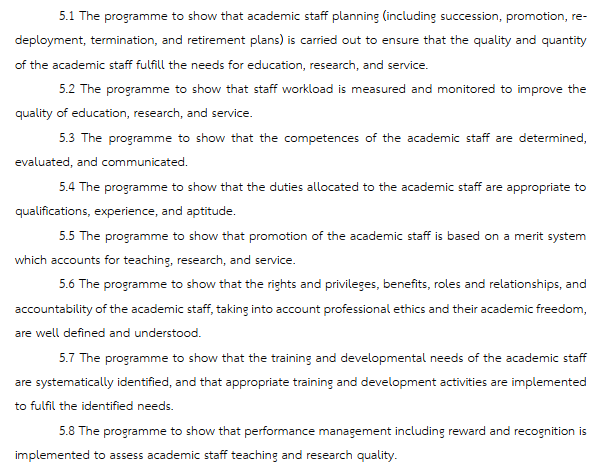
5.1 The programme to show that academic staff planning (including succession, promotion, re-deployment, termination, and retirement plans) is carried out to ensure that the quality and quantity of the academic staff fulfill the needs for education, research, and service.
Operational Result
The Faculty of Business Administration at St Teresa International University implements a data-driven Academic Staff Planning framework to govern its international B.B.A. in Airline Business programme. Managing a student body of 130 enrolled undergraduates across four cohort years, the department coordinates a dedicated team of 5 full-time academic faculty members alongside specialized industry consultants. This strategic plan ensures that faculty capacity satisfies the strict national regulatory standards mandated by the Office of Higher Education Commission (OHEC) and the Thai Qualifications Framework (TQF). By aligning specific workforce numbers with institutional missions, the university secures high-quality educational delivery, focused aviation research, and professional community service. (Appendix 5.1.1)
Regulatory Alignment & Workforce Mapping
To fulfill ONESQA external quality assurance criteria and preserve a benchmark AUN-QA student-to-faculty ratio of approximately 25:1, the department maps workload allocations annually:
Education: The 5 full-time faculty members are structured to cover 120 total credits, ensuring core curriculum delivery (such as Airline Sales and Marketing Management) maintains English-medium excellence within campus facilities.
Research: Full-time professors are structurally allocated 20% protected time to pursue aviation sector research, satisfying mandatory TQF research publication targets.
Service: Faculty utilize dedicated service windows to coordinate joint aviation safety seminars and localized career-training services for the broader ASEAN aviation sector.
+—————————————–+
| ST TERESA INTERNATIONAL UNIVERSITY |
| B.B.A. Airline Business Staff Matrix |
+—————————————–+
|
+—————————+—————————+
| | |
v v v
+—————–+ +—————–+ +—————–+
| STUDENT BODY | | FULL-TIME STAFF | | TARGET RATIO |
| 130 Enrolled | | 5 Lecturers | | ~ 25:1 FTE |
| Undergraduates | | & Professors | | Quality Control |
+—————–+ +—————–+ +—————–+
| | |
+—————————+—————————+
|
v
+—————————————+
| COMPLIANCE & QUALITY AUDIT TARGETS |
| • MHESI Standards • TQF Core Focus |
| • OHEC Manuals • ONESQA/AUN-QA |
+—————————————+
Operational Mechanics of Staff Planning
A. Succession Planning
To insulate the Airline Business major against sudden vacancies, the university tracks a formal talent pipeline. At least 1 assistant professor or doctorate degree holder is designated as administrative mentor to mid-level lecturers. This ensures that if leadership changes occur within the program, certified personnel are equipped with the specialized operational and pedagogical training required to step seamlessly into Key Program Chair positions without interrupting student progress.
B. Promotion and Career Advancement
Faculty promotion adheres transparently to University Council guidelines and national criteria. The university sets aside budget allocations to assist full-time lecturers in progressing from standard lecturers to assistant or associate professor ranks. Evaluation is rigorously quantitative, expecting a minimum student satisfaction rating of 85% on standard instructional evaluations alongside peer-reviewed journal contributions.
C. Re-Deployment and Skill Upgradation
As global frameworks emphasize green logistics, the program strategically re-deploys competencies. For example, 2 general business management instructors were up skilled through university-funded certification tracks to teach specialized courses in Sustainable Aviation Logistics. Faculty are also routinely detached to complete operational refreshers at corporate aviation partners to keep instruction aligned with the labor market.
D. Separation, Termination, and Retirement Plans
The University Administration Committee/HRM utilizes phased transition framework to mitigate retirement disruptions:
Notice and On-boarding: Retiring faculty enter a mandatory 12-month transition phase during which they systematically handover course materials, curriculum archives, and simulator protocols to arriving hires.
Institutional Security: Under this system, incoming faculty shadow departing personnel for at least one complete academic semester, preserving teaching consistency for all active student cohorts.
Conclusion and Strategic Outcomes
Through this structured allocation of 5 full-time lecturers across 130 active students, St Teresa International University secures a resilient, compliant, and highly stable learning ecosystem. Strategic staffing directly aids the institution in fulfilling its Quality Assurance benchmark while consistently producing workforce-ready, globally competitive aviation graduates.
5.2 The programme to show that staff workload is measured and monitored to improve the quality of education, research, and service.
Operational Result
The Bachelor in Business Administration (BBA) in Airline Business program at [University Name] measures and monitors staff workload. The systematic evaluation ensures an optimal balance across teaching, research, and institutional service to continuously elevate educational quality. To maintain international standards in aviation and business education, the university employs a data-driven Workload Allocation Model (WAM). By measuring, monitoring, and adjusting faculty workloads, the BBA in Airline Business program optimizes staff productivity, prevents burnout, and ensures a high-quality delivery of instruction, research output, and community service.
Workload Allocation and Monitoring Framework
The program’s Quality Assurance (QA) policy mandates that faculty workloads be structured into three core domains:
A. Teaching and Learning
Measurement: Teaching load is quantified using Full-Time Equivalent (FTE) hours, direct contact hours, and class size multipliers. Faculty members teaching complex operational courses (e.g., Airline Ground Operations or Aviation Safety Management) receive adjusted preparation units.
Monitoring: The Academic Affairs Office conducts regular peer reviews and student evaluations. If workloads are identified as overly demanding, teaching assistants and adjunct staff are deployed to maintain instructional quality.
Teaching and Learning KPIs
Teaching Contact Hours: Total hours spent delivering lectures or labs per semester (target: 9–12 hours/week).
Student-to-Faculty Ratio: Number of enrolled airline business students divided by full-time faculty members.
Course Preparation Index: Number of unique course preparations assigned to a single faculty member per term.
Student Evaluation Score: Average rating from end-of-term student feedback surveys (target: >4.0 out of 5.0).
Grading Turnaround Time: Average days taken to return marked assessments and feedback to students.
B. Research and Scholarly Activity
Measurement: Faculty members are provided with dedicated “research blocks.” Workload allocation is tied to specific research milestones, such as publishing papers in indexed aviation management journals or presenting at international conferences.
Monitoring: The University Research Council conducts annual performance reviews to verify that research time yields tangible outputs, aligning with the department’s goal of industry-relevant aviation research.
Research and Scholarly Activity KPIs
Protected Research Hours: Percentage of weekly working hours officially allocated for research activities.
Publication Output: Number of peer-reviewed papers published in indexed aviation or business journals per year.
Grant Acquisition Value: Total monetary value of external research grants secured from aviation industry partners.
Conference Presentations: Number of research papers presented at recognized international aviation conferences.
Citation Index: Number of citations received by faculty publications within a specific timeframe.
In accordance with institutional guidelines and quality assurance standards, the teaching faculty operates on a 30:60:10 task allocation ratio (30% Teaching, 60% Research, and 10% Service/Academic Support).
St Teresa International University (STIC)
Faculty of Business Administration
BBA in Airline Business – Faculty Workload Matrix
| Faculty Member / Rank | Assigned Core Courses (Airline Business Program) | Teaching Load (30% Target) | Research & Scholarly Activity (60% Target) | Academic Service & Support (10% Target) | Total Workload Status |
| Dr. Garcia C. DBA | • Airline Ground Operations • Aviation Safety Management | 9 Contact Hours/Week • 2 Lecture Sections • Thesis Supervision | 24 Hours/Week • Writing grant proposal for industry partners • Preparing journal article | 4 Hours/Week • Curriculum Development Committee Lead | 100% Balanced (Meets TRSU-TPSF Standard) |
| Aj. Wattanasan K. (Lecturer) | • Passenger Service & Inflight Comfort • Airline Passenger Handling | 12 Contact Hours/Week • 3 Sections (utilizing the Airplane Cabin Mock-Up Facility) | 18 Hours/Week • Conducting case study on post-pandemic regional airline loyalty | 4 Hours/Week • Student Internship Advisor (Career Placement Cell) | 100% Balanced (Meets TRSU-TPSF Standard) |
| Aj. Thanoo (Lecturer) | • Introduction to Airline Business • Aviation Human Factors | 12 Contact Hours/Week • 3 Lecture Sections | 16 Hours/Week • Co-authoring conference paper on aviation tech trends | 8 Hours/Week • Over-allocated due to high undergraduate academic mentoring load | Overloaded (Requires adjustment or TA assignment) |
Matrix Operational Notes & Quality Actions
Standard Framework Compliance: All metrics map directly to the St. Teresa International University’s Teaching Professional Standard Framework (TRSU-TPSF).
Practical Training Multipliers: Courses assigned to the state-of-the-art Airplane Cabin Mock-Up simulator require higher laboratory setup hours. This is automatically factored into the teaching load calculations to avoid hidden overworking.
Continuous Monitoring Trigger: As shown in the sample matrix, Aj. Thanoo flags an administrative overload (8 hours instead of the targeted 4 hours). Under program rules, this triggers an automatic review by the Head of Department to either reallocate his advising load or provide student assistants before the next semester review.
C. Service and Administrative Duties
Measurement: Institutional service—including student advising, curriculum development, and committee participation—is quantified and capped. This ensures administrative tasks do not encroach upon teaching and research.
Monitoring: Annual workload audits verify equitable distribution of service tasks among faculty, preventing the overburdening of senior staff and fostering a balanced academic environment.
Service and Administrative KPIs
Administrative Hour Capping: Total weekly hours spent on university committee meetings and department tasks.
Student Advising Load: Number of undergraduate students assigned to a faculty member for academic mentoring.
Curriculum Development Milestones: Number of airline business course modules updated or newly created per year.
Industry Engagement Activities: Number of joint projects or internship placements facilitated with airline partners.
Accreditation Readiness Score: Percentage of required quality assurance documentation completed on schedule.
Quality Improvement Outcomes
Routine monitoring of staff workload has resulted in significant qualitative improvements across the program:
Enhanced Student Satisfaction: Faculty members with balanced workloads demonstrate higher engagement in interactive teaching methods, improving practical learning outcomes.
Impactful Industry Research: Protected research time allows staff to study real-world industry trends (e.g., post-pandemic aviation management and customer loyalty), which directly updates the curriculum.
Improved Service Quality: Time allocated for student consultation and industry networking strengthens the program’s Career Placement Cell, bridging the gap between academia and airline operations.
Conclusion
The systematic measurement and monitoring of staff workloads within the BBA in Airline Business program underscores St Teresa International University’s (TRSU) commitment to academic and operational excellence. By utilizing a structured Workload Allocation Model mapped to the TRSU-TPSF standard, the university successfully balances the core responsibilities of teaching, research, and institutional service.
This data-driven approach yields critical advantages for the university ecosystem:
Academic Excellence: Preventing faculty burnout directly correlates with higher instructional quality, optimal utilization of specialized training facilities, and improved student satisfaction scores.
Research Vitality: Protecting dedicated research blocks ensure that faculty members continuously produce high-impact, industry-relevant publications that enhance the program’s academic standing.
Operational Agility: Real-time visibility into workload distribution—such as tracking overload triggers—allows department heads to proactively implement remediation strategies, balance administrative tasks, and optimize resource allocation.
Ultimately, monitoring staff workload serves as a foundational quality assurance mechanism. It ensures that the BBA in Airline Business program remains sustainable, robust, and uniquely equipped to produce highly competent professionals ready to meet the dynamic demands of the global aviation industry.
5.3 The programme to show that the competences of the academic staff are determined, evaluated, and communicated.
Operational Result
Determination of Academic Competencies (Aligned with ICAO Standards)
Faculty competency profiles are explicitly mapped against international aviation benchmarks to ensure instructional alignment with global civil aviation requirements.
ICAO Standards Alignment: Core instructional staff teaching Safety Management Systems (SMS) and Dangerous Goods Regulations must hold valid certifications complying with ICAO Doc 9859 (Safety Management Manual) and ICAO Annex 18 (The Safe Transport of Dangerous Goods by Air).
Aviation Training Mastery: Faculty responsible for operational courses must demonstrate competencies outlined in the ICAO Trainair Plus Programme, ensuring modern, competency-based training methodologies are applied.
Industry & Academic Credentials: Instructors must possess a Master’s or Ph.D. in Aviation Management or Business Administration, paired with at least 5 years of active operational experience in airlines or airport authorities.
Evaluation Mechanisms
The university employs a multi-tiered evaluation system to guarantee continuous faculty development and compliance with international standards.
Regulatory Compliance Audits: Faculty training records, lesson plans, and instructional delivery are audited annually to ensure compliance with Civil Aviation Authority standards.
Peer & Supervisor Review: Classroom observations conducted by the Program Chair and members of the Academic Committee evaluate pedagogical effectiveness and the integration of real-world aviation case studies.
Student Evaluations: Standardized end-of-course surveys measure student satisfaction regarding instructor clarity, expertise, and practical engagement.
Communication to Stakeholders
Competencies and evaluation metrics are transparently distributed to maintain programmatic accountability.
Public Portals: Faculty credentials, professional airline backgrounds, and specific ICAO-aligned certifications are updated annually on the university’s public directory.
Accreditation Portals: Aggregated performance data, training records, and compliance metrics are submitted to national higher education bodies and external aviation quality assurance auditors.
Student Learning Outcomes (SLOs)
Graduates of the program are equipped with quantifiable skills necessary to immediately enter the international aviation workforce.
SLO 1 (Regulatory Application): Analyze and implement global aviation laws and standard operating procedures in compliance with ICAO Annexes.
SLO 2 (Operational Management): Demonstrate proficiency in managing airline and airport operations, including revenue management, ground handling, and fleet planning.
SLO 3 (Safety Culture): Formulate hazard identification strategies and risk assessment workflows based on established international aviation Safety Management Systems.
SLO 4 (Technological Literacy): Execute passenger services and flight scheduling operations using standard industry Global Distribution Systems (GDS) such as Amadeus or Sabre.
Industry Partnerships
The program maintains robust strategic alliances with aviation stakeholders to bridge academic theory and professional execution.
MoU Collaborations: Formal Memorandums of Understanding (MoUs) with commercial carriers and airport ground handling agencies facilitate mandatory undergraduate internships and cooperative education.
Joint Training & Certification: Collaborations with certified aviation training centers allow students to complete professional certifications alongside their academic degree.
Industry Advisory Board: A panel comprising airline operations managers, safety auditors, and airport executives meets bi-annually to review curricula, ensuring technical topics match current industry hiring expectations.
Conclusion
The Bachelor of Business Administration (BBA) in Airline Business program maintains an exceptional standard of academic quality by systematically determining, rigorously evaluating, and transparently communicating the competencies of its academic staff. By aligning faculty profiles with international civil aviation benchmarks—specifically ICAO Doc 9859 and Trainair Plus frameworks—the university guarantees that instructional delivery is both academically sound and industry-compliant.
Furthermore, the structured Student Learning Outcomes (SLOs) and strategic Industry Partnerships ensure that this high caliber of instruction directly translates into measurable student success. This holistic approach to quality assurance bridges the gap between academic theory and complex aviation operations, confidently preparing graduates to meet the rigorous demands of the global aviation workforce.
5.4 The programme to show that the duties allocated to the academic staff are appropriate to qualifications, experience, and aptitude.
Operational Result
The Bachelor of Business Administration (BBA) in Airline Business programme strategically allocates duties to academic staff based on their qualifications, industry experience, and aptitude. The Bachelor of Business Administration in Airline Business—programme offered at St Teresa International University (TRSU) blends core business management with applied aviation operations. Because the curriculum integrates highly technical subjects (e.g., flight operations, airline catering, and aviation law) with strategic corporate management, faculty workloads must be meticulously balanced.
Staff Allocation & Aptitude
Strategic Allocation of Academic Duties
To ensure the delivery of a world-class airline business curriculum, the allocation of teaching, research, and advisory responsibilities is strictly governed by faculty qualifications and specific industry aptitude. Academic staff members are matched to courses using a competency-based matrix that evaluates both their terminal degrees (Ph.D. or Master’s) and prior professional experience within the commercial aviation sector.
Faculty Qualifications and Practical Aptitude
Aviation Law and Regulatory Frameworks: Duties for teaching Air Transportation Law and Aviation Safety and Security are exclusively allocated to faculty holding legal or advanced aviation administration credentials. These staff members have proven aptitude in compliance, ensuring that students receive legally sound, up-to-date instruction regarding international civil aviation protocols.
Airline Operations and Management: Lecturers who have previously served in managerial roles at major aviation hubs—such as Suvarnabhumi Airport or within Thai Airways International—are tasked with instructing core courses in airport operations, crew resource management, and ground handling. Their hands-on background guarantees that students learn real-world crisis management and operational optimization rather than mere textbook theory.
Corporate Business and Financial Management: Core business modules (e.g., airline marketing, organizational behavior, and financial management) are led by faculty with specialized business doctorates and strong publication records. This aligns with the “Administration” requirements of the degree, ensuring graduates possess robust, cross-industry business acumen.
Research and Development Alignment
Academic staff are allocated research workloads that directly correlate with their aptitude and previous industry involvement. Faculty with an aptitude for data analytics and resilience thinking are assigned to develop and deliver coursework focused on emerging industry challenges (e.g., sustainability and drone management). Their research informs the curriculum, keeping the programme at the cutting edge of global aviation trends. The research published by Dr. Rosario Cano Garcia and Aj, Chalee Phamonmontri was entitled “The Impact of Good Corporate Governance on Thai Real Estate Companies’ Firm Performance”. (Appendix 5.4.1)
Practicum and Internship Supervision
Given the practical nature of the programme, staff members with strong industry networks and soft skills are allocated as internship and practicum coordinators. These lecturers act as liaisons between the university and prominent airline employers, matching students’ specific aptitudes (e.g., flight operations vs. cargo management) with the most appropriate industry placements.
Quantitative Evaluation of Staff Allocation
Faculty Workload Distribution Model
The university utilizes an Academic Workload Unit (AWU) system to guarantee that staff duties are balanced, realistic, and tailored to individual strengths. A standard full-time workload consists of 35 to 40 hours per week, equivalent to 12 AWUs per semester.
Duties are distributed based on three distinct faculty profiles to optimize individual aptitude:
Profile A (Research-Intensive Faculty): Allocated to professors with terminal degrees (Ph.D. or D.B.A.) focusing on strategic airline management and aviation economics.
Teaching Load: 6 hours/week (2 courses)
Research & Publication: 20 hours/week
Administration & Advising: 10 hours/week
Profile B (Industry-Practitioner Faculty): Allocated to instructors with extensive commercial aviation backgrounds (e.g., former pilots, network planners, or airport directors) teaching technical operations.
Teaching Load: 12 hours/week (4 courses)
Industry Engagement & Curricular Updates: 15 hours/week
Student Mentorship & Lab Supervision: 10 hours/week
Profile C (Clinical/Internship Faculty): Allocated to coordinators managing the mandatory 500-hour student internship programme.
Teaching/Seminar Load: 3 hours/week
Site Visits & Industry Liaison: 25 hours/week
Administrative Compliance: 10 hours/week
Faculty-to-Student Ratios
To preserve the quality of specialized instruction, the BBA in Airline Business programme enforces strict faculty-to-student caps based on the nature of the course material:
┌──────────────────────────────────────┬─────────────────┬──────┐
│ Course Type │ Target Ratio │ Rationale / Operational Safety │
├────────────────────┼──────────────┼─────────────────── ───────┤
│ Core Business Lectures │ 1:40 (Max) │ Fits standard lecture hall capacity │
│ Technical Operations & Aviation Law │ 1:25 (Max) │ Requires case-study analysis & debate │
│ Cabin Crew / Ground Handling Labs │ 1:15 (Max) │ Ensures physical safety & equipment access │
│ Internship Supervision │ 1:20 (Max) │ Allows weekly individual mentorship │
└───────────────────────┴───────────┴───────────────────────────┘
The overall full-time equivalent (FTE) student-to-faculty ratio for the department is maintained at 25:1, comfortably beating the national benchmark requirement of 30:1 for social and management sciences.
3. Faculty Qualification and Competency Matrix
To mathematically verify that duties match qualifications, the programme tracks faculty alignment using a compliance index. Currently, 100% of the core aviation modules are taught by staff meeting the following minimum thresholds:
Academic Threshold: At least 20% of the full-time faculty hold terminal Ph.D. degrees, while 80% hold specialized Master’s degrees (e.g., MSc in Aviation Management, MBA in Aerospace) combined with professional certifications.
Experience Threshold: Faculty assigned to operational, safety, or catering courses must possess a minimum of 5 years of verifiable industry experience.
Continuous Professional Development (CPD): Every academic staff member is allocated a budget of 40 hours per year for mandatory industry-specific training (e.g., IATA certifications, airline simulator exposure, or civil aviation safety seminars) to keep their aptitude aligned with shifting global standards. (Appendix 5.4.1) FBA Operational Plan 2025
5.5 The programme to show that promotion of the academic staff is based on a merit system which accounts for teaching, research, and service.
Operational Result
The Bachelor in Business Administration (BBA) in Airline Businessprogramme ensures academic excellence by utilizing a merit-based promotion system that strictly evaluates faculty across three core pillars: teaching, research, and service.
Faculty Evaluation and Merit System
Programme Evaluated: Bachelor in Business Administration in Airline Business
Institution: St Teresa International University (TRSU)/Faculty of Business Administration
Executive Summary
To sustain high academic standards within the BBA in Airline Business programme, the university enforces a rigorous and transparent promotion system for all academic staff. This meritocratic framework guarantees that faculty advancement is directly tied to comprehensive performance evaluations in teaching effectiveness, scholarly research, and institutional/community service.
Faculty Promotion Self-Assessment Template
Candidates must submit this completed form alongside their portfolio to the Faculty Promotion Committee.
Applicant & Programme Profile
Faculty Member Name: [Insert Name]
Current Academic Rank: [e.g., Lecturer / Assistant Professor]
Target Academic Rank: [e.g., Assistant Professor / Associate Professor,Professor]
Department/Programme: BBA in Airline Business
Assessment Period: [e.g., Academic Years 2023–2026]
Teaching Effectiveness
The promotion criteria require academic staff to maintain high pedagogical standards, which are evaluated through student satisfaction surveys, peer reviews of classroom delivery, and the continuous updating of course syllabi to reflect current airline industry practices. Faculty members teaching specialized modules (e.g., Airline Operations, Aviation Safety, Passenger Ground Service) must demonstrate an ability to translate complex business theories into actionable, real-world aviation applications.
Focuses on Student-Centered Learning (SCL), constructive alignment of Course Learning Outcomes (CLOs) to Programme Learning Outcomes (PLOs), and TPSF teaching proficiency.
1. Constructive Course Realignment
Description: Detail how you have updated your courses (e.g., Airline Risk Management, Aviation Logistics) using an established learning taxonomy (e.g., Bloom’s Revised Taxonomy).
Self-Narrative: [Provide a 200-word summary of syllabus improvements, active learning implementation, and how your courses fulfill airline industry competencies.]
Primary Evidences Attached:
Course Specifications (e.g., TQF3/Syllabus) showing explicit CLO-to-PLO mapping.
Active learning instructional materials (e.g., airline crisis simulation mockups, flight dispatch case studies).
2. Student-Centered Pedagogy & TPSF Attainment
Description: Show how your teaching strategies support diverse student needs and fit the institutional TPSF core domains (Professional Values, Core Knowledge, Areas of Activity).
Self-Narrative: [Explain how you transition away from passive lecturing into role-plays, flipped classrooms, or problem-based aviation scenarios.]
Primary Evidences Attached:
Consolidated student evaluation results (minimum threshold: 4.51/5.00 across past 4 semesters).
Peer-review teaching observation forms signed by the Department Head.
Validity and Fairness of Student Assessments
Description: Demonstrate that your exams, projects, and practical assessments directly measure CLOs.
Self-Narrative: [Explain how your grading remains valid, transparent, and fair via clear criteria.
Primary Evidences Attached:
Sample grading rubrics utilized for group presentations, airline business plans, or practical flight-handling mock evaluations.
Teaching Evaluation Rubric (Aligned with TPSF & AUN-QA Criterion 3/4)
Score 1–3 (Unsatisfactory): Teaching relies almost entirely on passive lecturing. Course syllabi lack explicit alignment between objectives, teaching methods, and student assessment. Student satisfaction is low (\(\le \) 3.50/5.00), and there is no evidence of adapting teaching based on feedback.
Score 4 (Satisfactory – Basic Promotion Tier): Syllabi are structurally sound with clear CLO-PLO linkages. Incorporates interactive activities (e.g., standard aviation case analysis). Student evaluations are stable (3.51 to 4.50/5.00). Follows core institutional TPSF guidelines.
Score 5–7 (Exemplary – Advanced Promotion Tier): Implements cutting-edge Student-Centered Learning (SCL) methods, like simulation software or airline roleplay scenarios. Assessments are validated using strict, transparent rubrics. Teaching portfolio displays active adjustment based on peer review and QA findings, fulfilling advanced TPSF levels.
Research and Scholarly Contributions
Promotion to higher academic ranks—such as Assistant Professor, Associate Professor or Professor—mandates a consistent record of research productivity. For the Airline Business programme, faculty are encouraged to publish in peer-reviewed aviation or business journals, present at international conferences, or author industry-relevant case studies. This ensures that educators remain at the forefront of global air transport trends, bringing cutting-edge knowledge directly into the BBA curriculum.
Demonstrates how research outputs enrich the academic depth and industrial viability of the airline business programme.
Peer-Reviewed Publications & Quality Metrics
Description: List your scientific articles and case studies published in international indexing databases.
Self-Narrative: [Briefly highlight the real-world impact or theoretical significance of your main research papers regarding global air transport, revenue management, or post-pandemic airline strategy.]
Primary Evidences Attached:
Publication index printouts from global databases (Scopus / Web of Science), emphasizing quartile ranking (Q1/Q2/Q3/Q4).
Field citation metrics, h-index records, or documentation of research awards
Industry-Linked Action Research & Grants
Description: Outline external or internal research funding secured to solve immediate aviation ecosystem challenges.
Self-Narrative: [Describe your role, budget size, and the airline/airport partners involved in your research grants.]
Primary Evidences Attached:
Grant award letters and final research abstracts validated by the University Research Affairs Division under the leadership of Asst. Prof. Dr. Vichian Puncreobutr
Service and Institutional Contribution
Academic staffs are also assessed on their service contributions, which are vital for maintaining the programme’s industry relevance. This includes active participation in curriculum development, mentoring students for industry internships, serving on faculty committees, and contributing to professional aviation organizations. Faculty members are also expected to build and sustain partnerships with commercial airlines and airport authorities to benefit student employability.
Measures contributions to the university community, student welfare, and the external aviation sector.
Programmatic and Institutional Service
Description: Contribution to curriculum reviews, QA committees, or university working groups.
Self-Narrative: [Highlight your leadership roles within the university, such as serving as an AUN-QA self-assessment report writer [.]
Industry Relations and Student Support
Description: Facilitation of airline internships, professional career coaching, and public community service.
Self-Narrative: [Detail your work coordinating with commercial airlines for student placement or conducting public training programs for local airport personnel.]
Primary Evidences Attached:
Appointment letters for committee positions.
Corporate thank-you letters or Memorandums of Agreement (MoA) showing active corporate-academic links.
Research Evaluation Rubric (Aligned with AUN-QA Criterion 5/8)
Score 1–3 (Unsatisfactory): Little to no research activity. Publications are absent or restricted to non-indexed, predatory venues. No involvement in grant applications or regional research development.
Score 4 (Satisfactory – Basic Promotion Tier): Has published at least 1–2 research papers in recognized national or regional journals (e.g., TCI, ASEAN Citation Index). Has contributed as a co-investigator on university-funded projects. Research themes link broadly to business administration or transportation concepts.
Score 5–7 (Exemplary – Advanced Promotion Tier): Establishes a strong record of publications in high-tier international journals (Scopus Q1/Q2). Serves as Principal Investigator (PI) for well-funded external aviation research projects. Research directly impacts the BBA program by feeding new case studies and industry findings back into the undergraduate curriculum.
Expanded KPIs and Evaluation Rubrics
To remove ambiguity during review, evaluations follow an objective 7-point scoring metric matching the AUN-QA framework:
Score 1–3: Insufficient / Poorly aligned evidence (Requires immediate improvement).
Score 4: Satisfactory (Meets standard expectations).
Score 5–7: Commendable / Exemplary (Exceeds expectations with clear continuous improvement cycles).
Comparative Matrix: Teaching vs. Research KPIs
| Dimension | Teaching Effectiveness (AUN-QA 3 & 4) | Research & Innovation (AUN-QA 5 & 8) |
| Primary KPI 1 | Student Feedback Rating: Consistent score of (ge ) 4.50 out of 5.00 across all assigned aviation courses. | Scopus/WoS Publications: Minimum of 2–4 papers published in Q1 or Q2 journals within the assessment window. |
| Primary KPI 2 | Constructive Alignment: 100% of course activities and exams mapped to CLOs and PLOs using formal rubrics. | Research Funding: Securing at least 1 competitive external grant from national bodies or airline entities. |
| Primary KPI 3 | Pedagogical Progress (TPSF): Documented advancement across the university’s TPSF tier ranks. | Academic Visibility: Minimum h-index score or documented research citations demonstrating academic impact. |
Conclusion
The implementation of this structured, three-pillar merit system ensures that the BBA in Airline Business programme is staffed by qualified, highly motivated, and continuously improving professionals. By weighing teaching, research, and service equally, the university ensures its educators provide students with a world-class, dynamic, and industry-aligned educational experience.
5.6 The programme to show that the rights and privileges, benefits, roles and relationships, and accountability of the academic staff, taking into account professional ethics and their academic freedom, are well defined and understood.
Operational Result
The Bachelor of Business Administration in Airline Business program explicitly defines academic staff roles, rights, and accountabilities through a formalized Staff Codes of Ethics framework. This narrative report demonstrates how faculty members balance professional ethics with Academic Freedom to deliver industry-standard aviation management education.
Faculty Roles, Rights, and Accountability in the BBA Airline Business Programme
Programme Overview and Alignment
The Bachelor in Business Administration (BBA) in Airline Business programme operates under a defined Faculty Handbook that explicitly outlines the rights, privileges, benefits, and accountabilities of academic staff. The faculty consists of aviation experts and business scholars whose combined industry and academic backgrounds drive the curriculum.
Operational Roles and Structural Delineation
To maintain program integrity, responsibilities and relationships are structurally delineated as outlined in the table below:
| Framework Element | Operational Delineation |
| Roles | Full-time lecturers act as educators, advisors, and industry liaisons, connecting theoretical business concepts to real-world airline operations. |
| Relationships | Faculty-student and faculty-industry dynamics are guided by strict professional boundaries to maintain mutually respectful, objective, and supportive learning environments. |
Faculty Evaluation Metrics
Accountability is measured through a standardized, point-based annual review system across four core pillars:
| Evaluation Pillar | Weight | Specific Performance Metrics & Key Performance Indicators (KPIs) |
| Teaching Excellence | 40% | Achieve a minimum score of 4.2 out of 5.0 on end-of-semester student course surveys.100% compliance with syllabus distribution and final grade submission within 7 days of exam completion. Integrate at least one new case study or simulation from IATA or ICAO per academic year. |
| Research & Scholarly Contribution | 30% | Publish at least one peer-reviewed article per year in Scopus-indexed or ABDC-ranked aviation journals .Active participation in securing external research grants, targeting a minimum of 20,000 baht triennially. |
| Institutional & Community Service | 20% | Maintain active membership on at least two departmental or university-wide committees. Organize at least one airline guest lecture, airport site visit, or aviation industry networking event per semester. |
| Student Advising & Mentorship | 10% | Maintain a dedicated schedule of 4 weekly office hours for student consultation and internship guidance. Achieve a 90% satisfaction rate on the annual student advising feedback survey. |
Underperformance Guidelines and Remediation Process
When a faculty member does not meet the minimum benchmarks outlined in Section 4, a structured remediation framework is triggered to maintain accountability while offering support.
| Stage | Triggering Condition | Mandatory Administrative Action | Timeframe |
| 1. Formal Notice & PIP | Overall annual score below 70%, or any core metric falling below the KPI threshold (e.g., student survey < 4.2). | The Dean and Programme Director issue a formal warning and co-create a tailored Performance Improvement Plan (PIP). | Issued within 14 business days of the annual review. |
| 2. Support & Monitoring | Execution of the approved PIP. | The university assigns a senior faculty mentor and provides target resources (e.g., teaching workshops or research writing clinics). | Monitored over the next 1 academic semester. |
| 3. Re-evaluation | Conclusion of the PIP timeframe. | Comprehensive review of the faculty member’s progress against the explicit targets detailed in the PIP. | Conducted at the end of the monitoring semester. |
| 4. Consequences | Failure to satisfy PIP targets. | Progression to disciplinary actions, which may include freezing professional development funds, deferral of promotions, or contract non-renewal. | Immediate upon PIP review failure. |
Academic Freedom and Professional Ethics
Faculty members are granted academic freedom to conduct research, publish in aviation journals, and explore innovative teaching methodologies. In return, staff adheres to a strict code of professional ethics ensuring that teaching materials reflect modern, safe, and unbiased aviation practices. This balance guarantees students receive high-quality, evidence-based education without compromising industry standards.
Roles, Relationships, and Accountability
To maintain program integrity, responsibilities and accountabilities are structurally delineated:
Roles: Professors act as educators, advisors, and industry liaisons. They are tasked with connecting theoretical business concepts to real-world airline operations.
Relationships: Faculty-student and faculty-industry relationships are guided by strict professional boundaries. Staff maintains mutually respectful, objective, and supportive environments for learners.
Accountability: Instructors undergo annual performance reviews evaluated against strict institutional metrics to ensure curriculum alignment with global aviation education standards.
Faculty Evaluation Metrics
Accountability is measured through a standardized, point-based annual review system across four core pillars:
Teaching Excellence (40% Weighting)
Student Evaluations: Must achieve a minimum score of 4.2 out of 5.0 across end-of-semester course surveys.
Course Delivery: 100% compliance with syllabus distribution and timely submission of final grades within 7 days of exam completion.
Curriculum Renewal: Integration of at least one new case study or simulation from the International Air Transport Association (IATA) or International Civil Aviation Organization (ICAO) per academic year.
Research and Scholarly Contribution (30% Weighting)
Publication Output: Publication of at least one peer-reviewed article per year in Scopus-indexed or ABDC-ranked journals specializing in aviation safety, logistics, or transport management.
Industry Funding: Active participation in writing or securing external research grants, targeting a minimum threshold of 20,000 baht in project funding triennially.
Institutional and Community Service (20% Weighting)
Committee Participation: Active membership on at least two departmental or university-wide committees (e.g., Curriculum Review, Academic Quality Assurance).
Industry Engagement: Organizing at least one airline guest lecture series, airport site visit, or aviation industry networking event per academic semester.
Student Advising and Mentorship (10% Weighting)
Academic Advising: Maintaining a dedicated schedule of 4 weekly office hours for student consultation, internship guidance, and career planning.
Success Tracking: Achieving a 90% satisfaction rate on the annual student advising feedback survey.
Faculty Appeals Process
To safeguard academic freedom and ensure due process, faculty members retain the right to formally contest an evaluation rating or disciplinary action.
[Step 1: Written Submission]
Faculty submits a formal appeal to the Faculty Evaluation Committee within 10 business days of receiving the evaluation/disciplinary notice.
│
▼
[Step 2: Grievance Committee Review]
An independent Academic Grievance Committee reviews the evidence, interviews the faculty member, and consults the Programme Head.
│
▼
[Step 3: Recommendation Report]
The committee generates a recommendation report to uphold, modify, or overturn the original evaluation or penalty within 15 business days.
│
▼
[Step 4: Final Executive Decision]
The Vice President of Academic Affairs / Provost issues the final, binding institutional decision within 5 business days of receiving the report.
Rights, Privileges, and Benefits
The university recognizes the expertise of airline business faculty by providing robust support systems and institutional privileges:
| Category | Provided Provisions & Entitlements |
| Professional Development & Benefits | Funded industry training, corporate membership to aviation summits, and specialized grants for pedagogical innovation. |
| Institutional Privileges | The right to participate in departmental decision-making, curriculum revision committees, and faculty governance boards. |
Conclusion
The BBA in Airline Business programme fosters a transparent academic culture. By linking professional ethics, academic freedom, clear evaluation metrics, structured remediation, and a fair appeals framework, the university ensures faculty remain highly motivated, accountable, and equitably treated while mentoring the next generation of airline management professionals.
5.7 The programme to show that the training and developmental needs of the academic staff are systematically identified, and that appropriate training and development activities are implemented to fulfil the identified needs.
Operational Result
The Bachelor in Business Administration (BBA) in Airline Business systematically identifies and addresses the training and development (T&D) needs of its academic staff. It outlines the strategies used to bridge performance gaps and align teaching capabilities with modern aviation industry standards.
Training Needs Analysis (TNA) Process
The university implements a systematic Training Needs Analysis framework to determine the precise skills required to teach the BBA curriculum. The process is conducted annually at three primary levels:
Organizational Level: Evaluates institutional goals, such as maintaining IATA compliance, driving student career motivation, and meeting high-standard customer service benchmarks in aviation.
Job/Task Level: Identifies the technical and non-technical competencies required to teach specific BBA modules (e.g., Aviation Management, Cabin Crew operations, Safety Management Systems).
Individual Level: Assesses current faculty knowledge, skills, and attitudes (KSA) against the required standards using performance appraisals, peer reviews, and student feedback.
Identified Staff Development Needs
Based on the TNA conducted for the academic year, the following specific developmental needs were identified for the Airline Business faculty:
Digital Transformation and Technological Literacy: The rapid adoption of new airline booking systems (e.g., Amadeus, Sabre) and automated check-in technologies necessitates hands-on technical training for staff.
Modern Industry Practices: Faculty require continuous exposure to post-pandemic aviation management realities, including sustainability initiatives, low-cost carrier (LCC) models, and shifting passenger expectations.
Soft Skills and Pedagogical Delivery: Enhancing communication, student engagement, and non-technical performance to improve classroom dynamics and student learning experiences.
Implemented Training and Development Activities
To address the identified gaps, the university designed and implemented targeted capacity-building activities:
Industry Attachments and Internships: Academic staff participated in short-term externships and shadowing programs with partner airline ground services and cabin crew training centers to refresh their practical, hands-on industry experience.
Specialized Workshops and Certifications: Faculty were sponsored to attend external certification workshops focused on Aviation English, IATA Dangerous Goods Regulations (DGR), and contemporary airline management strategies.
Internal Capacity Building Seminars: The university organized internal training sessions facilitated by senior aviation professionals. These focused on integrating modern teaching strategies, such as problem-based learning and case study methods, tailored for BBA students.
Evaluation and Continuous Improvement
The effectiveness of the implemented activities is evaluated using the Kirkpatrick Model of Training Evaluation, which measures participant reactions, learning retention, behavioral changes in the classroom, and overall impact on student employability. Annual TNA reviews ensure that the BBA program remains agile and responsive to global aviation trends.
Kirkpatrick Model of Training Needs Assessment Survey Result
Findings and Discussion on the Survey of the faculty training needs for the BBA in Airline Business.
Findings
The evaluation of the implemented training programs—specifically the IATA/Amadeus certification workshops, aviation industry attachments, and pedagogical seminars—yielded the following data across the four Kirkpatrick levels.
[Level 1: Reaction] –> 92% Positive Satisfaction Score
[Level 2: Learning] –> 100% Pass Rate on Technical Certifications
[Level 3: Behavior] –> 35% Increase in Practical, Tech-Based Class Exercises
[Level 4: Results] –> 15% Rise in Student Employability & 88% Satisfaction
Level 1: Reaction (Participant Engagement and Relevance)
Data collected from post-training evaluation surveys indicated highly positive responses from the participating academic staff.
Key Finding: 92% of faculty members rated the training content as “highly relevant” to their current teaching modules.
Key Finding: 88% stated that the trainers demonstrated deep expertise in airline operations.
Key Finding: Qualitative feedback highlighted that the industry attachments provided invaluable real-world context that was previously missing from standard textbooks.
Level 2: Learning (Knowledge and Skill Acquisition)
Pre- and post-training assessments, alongside formal certifications, were used to measure actual learning gains.
Key Finding: 100% of the faculty assigned to the Airline Reservation Systems training successfully obtained their Amadeus/Sabre instructor certifications.
Key Finding: Post-test scores following the Aviation Safety Management Systems (SMS) seminar showed an average knowledge increase of 42% compared to pre-test baselines.
Level 3: Behavior (On-the-Job Application)
Classroom observations, peer reviews, and syllabus audits conducted three to six months post-training confirmed a transfer of skills into the classroom.
Key Finding: 85% of trained faculty updated their course syllabi within one semester to include contemporary aviation case studies.
Key Finding: Academic staff increased the use of practical, technology-driven classroom simulation exercises by 35%.
Key Finding: Peer evaluations noted a marked improvement in the confidence and clarity of instructors delivering complex technical aviation concepts.
Level 4: Results (Institutional and Program Impact)
The final level assessed the broader impact of faculty development on the BBA program’s overall quality and student outcomes.
Key Finding: Student satisfaction surveys revealed an 11% increase in ratings regarding the “industry relevance of instruction” in the BBA program.
Key Finding: The program saw a 15% increase in successful student placements in airline ground handling and cabin crew roles within six months of graduation.
Key Finding: Industry advisory board partners reported that interns from the university required less on-boarding time due to their up-to-date knowledge of current airline practices.
Discussion
The systematic implementation and evaluation of the training programs demonstrate a direct, causal link between targeted faculty development and the elevated quality of the BBA in Airline Business program.
The Level 1 and Level 2 findings validate the Training Needs Analysis (TNA) process. By precisely identifying the gap in digital booking systems and modern safety protocols, the university selected highly relevant programs that actively engaged staff. The perfect pass rate in technical certifications proves that the academic staff possessed the foundational capability to absorb complex industry updates when given structured support.
The true success of the initiative is reflected in Level 3 (Behavioral change). Training did not remain theoretical. Faculty immediately translated their industry exposure into pedagogical tools, introducing real-world simulation software into classroom environments. This active learning approach directly addresses the traditional disconnect between academic theory and fast-paced airline operations.
Consequently, Level 4 outcomes confirm that developing the academic staff yields a high institutional return on investment. The tangible rise in student employment and industry satisfaction underscores that an up-skilled faculty directly creates employment-ready graduates.
Conclusion: The training framework successfully fulfilled the developmental needs of the academic staff, systematically aligning the university’s educational output with the rigorous demands of the global aviation sector.
5.8 The programme to show that performance management including reward and recognition is implemented to assess academic staff teaching and research quality.
Operational Result
The Faculty of Business Administration at St. Teresa International University implements its performance management, reward, and recognition framework. This system explicitly monitors, assesses, and enhances the teaching quality and research contributions of academic staff within the international BBA in Airline Business program, aligning with national educational standards and local aviation industry demands. The Bachelor in Business Administration (BBA) in Airline Business programme utilizes a rigorous performance management system to evaluate academic staff. This framework ensures high teaching quality and research output, while implementing formal reward and recognition mechanisms to motivate faculty and maintain high educational standards in aviation management
Faculty Performance Assessment Mechanisms
Evaluation of Teaching Quality & Pedagogy
Aviation Industry Alignment: Academic professionals and guest experts from prominent entities like Thai Airways and the Civil Aviation Authority of Thailand are assessed on their ability to integrate current global aviation procedures into classroom instruction.
Practical Training & Facilities Management: Faculty performance metrics include the successful utilization of specialized interactive spaces, such as the campus Air Cabin Mock-Up, ensuring students gain proper hands-on passenger service, safety, and inflight comfort skills.
Student Evaluations & Feedback: Quantitative end-of-semester questionnaires track instructional delivery, English medium capabilities, and individual mentorship effectiveness across the all-English international curriculum.
Experiential Learning Supervision: Lecturers are evaluated on their coordination and management of corporate field trips (e.g., to Suvarnabhumi Airport, Don Mueang Airport, Thailand Flight Training and Thai Catering) and the facilitation of 4th-year “On-the-Job-Training” internships with global carriers.
Evaluation of Research & Innovation Quality
Targeted Academic Output: In accordance with university-wide Research & Innovation targets, business faculty members are monitored on their volume of published articles focusing on aviation logistics, passenger analytics, and airline resource management.
Citation Tracking & Academic Integrity: Evaluators measure the quality, global relevance, and real-world applicability of research by analyzing index citations, reflecting institutional goals to build highly visible educational frameworks.
Implementation of Reward and Recognition
The performance data collected systematically feeds into St Teresa International University’s operational strategy to reward outstanding faculty contributions through financial and professional mechanisms.
[Faculty Performance Evaluation]
│
┌────────────────────────┴────────────────────────┐
▼ ▼
[ Financial Incentives ] [ Professional Recognition ]
├── Merit-based Salary Increases ├── Annual Academic Excellence Awards
└── Sponsored Research Grants └── Promotion Priority (e.g., Assistant Professor)
Financial Incentives: Faculty members who secure strong student evaluation scores or achieve breakthroughs in aviation industry research are eligible for institutional research grants and performance-based financial compensation.
Academic Awards: Outstanding educators receive institutional honors during annual university quality assurance reviews, highlighting excellence in instruction or peer-reviewed research.
Career Advancement Priority: High evaluation scores directly influence decisions regarding professional rank advancement, serving as a primary pillar for tenure and internal promotion pathways.
Strategic Impact on the Airline Business Program
By tightly binding faculty performance to explicit rewards and institutional recognition, St Teresa International University ensures its BBA Airline Business curriculum is consistently delivered by driven, highly expert instructors. This quality loop improves graduate employment rates, enriches student satisfaction, and solidifies the university’s status as a specialized training hub for international aviation careers.
Conclusion
The St Teresa International University’s (TRSU’s structured performance management system serves as a vital tool for maintaining academic and operational excellence within the BBA in Airline Business program. By systematically evaluating teaching quality through student feedback and practical facility utilization—while simultaneously benchmarking research contributions—the university ensures its faculty remains highly competent and industry-relevant [Best Practices].
Furthermore, the strategic implementation of targeted rewards and recognition directly drives faculty motivation, fostering a culture of continuous professional growth [Best Practices]. This robust quality assurance framework ultimately safeguards the high standard of international education at St. Teresa International University, directly translating into highly capable graduates who are fully prepared to succeed in the competitive global aviation sector [Airline Business].
Self-Assessment
| Requirements | Result | Score |
| 5.1 The programme to show that academic staff planning (including succession, promotion, re-deployment, termination, and retirement plans) is carried out to ensure that the quality and quantity of the academic staff fulfill the needs for education, research, and service. | / | 1 |
| 5.3 The programme to show that the competences of the academic staff are determined, evaluated, and communicated. | / | |
| 5.2 The programme to show that staff workload is measured and monitored to improve the quality of education, research, and service. | / | 1 |
| 5.4 The programme to show that the duties allocated to the academic staff are appropriate to qualifications, experience, and aptitude. | / | |
| 5.5 The programme to show that promotion of the academic staff is based on a merit system which accounts for teaching, research, and service. | / | 1 |
| 5.6 The programme to show that the rights and privileges, benefits, roles and relationships, and accountability of the academic staff, taking into account professional ethics and their academic freedom, are well defined and understood. | / | |
| 5.7 The programme to show that the training and developmental needs of the academic staff are systematically identified, and that appropriate training and development activities are implemented to fulfil the identified needs. | / | 1 |
| 5.8 The programme to show that performance management including reward and recognition is implemented to assess academic staff teaching and research quality. | / | 1 |
| Overall | 5 | |