Criterion 2 – Programme Structure and Content
Criterion
Requirements
Quality level assessment

Result
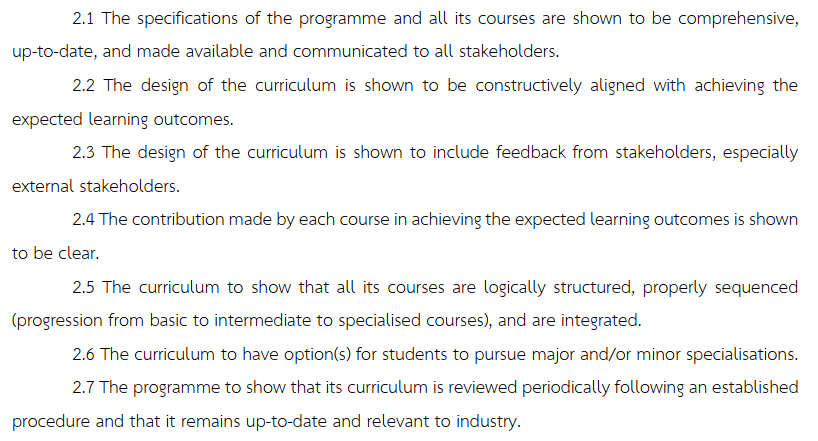
2.1 The specifications of the programme and all its courses are shown to be comprehensive, up-to-date, and made available and communicated to all stakeholders.
Operational Result
The specifications of the programme and all its courses are comprehensive, regularly updated, and clearly communicated to all stakeholders. To ensure this, several measures have been implemented. Each course includes a detailed syllabus, and a comprehensive programme handbook is provided to outline the overall structure, course sequence, and programme goals. Annual reviews of course content are conducted, and feedback is gathered from students, faculty, partner schools, and alumni to maintain relevance and currency.
Updated programme specifications and course information are made accessible through the institution’s website and learning management systems. Printed materials are also distributed during orientation and made available in the library. In addition, regular advisory sessions and information workshops are organized to explain programme details and updates. Transparency is further maintained by publishing annual reports on curriculum revisions and holding open forums for stakeholder discussions. Through this comprehensive approach, all stakeholders remain well-informed and actively engaged with the latest programme developments
The steps below demonstrate that the specifications of our programme and all its courses are comprehensive, up-to-date, and communicated to all stakeholders:
1. Detailed Documentation : Comprehensive and Up-to-Date Course Specifications
- Course Outlines: Courses have a detailed syllabus that includes objectives, learning outcomes, content, teaching methods, and assessment methods.
- Program Handbook: There is a program handbook that outlines the overall structure, course sequences, and program goals.
2. Regular Review and Updates : Regular Review Process:
- Annual Reviews: There is annual reviews of course content and program structure to ensure they remain current and relevant.
- Stakeholder Feedback: Feedback from students, faculty, industry partners, and alumni are gathered.
3. Clear Communication Channels : Information Availability and Communication
- Online Platforms: All program specifications and course details available on the institution’s website and learning management systems.
- Printed Materials: Printed handbooks and course guides during orientation and in the library.
- Advisory Sessions: Regular advisory sessions and meetings where stakeholders can discuss and understand course specifications.
4. Engagement with Stakeholders: Involvement of all Stakeholders
- Information Sessions: Meetings are held to explain program details and updates to students and faculty.
- School Partners: Consultation with partner school to ensure the program aligns with current professional standards and practices.
- Alumni Network: Use feedback from the alumni network to adjust and improve the curriculum.
With these steps, we ensure that the program and its courses are comprehensive, up-to-date, and effectively communicated to all stakeholders. This approach not only meets the requirement but also enhances the overall quality and transparency of our programme.
Evidence
2.2 The design of the curriculum is shown to be constructively aligned with achieving the expected learning outcomes.
Operational Result
The BEd–English curriculum is designed to develop professional teachers who possess strong English language proficiency, comprehensive knowledge, good character, integrity, honesty, and lifelong learning skills. To achieve this goal, the program ensures a clear alignment among the Program Learning Outcomes (PLOs), Year Learning Outcomes (YLOs), and Course Learning Outcomes (CLOs), together with appropriate learning management strategies.
Lecturers are encouraged to adapt to emerging developments and technologies in teaching, particularly in the post-pandemic era, which has accelerated the use of innovative digital tools such as Google Classroom, Google Meet, and the MIS system. These platforms support interactive learning environments and enable effective online communication, ensuring continuous student engagement and academic progress.
Each course in the program is mapped to specific PLOs so that every component of the curriculum contributes directly to the program’s overall objectives. For instance, language courses focus on strengthening students’ English proficiency, while pedagogical courses emphasize teaching methodologies, classroom management, and educational psychology. Both formative and summative assessments are integrated into the courses to monitor and evaluate students’ achievement of the intended learning outcomes.
In addition, the curriculum is regularly reviewed through periodic evaluations and consultations with stakeholders, including students, alumni, and partner institutions. Feedback, assessment data, and student performance are carefully analyzed to identify areas for improvement and to ensure that the program remains relevant and effective.
Through the strategic alignment of curriculum design and learning outcomes, the program ensures that graduates are not only academically competent but also equipped with the professional and ethical qualities required of effective educators. This comprehensive approach enables graduates to meet the expectations of educational institutions, employers, and the wider community.
Evidence
| ID_Evidence | Name_Evidence |
| 2.2-1 | Curriculum Structure & Learning Outcomes BEd English Curriculum 2024 |
| 2.2-2 | Program Learning Outcomes |
2.3 The design of the curriculum is shown to include feedback from stakeholders, especially external stakeholders.
Operational Result
The participation of stakeholders is an essential component in the design, revision, and implementation of our curriculum. The curriculum development process actively incorporates feedback from a wide range of stakeholders, particularly external stakeholders such as professional organizations and employers. We regularly evaluate the achievement of our program objectives and conduct comprehensive surveys to gather insights from these groups. Their contributions are vital in ensuring that the curriculum remains relevant and effective.
As part of this process, we also analyze potential opportunities and challenges to ensure that our graduates are well-prepared for the evolving trends in English Language Teaching. Regular feedback sessions, focus group discussions, and advisory board meetings are organized to gather and integrate stakeholder perspectives.
This collaborative approach enables us to align our educational programs with the needs and expectations of schools, thereby strengthening the employability and professional readiness of our graduates. Through these initiatives, we ensure that the curriculum not only meets academic standards but also responds to the practical demands of the teaching profession.
Evidence
| ID_Evidence | Name_Evidence |
| 2.3-1 | Dominant Characteristics of the Revised Curriculum |
| 2.3-2 | New Curriclum Critique Meeting with Stakeholders |
2.4 The contribution made by each course in achieving the expected learning outcomes is shown to be clear.
Operational Result
The contribution of each course in achieving the expected learning outcomes is clearly defined and systematically mapped within the curriculum structure. Each course is aligned with the Program Learning Outcomes (PLOs), Year Learning Outcomes (YLOs), and Course Learning Outcomes (CLOs), ensuring that students progressively develop the required knowledge, skills, values, and professional competencies throughout the program. Course syllabi and TQF documents explicitly indicate the learning outcomes addressed by each course, together with the corresponding teaching strategies, learning activities, and assessment methods.
Foundational courses provide students with essential theoretical knowledge and language competencies, while professional education and specialized English courses strengthen pedagogical knowledge, communication skills, critical thinking, and classroom application. Field study and internship courses further contribute by allowing students to apply theories and teaching methodologies in authentic school environments, thereby enhancing professional competence and reflective practice.
In addition, curriculum mapping and regular curriculum review processes help ensure that all courses contribute meaningfully and progressively toward the achievement of the expected learning outcomes. Faculty members collaboratively review course alignment, assessment results, and stakeholder feedback to verify that learning outcomes are adequately addressed and continuously improved. This systematic alignment demonstrates that the role and contribution of each course in achieving the program’s expected learning outcomes are clear, coherent, and effectively implemented
Course Mapping: Each course syllabus includes a mapping section that shows how the course supports the program’s learning outcomes (PLOs). Specific Course Learning Outcomes (CLOs) are aligned with both the PLOs and the Year Learning Outcomes (YLOs).
Detailed Course Rubrics: Detailed rubrics are used for assignments and examinations to indicate which learning outcomes are being assessed. This approach promotes transparency for both students and instructors.
Curriculum Reviews: Regular curriculum review meetings are conducted among faculty members, and feedback is collected from students, alumni, and external stakeholders to ensure that courses remain effectively aligned with the intended learning outcomes.
Course Portfolios: Each course maintains a portfolio documenting how it contributes to the learning outcomes. These portfolios typically include course syllabi, samples of assessments, and summaries of student performance data.
Supplementary Activities: To support the achievement of the program learning outcomes, the faculty continuously organizes a set of activities designed to enhance students’ academic knowledge, teaching competencies, communication skills, leadership, collaboration, creativity, and professional ethics. These activities provide students with meaningful opportunities to apply theoretical knowledge in practical contexts, engage in reflective learning, and develop the essential competencies required for the teaching profession in both local and global educational settings.
Communication to Students: The alignment between courses and program learning outcomes is clearly communicated to students during orientation and advising sessions. Course guides also explicitly link learning activities and assessments to the relevant outcomes.
Through these practices, the role of each course in achieving the program’s learning outcomes is clearly demonstrated and systematically documented, ensuring transparency and accountability within the program
Evidence
| ID_Evidence | Name_Evidence |
| 2.4-1 | BEd Curriculum 2024: Course Description, Mapping Course Structure |
| 2.4-2 | Supplementary Activities enhancing BEd Students Learning |
2.5 The curriculum to show that all its courses are logically structured, properly sequenced (progression from basic to intermediate to specialised courses), and are integrated.
Operational Result
The BEd–English curriculum is carefully designed to ensure that all courses are logically organized, properly sequenced, and well integrated. The curriculum systematically maps the development of knowledge, skills, and content, allowing students to progressively build upon their previous learning experiences. Beginning with foundational courses, students are introduced to essential concepts that prepare them for more complex topics presented in intermediate and specialized courses.
Each stage of the curriculum is structured to support a gradual and coherent development of knowledge and skills. For example, introductory courses in English language fundamentals and basic teaching methodologies provide the foundation for more advanced subjects such as educational psychology, advanced grammar, and literature analysis. As students progress through the program, they engage with increasingly complex content that requires the application of previously acquired knowledge and competencies.
The curriculum also emphasizes the integration of knowledge and skills across courses. Various learning modes—including lectures, workshops, and practical teaching experiences—are incorporated to support effective learning. This integrated structure ensures continuity between courses and helps students understand the connections among different areas of study within the broader context of English language teaching.
In addition, prerequisite courses are established to ensure that students acquire essential knowledge and skills before advancing to more demanding subjects. For instance, courses in basic linguistics and introductory pedagogy must be completed before students enroll in more specialized courses such as curriculum design and classroom management. This structure helps ensure that students are adequately prepared for advanced coursework.
To maintain the curriculum’s relevance and effectiveness, regular reviews and updates are conducted. These reviews involve input from various stakeholders, including professional organizations, employers, alumni, and current students. Their feedback helps refine and strengthen the curriculum so that it continues to meet the evolving needs of the education sector and prepares graduates for professional practice.
Overall, the BEd–English curriculum provides a well-structured and progressive learning pathway that enables students to develop the knowledge, skills, and professional competencies required for successful careers in English language teaching
Evidence
| ID_Evidence | Name_Evidence |
| 2.5-1 | Programme Course Structure |
| 2.5-2 | Learning Plan & Course Progression |
2.6 The curriculum to have option(s) for students to pursue major and/or minor specialisations.
Operational Result
The Bachelor of Education program provides students with the flexibility to pursue both major and minor specializations, including English, Mathematics, and Science and Early Childhood Education , allowing them to tailor their studies according to their interests and career goals. In addition to these specialization options, the Faculty of Education offers students the opportunity to gain international academic experience through an innovative 3+1 program. Under this scheme, students complete the first three years of their studies at St. Teresa International University and spend their final year at one of the university’s partner institutions abroad.
The university has established partnerships with several local and international institutions, providing students with a broad range of academic opportunities. These collaborations enhance the learning experience by exposing students to diverse academic resources, educational systems, and global perspectives. Through these partnerships, students benefit from a well-rounded educational experience that is internationally oriented.
Furthermore, the 3+1 program is designed to expand students’ global outlook, strengthen their language proficiency, and prepare them for the international job market. By studying abroad during their final year, students are able to experience different cultures, develop broader professional networks, and enhance their adaptability and problem-solving skills. This international exposure significantly enriches both their academic and personal development, equipping them with the competencies needed for successful careers in education.
Evidence
| ID_Evidence | Name_Evidence |
| 2.6-1 | BEd English Curriculum 2024 and . Revised Curriculum 2027 |
| 2.6-2 | Major/Minor and Specialization |
2.7 The programme to show that its curriculum is reviewed periodically following an established procedure and that it remains up-to-date and relevant to industry.
Operational Result
The faculty follows a comprehensive and inclusive curriculum development process that incorporates input from various stakeholders to ensure the curriculum’s relevance and effectiveness. Curriculum development committees are composed of experts from both within and outside the university, bringing diverse academic perspectives and professional insights. These committees carefully review and update the curriculum based on the college’s established criteria, including its philosophy, objectives, structure, and standards for course content.
The development process is guided by clear standards to ensure that the curriculum responds to the evolving demands of the education sector. Committee members work collaboratively to design and refine the curriculum so that it aligns with current trends and best practices in English Language Teaching. In addition, they oversee the management of curriculum documents, ensuring that they remain accurate, updated, and readily accessible to faculty members and students.
For example, the Committee on Curriculum Revision for the Bachelor of Education program held a meeting on May 12, 2026, to review and critique the new curriculum (25670 . This initiative reflects the faculty’s commitment to maintaining high academic standards through continuous review and improvement. It also demonstrates the faculty’s dedication to providing a curriculum that is academically rigorous, relevant, and responsive to the evolving needs of the education profession
Evidence
| ID_Evidence | Name_Evidence |
| 2.7-1 | BEd English Curriculum 2024 Vs. Revised Curriculum |
| 2.7-2 | New Curriclum Critique Meeting with Stakeholders |
| 2.7-3 | Curriculum Critique Committee |
Self-Assessment
| Requirements | Result | Score |
| 2.1 The specifications of the programme and all its courses are shown to be comprehensive, up-to-date, and made available and communicated to all stakeholders. | / | 1 |
| 2.4 The contribution made by each course in achieving the expected learning outcomes is shown to be clear. | / | |
| 2.2 The design of the curriculum is shown to be constructively aligned with achieving the expected learning outcomes. | / | 1 |
| 2.3 The design of the curriculum is shown to include feedback from stakeholders, especially external stakeholders. | / | |
| 2.5 The curriculum to show that all its courses are logically structured, properly sequenced and integrated. | / | 1 |
| 2.6 The curriculum to have option(s) for students to pursue major and/or minor specialisations. | / | 1 |
| 2.7 The programme to show that its curriculum is reviewed periodically following an established procedure and that it remains up-to-date and relevant to industry. | / | 1 |
| Overall | 5 | |