Criterion 3 – Teaching and Learning Approach
Criterion
Requirements
Quality level assessment

Result
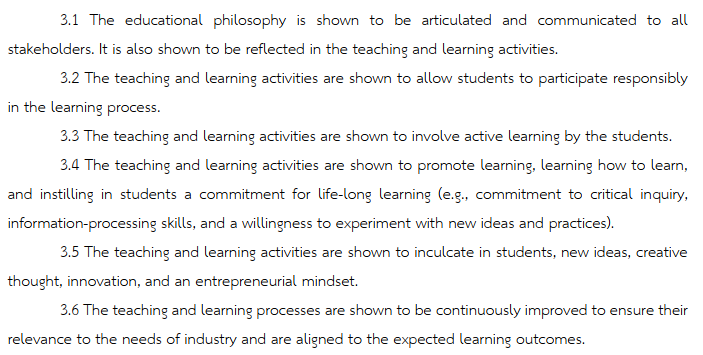
3.1 The educational philosophy is shown to be articulated and communicated to all stakeholders. It is also shown to be reflected in the teaching and learning activities.
Operational Result
The Faculty’s Educational Philosophy is clearly articulated and communicated to all stakeholders through various channels to promote a shared understanding and commitment to the faculty’s mission. The philosophy is disseminated through official platforms and activities to ensure that students, faculty members, and external partners are aware of and aligned with its principles.
Philosophy: The Faculty aims to produce knowledgeable teachers and educational personnel who possess strong academic and professional competencies, together with integrity, morality, and ethical values. It seeks to develop educators who are eager to learn, disciplined, compassionate, and responsible, and who contribute to the development of local communities as well as the nation as a whole.
Within the Bachelor of Education in English (BEd–English) Program, this philosophy is reflected in the program’s emphasis on developing the essential knowledge and professional skills required for teaching English. The curriculum integrates innovation, information technology, modern instructional materials, and effective classroom management. It balances theoretical foundations with practical experience, ensuring that students are well prepared to meet the evolving demands of the teaching profession.
The Faculty’s Educational Philosophy is communicated through several platforms, including the official website, brochures, orientation programs, and stakeholder meetings. Regular updates and newsletters are also shared to keep stakeholders informed about program developments and how the philosophy is implemented in practice. In addition, Professional Learning Communities (PLCs) are organized to provide opportunities for faculty members, students, and external partners to discuss the philosophy and its application in educational settings. Feedback from stakeholders is actively collected and used to improve both implementation and communication.
The philosophy is also integrated into teaching and learning activities within the BEd–English program. Courses incorporate innovative teaching strategies, information technology, and current trends in English language teaching and assessment. Classroom management and professional skills are strengthened through workshops and teaching practicum experiences. Students also engage in activities that promote ethical and professional behavior, such as case studies, role-playing, and discussions on ethical issues in education.
Lecturer’s Teaching Manual . To ensure quality and consistency in instruction, the Faculty of Education of St. Theresa International University provides lecturers with teaching manuals and instructional guidelines to support effective teaching and learning practices within the B.Ed.–English program. The teaching manuals include guidance on course planning, preparation of TQF-aligned course specifications, lesson planning, learning outcome alignment, classroom management, assessment and evaluation procedures, rubric development, and the integration of technology and learner-centered teaching approaches. The manuals also provide recommendations on the use of active learning strategies, reflective teaching practices, professional ethics, and the preparation of instructional materials and teaching portfolios. These resources serve as references for lecturers in maintaining academic standards, ensuring consistency across courses, and supporting continuous improvement in teaching effectiveness and student learning outcome
Furthermore, the program encourages student participation in extracurricular and community-based activities that support local development. These include community service initiatives, internships in local schools, and collaborative projects with educational institutions and communities. Students are also encouraged to attend professional development seminars and conferences to stay informed about current trends and best practices in English language teaching.
Through this comprehensive approach, the program ensures that graduates not only demonstrate strong academic and professional competencies but also embody the moral and ethical values emphasized in the Faculty’s Educational Philosophy
Evidence
| ID_Evidence | Name_Evidence |
| 3.1-1 | Program Education Philosophy Faculty of Education , PLC |
| 3.1-2 | Teaching Manual |
| 3.1.-3 | BEd Student_Centered Learning Strategies |
3.2 The teaching and learning activities are shown to allow students to participate responsibly in the learning process.
Operational Result
Students are responsible for their own learning. This means that our students are involved in the teaching and learning process every step of the way. Both academic and co-curricular activities involve students, which are aimed at helping them advance academically, socially, nationally, and internationally.
Active Student Participation: Students are encouraged to take an active role in their learning by participating in setting personal learning goals and engaging in self-assessment and peer-assessment activities through our faculty wide project, Student Portfolios. This fosters a sense of ownership and responsibility for their own learning. In 2025, students actively participated in various teaching and learning activities aimed at promoting English language skills and educational engagement.
- Academic Expo – Course Output Exhibit
During the Academic Expo, students showcased the outcomes of different courses through creative displays, interactive presentations, and performances. These exhibits highlighted their learning progress, project work, and the practical application of English skills, reflecting both academic and personal growth.
2. English on Tour Project
The 3rd year students of the Faculty taking English Language Teaching 2, along with volunteers from different year levels, visited four different schools to teach for younger students. This activity allowed them to apply their language knowledge in real-life contexts, while also enhancing their communication, teamwork, and leadership skills.
Collaborative Projects: Students are involved in collaborative projects that require teamwork, communication, and problem-solving skills. These projects are often designed to address real-world issues, allowing students to apply their theoretical knowledge in practical settings.
Creativity and Innovation: The program promotes creativity and innovation by involving students in research projects, encouraging them to explore new ideas and contribute to the advancement of knowledge in their field. Our students’ outputs are showcased in our annual Academic Expo where students showcase their academic output across all courses.
Practical Training and Internships: Practical training and internships are integral parts of the program. Students gain hands-on experience in real educational settings, working under the guidance of experienced mentors. This not only enhances their practical skills but also builds their confidence and professionalism.
Micro-Teaching/Teaching Demonstrations . an essential component of the BEd-English Program’s student assessment and professional preparation process, where students are given opportunities to practice and demonstrate their teaching skills in a simulated classroom environment. As part of the activity, students prepare detailed lesson plans, instructional materials, classroom activities, and assessment tools aligned with learning objectives and learner needs. They conduct teaching demonstrations observed by lecturers and peers, followed by constructive feedback and reflective discussions to enhance their teaching strategies, classroom management, communication skills, and confidence. The activity allows students to apply pedagogical theories into practice while developing creativity, professionalism, and readiness for actual teaching experiences.
Student-Led Initiatives: Students are given opportunities to lead and organize various activities and events, such as workshops, seminars, and community service projects. These initiatives help students develop leadership and organizational skills while contributing to their communities.
Feedback and Continuous Improvement: Regular feedback sessions are conducted where students can voice their opinions on the curriculum, teaching methods, and overall program effectiveness. This feedback is taken seriously and used to make continuous improvements, ensuring that the program meets the needs and expectations of the students.
.
Evidence
3.3 The teaching and learning activities are shown to involve active learning by the students.
Operational Result
Student learning in the program emphasizes active engagement and student-centered learning. Students are encouraged to participate actively in the learning process rather than simply receiving information passively. Through interactive activities and collaborative learning experiences, students are guided to construct knowledge, develop new ideas, and explore innovative approaches to learning. This approach integrates both cognitive processes, which promote critical thinking, and social processes, which encourage collaboration and meaningful interaction among students. In this learning environment, the teacher serves as a facilitator who supports students by connecting their interests, abilities, and skills with opportunities to integrate knowledge across different disciplines. Various teaching methods, learning resources, and assessment strategies are used to support this integrated learning process.
Teaching strategies and evaluation methods are carefully designed to promote active student participation. These approaches encourage students to take a meaningful role in their own learning, thereby improving learning outcomes and academic achievement. By applying their knowledge in practical and real-world contexts, students become more engaged and develop a deeper understanding of the subject matter. Teachers play an important role in selecting instructional and assessment strategies that align with student-centered principles and promote active and reflective learning.
- Communicative Language Teaching
- Content & Language Integrated Learning
- Task-Based Language Teaching
- Collaborative Learning
- Total Physical Response
Another important aspect of the program is the integration of co-curricular learning activities across many courses to further strengthen student involvement. Courses such as Children’s Literature, Teaching English through Drama, English Teaching and Learning, and Research for Learning Development incorporate co-curricular components that extend learning beyond traditional classroom instruction. These activities encourage students to participate actively both inside and outside the classroom, enriching their overall learning experience and supporting the development of practical skills essential for their future teaching careers
Evidence
| ID_Evidence | Name_Evidence |
| 3.3 | Teaching and learning activities that actively involve active learning by the students. 3.3-1 Teaching Demonstration/Micro Teaching 3.3-2: Sample Teaching Plan 3.3.-3 Teaching Rubrics |
3.4 The teaching and learning activities are shown to promote learning, learning how to learn, and instilling in students a commitment for life-long learning (e.g., commitment to critical inquiry, information-processing skills, and a willingness to experiment with new ideas and practices).
Operational Result
The teaching and learning approaches in the BEd–English program promote learning how to learn, lifelong learning, strong information-processing skills, and openness to new ideas and practices. Through Task-Based Learning and Work-Integrated Learning (WIL) approaches, students engage in meaningful learning experiences that encourage independence, critical inquiry, and continuous self-development. These approaches help students develop the ability to analyze information effectively while fostering a willingness to explore and experiment with innovative ideas and teaching practices.
In line with the broader missions of higher education, the program integrates coursework with research activities, community academic services, as well as arts and cultural engagement. These elements enrich students’ learning experiences and encourage them to take responsibility for their learning beyond the classroom. The curriculum is designed not only to provide academic knowledge but also to cultivate the mindset and competencies necessary for lifelong personal and professional development.
Recognizing that significant learning occurs outside the traditional classroom environment, the program places strong emphasis on experiential and immersive learning opportunities. Students are encouraged to participate in activities that develop critical thinking, leadership, and teamwork—skills essential for addressing real-world challenges. In addition, the program promotes active participation in co-curricular and student-led activities, allowing students to apply classroom knowledge in practical contexts and further strengthening their commitment to lifelong learning. These activities are reflected not only in our Teaching Guidelines but across all Faculty’s Assessment Tools.
Evidence
| ID_Evidence | Name_Evidence |
| 3.4-1 | Instructional Materials Development and Presentation |
| 3.4. 1 | Resources for Teachers and Students |
| 3.4-2 | BEd Internship Teaching Guidelines |
3.5 The teaching and learning activities are shown to inculcate in students, new ideas, creative thought, innovation, and an entrepreneurial mindset.
Operational Result
The teaching and learning activities in the BEd-English Program are designed to encourage the development of new ideas, creative thinking, innovation, and an entrepreneurial mindset among students. Through Task-Based Learning and Work-Integrated Learning (WIL) approaches, students engage in meaningful and authentic learning experiences that promote independent learning, critical inquiry, problem-solving, and a strong commitment to lifelong learning.
These approaches strengthen students’ information-processing, collaboration, leadership, and communication skills while encouraging them to explore innovative ideas and practices in preparation for a rapidly changing world. To further support these goals, the Faculty of Education regularly organizes activities such as Academic Expos and Student Academic Product Showcases, where students present research projects, instructional materials, literary works, teaching innovations, and other academic outputs to peers, faculty members, and guests. In addition, students are given opportunities to organize seminars and academic events, allowing them to gain hands-on experience in planning, coordinating, inviting speakers, managing programs, facilitating activities, and evaluating events. These experiential learning opportunities help students develop creativity, professionalism, leadership, teamwork, and practical workplace competencies essential for their future careers
Recognizing that meaningful learning also occurs outside traditional classroom environments, the program emphasizes experiential and immersive learning opportunities. Students are encouraged to participate in activities that foster critical thinking, leadership, collaboration, and problem-solving—skills essential for addressing real-world challenges. In addition, the program promotes active involvement in co-curricular activities, many of which are student-led. These experiences provide practical opportunities for students to apply their knowledge and further strengthen their creativity, innovation, and entrepreneurial thinking
Students published a book. Kaleidoscope: Collections of Lived Moments a compilation of selected student literary works produced in the Creative Writing course, showcasing students’ creativity, personal reflections, and storytelling skills. The publication features diverse poems, essays, short stories, and reflective pieces that capture meaningful experiences and lived moments from the students’ perspectives. The book was successfully published and is available on Amazon, providing students with an authentic platform to share their works with a wider audience while promoting confidence, creativity, and academic achievement in the field of writing and literature.
Evidence.
| ID_Evidence | Name_Evidence |
| 3.5-1 | Teaching – learning activities that inculcate in students, new ideas, creative thought, innovation, and an entrepreneurial mindset. 1. Task_Based Learning 2. Work-Integrated Learning 3.Student Output: English Teaching Seminar 4. Student Book published . Kaleidoscope: Collections of Lived Moments |
3.6 The teaching and learning processes are shown to be continuously improved to ensure their relevance to the needs of industry and are aligned to the expected learning outcomes.
Operational Result
The teaching and learning processes in the BEd program are continuously reviewed and improved to ensure their relevance to the needs of the education sector and their alignment with the program’s expected learning outcomes. The BEd curriculum and its teaching–learning approaches are regularly evaluated and refined to respond to current professional demands while supporting the achievement of the program’s intended learning outcomes. Instructional practices are also strengthened through the integration of digital platforms such as Google Classroom and Moodle, which enhance course delivery and support effective student learning.
Evaluation Process
Both program administrators and students play an important role in evaluating the teaching and learning process. They provide feedback on teaching methods, course content, learning experiences, and instructor performance. This feedback helps identify areas for improvement and supports the refinement of teaching strategies. In addition, instructors conduct self-reflection and self-assessment to review their teaching practices and identify opportunities for professional development. The combined input from students and faculty contributes significantly to the continuous enhancement of teaching quality.
Teaching Performance Evaluation Results and Improvement Plan
Teaching Performance Results Summary
The teaching evaluation results show a highly satisfactory overall
performance of the lecturer, with an overall mean of 4.262. This indicates
strong competence in subject mastery, lesson delivery, classroom
management, and student engagement. The highest-rated areas include
demonstrating masterful knowledge of the subject matter (4.56), providing
effective feedback and motivation to students (4.56), giving clear lesson
overviews and connections to previous lessons (4.60), and employing
student-centered teaching approaches (4.50). The lecturer was also highly
rated in maintaining smooth lesson progression, enthusiasm during
teaching, and building positive rapport with students, reflecting effective
and engaging instructional practices.
Improvement Plan
To further improve teaching effectiveness, the lecturer may
strengthen the use of higher-order questioning techniques, critical
thinking activities, and differentiated instructional strategies to
promote deeper student engagement and active learning. Additional
training and professional development in innovative teaching strategies,
authentic assessment methods, and advanced technology integration may
also be encouraged to further enhance classroom instruction.
The faculty may also continue supporting lecturers through regular
classroom observations, peer mentoring, faculty development seminars,
and sharing of best teaching practices. Continuous feedback from students
and academic monitoring mechanisms may be utilized to ensure
continuous improvement in teaching quality, student engagement, and
overall learning outcomes
Evidence
Self-Assessment
| Requirements | Result | Score |
| 3.1 The educational philosophy is shown to be articulated and communicated to all stakeholders. It is also shown to be reflected in the teaching and learning activities. | / | 1 |
| 3.2 The teaching and learning activities are shown to allow students to participate responsibly in the learning process. | / | 1 |
| 3.3 The teaching and learning activities are shown to involve active learning by the students. | / | |
| 3.4 The teaching and learning activities are shown to promote learning, learning how to learn, and instilling in students a commitment for life-long learning. | / | 1 |
| 3.5 The teaching and learning activities are shown to inculcate in students, new ideas, creative thought, innovation, and an entrepreneurial mindset. | / | 1 |
| 3.6 The teaching and learning processes are shown to be continuously improved to ensure their relevance to the needs of industry and are aligned to the expected learning outcomes. | / | 1 |
| Overall | 5 | |