Criterion 2 – Programme Structure and Content
Criterion
Requirements
Quality level assessment

Result
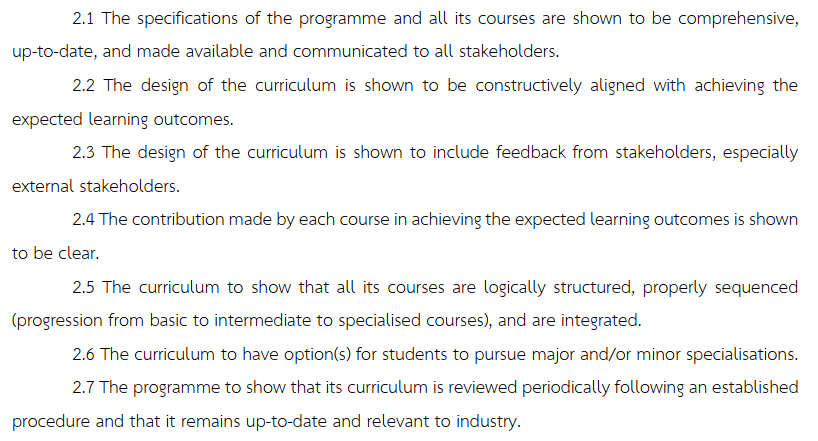
2.1 The specifications of the programme and all its courses are shown to be comprehensive, up-to-date, and made available and communicated to all stakeholders.
Operational Result
The specifications of the programme and all its courses are comprehensive, up-to-date, and effectively communicated to all stakeholders. We have implemented several measures. Each course has a detailed syllabus, and a comprehensive program handbook is made available, outlining the overall structure, course sequences, and goals. We conduct annual reviews of course content and gather feedback from students, faculty, partner schools, and alumni to ensure relevance and currency. All updated program specifications and course details are accessible on our institution’s website and learning management systems, and printed materials are provided during orientation and in the library. Regular advisory sessions and information workshops are held to explain program details and updates. Additionally, we maintain transparent processes by publishing annual reports on curriculum updates and organizing open forums for stakeholder discussions. This comprehensive approach ensures that all stakeholders are well-informed and engaged with the latest program developments
The steps below demonstrate that the specifications of our programme and all its courses are comprehensive, up-to-date, and communicated to all stakeholders:
1. Detailed Documentation : Comprehensive and Up-to-Date Course Specifications
- Course Outlines: Courses have a detailed syllabus that includes objectives, learning outcomes, content, teaching methods, and assessment methods.
- Program Handbook: There is a program handbook that outlines the overall structure, course sequences, and program goals.
2. Regular Review and Updates : Regular Review Process:
- Annual Reviews: There is annual reviews of course content and program structure to ensure they remain current and relevant.
- Stakeholder Feedback: Feedback from students, faculty, industry partners, and alumni are gathered.
3. Clear Communication Channels : Information Availability and Communication
- Online Platforms: All program specifications and course details available on the institution’s website and learning management systems.
- Printed Materials: Printed handbooks and course guides during orientation and in the library.
- Advisory Sessions: Regular advisory sessions and meetings where stakeholders can discuss and understand course specifications.
4. Engagement with Stakeholders: Involvement of all Stakeholders
- Information Sessions: Meetings are held to explain program details and updates to students and faculty.
- School Partners: Consultation with partner school to ensure the program aligns with current professional standards and practices.
- Alumni Network: Use feedback from the alumni network to adjust and improve the curriculum.
With these steps, we ensure that the program and its courses are comprehensive, up-to-date, and effectively communicated to all stakeholders. This approach not only meets the requirement but also enhances the overall quality and transparency of our programme.
2.2 The design of the curriculum is shown to be constructively aligned with achieving the expected learning outcomes.
Operational Result
Expected learning outcome(s) is extracted from a well-defined curriculum. Before teaching takes place, the school has scrutinized if such curriculum is constructively aligned with the intended learning outcome(s).
Many scholars have infinite definitions of learning outcome. One of the scholars says “A learning outcome is a clear and specific statement that identifies what learners must demonstrate at the level and standard required to successfully pass their study at program and course levels.”
When a program is using the
constructive alignment approach to curriculum design, one basic activity is to
choose and develop learning activities that are aligned with intended learning
outcomes. That is, they are: likely to lead to learners achieving the specified
learning outcomes for a particular teaching session, course or program and
practical and appropriate to use within your current context and with available
resources in the program.
The moment you have captured about how the course learning activities can
provide learners with chances to elevate through these levels, the course might
want to change the measurable assessment words that form the basis of its
learning outcomes.
All the coursework as well as non-coursework activities within each curriculum have been designed to contribute, at least in part, to students‟ achievement of program expected learning outcomes. By integrating all teaching and learning processes along with non-coursework activities, all ELOs can be achieved.
2.3 The design of the curriculum is shown to include feedback from stakeholders, especially external stakeholders.
Operational Result
Participation of stakeholders is a crucial factor in the design, revision, and implementation of our curriculum. The curriculum development process actively incorporates feedback from a diverse group of stakeholders, especially external stakeholders, including professional organizations and employers. We regularly assess the achievement of our program’s objectives and conduct comprehensive surveys to gather insights from these stakeholders. Their input is invaluable in ensuring our curriculum remains relevant and effective.
This includes analyzing opportunities and threats to ensure our graduates are well-prepared for the ever- evolving English Teaching trends. Regular feedback sessions, focus groups, and advisory board meetings are conducted to discuss and integrate stakeholder perspectives.
First-year students are introduced to the contents of BEDM programme during the summer semester. The detailed curriculum and syllabi are also available on university website, so students and stakeholders can refer to the curriculum structure and program specification. St. Teresa organizes annual enrolment consultations.
Through this activity, Faculty of Education Mathematics can introduce Bachelor of Education Mathematics program to high school students as well as parents across the country. In addition, on the first day of each course, lecturers introduce the detailed syllabus and assessment methods to students. Lecturers are also responsible for posting the syllabus on the Google classroom and LMS for students to refer to.
The Program will conduct survey to stakeholders and it will consider the feedback provided by them. The feedback will constitute to the development and design of the curriculum. Thus along with these factors, it will have its own system and mechanism, assessment process, improvement and development and lastly the result.
1. The curriculum or program will
plan for a meeting and discus the significance of data in measuring success in
relation to the attainment of the objectives of the curriculum.
2. A survey questionnaire will be carried out stakeholders particularly the
students, the lecturers, the employers, the parents and others at the end of
the academic year to assess the curriculum.
3. The curriculum or program will determine the findings of the survey,
conclude and come up with recommendation(s) thus integrate in the development
of the new curriculum.
4. The curriculum or program will write a draft of the new curriculum and
present it college council for approval.
5. The curriculum or program will submit a final copy to the college to get
final approval from the Ministry of Higher education, Research and Innovation.
6. The curriculum or program will be used by the instructors in every semester
and recommend their ideas in TQF5 to improve the course plan and assessment
plan.
The curriculum or program identifies areas with problems or lack of significance.
The curriculum or program will require a proposal from responsible lecturers to give insights on the new curriculum. The curriculum or program will go over on the progress of data utilization and identify the result.
The curriculum or program scrutinize the assessment criteria and its implementation after the curriculum revision
Improvement and Development
The curriculum or program was designed, and it has to fulfill the assessment criteria to ensure the attainment and success of the objectives of the curriculum. The curriculum or program will continue to conduct a meeting between and among the lecturers, head of program and the dean to oversee what has not been achieved if there is any.
2.4 The contribution made by each course in achieving the expected learning outcomes is shown to be clear.
Operational Result
Expected learning outcome(s) is extracted from a well-defined curriculum. Before teaching takes place, the school has scrutinized if such curriculum is constructively aligned with the intended learning outcome(s).
All the contribution made by each course in achieving expected learning outcomes is clear. To demonstrate that each course’s contribution to achieving the expected learning outcomes is clear, we have implemented several key practices.
- Course Mapping: Each course syllabus includes a mapping section that outlines how the course contributes to the program’s learning outcomes (PLOs), with specific course learning outcomes (CLOs) aligned with PLOs and Year Learning Outcomes (YLOs).
- Detailed Course Rubrics: We use detailed rubrics for assignments and exams to highlight which learning outcomes are being assessed, ensuring transparency for students and instructors.
- Curriculum Reviews: Regular curriculum review meetings with faculty and feedback from students, alumni, and external stakeholders help ensure that courses are effectively aligned with learning outcomes.
- Course Portfolios: Detailed course portfolios that document how each course contributes to the learning outcomes. These portfolios include syllabi, assessment samples, and summaries of student performance data.
- Communication to Students: During student orientation and advising sessions, we clearly communicate the alignment of courses with program learning outcomes, and course guides explicitly link activities and assessments to these outcomes.
These comprehensive practices ensure that the contribution of each course to achieving the learning outcomes is clear and well-documented, providing transparency and accountability in our program.
All the coursework as well as non-coursework activities within each curriculum have been designed to contribute, at least in part, to students’ achievement of program expected learning outcomes. By integrating all teaching and learning processes along with non-coursework activities, all ELOs can be achieved.
2.5 The curriculum to show that all its courses are logically structured, properly sequenced (progression from basic to intermediate to specialised courses), and are integrated.
Operational Result
The BEd-Mathematics curriculum is meticulously designed to ensure that all courses are logically structured, properly sequenced, and fully integrated. The curriculum maps out skills, knowledge, and content systematically, enabling students to build on their previous learning experiences progressively. Starting with foundational courses, students are introduced to basic concepts, which are essential for understanding more complex ideas presented in intermediate and specialized courses.
Each stage of the curriculum is carefully planned to ensure a gradual and coherent build-up of knowledge and skills. For instance, introductory courses in fundamentals of mathematics and basic teaching methodologies lay the groundwork for more advanced topics such as educational psychology, advanced theories, applications with computation and critical thinking problems and analysis. As students move through the program, they encounter increasingly sophisticated content that requires the application of previously acquired knowledge.
The curriculum also emphasizes the integration of content and skills across different courses. This includes the logical and psychological contents necessary for effective learning, a variety of learning methods such as lectures, workshops, and practical teaching experiences, and a continuity that connects each course to the next. This integrated approach ensures that students can see the connections between different areas of study and understand how they fit into the broader context of Mathematics teaching and learning.
Furthermore, the curriculum includes prerequisite courses to ensure that students have mastered essential skills before advancing to more challenging material. For example, courses in basic mathematics and introductory pedagogy must be completed before students can enroll in specialized courses like curriculum design and classroom management. This prerequisite structure ensures that students are well-prepared and capable of handling advanced coursework.
To maintain the relevance and effectiveness of the curriculum, regular reviews and updates are conducted. These involve input from a diverse group of stakeholders, including professional organizations, employers, graduates, and present students. Their feedback helps to refine the curriculum, ensuring that it meets the evolving needs of the education sector and prepares graduates for the demands of the job market.
Overall, the BEd-Mathematics curriculum is a carefully crafted educational pathway that ensures students to develop the necessary skills and knowledge in a logical, progressive, and integrated manner, fully preparing them for successful careers in Mathematics teaching.
The brief is as follows:
| Chronology of course structure and its integration in Curriculum | As per vision and mission and philosophy of the BEDM programme, the courses are considered in the curriculum very carefully and logically and arranged sequentially and chronologically from basic to higher with integration to the teaching profession. | All the courses in the curriculum of BEDM programme are shown to be considered as per the definition of the programme and logically structured and arranged properly and sequentially from basic to higher. |
The detail study plan of the 4 – year BEDM programme is depicted very clearly in the following tables:
Study plan:
Year 1 Semester 1:
| Courses | Code and subject name | N (T-P-S) | Integrated Projects to Enhance Teacher Competency and Teacher Competency | |
| General Education Subjects | 100 1xx | Humanities and Aesthetics of Life (Compulsory) | 3(3-0-6) | Activity 1-1: Set life goals. “I can be a good teacher who can be an example” and created an E-portfolio to be a collection of academic and professional work as a teacher over 4 academic years. |
| 100 2xx | 3(3-0-6) | |||
| 100 3xx | 3(3-0-6) | |||
| Specific Subjects (Specialization) (Majors) | 152 303 | 2(2-2-5) | ||
| Specialization (Minor) | 151 3xx | 3(2-2-5) | ||
| Total Credits | 18 | |||
Year 1 Semester 2
| Courses | Code and subject name | N (T-P-S) | Integrated Projects to Enhance Teacher Competency and Teacher Competency | |
| General Education Subjects | 100 1xx | Humanities and Aesthetics of Life (Compulsory) | 3(3-0-6) | Activity 1-2: Assess the competency base and plan for development: Self-assessment of Thai and English for communication and use of digital technology for education S01-S02 skills and personality C01-C05 Plan for self-development in all items and continuously develop yourself. In Years 1-2-3-4, self-assessment and verification from an academic advisor are required at the end of Year 2 and 3. |
| 100 2xx | Language for Communication and Learning (Compulsory) | 3(3-0-6) | ||
| 100 3xx | Knowledge and Technology for Life | 3(3-0-6) | ||
| Specific subjects (teaching profession) | 150 101 | Teachership | 3(2-2-5) | |
| Specific Subjects (Specialization) (Majors) | 152 301 | 3(2-2-5) | ||
| 152 302 | 3(2-2-5) | |||
| 152 306 | 2(2-2-5) | |||
| Specialization (Minor) | 151 3xx | 3(2-2-5) | ||
| Total Credits | 21 | |||
Year 2 Semester 1
| Courses | Code and subject name | N (T-P-S) | Integrated Projects to Enhance Teacher Competency and Teacher Competency | |
| General Education Subjects | 100 1xx | Humanities and Aesthetics of Life (Compulsory) | 3(3-0-6) | Activity 2-1: Study the characteristics of good teachers and plan for ethical self-development E01-E02 with the implementation of the plan and continuous assessment of development. During Years 2-3-4 with a self-assessment and request an assessment for verification by an academic advisor at the end of Year 2 and 3. |
| 100 2xx | Language for Communication and Learning (Compulsory) | 3(3-0-6) | ||
| 100 3xx | Knowledge and Technology for Life | 3(3-0-6) | ||
| Specific subjects (teaching profession) | 150 102 | Principles of the teaching profession | 3(2-2-5) | |
| 150 103 | Psychology for Teachers | 3(2-2-5) | ||
| Specific Subjects (Specialization) (Majors) | 152 304 | 3(2-2-5) | ||
| 152 305 | 3(2-2-5) | |||
| 152 309 | 2(2-2-5) | |||
| 152 311 | 2(2-2-5) | |||
| Specialty (Minor) | 151 3xx | 3(3-0-6) | ||
| Total Credits | 18 | |||
Year 2 Semester 2
| Courses | Code and subject name | N (T-P-S) | Integrated Projects to Enhance Teacher Competency and Teacher Competency | |
| General Education Subjects | 100 2xx | Language for Communication and Learning (Compulsory) | 3(3-0-6) | Activity 2-2: Study the characteristics of good teachers and plan for ethical self-development E01-E02 with the implementation of the plan and continuous assessment of development. During Years 2-3-4 with a self-assessment and request an assessment for verification by an academic advisor at the end of Year 2 and 3. |
| Specific subjects (teaching profession) | 150 104 | Communicative Language for Teachers | 3(2-2-5) | |
| 150 105 | Curriculum and Learning Management Methodology | 3(2-2-5) | ||
| Specific Subjects (Specialization) (Majors) | 152 307 | 3(2-2-5) | ||
| 152 308 | 3(2-2-5) | |||
| 152 310 | 2(2-2-5) | |||
| 152 312 | 2(2-2-5) | |||
| Specialty (Minor) | 151 3xx | 3(3-0-6) | ||
| Total Credits | 18 | |||
Year 3 Semester 1
| Courses | Code and subject name | N (T-P-S) | Integrated Projects to Enhance Teacher Competency and Teacher Competency | |
| Specific subjects (teaching profession) | 150 106 | Innovation in Information Technology | 3(3-0-6) | Activity 3-1: Design learning that emphasizes the cultivation of morality and ethics for students (Ethics-PLC) and puts it into practice by continuing both Semester 1 and 2 of Year 3. |
| 150 107 | Educational Measurement and Evaluation | 3(2-2-5) | ||
| 150 201 | Practicing teacher Professional experience 1 | 2(90 hour) | ||
| Specific Subjects (Specialization) (Majors) | 152 313 | 2(2-2-5) | ||
| 152 314 | 2(2-2-5) | |||
| 152 315 | 2(2-2-5) | |||
| 152 316 | 2(2-2-5) | |||
| Specialty (Minor) | 151 3xx | 3(2-2-5) | ||
| 151 3xx | 3(2-2-5) | |||
| Total Credits | 20 | |||
Year 3 Semester 2
| Courses | Code and subject name | N (T-P-S) | Integrated Projects to Enhance Teacher Competency and Teacher Competency | |
| Specific Subjects (Teaching Profession) | 150 108 | Research to improve learning | 3(2-2-5) | Activity 3-2(1): Design learning for 1-2 units of specific subjects (S03) taught in English under the supervision of in-service teachers and mentors and continued operations in Year 1, Semester 1. Activity 3-2(2): Study and practice carefully and sincerely Problem solving Learner Development (E01) as a role of classroom teacher/teacher advisor. |
| 150 202 | Practicing teacher Professional experience 2 | 2(90 hour) | ||
| Specific Subjects (Specialization) (Majors) | 152 317 | 2(2-2-5) | ||
| 152 318 | 2(2-2-5) | |||
| 152 320 | 2(2-2-5) | |||
| 152 401 | 2(2-2-5) | |||
| 152 201 | Teaching Mathematics I | 2(2-2-5) | ||
| Special Subject (Minor) | 151 3xx | 3(2-2-5) | ||
| 151 3 xx | 3(2-2-5) | |||
| Free electives | xxx xxx Free electives | 3(x-x-x) | ||
| Total Credits | 22 | |||
Year 4 Semester 1
| Courses | Code and subject name | N (T-P-S) | Integrated Projects to Enhance Teacher Competency and Teacher Competency | |
| Specific Subjects (Teaching Profession) | 150 203 | Practicing teacher Professional experience 3 | 2(90 hour) | Activity 4-1 (1) : Develop tools to measure and evaluate learning outcomes 1-2 learning units ( S03). Activity 4-1 (2) : Study teaching problems in specific subjects , research, design to develop learning 1 item (S04) and continue practice in Year 4, Semester 2. |
| Special Subject (major) | 154 202 | Teaching mathematics II | 2(1-2-3) | |
| Special Subject (Minor) | 151 3xx | 3(2-2-5) | ||
| 151 401 | Teaching English | 3(2-2-5) | ||
| Free electives | 152 402 | Free electives | 2(2-2-5) | |
| 152 319 | 2(2-2-5) | |||
| 152 321 | 2(2-2-5) | |||
| Total Credits | 13 | |||
Year 4 Semester 2
| Courses | Code and subject name | N (T-P-S) | Integrated Projects to Enhance Teacher Competency and Teacher Competency | |
| Special Subject {practice) | 150 204 | Practicing teacher Professional experience 4 | 6(270 hours) | |
| Total Credits | 6(270) | |||
Evidence
| ID_Evidence | Name_Evidence |
| 2.5-1 | |
| 2.5-2 | |
| …………………………………….. |
2.6 The curriculum to have option(s) for students to pursue major and/or minor specialisations.
Operational Result
he Bachelor of Education program offers students the flexibility to pursue major and minor with specializations, in English, Mathematics & Science, allowing them to tailor their education to their interests and career goals. In addition to offering a variety of majors, the Faculty of Education provides students with the opportunity to continue their studies overseas through our innovative 3+1 program. This program allows students to study for three years at our institution, St. Teresa International University, and spend their final year at one of our partner universities abroad.
We have established partnerships with numerous local and international universities, enhancing the educational experience by providing a wide range of choices and opportunities for our students. These partnerships enable students to gain global perspectives, access diverse academic resources, and experience different educational environments. Our collaborations with esteemed institutions around the world ensure that our students receive a well-rounded and internationally recognized education.
Moreover, the 3+1 program is designed to broaden students’ horizons, improve their language proficiency, and prepare them for the global job market. By spending a year abroad, students can immerse themselves in a different culture, expand their professional networks, and enhance their adaptability and problem-solving skills. This unique opportunity significantly enriches their academic and personal development, making them well-equipped to excel in their future teaching careers.
The BEDM Programme is one of the programmes under the Faculty of Education with the division of total course and the total credits as described in the following Table:
Table:
| Item | Course | Credit |
| 1. | General Education | 24 |
| 2. | Specialized | 120 |
| 2(i). | Professional Teaching | 36 |
| 2(ii). | Major [Mathematics] | 46 |
| 2(iii). | Minor [English] | 20 |
| 3. | Free Elective | 06 |
| Total | 132 | |
The detail of the course structure with major and minor subjects are depicted as below:
Courses in the curriculum:
(1) General education courses – not less than 24 credits
1. Humanities and Aesthetics of Life – Study at least 6 credits
2. Language for Communication and Learning – Study at least 12 credits
3. Knowledge and Technology for Life – Study at least 6 credits
(2) Specialized Courses – study at least 106 credits
2.1.Group (Teacher Professional Group – 36 credits
1) Teacher Professional – Theory and Practice: 24 credits
| Code | Course Name | Credits |
| 150 101 | Self-Actualization for Teacher | 3(2-2-5)* |
| 150 102 | Principle of Teaching Profession | 3(2-2-5)* |
| 150 103 | Psychology for Teacher | 3(2-2-5)* |
| 150 104 | Communication Language for Teacher | 3(2-2-5)* |
| 150 105 | Curriculum and Learning Management | 3(2-2-5)* |
| 150 106 | Educational Innovation and Information Technology | 3(2-2-5)* |
| 150 107 | Learning Measurement and Evaluation | 3(2-2-5)* |
| 150 108 | Research for Learning Development | 3(2-2-5)* |
2)Teaching Profession – Professional Practice: Compulsory 12 credits
| Code | Course Name | Credits |
| 150 201 | Teacher Professional Internship 1 | 2(90) |
| 150 202 | Teacher Professional Internship 2 | 2(90) |
| 150 203 | Teacher Professional Internship 3 | 2(90) |
| 150 204 | Teacher Professional Internship 4 | 6(270) |
Note:* Numeric code assignment 3(2-2-5) – here focuses on teaching staff to focus more on student participation and practice.
2.2. Mathematics majors: Study at least 40 credits.
-Mandatory major: 36 credits
-Teaching group for math majors: 4 credits
Mandatory major: 36 credits:
| Code | Course Name | Credits |
| 152 301 | College Algebra | 3(2-2-5) |
| 152 302 | College Geometry | 3(2-2-5) |
| 152 303 | History of Mathematics | 2(2-2-5) |
| 152 304 | Calculus I | 3(2-2-5) |
| 152 305 | Equation Theory | 3(2-2-5) |
| 152 306 | Probability and Statistics | 2(2-2-5) |
| 152 307 | Numerical Analysis | 3(2-2-5) |
| 152 308 | Calculus II | 3(2-2-5) |
| 152 309 | Abstract Algebra | 2(2-2-5) |
| 152 310 | Linear Algebra | 2(2-2-5) |
| 152 311 | Logic and Reasoning | 2(2-2-5) |
| 152 312 | Discrete Mathematics | 2(2-2-5) |
| 152 313 | Number Theory | 2(2-2-5) |
| 152 314 | Graph Theory | 2(2-2-5) |
| 152 315 | Set Theory | 2(2-2-5) |
| 152 316 | Ordinary Differential Equations and Applications | 2(2-2-5) |
| 152 317 | Finite Mathematics | 2(2-2-5) |
| 152 318 | Mathematical Analysis | 2(2-2-5) |
| 152 319 | Mathematics and Statistics for research Project | 3(2-2-5) |
| 152 320 | Seminar on Mathematics Education | 3(1-2-3) |
Teaching group for math majors: 4 credits
| Code | Course Name | Credits |
| 152 401 | Mathematics Teaching I | 2(1-2-3) |
| 152 402 | Mathematics Teaching II | 2(1-2-3) |
2.3. Minor (English): Not less than 30 credits
1) English Minor: Not less than 27 credits
Choose from the following subjects:
| Code | Course Name | Credits |
| 151 301 | Listening and Speaking I | 3(2-2-5) |
| 151 302 | Paragraph Reading and Writing | 3(3-0-6) |
| 151 303 | Introduction to Linguistics | 3(3-0-6 ) |
| 151 304 | English Syntax | 3(3-0-6) |
| 151 305 | Forms and Usage in Modern English I | 3(3-0-6) |
| 151 306 | Practical English Phonetics | 3(3-0-6) |
| 151 307 | Children Literature | 3(3-0-6) |
| 151 308 | Language Learning through Drama | 3(2-2-5) |
| 151 309 | Materials and Information Technology in English Teaching | 3(2-2-5) |
| 151 310 | Assessment and Evaluation in English Teaching | 3(2-2-5) |
| 151 311 | Advanced Reading | 3(3-0-6) |
| 151 312 | Creative Writing | 3(2-2-5) |
2) English Teaching Techniques (for students who choose to minor in English): 3 credits
| Code | Course Name | Credits |
| 151 401 | English Language Teaching | 3(2-2-5) |
3) Free elective courses: 6 credits
Choose to study any subject in the courses of St. Teresa International University or at another university recognized by St. Teresa International University. It is unique to the subjects already studied.
Evidence
| ID_Evidence | Name_Evidence |
| 2.6-1 | |
| 2.6-2 | |
| …………………………………….. |
2.7 The programme to show that its curriculum is reviewed periodically following an established procedure and that it remains up-to-date and relevant to industry.
Operational Result
The following is a brief narration of the above statement:
| Review and updation of the curriculum of EDM programme | After each semester all courses are thoroughly reviewed and at the end of the every year all courses of the curriculum are re-reviewed and points for gaps as per feedback of relevant stakeholders (mainly students and the schools where students are expected to join for intern and job) and to maintain the standard and definition of the programme are to be noted; keeping basic courses unchanged (except possibly a little modification) other courses are kept for modification if necessary at the time of curriculum revision. | This process is followed meticulously throughout the year and at the time of curriculum revision, this is taken into consideration for each course to make the programme effective for the job. |
1. Reviewed and developed up to date as per stakeholders’ requirements:
From the development situation and changes from the economy, society and culture, as well as the need for professional development of teachers. The St. Teresa International University has reviewed the results of the past Graduate Certificate in Teaching Profession, as follows:
In the academic year 2019 – 2023, the Bachelor of Education Mathematics program (English), which is the second revised curriculum, was approved by the Kuru Shapa to produce 30 students per class. The latest 4-year program assessment results are for the academic year 2019 – 2021. The assessment scores for the academic year 2019, 2020 and 2021 were 4.17, 4.40 and 4.43 respectively. The quality is at the “very good” level for all 3 academic years, and the trend continues to rise.
In the case of the teacher professional license exam No. 1 in Academic Year 2021, 16 percent of the university graduates who applied for the exam of which about 11 percent were able to pass the exam and obtain a teacher’s license immediately (passing all subjects).), and in the second examination of the 2022 academic year, it appeared that 34 percent of the students were passed in this course (while the country passed only 18 percent).
To evaluate the curriculum, research was conducted during the academic year 2019 – 2023. From key informants based on this research, the study focused on 4 aspects of educational management: 1) attitude, feelings or satisfaction with the curriculum and teaching and learning management (Reaction/Satisfaction), 2) learning experience obtained from the curriculum (Learning), 3) changes in learning management behavior or performance behavior in the role of teachers. (Behavior/Performance) and 4) Results/effectiveness: The average score for the assessment was 4.37 (S.D. = 0.57), 4.35 (S.D. = 0.61), 4.40 (S.D. = 0.60) and 4.26 (S.D. = 0.59), respectively, with an overall mean of 4.35 (S.D. = 0.55). The results of using the curriculum in all 4 areas are higher than the required achievement criteria (3.50 on a 5.00 score system).
However, the implementation of the revised curriculum in 2018, although found to be satisfactory success, has been used for 5 academic years. In addition to providing content that covers knowledge standards and professional experience standards, it should be able to develop more intensively. He considered that emphasis should be placed on Work Integrated learning (WIL) and more intensive assessment of competencies according to professional standards set by the Kuru Sapha and in accordance with the Higher Education Qualification Standards Framework. In this regard, the university has appointed a committee to develop this curriculum which includes teachers in charge of the curriculum, experts in education and experts from professional councils and school administrators who are graduate users and evaluate the quality of the curriculum next.
Listening to opinions from graduate users, learners or related parties [stakeholders]:
This program has been developed and used continuously for 9 academic years (started accepting students in the academic year 2014) with 6 generations of graduates.
During each cohort, there will be a meeting with the school where the student works as a full-time teacher or practicing professional experience twice a semester, at the beginning and end of the semester, to listen to the opinions of graduate users and current students. In addition, on the orientation day for all new students, alumni are invited to share their experiences, guide their studies, or suggest areas that should be improved according to the opinions of the alumni. The evaluation seminar was conducted in the form of Focus group Discussion. I got feedback that the instructors of each subject gave different orders, had redundant tasks and the professors were much focused on lectures. In this regard, in 2022 and 2023, which are the last two years of the course, a joint meeting was held between instructors at the beginning of the semester to agree on an integration project between subjects and pay more attention to practice. It was found that the current students have a high level of satisfaction and perceived that this kind of practice is a full-time improvement in one’s work. In this regard, in the revised 2024 curriculum, a semester integration project has been established. In addition, the meeting with graduate users in 2023, many school administrators suggested that although the graduates of this course (which is a teacher production course) have not yet faced difficulties, in the context of today’s world, they will not be able to do so. There are more environmental problems and problems of violating the rights of others or violating the rights of children. In this regard, the curriculum should focus on producing graduates with characteristics of “environmental consciousness” and “respect for children’s rights.”
Programme Structure and Content improvement as per suggestion:
| Focus Area | Current Status | Identified Gaps / Issues | Stakeholder Needs | Improvement Actions | Responsible Unit | Timeline |
| Curriculum Alignment with Employer Needs | Curriculum includes core mathematics and pedagogical theory but lacks up-to-date practices reflecting current school demands. | Limited integration of industry trends like digital pedagogy, classroom analytics, and school-based innovation. | Employers expect graduates to be proficient in modern teaching tools, adaptive methodologies, and real-world problem-solving. | Conduct annual curriculum reviews with industry input; integrate modules on emerging math teaching practices. | Curriculum Committee, External Academic Advisory Board | Semester 1 (2023–2024) |
| Relevance to Industry and Society | The curriculum includes practicum and community service but lacks explicit links to local and national educational demands. | Few courses directly address evolving social challenges such as inclusive education and digital literacy. | Society and education stakeholders expect the curriculum to address equity, diversity, and digital competence in the classroom. | Update curriculum to include inclusive education, mathematical applications for societal needs, and policy awareness modules. | Curriculum Committee, Faculty of Education | Semester 2 (2023–2024) |
Summary
Objective: Ensure the curriculum reflects employer expectations and responds to national and societal educational priorities.
• Align curriculum with current and future needs of schools and educational employers.
• Integrate topics addressing digital transformation, inclusivity, and community-based educational applications.
• Involve external stakeholders in curriculum review and innovation.
Outcome: A relevant, responsive, and forward-thinking programme structure that supports graduate employability and social responsibility.
Evidence
Self-Assessment
| Requirements | Result | Score |
| 2.1 The specifications of the programme and all its courses are shown to be comprehensive, up-to-date, and made available and communicated to all stakeholders. | / | 1 |
| 2.4 The contribution made by each course in achieving the expected learning outcomes is shown to be clear. | / | |
| 2.2 The design of the curriculum is shown to be constructively aligned with achieving the expected learning outcomes. | / | 1 |
| 2.3 The design of the curriculum is shown to include feedback from stakeholders, especially external stakeholders. | / | |
| 2.5 The curriculum to show that all its courses are logically structured, properly sequenced and integrated. | / | 1 |
| 2.6 The curriculum to have option(s) for students to pursue major and/or minor specialisations. | / | 1 |
| 2.7 The programme to show that its curriculum is reviewed periodically following an established procedure and that it remains up-to-date and relevant to industry. | / | 1 |
| Overall | 5 | |