Criterion 4 – Student Assessment
Criterion
Requirements
Quality level assessment

Result
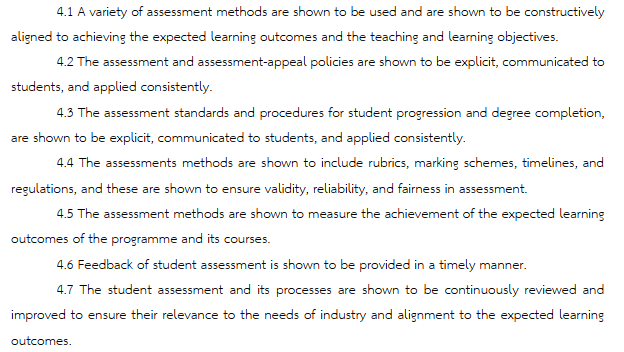
4.1 A variety of assessment methods are shown to be used and are shown to be constructively aligned to achieving the expected learning outcomes and the teaching and learning objectives.
Operational Result
BEd-Mathematics Programme implements a variety of assessment methods to ensure that students achieve the desired learning outcomes. The program assessments are aligned with the learning outcomes according to the Thai Qualification Framework for Higher Education (TQF) and are conducted through midterm and final exams, class discussions, and all assigned work. The learning outcomes of each course are based on the curriculum mapping in TQF.2. Students’ achievements are verified based on the learning outcome standards in TQF.3. The three key learning outcomes—Person-Learner, Active Citizen, and Co-Creator—are also integrated and assessed in all student activities and projects. Additionally, schools where our 4th-year students complete their internships also assess the students.
Student Assessment System
- Variety of Assessment Methods: The curriculum incorporates a diverse range of assessment methods to evaluate students’ learning comprehensively, including:
- Written Exams: Midterm and final exams to assess students’ understanding of theoretical concepts.
- Class Discussions: Regular class discussions to gauge students’ participation, critical thinking, and understanding of the subject matter.
- Projects and Presentations: Group and individual projects, along with presentations, to evaluate practical application, creativity, and communication skills.
- Practical Assessments: Hands-on tasks, lab work, and simulations to assess practical skills and problem-solving abilities.
- Peer Assessments: Peer reviews and group evaluations to foster collaborative learning and self-assessment skills.
- Portfolios: Compilation of student work over time to track progress and depth of learning.
- Internship Evaluations: Feedback from internship supervisors to assess real-world application of skills and professional behavior.
- Learning Assessment Plan: The curriculum or program sets up a learning assessment plan according to the Thailand Qualification Framework (TQF).
- Assessment Criteria: The curriculum or program informs the learning assessment criteria to all students in the program.
- Monitoring and Evaluation: The curriculum or program follows up and monitors teaching, learning, and assessment according to the plan and assessment specified in TQF 3 and TQF 4.
- Review of Student Achievement: The curriculum or program provides a review of the students’ achievements.
- Instructor Reporting: Instructors prepare TQF 5 and TQF 6 and submit them to the curriculum or program after the completion of teaching.
The Programme’s comprehensive assessment methods ensures that our students not only meet but exceed the learning outcomes, preparing them to be effective learners, active citizens, and innovative co-creators.
4.2 The assessment and assessment-appeal policies are shown to be explicit, communicated to students, and applied consistently.
Operational Result
The assessment criteria are clearly communicated to the students on the first day of class to ensure transparency and understanding of the expectations. Students are provided with detailed information about how their performance will be evaluated, including the weight of various assessments such as exams, projects, participation, and other assignments.
Student Rights and Appeals Process
- Right to Appeal: Students have the right to appeal or petition for their grades if they believe there has been an error or unfair assessment.
- Grade Re-Check Procedure: Students who wish to request a re-check of their grades must complete an official appeal form, available at the Examination Office. This process ensures that any concerns are formally documented and addressed systematically.
- Petition Fee: A petition fee is required to process the appeal, which covers administrative costs associated with the re-evaluation.
- Appeal Deadline: The deadline for submitting an appeal is the first day of the week of the following semester. This timeframe allows sufficient opportunity for students to review their grades and prepare their appeal if necessary.
Detailed Appeal Process
- Initial Communication: On the first day of class, instructors provide students with a syllabus that outlines the assessment criteria, grading policies, and important deadlines.
- Appeal Form Submission: Students must obtain and complete the official appeal form from the Examination Office, clearly stating the reasons for their appeal and the specific assessments in question.
- Supporting Documentation: Students are encouraged to include any relevant documentation or evidence that supports their appeal, such as graded assignments, exam papers, or feedback from instructors.
- Review Process: Once the appeal form and petition fee are submitted, the Examination Office will review the request and forward it to the appropriate faculty members for re-evaluation.
- Outcome Notification: Students will be notified of the outcome of their appeal within a specified period, typically within two weeks of submission. If the appeal is successful, the grade will be adjusted accordingly.
The programme ensures that students have a fair opportunity to address any concerns regarding their grades and maintain trust in our academic evaluation system by clearly communicating the assessment criteria and providing a structured appeal process.
The assessment criteria are communicated to the students on the first day of class. The general student appeal procedure is governed by the norms of TRSU Faculty of Education. The students have the right to appeal or petition for the grades. Students who wish to recheck their grades must file an official appeal with the Examination Office. A petition fee is required. The deadline for the appeal is the FIRST day of the week of the following semester.
After course completion, the course coordinators and instructors collected and analyzed the scores and then identified the grade of the individual student by the criteria referenced. The grading of each course would be considered by the department committee and then submitted for approval by the Academic Committee and the University Executive Committee.
All information about the course evaluation plan and the grading criteria was available to the students at the orientation day and provided via Google Classroom. Every course had to identify and communicate the appeal process in the course specifications by using the sentence.
For a grading appeal, the student could send the request form to be approved by his or her academic advisor and the course coordinator and then submitted to the BEDM Programme office. The Appeal Committee Regarding Academic Affairs was appointed to operate when there was an appeal. In academic years, there was only informal meeting. For example, a student asked the course coordinator to review her grade because the student was unclear about the assignment score. The course coordinator explained the assessment and evaluation criteria until the student was satisfied with the score and grade.
The following table is a brief of student – based learning strategy of BED Programme:
| Strategy/Learning and Teaching Method | Role of Teacher | Role of Student |
| Retrieval | – Assign topics/subjects clearly – Teach/suggest retrieval method | Study to find knowledge and data by themselves, recode/report data retrieval |
| Teach with educational media and technology such as learning and teaching kit, computer, E-learning | Supply and develop teaching aids Develop learning center | Self-study, answer the question, do the exercise, solve the problem/question under knowledge and ability |
| Problem solving | Arrange/prepare problem situation for case study | Problem understanding, additional study, synthesis problem summary/solution suggestion, evaluation, written report |
| Case study | Arrange/prepare case study under developed learning results | Understanding, case study, additional study, solution analysis/answer the question, case study discussion |
| Problem-based teaching | Prepare the problem, patient case, document, report, related media Provide data/answer the question, suggest the benefit source | Set the question that will bring to solutionStudy, seek knowledge from the related benefit sourceEvaluate self-learning |
| Concept mapping | – Concept setting to be studied/stimulating thinking | – Manage system and think- Think, analyze problem concept/question, thinking – Manage system and think process, create the relationship in components |
| Debate | – Propose/discuss issue/subject to learn, arrange the debate process, support self-learning | – Study the standard-setting process, clear learning results – Group meeting to plan the debate, assign the related work – Build participation, conclusion and evaluation |
| Demo and Reaction | – Arrange demo process, prepare equipment (if needed), process document, teaching aids, show demo, observation, reaction and suggestion | – Observe, record, set the question, make understanding in practice process, response for self-evaluation |
| Discussion | – Set discussion issue, facilitate stimulation, discussion to occur participation – Give data, summarize | – Prepare knowledge (study), give opinion, analyze and criticize wisely, respect others |
| Project | – Create understanding in learning results to be developed, practice understanding on project, brief subject setting | – Make understanding with question or subject/learning results – Group meeting with project participants (if group work) |
4.3 The assessment standards and procedures for student progression and degree completion, are shown to be explicit, communicated to students, and applied consistently.
Operational Result
The assessment standards and procedures are meticulously designed to measure students’ progression year by year until graduation. These procedures are aligned with the program’s Year Learning Outcomes (YLOs) to ensure that students develop the necessary competencies at each stage of their academic journey.
Year-Level Learning Outcomes
- Year 1:
- Knowledge and Understanding: Students are expected to gain foundational knowledge about moral principles and ethics in life.
- Skills Development: Basic knowledge and skills related to their field of study.
- Personal Development: A strong sense of responsibility and an understanding of ethical behavior in personal and professional contexts.
- Year 2:
- Academic Proficiency: Students are expected to have acquired at least 40% of the knowledge and skills in their English major.
- Educational Foundations: An understanding of educational philosophy and key concepts in educational management.
- Professional Growth: Enhanced skills in communication, critical thinking, and a deeper engagement with their chosen discipline.
- Year 3:
- Advanced Knowledge: Students are expected to have at least 80% of the required knowledge and skills in Teaching English.
- Analytical and Problem-Solving Skills: The ability to think critically, analyze situations, and solve problems effectively.
- Teamwork and Collaboration: Development of teamwork skills and the ability to face challenges collaboratively in a work environment.
- Year 4:
- Professional Competency: Mastery of the necessary skills in English Proficiency for Teaching, preparing students for their teaching careers.
- Leadership and Analytical Skills: Strong leadership abilities and analytical thinking skills relevant to the teaching profession.
- Preparation for Employment: Equipped with the skills and knowledge to enter the workforce confidently, take on leadership roles, and contribute positively to their professional communities.
Assessment Procedures
- Continuous Evaluation: Throughout each academic year, students’ progress is continuously monitored through a combination of written exams, projects, presentations, practical assessments, and class participation.
- Midterm and Final Exams: Structured assessments at the midterm and end of each semester to evaluate students’ understanding and mastery of course material.
- Projects and Practical Work: Hands-on projects and practical tasks to assess students’ ability to apply theoretical knowledge to real-world scenarios.
- Portfolios: Encouraging students to track their progress over time through journals and portfolios.
- Internship and Fieldwork Assessments: Evaluations conducted during internships and fieldwork placements to assess students’ practical skills and professional behavior in real-world settings.
- Feedback and Improvement: Regular feedback sessions with instructors to discuss performance, identify areas for improvement, and set goals for further development.
These assessment standards and procedures with the Year Learning Outcomes ensure that students build the necessary knowledge, skills, and competencies progressively throughout their academic journey, culminating in their readiness for graduation and professional success.
4.4 The assessments methods are shown to include rubrics, marking schemes, timelines, and regulations, and these are shown to ensure validity, reliability, and fairness in assessment.
Operational Results
The BEDM programme has established Student assessment methods and criteria to ensure fairness, validity, and reliability. The examinations, including multiple-choice exams and subjective exams, were created based on CLO.
The programme employs a variety of assessment methods to ensure the validity and fairness of the assessment procedures. Lecturers are required to submit exam papers with detailed scoring rubrics, marking schemes, and Tables of Specification. The following assessment guidelines and procedures are implemented to ensure fairness, validity, and reliability:
- The program follows up and monitors teaching, learning, and assessment according to the plans and specifications outlined in TQF 3 and TQF 4.
- The program sets schedules and guidelines for preparing midterm and final exam papers.
- Instructors prepare and submit exam papers, including Rubrics and Tables of Specification, according to the guidelines and criteria set by the program.
- The Program Academic Committee reviews and approves midterm exam papers to ensure their validity and reliability.
Evaluation and Improvement Plan
- The program reviews student achievement to ensure the effectiveness of teaching and learning.
- Instructors prepare TQF 5 and TQF 6 reports and submit them to the program after the completion of teaching to report student achievements.
- The program validates and corrects TQF 5 and TQF 6 reports within 30 days.
- The program submits academic results to the academic department for the announcement of grades.
- The program organizes meetings to assess teaching and learning management at the end of each semester.
- The program prepares TQF 7 within 60 days after the end of the academic year.
- The program assesses the quality of the curriculum and uses the evaluation results to improve quality in the next academic year.
These assessment methods, including rubrics, marking schemes, timelines, and regulations, are designed to ensure the validity, reliability, and fairness of the assessment process.
4.5 The assessment methods are shown to measure the achievement of the expected learning outcomes of the programme and its courses.
Operational Result
The assessment methods are designed to achieve the desired learning outcomes for students. Lecturers are encouraged to use diverse and varied assessment methods to ensure that the expected learning outcomes are achieved by the students at the end of the course. These methods are crafted to measure the achievement of the program’s and its courses’ expected learning outcomes, ensuring validity, reliability, and fairness in assessment.
Assessment Guidelines and Procedures
- Monitoring and Evaluation: The programme follows up and monitors teaching, learning, and assessment according to the plans and specifications outlined in TQF 3 and TQF 4. This continuous monitoring ensures alignment with the program’s learning objectives.
- Scheduling and Guidelines: The programme sets clear schedules and guidelines for preparing midterm and final exam papers. This includes ensuring that all assessments are aligned with the intended learning outcomes.
- Comprehensive Preparation: Instructors prepare and submit exam papers, including detailed scoring rubrics, marking schemes, and Tables of Specification, according to the guidelines and criteria set by the program. These tools help measure student performance accurately against the expected learning outcomes.
- Review and Approval: The Programme Academic Committee reviews and approves midterm and final exam papers to ensure their validity and reliability. This review process guarantees that assessments are fair and measure the intended learning outcomes.
Evaluation and Improvement Plan
- Review of Student Achievement: The programme provides a systematic review of student achievements to ensure the effectiveness of teaching and learning in meeting the learning outcomes.
- Reporting: Instructors prepare TQF 5 and TQF 6 reports, which detail student achievements and submit them to the program upon the completion of teaching. These reports are critical in assessing whether learning outcomes have been met.
- Validation and Correction: The programme validates and corrects TQF 5 and TQF 6 reports within 30 days to ensure accuracy and reliability in reporting student achievements.
- Grade Announcement: The programme submits academic results to the academic department for the announcement of grades, ensuring transparency and accountability in the assessment process.
- Semester Assessments: The programme organizes meetings to assess teaching and learning management at the end of each semester. These assessments provide feedback on the effectiveness of the curriculum and teaching methods in achieving learning outcomes.
- Annual Review: The programme prepares TQF 7 within 60 days after the end of the academic year, which includes a comprehensive evaluation of the curriculum and program quality.
- Continuous Improvement: The programme assesses the quality of the curriculum and uses the evaluation results to make improvements for the next academic year. This continuous improvement cycle ensures that the curriculum remains effective in achieving the desired learning outcomes.
Employment of a variety of assessment methods, including rubrics, marking schemes, timelines, and regulations, the program ensures that all assessments are valid, reliable, and fair. These methods are integral in measuring the achievement of the program’s and courses’ expected learning outcomes.
St. Teresa International University, specifically the BEDM programme, ensures that all assessments undertaken follow standardized methods to observe the validity, reliability, and fairness of student evaluation. For knowledge-based (core and elective) courses, assessments are typically in the form of written examinations (midterm and final compositions of objective and subjective types of questions) with a Test Blueprint (Evidence: TB) incorporating Taxonomy’s higher-order thinking skills.
Most of the lecturers employ or are encouraged to employ the following:
| Type of Assessment | Description | Example |
| Assessment FOR Learning | Formative Assessment | Quizzes, Class Activities, etc. Pretest, Post test |
| Assessment OF Learning | Summative | Midterm Exam, Final exams |
| Assessment AS Learning | Self- Assessment | Student’s Portfolio |
| Learning Outcome | Description of the Alignment of the LOs to the Vision and Mission of the university | Bloom’s Taxonomy Level |
| Knowledge [K] | ||
| K1: Professional Knowledge | The University wants the graduates to articulate business theories & practices that are systematic, global and up-to-date , have extensive and thorough knowledge of fundamental principles and theories of mathematics and its teaching process and methodology up to possibility and viability to apply to the teaching profession in practice; have knowledge of understanding life, community around the world, and in living together based on diverse culture, able to cope up with the social change, able to apply the philosophy of sufficiency economy in life and can develop oneself to develop work and other fellow neighbours. [R1. Vision and Mission statements of the university]. | Cognitive / Understanding |
| K2: Subject Knowledge | The University wants the graduates to possess and apply basic subject knowledge such as an integrated knowledge between theory and practice in the profession, Curriculum Learning Management and Technology, Psychology for Assessment of Teachers’ measurement, understanding of the content of the major for the basic education or vocational education. [R1. Vision and Mission statements of the university]. | Cognitive / Understanding |
| K3: Research/ Development Knowledge | The University wants the graduates to have thorough and comprehensive knowledge of fundamental principles, theories and concepts of mathematics contents and teaching profession to analyze and solve critical and unseen problems and able to conceive and find new innovative concepts and problems to pursue basic research appropriate and suitable for the programme for professional and knowledge advancement. [R1. Vision and Mission statements of the university]. | Cognitive / Applying |
| K4: Critical Thinking/ Problem Solving Knowledge | The University wants to have strong knowledge and understanding of principles, theories and intrinsic concepts of mathematics taught; able to apply knowledge to analyze, appraise and solve various problems involving critical thinking; able to integrate teaching and learning with real practice and cross-science integration; able to apply knowledge of information technology in teaching profession; able to apply knowledge to track progress in academics and to develop neighbour learners. [R1. Vision and Mission statements of the university]. | Cognitive / Applying |
| Skills [S] | ||
| S1: Self-Education & Professional/ Personal Development Skill | The Universitywants the graduates to analyze the information required and be able to search for information through information technology systems from various learning sources or databases and categorize information that is convenient to call to support life or study and professional development. [R1. Vision and Mission statements of the university]. | Psychomotor / Articulate |
| S2: Team Work & Communication Skill | The University wants the graduates to value teamwork, to work with others collaboratively and with agility, either as a group member or group leader, distributing responsibilities to colleagues, directing and exchanging knowledges with each other, that respects others and accepts differences between individuals. [R1. Vision and Mission statements of the university]. | Psychomotor / Articulate |
| S3: English usage & Learning Management Skill | The University wants the graduate to demonstrate English usage skills at a standard level, with people of diverse culture, possess good leadership and service mindedness, collaborate or work well with other people; also to design learning, develop learning management plans and innovative media to support learning and effective evaluation tools to coordinate with parents for care; to solve problems or develop learners’ learning to develop to their full potential.[R1. Vision and Mission statements of the university]. | Cognitive / Applying |
| S4: Innovative Research/ development Skill | The University wants the graduates to analyze learning difficulties, select research issues and conduct studies, analysis, research and development until conclusions or innovations are obtained; also, to know the various options to improve learning continuously. [R1. Vision and Mission statements of the university]. | Cognitive / Applying |
| Ethics [E] | ||
| E1: Professional Ethics | The University wants the graduates to show self-consistency between moral & ethical belief and behavior, be patient, humble, kind, calm and quiet, considerate, caring; expressing love, faith and pride in the teaching profession, the spirit of being a teacher and behave as per the professional ethics. [R1. Vision and Mission statements of the university]. | Affective / Valuing |
| E2: Legal & Cultural Ethics | The University wants the graduates to be a disciplinary person who acts in accordance with the law. Regulations or guidelines are the agreements of the organization or the country including the activity in accordance with the good culture of the community of the society in which they live. [R1. Vision and Mission statements of the university]. | Affective / Valuing |
| Character [C] | ||
| C1: Self- Actualization | The University wants the graduates to be a health care provider for self-health, to have good physical health conditions; to have good mental health, appropriate and decent dress for the context of the organization or lifestyle period; to have physical and verbal expressions that reflect poise, maturity, credibility, model, or faith of the onlooker. [R1. Vision and Mission statements of the university]. | Affective/ Organizing |
| C2: Personality & Integrity | The University wants the graduates to be a person with kindness, compassionate and generous to their colleagues and fellow friends and neighbours in their profession and to the nation too, be honest to their profession, organization and also nation. [R1. Vision and Mission statements of the university]. | Affective/ Valuing |
| C3: Inquisitiveness & Commitment | The University wants the graduates to be a person with an inquisitive disposition who studies, researches, and brings new ideas or methods to exchange knowledges with colleagues; plan work and execute according to a plan with clear objectives; with commitment and responsibility until the work is completed, which is always evident to colleagues. [R1. Vision and Mission statements of the university]. | Cognitive / Applying |
| C4: Self-belief, Behaviour & Leadership | The University wants the graduates to be a person with strong self-belief on their knowledge and profession, able to work in a group or team having good behavior with teammates, able to distribute and execute workloads properly and professionally till finish with strong leadership quality. [R1. Vision and Mission statements of the university]. | Cognitive / Applying |
| C5: Professional Responsibility & Respect | The University wants the graduates to have a friendly personality and interact with all that reflect being kind, generous, caring and helpful at all times; have responsibility in their profession (teaching profession), respect and follow all rights and norms of the organization in all situations, listen to different ideas and opinions with understanding and acceptance of differences among individuals. [R1. Vision and Mission statements of the university]. | Cognitive / Applying |
4.6 Feedback of student assessment is shown to be provided in a timely manner.
Operational Result
The assessment of teaching management is primarily based on students’ evaluation of teaching performance in each course. The program committee reviews these evaluations and meets with instructors who receive assessment results lower than 3.51 to develop a personalized improvement plan. This process ensures that instructors are supported in enhancing their teaching quality.
At the end of the academic year, the program chair prepares TQF 7, which includes a summary of the teaching assessment results, the improvement plans, and any outcomes achieved. This report is submitted to the faculty for further review and discussion.
Regarding the assessment of learning outcomes, TQF 3 and TQF 5 are reviewed to ensure that course objectives align with the learning outcomes specified in TQF 2. Examination papers and student learning results are analyzed to assess the effectiveness of teaching methods in achieving these outcomes. Student feedback on their learning experiences is also considered, and the process of student evaluation is regularly reviewed to maintain its effectiveness.
In addition to student evaluations, feedback from the community and other stakeholders is sought to provide a broader perspective on student performance. For instance, the community evaluates students’ involvement in community services, which is an integral part of their learning experience. Furthermore, a peer assessment system involving other program instructors is implemented to provide comprehensive feedback on student performance.
To improve the timeliness of student feedback, the program can implement the following measures:
- Regular Feedback Sessions: During adviser sessions, advisors provide feedback to students on their performance.
- Feedback Mechanisms & Channels: Digital platforms like our Learning Management System and Google Classroom enable us to provide immediate feedback on assignments and assessments.
- Feedback Policies: The university has established clear policies regarding the timeline for providing feedback. Ensure that instructors adhere to these policies and provide feedback within a reasonable timeframe.
Implementing these measures can help improve the timeliness of student feedback, enhancing the overall learning experience for students in the programme.
4.7 The student assessment and its processes are shown to be continuously reviewed and improved to ensure their relevance to the needs of industry and alignment to the expected learning outcomes.
Operational Result
To ensure the quality and relevance of student assessments, our institution employs a comprehensive and continuous review process overseen by two internal committees, in addition to external oversight.
These committees work tirelessly to ensure that student assessments align with the expected learning outcomes of each course and remain relevant to the needs of the industry.
At the Faculty Level, all exams are submitted to the head of the program. The designated faculty committee reviews all papers to ensure they meet the expected standards and that exam papers align with the expected learning outcomes for the course. This review process includes feedback from industry professionals to ensure that assessments reflect current industry needs and standards. Any necessary revisions to assessments are made based on this feedback to improve alignment with the professional requirements.
At the Institution Level, all exam papers reviewed at the faculty level are forwarded to the Office of the Vice President for Academic Affairs. The papers undergo a rigorous review process that includes input from industry experts. This ensures that assessments not only meet the Course Learning Outcomes (CLOs) but also remain relevant to the evolving professional requirements. Feedback from this review is used to continuously improve assessment processes and ensure alignment with both academic standards and professional requirements.
Overall, the continuous review and improvement of assessment processes are paramount to our commitment to academic excellence and student success. By incorporating feedback from both faculty students, school mentors, we ensure that our assessments prepare students for the challenges and opportunities of the modern classroom.
Student Assessment Aligned with Stakeholder Needs improvement as per suggestion:
This document outlines the student assessment methods designed to align with the needs of various stakeholders, ensuring quality and fairness in student evaluation as per AUN-IQA standards.
| Stakeholder | Assessment Method | Purpose | Implementation Plan |
| Students | Formative assessments & summative (quizzes, reflective journals, peer/self-assessment) | Enhance learning, Monitor progress, mastery of course outcomes and provide timely feedback. | Regularly scheduled quizzes, assignments, midterms, finals, presentations and in-class activities from previous semester |
| Faculty | Use of rubrics, peer reviews, standardized grading | Ensure fairness, consistency, and quality of assessment | Develop detailed rubrics; hold peer review sessions for grading calibration |
| Employers | Project-based learning, teaching simulations, practical skill tests, internships, and portfolio evaluation | Evaluate practical and pedagogical skills relevant to teaching careers, and job readiness | Integrate real-world problems, case studies, and portfolio requirements into assessment, Incorporate in final-year courses and practicum from previous semester |
| Academic Staff/ Advisors | Continuous monitoring, academic advising meetings, rubric-based evaluation and CLO-aligned assessments | Identify and support at-risk students, ensure consistent and transparent grading aligned with learning outcomes. | Use LMS analytics and one-on-one advising to track progress and provide feedback |
| Alumni | Capstone project evaluations and exit surveys | Reflect on curriculum relevance and readiness for teaching profession. | Conduct surveys post-graduation; revise project assessment criteria. |
| Parents & Guardians | Progress reports and feedback sessions | Keep families informed and involved | Organize periodic parent-teacher meetings and distribute report cards |
| Community & Society | Service-learning projects and community engagement | Foster social responsibility and civic engagement | Embed community projects in curriculum with reflective components |
| Accreditation Bodies (AUN-IQA) | Outcome-based assessment aligned with program learning outcomes (PLOs) | Demonstrate program quality and compliance | Map assessments to PLOs and prepare comprehensive reports for accreditation |
Summary :
The BEDM program at St. Teresa International University embraces a multi-stakeholder, comprehensive assessment framework aligned with AUN-IQA standards. It employs a blend of formative and summative assessments to continuously monitor student learning and achievement.
Faculty ensure consistency and transparency through clear rubrics and peer review mechanisms, while practical assessments prepare students for real-world challenges by integrating internships and portfolio evaluations. Continuous monitoring by academic advisors via LMS platforms helps promptly identify and support students needing intervention.
The program’s alignment with accreditation requirements is ensured through outcome-based assessments tied to program learning outcomes. Engagement with parents, employers, and the wider community through progress reports and service-learning projects further enriches the assessment process, fostering a holistic educational environment that nurtures academic excellence and social responsibility.
Evidence
Self-Assessment
| Requirements | Result | Score |
| 4.1 A variety of assessment methods are shown to be used and are shown to be constructively aligned to achieving the expected learning outcomes and the teaching and learning objectives. | / | 1 |
| 4.2 The assessment and assessment-appeal policies are shown to be explicit, communicated to students, and applied consistently. | / | 1 |
| 4.3 The assessment standards and procedures for student progression and degree completion, are shown to be explicit, communicated to students, and applied consistently. | / | 1 |
| 4.7 The student assessment and its processes are shown to be continuously reviewed and improved to ensure their relevance to the needs of industry and alignment to the expected learning outcomes. | ||
| 4.4 The assessments methods are shown to include rubrics, marking schemes, timelines, and regulations, and these are shown to ensure validity, reliability, and fairness in assessment. | / | 1 |
| 4.5 The assessment methods are shown to measure the achievement of the expected learning outcomes of the programme and its courses. | / | |
| 4.6 Feedback of student assessment is shown to be provided in a timely manner. | / | 1 |
| Overall | 5 | |