Criterion 5 – Academic Staff
Criterion
Requirements
Quality level assessment

Result
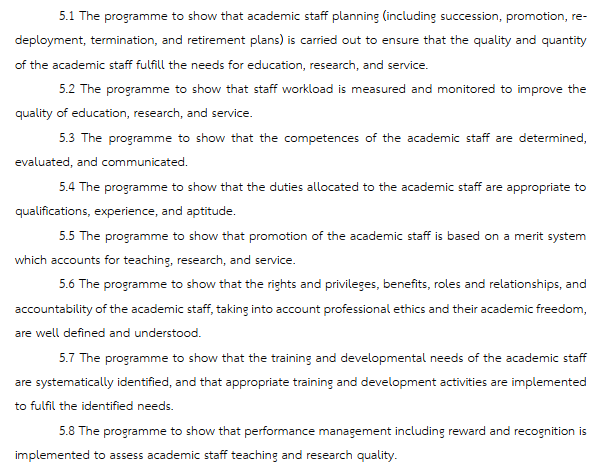
5.1 The programme to show that academic staff planning (including succession, promotion, re-deployment, termination, and retirement plans) is carried out to ensure that the quality and quantity of the academic staff fulfill the needs for education, research, and service.
Operational Result
This can be described briefly as in the following table:
| Academic staff planning to fulfill quantity and quality of staff as per needs | The programme has to have at least five academic staff who are deemed to be qualified to fulfill the needs of their stipulated academic escalation. | The programme has the stipulated planning for their academic staff which ensures that the quality and quantity of the academic staff fulfill the needs of the enhancement and enrichment of their academic activities. Evidence: Minutes of the meeting |
The above table can be explained in detail as under:
To ensure that the quality and quantity of academic staff to fulfill the needs for education, research, and service, our program employs a comprehensive academic staff planning strategy that encompasses succession, promotion, re-deployment, termination, and retirement plans. This holistic approach is designed to foster a supportive and dynamic environment that encourages professional growth, recognizes outstanding contributions, and adapts to the evolving demands of our academic community. By strategically planning for every stage of an academic staff member’s career, we are able to maintain a robust and motivated team that is well-equipped to deliver high-quality education, innovative research, and exceptional service to our institution and its stakeholders.
Succession Planning
The Program identifies and nurtures potential future leaders within our academic staff through professional development programs, mentoring, and leadership training. This ensures a seamless transition in key roles and maintains continuity in delivering high-quality education and research.
Promotion
Our promotion policy is designed to recognize and reward academic excellence and contributions to research and academic service to the community. Regular performance evaluations, based on clear criteria, ensure that deserving staff members are identified for advancement, promoting a culture of excellence, dedication and motivation.
Re-deployment
To maximize the utilization of our academic staff’s expertise, we implement strategic re-deployment. This involves assessing the evolving needs of our programs and re-assigning staff to areas where their skills and knowledge can have the most significant impact. This flexibility helps us address emerging educational and research demands efficiently.
Termination
Our termination policy is conducted with the utmost fairness and adherence to institutional guidelines. It involves a transparent process, including performance reviews and opportunities for improvement. When necessary, termination is handled professionally to maintain a positive and respectful environment.
These strategies, ensures that our program maintains a dedicated and high-performing academic staff that meets the dynamic needs of education, research, and service. This holistic approach not only supports our current objectives but also positions us for sustained success and growth in the future.
5.2 The programme to show that staff workload is measured and monitored to improve the quality of education, research, and service.
Operational Result
Our program employs a systematic approach to ensure that staff workload is measured and monitored to improve the quality of education, research, and service. This approach encompasses instructors’ subject assignments, supervision, monitoring, evaluation, and improvement processes. It aims to balance instructor workload while maintaining high educational standards and promoting an environment conducive to professional growth and excellence. By carefully planning and evaluating each stage of the academic process, we ensure that our instructors are well-supported and able to deliver high-quality education and innovative research. This approach not only supports the individual needs of our instructors but also aligns with our commitment to continuous improvement and excellence in all areas of academic and service delivery.
Instructors’ Subject Assignment
The curriculum or program schedules meetings prior to the beginning of the first semester to assign instructors to subjects offered in the next academic year, with careful consideration of students’ benefits. Instructor expertise, qualifications, and evaluation results from students in previously taught courses are key factors in this process. Only instructors with an average score of at least 3.85 out of 5 marks in student evaluations are considered, ensuring that only high-performing educators are assigned to courses.
Supervision, Monitoring, and Evaluation
The curriculum instructor is responsible for supervising, monitoring, and evaluating the performance of teaching instructors throughout the semester. This involves regular check-ins and assessments to ensure that instructors are meeting educational standards and effectively managing their workload. At the end of each semester, students evaluate the teaching performance of their instructors. These evaluations are crucial for ongoing quality assurance.
The program also evaluates the system used to assign instructors to subjects, incorporating feedback and recommendations to enhance the process in the next academic year. This evaluation ensures that workload distribution remains fair and aligned with the program’s goals.
Improvement Process from Evaluation Results
The curriculum instructor encourages teaching instructors to integrate feedback from evaluation results into their teaching and learning practices. Improvement plans developed from these evaluations are reflected in the teacher’s TQF (Thai Qualifications Framework), ensuring a continuous cycle of improvement.
Workload Measurement and Monitoring
To specifically address instructor’s workload, our program measures and monitors the workload of each instructor to ensure it is balanced and manageable. This involves:
- Regular Workload Assessments: Conducting assessments at the beginning and throughout the academic year to ensure instructors are not overburdened.
- Feedback Mechanisms: Collecting feedback from instructors about their workload and making necessary adjustments to prevent burnout and maintain high teaching standards.
- Data Analysis: Analyzing data from student evaluations, performance reviews, and workload assessments to identify trends and areas for improvement.
- Support Systems: Providing support and resources for instructors to manage their workload effectively, including professional development opportunities and access to teaching aids.
This systematic and comprehensive measuring and monitoring staff workload aim to enhance the quality of education, research, and service provided by our academic staff. This approach ensures that our instructors are well-supported and able to deliver their best performance, ultimately benefiting the students and the institution as a whole.
Maintaining a good work-life balance, assuring productivity, and delivering high-quality results all need effective task management.
All lecturers in the BEDM major are assigned workloads that are reviewed for fairness and openness, ensuring that responsibilities are assigned evenly based on staff competence and capacity. It also assessed whether workload allocation took individual abilities, professional growth goals, and overall duties into account. This guaranteed that employees were not overburdened or underutilized, resulting in higher work quality as individuals were able to focus on their allocated jobs more effectively.
Each staff member’s responsibility is distributed to them prior to the start of each semester by allocating classes and time sufficient to complete the teaching plan outlined in the TQF3.
Workloads are assigned to each lecturer based on student input and evaluation in TQF5. This proactive approach improved job quality by allowing for prompt modifications and ensuring that employees have the required assistance and resources to carry out their duties.
5.3 The programme to show that the competences of the academic staff are determined, evaluated, and communicated.
Operational Result
The BEd-Mathematics program follows a comprehensive and systematic approach to ensure that the competences of the academic staff are determined, evaluated, and communicated effectively. This approach is designed to maintain the highest standards of teaching, research, and service, thereby promoting a strong academic environment. These rigorous supervision, monitoring, and evaluation practices, alongside a structured and transparent recruitment and appointment process, ensure that our instructors are well-equipped to meet the educational needs and uphold the curriculum standards. This thorough process not only verifies the qualifications and expertise of our staff but also facilitates continuous professional development and improvement. Through these measures, we are committed to delivering high-quality education and advancing the institution’s mission by ensuring that all academic staff are competent, supported, and aligned with our educational objectives.
Supervision, Monitoring, and Evaluation
The curriculum instructor supervises, monitors, and evaluates the performance of the teaching instructors throughout the semester. This includes regular observations, feedback sessions, and performance assessments to ensure instructors meet the curriculum standards and educational objectives. At the end of each semester, students also evaluate their instructors’ teaching performance, providing valuable insights into the effectiveness and impact of the instructors.
Recruitment and Appointment Process
- Meeting to Determine Instructor Numbers: The program organizes a meeting to assess and determine the number of instructors required in accordance with curriculum standards criteria. This ensures that staffing levels meet the educational needs and maintain quality standards.
- Specification of Instructor Qualifications: The program specifies the qualifications required for instructors responsible for the curriculum or program. These qualifications are aligned with the curriculum standards criteria to ensure that all instructors possess the necessary expertise and credentials.
- Selection of Internal Instructors: For internal instructors, the program selects those who meet the curriculum standards criteria. This involves a thorough review of their qualifications, experience, and previous performance evaluations to ensure they are well-suited for the role.
- Recruitment of External Instructors: In the case of requiring external instructors, the curriculum or program requests approval from the faculty or university management committee to accept applications. The human resource department handles the application announcement and checks qualifications and documents. The curriculum or program then considers, selects, and announces the selected instructors.
- Review and Approval: New selected instructors, whether internal or external, are submitted to the academic department of the University for checking and reviewing. Following this, the curriculum or programme submits the candidates to the University Academic Council and the University Council for approval and further appointment.
- Curriculum Revision Form Submission: The program submits a curriculum revision form (Form 08) for requesting amendment or addition of instructors responsible for the curriculum or program. This is done through the faculty, the University Academic Council, and the University Council, prior to submission to the Office of Higher Education Commission.
- Evaluation of Recruitment and Appointment Processes: The program evaluates the procedures and processes for recruiting and appointing instructors. This evaluation includes assessing the effectiveness and efficiency of the recruitment process and making recommendations for improvement to ensure the highest standards are maintained.
This comprehensive approach ensures that all instructors are highly qualified and capable of delivering quality education, conducting meaningful research, and providing excellent service. This structured approach not only supports our current educational goals but also promotes continuous improvement and excellence in all areas of academic staff performance.
Competent and skilled academic personnel are crucial for providing high-quality education, conducting research, and contributing to the overall success of the institution.
The academic staff’s strengths in education, research, and academic service are prioritized by the TRSU policy.
Teaching competency is evaluated through student feedback, peer feedback, a course audit at the completion of each course, and a competency appraisal system designed by the university at the end of each academic year. The TRSU sets an evaluation for the academic staff’s teaching performance systematically by student evaluation via online regarding teaching ability, availability, mentorship skills of problem solving, reflecting questioning, level of knowledge content, and ability to draw student participation in class. The supporting staff will collect all evaluation forms and submit the evaluation analysis to the Associated Dean of Academic Affairs to formulate an improvement plan.
Lecturers are expected to design a teaching plan and an assessment plan that match with the course and program learning outcomes in order to provide high-quality education to students. Each Head of the Bachelor of Business major reviews the teaching and assessment plans, and feedback is provided to the staff member in a timely way, so that the lecturer can make modifications and prepare according to the reviewer’s criteria.
The questions prepared by lecturers for conducting midterm and final tests are reviewed by at least three reviewers, so that the lecturer may improve the questions to be competent and make the students to successfully complete the examinations.
Each Program lecturer is assigned to do research for the academic year and is advised to conduct their study in their area of competence. The instructors have also conducted research and published publications in prestigious journals that are indexed in some affiliated body as Scopus, Web of Sci, SCI or TCI.
At the conclusion of the year, each faculty member submits a performance appraisal report to the college’s human resources department, which includes accomplishments, personal goals for the following year, and improvement plans. This allows staff employees to evaluate themselves and do what is necessary to attain the goals.
5.4 The programme to show that the duties allocated to the academic staff are appropriate to qualifications, experience, and aptitude.
Operational Result
Our program follows a structured and rigorous system to ensure that the duties allocated to the academic staff are appropriate to their qualifications, experience, and aptitude. The system designed to align with curriculum standards and the missions of higher education, including teaching, research, academic service, and arts and culture preservation. By carefully considering each instructor’s unique strengths and expertise, we strive to create a balanced and supportive work environment that enhances their professional development and effectiveness. Our approach includes a detailed process for workload determination, regular review and adjustment, and provision of necessary support and resources. This ensures that all staff members can perform their roles efficiently and contribute meaningfully to the institution’s goals and the overall student learning experience.
System for Assigning Duties and Responsibilities
The program organizes a meeting to consider the number of instructors required in accordance with the curriculum standards criteria. This meeting also addresses the distribution of duties to ensure that they are appropriate to each instructor’s qualifications, experience, and aptitude.
- Workload Determination and Assignment: The curriculum or program determines and assigns instructor workloads that encompass all missions of Higher Education, including Teaching, Research, Academic Service, and Arts and Culture Preservation. This holistic approach ensures that all aspects of an instructor’s role are considered.
- Instructor Work Plan Development: Instructors set up a work plan according to their assigned workload and goals. This plan includes specific objectives in the following areas:
- Production of Research Results / Academic Works: Instructors outline their plans for producing research results and academic works, ensuring they contribute to the body of knowledge in their field.
- Development of Academic Knowledge / Work Experience: Instructors detail their plans for continuing professional development, including gaining new academic knowledge and work experience to enhance their expertise.
- Development of Teaching and Learning: Instructors propose initiatives for improving their teaching methods and enhancing the learning experience for students. This may include integrating new technologies, pedagogical strategies, and assessment techniques.
- Other Designated Assignments: Instructors include any additional responsibilities assigned to them, such as committee work, administrative duties, or participation in extracurricular activities.
Allocation Process
- Consideration of Qualifications and Experience: The program considers each instructor’s qualifications and experience when assigning duties. This ensures that tasks are matched to the instructor’s expertise and capability, allowing them to perform effectively and confidently.
- Alignment with Instructor Aptitude: The program takes into account the individual aptitudes and strengths of instructors. By aligning duties with their natural skills and interests, we enhance job satisfaction and performance.
- Regular Review and Adjustment: The program regularly reviews and adjusts instructor workloads to ensure they remain appropriate and manageable. This includes periodic meetings to assess progress and make necessary adjustments based on feedback and performance evaluations.
- Support and Resources: The program provides support and resources to help instructors manage their duties effectively. This includes access to professional development opportunities, teaching aids, and research funding.
This ensures that the duties allocated to academic staff are not only appropriate to their qualifications, experience, and aptitude but also support their professional growth and contribution to the institution’s mission. This structured system promotes a balanced workload, high-quality education, and overall academic excellence.
It is crucial to ensure that there is an appropriate number of academic staff members to effectively deliver quality education, conduct research, and fulfil administrative responsibilities. The duties of the academic staffs are allocated appropriately based on their educational background, their areas of expertise, and personal choices made by the lecturers.
A plan regarding teaching-, research- and academic title-oriented duties were allocated to the lecturers is done during the start of the academic year and were discussed and in the department meetings. The staffs were monitored and regular updates were discussed in the subsequent department meetings so that the lecturers were meeting the timelines to do their duties.
The appropriate allocation of duties resulted in increased productivity and efficiency among academic staff members. By aligning workload with individual competencies, staff members were able to focus on their areas of expertise, leading to improved teaching quality, research outcomes, and administrative effectiveness.
Moving forward, the department should continue to monitor staff quantity and workload allocation, considering factors such as program growth, emerging needs, and evolving industry requirements. Regular reviews and adjustments will help maintain the appropriateness of staff quantity and workload allocation, ensuring continued success in delivering quality education and achieving program objectives.
5.5 The programme to show that promotion of the academic staff is based on a merit system which accounts for teaching, research, and service.
Operational Result
The Faculty of Education is dedicated to promoting excellence in teaching, research, and service among its academic staff. As part of our commitment to fostering a culture of meritocracy, the faculty has developed a comprehensive program to evaluate and promote academic staff based on their contributions to these key areas. This program aims to recognize and reward faculty members who demonstrate exceptional performance in teaching, research, and service, thereby ensuring the continued growth and success of our academic community
- Teaching Excellence: Emphasize the importance of effective teaching practices, including innovative teaching methods, student engagement, and the ability to inspire and motivate students.
- Research Impact: Highlight the significance of research contributions, such as publications in reputable journals, presentations at conferences, and securing research grants.
- Academic Service : Acknowledge the value of academic service, including involvement in faculty committees, mentorship of junior faculty, and contributions to the wider academic community.
- Student Engagement: Recognize faculty involvement in student activities, such as advising student organizations, participating in student events, and providing mentorship and guidance to students.
- Evaluation Criteria: Clearly define the evaluation criteria for faculty performance, including specific metrics for teaching effectiveness, research output, service contributions, and student engagement.
- Evaluation Process: Describe the evaluation process, which may include student evaluations, self-assessment, peer evaluations, and evaluations by department heads or deans.
- Merit System: Ensure that the promotion process is based on merit, with promotions awarded to faculty members who demonstrate excellence in teaching, research, and service.
- Review Process: Outline the review process, which may involve evaluation by department heads, deans, and the vice president for academic affairs, to ensure that promotions are fair and transparent.
Through this comprehensive evaluation program, we aim to recognize and reward excellence in these areas, thereby inspiring our academic staff to continue striving for greatness. We believe that by fostering a culture of meritocracy, we can ensure the continued success and growth of our faculty and contribute positively to the field of education as a whole.
5.6 The programme to show that the rights and privileges, benefits, roles and relationships, and accountability of the academic staff, taking into account professional ethics and their academic freedom, are well defined and understood.
Operational Result
The Faculty of Education, St Teresa International University, is committed to fostering an environment where academic staff are well-informed, valued, and supported in their roles. To achieve this, we have established comprehensive communication methods that ensure all academic staff are fully aware of their duties, responsibilities, rights, and privileges. These methods are designed to emphasize professional ethics and academic freedom, ensuring a well-defined and understood framework for roles, relationships, and accountability. By maintaining clear and consistent communication, we aim to create a collaborative and transparent academic community where staff can thrive and contribute effectively to the institution’s mission and goals.
- Annual Meeting:
- Before the start of each semester, the institution conducts an Annual Meeting for all academic and supporting staff. This meeting serves as a platform to discuss the overarching goals, policies, and updates for the upcoming semester. It also provides an opportunity for staff to voice concerns, ask questions, and receive clarifications on their roles and responsibilities.
- Orientation for Newly Hired Lecturers:
- The program organizes a thorough Orientation for newly hired lecturers. This orientation includes detailed sessions on the institution’s mission, vision, values, and expectations. It covers the specific duties, roles, and responsibilities of academic staff, emphasizing professional ethics, academic freedom, and the supportive environment within the institution.
- Monthly Meetings with the Dean:
- A monthly meeting is held with the Dean of the Faculty. These meetings provide a regular forum for academic staff to discuss ongoing issues, receive updates on faculty matters, and ensure alignment with institutional goals. They also serve as an avenue for reinforcing the understanding of roles, responsibilities, and the importance of adhering to professional ethics and academic standards.
- Distribution of Lecturer’s Manual:
- Every new staff member receives a comprehensive “Lecturer’s Manual.” This manual contains detailed information about the faculty and the university in general. It clearly outlines the rights and privileges, benefits, roles, relationships, and accountability of academic staff. The manual ensures that all staff are informed about their professional duties and the ethical standards expected of them. It also provides guidance on maintaining academic freedom while fulfilling their responsibilities.
The implementation of these measures ensures that the rights and privileges, benefits, roles and relationships, and accountability of academic staff are well defined and understood, taking into account professional ethics and their academic freedom. This structured approach fosters a transparent and supportive environment, enabling academic staff to thrive in their roles while upholding the highest standards of professional conduct.
In terms of roles, relationships, and accountability, academic staff are expected and assigned to fulfill four main roles: teaching, research, academic services, and administrative services. However, the proportion of these four-dimensional workloads can be individually varied upon each academic staff’s choice, so long as it conforms to the HR regulation and is agreed upon by each individual. The academic staff can reflect on their thoughts and complaints towards the new regulations and any perceived ‘unfair’ regulation or decision through the various channels, including the TRSU Academic Staff Council, and the TRSU Personnel Committee. Together with the given rights and privileges, benefits, and roles, the academic staff is expected to fulfill the professional standard and be responsible for any consequences emanating from their work, including submitting grades on time, giving advice to students, and contributing academic assets to the community.
The TRSU, valuing the ethics for academic staff, addresses the ethics for academic staff to; give best service to students with empathy and fairness; be a role model in both professional and personal affairs; carry out academic roles without interference from other influences or benefits; follow the rules of the national board of research; constant study and make progress in academic knowledge; and serve society and the community with knowledge.
The presence of written documentation, such as employment contracts, and staff handbooks outlines the duties and responsibilities of academic staff members.
Newly recruited lecturer in the EDM department is given orientation on the day of joining the institution by the Head of the department about their roles, duties and responsibilities so that the new lecturer comprehensively understands and follow it. Regular departmental meetings are conducted throughout the academic year to communicate the same to all the staff members. Emails are also sent to individual staff members as a reminder to do the duties allocated to the staff members. These reminders help the staff to complete their work within the time period.
5.7 The programme to show that the training and developmental needs of the academic staff are systematically identified, and that appropriate training and development activities are implemented to fulfil the identified needs.
Operational Result
The BEDM program is dedicated to the continuous professional growth and development of its academic staff. To achieve this, we have established a framework that systematically identifies the training and developmental needs of our instructors. This framework ensures that appropriate activities are implemented to meet these needs, fostering an environment of ongoing learning and improvement. By supporting our staff in their professional journeys, we aim to enhance the quality of education and uphold the institution’s standards of excellence. This process involves comprehensive policies and structured plans that align individual goals with the overall mission of the faculty and the university, promoting a culture of continuous improvement, academic excellence, and professional integrity.
- Instructor Promotion and Development Policy:
- The program has established a comprehensive promotion and development policy for all instructors, which includes the following key areas:
1.1 Attendance in Seminars: Instructors are encouraged to attend seminars both inside and outside the university to update and expand their knowledge level and quality.
1.2 Academic Production: Instructors are expected to engage in research and produce academic works, publishing their findings in national and/or international academic indexed journals.
1.3 Academic Rank Development: Instructors are supported in their efforts to develop and achieve higher academic ranks.
1.4 Academic Service Performance: Instructors are involved in providing academic services to the community and enhancing their professional practice.
1.5 Further Education: Instructors are encouraged to pursue further/higher education to enhance their educational qualifications.
- Self-Development Plan:
- Each instructor sets up a self-development plan based on their needs in the areas mentioned above. This plan outlines specific goals and activities for their professional growth.
- Approval of Self-Development Plan:
- The curriculum or program reviews and approves each instructor’s self-development plan, ensuring alignment with the institution’s goals and standards.
- Integration into Faculty Plan:
- Once approved, all instructors’ self-development plans are submitted to the faculty for further approval. The faculty then organizes these individual plans into an overall faculty development plan.
- Request for Approval:
- Instructors request approval to proceed with their proposed self-development plans from the program, faculty, and university, ensuring a multi-tiered review process.
- Implementation of the Plan:
- Upon receiving approval, instructors proceed with the activities outlined in their self-development plans. This may include attending seminars, conducting research, pursuing further/higher education, and engaging in academic service.
- Operational Report and Evaluation:
- After completing their self-development activities, instructors write an operational report and evaluate the outcomes. This report includes an assessment of how the activities have contributed to their professional development and how they have integrated new knowledge and skills into their teaching practices.
- Evaluation and Improvement:
- The curriculum or program evaluates the results of the instructor promotion and development plans. Based on this evaluation, suggestions are made to improve the plan for the next academic year. This continuous improvement process ensures that the training and developmental needs of academic staff effectively met, and that the overall quality of education is continually enhanced.
This systematic approach ensures that the training and developmental needs of academic staff are identified and addressed in a structured and effective manner. This commitment to continuous professional development helps maintaining high standards of teaching and learning within the institution.
Systematically identifying and addressing the gaps ensures that employees have the essential skills, knowledge, and abilities to effectively perform their jobs.
Surveys, performance evaluations, self-assessments, and future development plans are used by the department to identify the academic staff’s training and development needs. The department encourages professors to obtain doctoral degrees and provides resources to help them continue their education on a part-time basis.
The department has also committed funds to develop teachers’ academic and professional capabilities in accordance with the institution’s objectives. (KM, IT, Research, and Quality Assurance).
A knowledge management presentation is held each semester to enable lecturers to increase their talents, learn about new teaching methodologies, and share their information and teaching methodologies with other departments and faculties.
The department has proven a commitment to methodically identifying and connecting academic staff training and development needs with program requirements. The department can further develop its processes and foster a culture of continuous learning and professional growth among its academic staff by conducting ongoing evaluation and improvement.
5.8 The programme to show that performance management including reward and recognition is implemented to assess academic staff teaching and research quality.
Operational Result
The BEd-Mathematics program is dedicated to upholding high standards of teaching and research quality through established performance management system. This system is designed to systematically assess the performance of academic staff, ensuring they meet the institution’s expectations. By incorporating regular assessments, rewards, and recognition, the program strives to promote a culture of excellence, motivation, and continuous improvement. Our approach ensures that academic staff are not only held accountable for their contributions but are also celebrated for their achievements. This comprehensive system supports professional growth, enhances job satisfaction, and ultimately contributes to the overall mission and goals of the institution
- Performance Assessment:
- Annual Reviews: Each academic staff member undergoes an annual performance review. This review assesses teaching effectiveness, research productivity, and contributions to academic service. The process includes self-assessments, peer reviews, student feedback, and evaluations by supervisors.
- Teaching Quality: Teaching quality is assessed through different areas, including student evaluations, peer observations, and analysis of student outcomes. Instructors are encouraged to reflect on their teaching practices and identify areas for improvement.
- Research Quality: Research performance is evaluated based on publications in reputable journals, citations, grant acquisitions, and contributions to the academic community. Staff are encouraged to engage in interdisciplinary research and collaborative projects.
- Reward and Recognition:
- Incentive Programs: The institution offers incentive programs to reward outstanding teaching and research performance. These programs may include financial bonuses, research grants, and additional professional development opportunities.
- Awards and Honors: Exceptional academic staff are recognized through various awards and honors. These accolades highlight achievements in teaching, research, and service, and are presented at formal ceremonies to celebrate their contributions.
- Promotions and Career Advancement: High-performing staff are considered for promotions and career advancement opportunities. The promotion process is transparent and based on merit, with clear criteria related to teaching excellence, research impact, and service contributions.
- Continuous Professional Development:
- Professional Development Plans: Staff are encouraged to create professional development plans that align with their career goals and institutional priorities. These plans are reviewed and supported by the institution to ensure continuous growth and improvement.
- Mentorship Programs: Experienced faculty members are paired with junior staff to provide mentorship and guidance. This fosters a supportive environment and helps junior staff develop their skills and achieve their career objectives.
- Feedback and Improvement:
- Regular Feedback: Academic staff receive regular feedback on their performance. This feedback is constructive and aims to help staff understand their strengths and areas for improvement.
- Improvement Plans: Staff who need to improve their performance are provided with tailored improvement plans. These plans include specific goals, resources, and timelines to support their development.
This comprehensive performance management system ensures that academic staff are assessed fairly and recognized appropriately for their teaching and research quality. This approach not only motivates staff to excel but also enhances the overall quality of education and research within the institution.
At the end of every term, the lecturer is evaluated by students. This evaluation tool is built into TQF 3 and TQF 5 of the MIS system. The numerical value of the assessment is not presented in the system and can only be seen by the lecturer after the grades are released.
These statistics were thoroughly analyzed to determine the lecturer’s strengths and weaknesses. Faculty members can also receive vital feedback on their teaching effectiveness, research contributions, and service commitments through performance evaluation. This feedback identifies faculty members’ strengths and areas for improvement, allowing them to improve their performance and continuously build their skills and expertise. This, in turn, leads to better program delivery and student learning experiences.
The department ensures that the program is responsive to changing educational needs and industrial requirements by assessing assessment results on a regular basis and implementing initiatives to address identified areas of concern.
Academic Staff Development improvement as per suggestion:
This table presents the development plan for faculty members of the BEDM program, addressing research and academic services in alignment with faculty needs, consistent with AUN-IQA requirements.
| Development Area | Focus | Short-Term Plan (2024–2025) | Long-Term Plan (Beyond 2025) |
| Research Capacity | Research | Organize research methodology workshops; provide seed grants. | Establish research clusters; support international journal publications. |
| Teaching Quality | Academic Services | Conduct teaching skills seminars; peer classroom observations. | Develop advanced pedagogical training and e-learning expertise. |
| Professional Development | Academic & Research | Support attendance at conferences and short courses. | Facilitate faculty sabbaticals and higher degree studies. |
| Collaboration & Networking | Research & Academic | Promote interdisciplinary projects and internal seminars. | Foster international partnerships and joint research grants. |
| Technology Integration | Academic Services | Train faculty on learning management systems and digital tools. | Develop blended and online course design capabilities. |
| Performance Evaluation & Feedback | Academic Services | Implement peer review and student feedback mechanisms. | Establish a continuous quality improvement system based on data analytics. |
| Mentoring & Support | Academic Services | Assign senior faculty mentors to junior staff. | Create structured mentoring programs and leadership training. |
Summary:
Overview:
The program commits to advancing faculty capabilities in both research and academic services, ensuring alignment with AUN-IQA standards and faculty needs.
Short-Term Focus (2024–2025):
- Research methodology workshops and seed grants to enhance research skills
- Teaching seminars and peer classroom observations to improve instructional quality
- Support for conference attendance and professional development activities
- Training on digital tools and learning management systems
- Mentorship programs pairing junior and senior faculty
- Encouragement of interdisciplinary collaboration within the university
Long-Term Goals (Beyond 2025):
- Establishment of research clusters and promotion of international journal publications
- Advanced pedagogical training, including blended and online course design
- Facilitation of faculty sabbaticals and support for higher degrees
- Expansion of global partnerships and joint research projects
- Continuous quality improvement through data-driven performance evaluations
- Structured mentoring and leadership development programs
Impact:
These initiatives ensure a motivated, research-active, and teaching-excellent faculty body, enhancing the overall academic quality and reputation of the BEDM program.
Evidence
Self-Assessment
| Requirements | Result | Score |
| 5.1 The programme to show that academic staff planning (including succession, promotion, re-deployment, termination, and retirement plans) is carried out to ensure that the quality and quantity of the academic staff fulfill the needs for education, research, and service. | / | 1 |
| 5.3 The programme to show that the competences of the academic staff are determined, evaluated, and communicated. | / | |
| 5.2 The programme to show that staff workload is measured and monitored to improve the quality of education, research, and service. | / | 1 |
| 5.4 The programme to show that the duties allocated to the academic staff are appropriate to qualifications, experience, and aptitude. | / | |
| 5.5 The programme to show that promotion of the academic staff is based on a merit system which accounts for teaching, research, and service. | / | 1 |
| 5.6 The programme to show that the rights and privileges, benefits, roles and relationships, and accountability of the academic staff, taking into account professional ethics and their academic freedom, are well defined and understood. | / | |
| 5.7 The programme to show that the training and developmental needs of the academic staff are systematically identified, and that appropriate training and development activities are implemented to fulfil the identified needs. | / | 1 |
| 5.8 The programme to show that performance management including reward and recognition is implemented to assess academic staff teaching and research quality. | / | 1 |
| Overall | 5 | |