Criterion 7 – Facilities and Infrastructure
Criterion
Requirements
Quality level assessment
Result
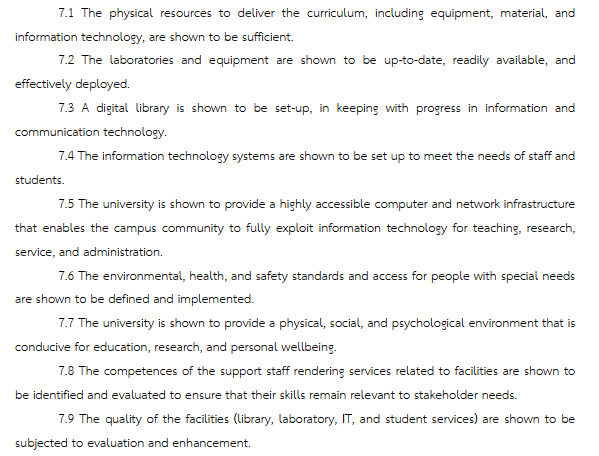
7.1 The physical resources to deliver the curriculum, including equipment, material, and information technology, are shown to be sufficient.
Operational Result
The Bachelor of education Program has physical resources for delivering the curriculum, including equipment, materials, and information technology, are sufficient to meet the needs of our students. The faculty learning support system aims to provide adequate and appropriate learning resources for all programs within the Faculty.
The Bachelor of Education in Mathematics program has established an efficient system and mechanisms for learning support to ensure students’ learning is well-supported with modern teaching media. The program boasts the following modern teaching facilities:
Library
TRSU provides library that foster a culture of lifelong learning and personal development. They offer a wide array of resources beyond academic subjects, including fiction and non-fiction books, literature, biographies, self-help books, and cultural materials. Students can explore their personal interests, broaden their horizons, and develop a love for reading and learning that extends beyond their academic pursuits.
These facilities offer valuable support for students’ academic success. Students can find textbooks, reference materials, and study guides in libraries, which can supplement their course materials and aid in exam preparation. They also provide access to academic databases, which are essential for literature reviews, research projects, and scholarly writing.
The library has digital library facility for studying e – books.
Classroom
The University provides modern classrooms that are equipped with the latest educational technology tools, such as interactive whiteboards, audiovisual equipment, and multimedia resources. These technologies enable teachers to deliver engaging and interactive lessons, making learning more dynamic and stimulating for students. Technology integration also helps students develop digital literacy skills that are essential in today’s world.
WiFi
Along with modern classroom facilities University also provides high speed WiFi facilities with which the students can access to a wealth of information at their fingertips. Internet connectivity, online databases, and digital resources enable students to conduct research, access up-to-date information, and explore a wide range of learning materials. This access promotes independent learning, empowers students to explore their interests, and expands their knowledge beyond the confines of textbooks.
Computer lab
The University has provided computer labs for the students to develop their ICT skills. The students can access these labs for Projects, Statistical Analysis, Variety of Mathematical Problems based on Theories and Application and also Mathematics Teaching Methods via various interesting games (how to teach mathematics using games for primary school students) and Assignments and Research works and Mathematics and Teaching Mathematics.
Physics and Chemistry Labs
Physics and chemistry labs provide students with hands-on learning experiences. They allow students to apply theoretical concepts, conduct experiments, and observe phenomena firsthand. This hands-on approach enhances understanding, critical thinking, problem-solving skills, and the ability to make connections between theory and practice.
Learning Community Centre (LCC)
Equipped with advanced educational media such as Smart Boards, videos, and other interactive tools.
Moodle Online System
TRSU’s Learning Portal allows teachers to upload lectures, quizzes, and other resources. Students can access these materials, take examinations, and interact with lecturers through this platform.
Program instructors regularly review all learning resources, including tests, journals, and both hardware and software teaching media, to ensure sufficiency. If the resources are found lacking, instructors promptly make requests to the faculty and the college for additional resources. The continuous improvement of learning support is driven by identified needs and feedback from the program.
7.2 The laboratories and equipment are shown to be up-to-date, readily available, and effectively deployed.
Operational Result
In today’s dynamic digital era, the demand for access to crucial resources has increased significantly. Our laboratories and equipment are up-to-date, readily available, and effectively deployed to meet the needs of our students and faculty.
Science Laboratory. Our science laboratories are equipped with the latest technologies and are fully stocked with all essential chemical compounds. These facilities are designed to support the scientific curiosities of our bright students. In the first year of their course, undergraduate students receive training in utilizing laboratory apparatuses and are introduced to advanced scientific topics. The labs provide hands-on practical experience, enabling students to conduct legitimate and credible experiments.
Language Laboratory . Our mission is to help students gain proficiency in multiple languages, particularly English. Our state-of-the-art language laboratories facilitate active student participation through a personalized teaching and learning process, making it easier for students to learn English effectively.
Computer Laboratory. Our computer laboratories are equipped with high-performance computer systems integrated with high-speed data networks, ensuring efficient and effective information acquisition and processing. Additionally, several computer workstations are available in our main library for student use.
Apple iMac Laboratory. The Apple Mac Computer Lab serves as the central hub for student film projects, where ideas are transformed into cinematic masterpieces. Each iMac unit is pre-installed with the following software packages:
- Adobe Creative Cloud suite
- DaVinci Resolve
- GarageBand
- Final Cut Pro
- Audacity
These resources ensure that our students have access to cutting-edge technology and tools, fostering a conducive environment for learning and creativity.
7.3 A digital library is shown to be set-up, in keeping with progress in information and communication technology.
Operational Result
A digital library is established in keeping with advances in information and communication technology.
Online University Library System (ULib)
We believe that the library is key to academic success, playing a vital role in linking students to critical information. Students not only consume information but also produce unique, independent works and contribute to the academic community. Our collection comprises both English and Thai publications, carefully selected to meet the requirements of all our degree programs.
Today’s generation of students, born into the dynamic digital era, demand increased access to crucial resources through information technology. With our Online University Library System (ULib), students can quickly and conveniently search our vast collection of electronic publications using either their computer or smartphone.
Our library offers the following features to ensure that our students’ learning experiences are maximized:
- Group Study Rooms: Spaces designed for collaborative learning and group discussions.
- ULib Computer Terminals: Dedicated terminals for accessing the digital library and other online resources.
- Printing and Photocopying: Services to support students’ academic needs.
- Research Support: Assistance with research projects, including access to various academic resources and databases.
These resources ensure that our students have the necessary tools to succeed in their academic endeavors, fostering a conducive environment for learning and innovation.
7.4 The information technology systems are shown to be set up to meet the needs of staff and students.
Operational Result
The digital era has brought about a revolution in the way we share and acquire information. Information technology promotes St Theresa’s commitment to academics and advanced research. Information Technology systems are set and readily available for all students, faculty and staff.
The TRSU supports the online databases, electronic books, and online journals that are accessible through the TRSU website, the library, and both inside- and outside-the-university websites. With one data reserve room for IT protection from disruption or cyberspace assault, which can be controlled through a remote system, the IT staff is in charge of creating the emergency plan for the IT system and IT security. The hiring of IT staff specialist results in the payment of specialists.
There are numerous IT systems available for students at the program level:
For employees and students to get the relevant information, go to the TRSU’s main website. Student resources for the student information system are available on the home page and include an internal link to housing, insurance, academic documents, and an external link to libraries and databases. Students can receive information about the personnel and the curriculum via this website.
TRSU MIS: We have shifted to almost paper-less transactions. Our TQFS, Attendance, Grades are processed through our MIS.
Google Classroom: All our teaching materials, student assignments and activities are conducted through google class. This platform facilitates seamless communication and collaboration between teachers and students, enhancing the learning experience.
Moodle: Enables our students to practice test on their pace and convenience.
About 7–15 students per teacher in the Bachelor of Education Mathematics program at TRSU are closely monitored using an advisor–advisee system that uses LINE, Google Chat, and other social media platforms. This technique allows for the early identification and assistance of students who may have learning challenges or other issues.
Students, support personnel, and academic staff are all connected through systems to transfer or share
knowledge and information. For instance, students can download and fill out the application form for graduation announcement from the main website before sending it to an adviser, who can then check the graduate’s qualifications by immediately accessing this announcement before signing.
7.5 The university is shown to provide a highly accessible computer and network infrastructure that enables the campus community to fully exploit information technology for teaching, research, service, and administration.
Operational Result
The University has established a highly accessible computer and network infrastructure that empowers our campus community to fully exploit information technology for teaching, research, service, and administration. Recognizing the significant role of technology in modern education, we are committed to providing our students, faculty, and staff with the necessary tools and resources to excel in a digital world. Our state-of-the-art facilities and cutting-edge technology infrastructure ensure that all members of our academic community can engage in innovative and effective learning and research practices
Computer Laboratories Our computer laboratories are equipped with high-performance computer systems integrated with high-speed data networks. This setup ensures that students can efficiently acquire and process information. The computer labs feature platforms running Windows and Unix (Linux) operating systems, providing a versatile computing environment.
Library Workstations Beyond the computer laboratories, several computer workstations are available in our main library. These resources are crucial for students to gain a firm grasp on advanced computing concepts and support their academic needs.
Specialist Software Essential specialist software packages, such as Amadeus for our Airline Business students and SPSS for our Mathematics students, are installed on all lab computers. These software packages are consistently kept up-to-date, ensuring that students have access to the latest tools required for their studies.
Our comprehensive computer and network infrastructure not only supports efficient learning and research but also enhances the overall academic experience at St Teresa International University.
7.6 The environmental, health, and safety standards and access for people with special needs are shown to be defined and implemented.
Operational Result
The university put significant importance to maintaining high environmental, health, and safety standards, while also ensuring accessibility for people with special needs. Our campus is designed to provide a safe, healthy, and inclusive environment for all members of our community. We believe that a well-maintained, secure, and inclusive campus is essential for fostering academic excellence and personal well-being. To this end, we have implemented comprehensive policies and practices that uphold these values across all aspects of campus life. The university follows all the protocols with respect to the health and safety standard
Environment:
The university provides a clean environment around the campus in-order to provide a healthy environment for the students. Also, they provide proper waste management and recycling management in and around the campus. Our university’s peaceful, green surroundings create the perfect environment for studying. We have implemented various environmental preservation initiatives, including the placement of trash bins throughout the campus. Signage and posters promoting environmental protection and sustainability are displayed prominently to encourage eco-friendly practices among students and staff.
Health:
- During the covid time, the university arranged for the vaccination of academic staff, support staff and students.
- The instructors and the students were asked to do the Rapid Antigen Testing every first day of the week to maintain a covid free environment
- They provide sanitizers in each floor as well as in all the buildings inside the campus.
- They encouraged social distancing
- For minor health issues, they provide facilities in the student affairs office and Nursing building for the welfare of the students.
- The university organizes a thorough health check-up every year for all students and staffs in collaboration with various well-established hospitals in Bangkok.
- Promoting mask-wearing in classrooms and during gatherings.
- Designation of smoking and non-smoking areas
Safety Standards:
- The university encourages the students and the lecturer to wear masks in order to be safe.
- They repeatedly inform the students who ride motorbikes to wear helmets. They have also put flex boards around the campus to remind the students about their safety.
- They provide proper security services and security systems inside the university campus. They have placed CCTV cameras everywhere and also, they have deputed security guards in all the entrance and exit points to provide a much safer environment for the students and the lecturers.
- The college has proper fire protection systems, and they are well-maintained.
Accessibility for People with Special Needs.
The University has made significant efforts to accommodate people with special needs, including the installation of ramps, and accessible restrooms. Our facilities are designed to ensure that everyone, regardless of physical ability, can navigate the campus comfortably and safely.
7.7 The university is shown to provide a physical, social, and psychological environment that is conducive for education, research, and personal wellbeing.
The physical environment refers to the tangible and visible aspects of the college campus and facilities. It encompasses the buildings, classrooms, libraries, laboratories, dormitories, outdoor spaces, and other physical infrastructure that make up the college campus.
The physical environment plays a crucial role in creating an atmosphere conducive to learning, socializing, and overall well-being of the students.
- Buildings and Facilities: The University provides academic buildings where classes are held, administrative buildings, libraries, computer labs, sports facilities, student centers, cafeterias, and other amenities.
- Classrooms: They have provided classrooms with all the digital age technology facilities such as LAN connection, Projector, and Audio facilities such as a microphone, amplifier, speakers etc. The classrooms have a proper seating arrangement for the students, air-conditioning facilities, lighting and acoustics. All these facilities significantly enhance the learning experience of the students.
- Laboratories: The University has provided various labs such as a physics lab, chemistry lab, Aircraft Simulator lab, language lab, computer lab etc. for enhancing the academic performance of the students. These labs are equipped with tools, equipment, and materials necessary for conducting experiments and practical learning.
- Dormitories: TRSU provides on-campus housing for students. Dormitories or residence halls offer living spaces, common areas, study rooms, and recreational facilities. The design and amenities in these spaces influence the comfort and social environment of the students.
- Outdoor Spaces: University campuses have open spaces, lawns, gardens, and courtyards where students can relax, study, or engage in recreational activities. Outdoor spaces contribute to the overall ambience and provide opportunities for social interaction and relaxation.
- Accessibility and Safety: The physical environment of the university is designed to be accessible to all individuals. Adequate safety measures, such as well-maintained pathways, emergency exits, lighting, and security systems, are provided for the well-being of students and staff.
The social environment refers to the interactions, relationships, and cultural dynamics that exist among the members of the university community, including students, faculty, staff, and administration. It encompasses the social atmosphere, norms, values, and overall social context within which individuals interact and engage with one another.
- Peer Interactions: The social environment in university is heavily influenced by the interactions among students. This includes forming friendships, participating in group activities, collaborating on projects, and engaging in social events. These interactions can shape a student’s sense of belonging, social identity, and overall well-being.
- Diversity and Inclusion: TRSU has diverse student populations in terms of cultural, ethnic, socioeconomic, and educational backgrounds. This is to foster inclusivity, respect for diversity, and opportunities for cross-cultural interactions. Embracing diversity enhances learning, promotes understanding, and prepares students for a global society.
- Clubs and Organizations: TRSU offers a wide range of student clubs, organizations, and extracurricular activities. These provide opportunities for students to pursue shared interests, develop leadership skills, and engage with like-minded peers. Clubs and organizations contribute to the social fabric of the college and help create a sense of community.
- Campus Events and Traditions: The University organized various events, such as sports tournaments, cultural festivals, academic conferences, and guest lectures. These events bring the community together, foster social connections, and provide opportunities for intellectual and cultural enrichment.
- Academic and Social Support: The social environment in TRSU includes support systems to help students thrive academically and emotionally. The support systems which we have here are academic advisors, mentors, counseling services, peer support groups, and resources for personal development. This supportive social environment enhances student success and well-being.
- Campus Culture: The collective values, norms, and traditions that develop within the college shape its unique campus culture. This includes shared values of academic excellence, community service, social responsibility, and ethical behavior. TRSU Campus culture influences social interactions, relationships, and overall student experiences.
The psychological environment refers to the overall atmosphere, conditions, and factors that influence the mental and emotional well-being of individuals within the university community, including students, faculty, staff, and administration. It encompasses various aspects of the college environment that impact the psychological experiences and states of individuals.
- Academic Expectations and Support: The academic expectations and support provided by the college influence the psychological environment. Clear expectations, fair grading practices, academic resources, and support services contribute to a positive psychological environment by reducing stress, enhancing motivation, and fostering a sense of competence.
- Sense of Belonging: TRSU provides a supportive psychological environment that promotes inclusivity, encourages social connections, and creates opportunities for students to engage in meaningful relationships with peers, faculty, and staff.
- Mental Health Support: The availability and accessibility of mental health services and resources within the university greatly impact the psychological environment. The university provides adequate support for mental health issues, such as counseling services, workshops, and awareness campaigns and creates a supportive environment that addresses the psychological well-being of individuals.
- Diversity and Inclusion: A psychologically healthy environment embraces diversity and fosters inclusivity. Our university that value and promote diversity create an environment where individuals from different backgrounds feel accepted, respected, and valued. This inclusivity contributes to a positive psychological environment for all members of the college community.
- Safety and Security: The physical and psychological safety of individuals within the university environment are intertwined. A safe and secure environment, both physically and psychologically, promotes a sense of well-being, trust, and psychological stability among students, faculty, and staff. TRSU provides such an environment.
- Leadership and Communication: Effective leadership, transparent communication, and opportunities for participation in decision-making processes contribute to a positive psychological environment. Clear communication channels and a sense of shared ownership foster trust, engagement, and a positive psychological climate.
Operational Result
7.8 The competences of the support staff rendering services related to facilities are shown to be identified and evaluated to ensure that their skills remain relevant to stakeholder needs.
Just like our academic staff and Support Service Staff, the competences of the support staff rendering services related to facilities are identified for recruitment and deployment. These competences are evaluated to ensure their continued relevance to stakeholders needs. Their Roles and relationships are well-defined to ensure smooth delivery of the services. This approach is designed to maintain the highest standards in the delivery of our student support services. These rigorous supervision, monitoring, and evaluation practices, alongside a structured and transparent recruitment and appointment process, ensure that our support staff rendering service arere well-equipped to ensure their continued relevance to stakeholders needs. This thorough process not only verifies the qualifications and expertise of our supporting staff but also facilitates continuous professional development and improvement.
Supervision, Monitoring, and Evaluation
The curriculum instructor supervises, monitors, and evaluates the performance of the supporting staff throughout the semester. This includes regular observations, feedback from students, and performance assessments to ensure that the supporting staff to ensure continued relevance to stakeholders needs. At the end of each semester, the program instructor summarizes the evaluation results and submit them to the Dean of the Faculty.
Recruitment and Appointment Process
- Meeting to Determine Supporting Numbers: The program organizes a meeting to assess and determine the number of supporting required in accordance with curriculum standards criteria.
- Specification of Supporting Staff Qualifications: The program specifies the qualifications required for supporting staff rendering services. These qualifications are aligned with the curriculum standards criteria to ensure that all supporting staff possess the necessary expertise and credentials.
- Review and Approval: New selected supporting staff are submitted to the Human Resource Office for checking and reviewing.
- Evaluation of Recruitment and Appointment Processes: The program evaluates the procedures and processes for recruiting and appointing supporting staff rendering services. This evaluation includes assessing the effectiveness and efficiency of the recruitment process and making recommendations for improvement to ensure the highest standards are maintained.
This comprehensive approach ensures that all supporting staff are highly qualified and capable of rendering excellent service. This structured approach not only supports our current educational goals but also promotes continuous improvement and excellence in all areas of supporting staff.
Operational Result
7.9 The quality of the facilities (library, laboratory, IT, and student services) are shown to be subjected to evaluation and enhancement.
Operational Result
The Program is dedicated to maintaining the highest standards of quality for our facilities, including the library, laboratories, IT infrastructure, and student services. Our commitment to excellence is reflected in our meticulous processes for regular evaluation and enhancement of these facilities. We understand that a supportive and well-equipped learning environment is crucial for the academic success and personal growth of our students. Therefore, we continuously assess and improve our resources to ensure they meet the evolving needs of our academic community.
Regular Evaluation of Facilities Our facilities are subjected to continuous evaluation to maintain their quality. Program instructors check all learning resources, including tests, journals, and teaching media (both hardware and software), to ensure they are sufficient and up-to-date. If any resources are found to be lacking, program instructors promptly request additional materials from the faculty and the college. Improvements in learning support are driven by these evaluations and the identified needs.
Enhancement Process Based on Satisfaction Assessments The process of enhancing facilities, equipment, and services is informed by satisfaction assessments from both students and faculty members. The most recent satisfaction survey results indicated an overall rating of more than 3.15 out of 5 for learning supports. Feedback from students and lecturers highlighted a desire for a larger room for the 21st-century classroom.
Action on Feedback . Program instructors report the results of these satisfaction surveys to the dean, who then manages the implementation of improvements to enhance the quality of learning for students. This feedback-driven approach ensures that our facilities continuously evolve to meet the needs of our academic community.
We believe that by regularly evaluating and enhancing our facilities, the Program remains committed to providing an optimal environment for education, research, and student well-being. The following satisfaction surveys, depicted in two tables, show the improvement of the facilities:
Table 7.9(1): Student Satisfaction Survey on Learning Support for 5Years
| Serial | Item Description | 2021 | 2022 | 2023 | 2024 | 2025 |
| 1. | Library Services | 4.80 | 4.78 | 4.86 | 4.93 | 4.92 |
| 2. | Physical Services | 4.80 | 4.86 | 4.84 | 4.83 | 4.88 |
| 3. | Education Facilities | 4.90 | 4.96 | 4.97 | 4.95 | 4.92 |
| 4. | Safety Facilities | 4.90 | 4.87 | 4.89 | 4.89 | 4.91 |
| 5. | Student Accommodation | 4.90 | 4.94 | 4.95 | 5.00 | 5.00 |
| 6. | Advisor service | 4.78 | 4.85 | 4.88 | 4.92 | 4.96 |
| 7. | Information Service | 4.89 | 4.96 | 4.89 | 4.93 | 4.97 |
| 8. | Academic Development | 4.99 | 4.98 | 4.98 | 4.95 | 4.96 |
| 9. | Physical Environment | 5.00 | 4.93 | 4.94 | 5.00 | 5.00 |
| 10. | Other Services | 5.00 | 5.00 | 5.00 | 5.00 | 4.98 |
| Total Mean Score | 4.90 | 4.91 | 4.92 | 4.94 | 4.95 | |
Table 7.9(2): Lecturer Satisfaction Survey on Learning Support for 5Years
| Serial | Item Description | 2021 | 2022 | 2023 | 2024 | 2025 |
| 1. | Library Services | 4.85 | 4.87 | 4.87 | 4.92 | 4.93 |
| 2. | Physical Services | 4.87 | 4.84 | 4.82 | 4.83 | 4.85 |
| 3. | Education Facilities | 4.79 | 4.83 | 4.90 | 4.88 | 4.90 |
| 4. | Safety Facilities | 4.84 | 4.86 | 4.89 | 4.90 | 4.90 |
| 5. | Student Accommodation | 4.95 | 4.89 | 4.90 | 5.00 | 5.00 |
| 6. | Advisor service | 4.78 | 4.87 | 4.89 | 4.94 | 4.96 |
| 7. | Information Service | 4.79 | 4.89 | 4.89 | 4.91 | 4.93 |
| 8. | Academic Development | 5.00 | 5.00 | 5.00 | 5.00 | 5.00 |
| 9. | Physical Environment | 5.00 | 5.00 | 4.94 | 4.92 | 4.95 |
| 10. | Other Services | 5.00 | 5.00 | 5.00 | 5.00 | 4.98 |
| Total Mean Score | 4.88 | 4.90 | 4.91 | 4.93 | 4.94 | |
Evidence
Self-Assessment
| Requirements | Result | Score |
| 7.1 The physical resources to deliver the curriculum, including equipment, material, and information technology, are shown to be sufficient. | / | 1 |
| 7.9 The quality of the facilities are shown to be subjected to evaluation and enhancement. | / | |
| 7.2 The laboratories and equipment are shown to be up-to-date, readily available, and effectively deployed. | / | 1 |
| 7.3 A digital library is shown to be set-up, in keeping with progress in information and communication technology. | / | |
| 7.4 The information technology systems are shown to be set up to meet the needs of staff and students. | / | 1 |
| 7.5 The university is shown to provide a highly accessible computer and network infrastructure that enables the campus community to fully exploit information technology for teaching, research, service, and administration. | / | |
| 7.6 The environmental, health, and safety standards and access for people with special needs are shown to be defined and implemented. | / | 1 |
| 7.7 The university is shown to provide a physical, social, and psychological environment that is conducive for education, research, and personal wellbeing. | / | |
| 7.8 The competences of the support staff rendering services related to facilities are shown to be identified and evaluated to ensure that their skills remain relevant to stakeholder needs. | / | 1 |
| Overall | 5 | |