Criterion 1 – Expected Learning Outcomes
Criterion
Requirements
Quality level assessment

Result
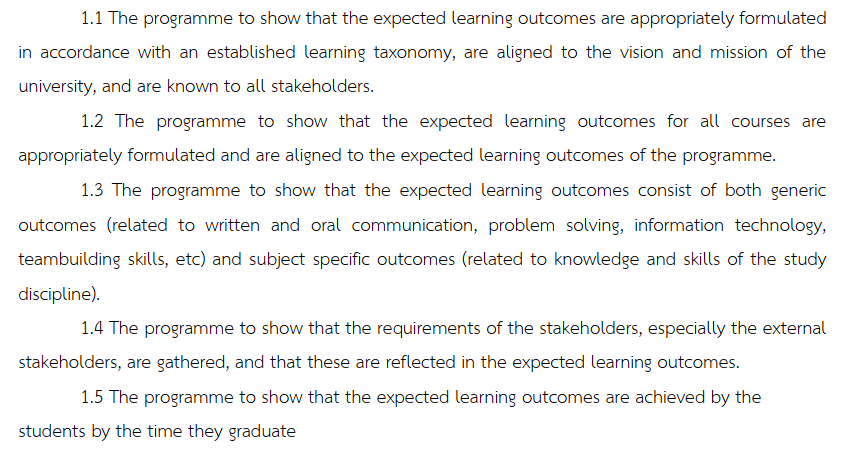
1.1 The programme to show that the expected learning outcomes are appropriately formulated in accordance with an established learning taxonomy, are aligned to the vision and mission of the university, and are known to all stakeholders.
Operational Result
The Program Expected Learning Outcomes (PLOs) are carefully designed based on educational taxonomy and are aligned to the Faculty and University’s vision and mission; communicated to all lecturers and students. These PLOs ensure that the curriculum not only imparts essential knowledge but also develops critical thinking, practical skills, and ethical values among students. Regular meeting sessions are conducted to keep lecturers updated on the PLOs, and students are introduced to these outcomes during orientation and adviser-advisee sessions, ensuring a clear understanding of expectations and goals throughout their academic journey.
Learning Outcomes:
There are (5) five Program Learning Outcome for general Education namely:
1.1.Moral & Ethics
1.2 Knowledge
1.3 Cognitive/Intellectual Skills
1.4 Interpersonal and Responsibility
1.5 Numerical and Information Literacy
There are total of (6) six Program Learning Outcomes for the specialized courses, namely:
1.2.1 Moral & Ethics
1.2.2 Knowledge
1.2.3 Cognitive/Intellectual Skills
1.2.4 Interpersonal and Responsibility
1.2.5 Numerical and Information Literacy
1.2.6 Learning Management Methodology
The above-mentioned Program Learning Outcomes are aligned with the University’s Vision & Mission below.
University Mission & Vision:
Mission : 1) To produce graduates with high performance in academic, professional and English language.
2) Develop research and academic works to be recognized at the national and international level
3) Develop a Center of Excellence in Academic, Professional and English Language
4) Preserve Thai and international arts and cultures to become a multicultural society.
5) Manage the organization towards excellence.
Vision : To be a leading university nationally and internationally recognized.
Communication to all Stakeholders : At the beginning of each semester, the Dean and the Head of the program convenes a meeting with all lecturers to discuss and disseminate the Faculty’s Vision, Mission, and Philosophy, alongside the Program Learning Outcomes (PLOs) and Year-Level Learning Outcomes. This meeting is a chance for instructors to align their course-specific outcomes with the overarching PLOs, ensuring a cohesive and integrated approach to curriculum delivery.
To ensure that these outcomes are known to all stakeholders, including faculty, students, and administrators, various channels are utilized. For faculty, detailed documentation is provided, including course outlines, which explicitly link course objectives to the PLOs. Students are informed through the course syllabi, which clearly outline the learning outcomes expected of them. Additionally, these outcomes are prominently displayed on the program’s website, Learning Management System, Google Classroom and other online platform to ensure that they are easily accessible to interested parties.
1.2 The programme to show that the expected learning outcomes for all courses are appropriately formulated and are aligned to the expected learning outcomes of the programme.
Operational Result
Each course has designated learning outcomes which are meticulously aligned with established Program Learning Outcomes (PLOs). The academic staff then carefully design teaching-learning activities to achieve the Course Learning Outcomes (CLOs). These CLOs are clearly communicated through our TQF 3 (Course Specifications) and TQF 4 documents. Lecturers formulate specific classroom learning outcomes to ensure the required learning outcomes for each course are met. Additionally, Year Learning Outcomes (YLOs) are aligned with Generic Learning Outcomes and integrated into the Learning Management System to ensure consistency and coherence across the curriculum.
Evaluation and Improvement Plan
Each lecturer is required to evaluate and report on whether the established Course Learning Outcomes are achieved at the end of each semester through TQF 5 and TQF 6 . In these reports, lecturers discuss any problems encountered during the course, provide insights into the effectiveness of the teaching-learning activities, and suggest plans for further improvement of the program.
This systematic approach ensures continuous enhancement of both teaching practices and student learning experiences, fostering an environment of ongoing academic excellence.
1.3 The programme to show that the expected learning outcomes consist of both generic outcomes (related to written and oral communication, problem solving, information technology, teambuilding skills, etc) and subject specific outcomes (related to knowledge and skills of the study discipline).
Operational Result
The program ensures that the expected learning outcomes for all courses are appropriately formulated and aligned with the program’s overarching learning goals. Each course is designed with specific learning outcomes (CLOs) that are aligned with the established Program Learning Outcomes (PLOs).
To achieve these CLOs, academic staff carefully designed teaching-learning activities that are intended to fulfill the course objectives. These CLOs are clearly communicated through our TQF 3 (Course Specifications) and TQF 4 documents, ensuring transparency and consistency in the curriculum.
Moreover, lecturers formulate specific classroom learning outcomes to guarantee that the required learning outcomes for each course are effectively met. Additionally, Year Learning Outcomes (YLOs) are aligned with Generic Learning Outcomes (GLOs) and integrated into the Learning Management System (LMS) to maintain consistency and coherence across the curriculum.
Evaluation & Continuous Improvement
To evaluate the achievement of these outcomes, each lecturer is required to assess and report on whether the established Course Learning Outcomes are met at the end of each semester through TQF 5 and TQF 6 documentation. In these reports, lecturers reflect on any challenges encountered during the course, provide insights into the effectiveness of the teaching-learning activities, and suggest plans for further improvement of the program.
1.4 The programme to show that the requirements of the stakeholders, especially the external stakeholders, are gathered, and that these are reflected in the expected learning outcomes.
Operational Result
The requirements of stakeholders, particularly external stakeholders, are systematically gathered and reflected in our expected learning outcomes. This is evidenced by the positive feedback from the employers of our graduates, who consistently report high levels of satisfaction with the skills and knowledge our alumni bring to the workplace. To ensure we meet these requirements, we engage in regular consultations with our alumni and employers through meetings. We also conduct comprehensive surveys and distribute detailed questionnaires to collect input on the relevance and effectiveness of our learning outcomes. The responses help us identify areas for improvement and align our curriculum with industry expectations. Our advisory committees, which include external stakeholders, play a crucial role in this process. .
Feedback from alumni who are now established in their careers provides additional insights into the effectiveness of our program. Their experiences help us fine-tune our learning outcomes to better prepare future graduates. We maintain comprehensive documentation of all stakeholder interactions, feedback received, and subsequent changes made to our curriculum. This includes meeting minutes, survey results, and detailed reports. Through these efforts, we ensure that our program not only meets but exceeds the expectations of our external stakeholders, ultimately contributing to the success and satisfaction of our graduates’ employers
The requirements, comments and suggestions of stakeholders were taken into account and included in the revision of our new curriculum.
1.5 The programme to show that the expected learning outcomes are achieved by the students by the time they graduate.
Operational Result
The expected learning outcomes are achieved by students before they graduate, as indicated by evaluations from school mentors and college supervisors.
School mentors, who work closely with students during practical training and internships, provide detailed assessments on the application of theoretical knowledge, problem-solving abilities, interpersonal skills, and overall professional readiness. Their feedback highlights students’ strengths and areas for improvement, ensuring they meet high industry standards.
University supervisors complement this by monitoring students’ progress through observations, evaluations, one-on-one meetings and our post- internship seminars. They review projects, presentations, and practical work, offering constructive feedback to help students achieve the desired learning outcomes.
The combined insights from mentors and supervisors confirm that our students have successfully achieved the program’s learning outcomes and are well-prepared for their careers. This continuous assessment process allows for necessary curriculum adjustments, ensuring alignment with industry standards and stakeholder expectations, ultimately guaranteeing our graduates are equipped with the necessary teaching skills and competencies.
The combined insights from mentors and supervisors confirm that our students have successfully achieved the program’s learning outcomes and are well-prepared for their careers. This continuous assessment process allows for necessary curriculum adjustments, ensuring alignment with industry standards and stakeholder expectations, ultimately guaranteeing our graduates are equipped with the necessary teaching skills and competencies.
Self-Assessment
| Requirements | Result | Score |
| 1.1 The programme to show that the expected learning outcomes are appropriately formulated in accordance with an established learning taxonomy, are aligned to the vision and mission of the university, and are known to all stakeholders. | / | 1 |
| 1.2 The programme to show that the expected learning outcomes for all courses are appropriately formulated and are aligned to the expected learning outcomes of the programme. | / | 1 |
| 1.3 The programme to show that the expected learning outcomes consist of both generic outcomes and subject specific outcomes. | / | 1 |
| 1.4 The programme to show that the requirements of the stakeholders, especially the external stakeholders, are gathered, and that these are reflected in the expected learning outcomes. | / | 1 |
| 1.5 The programme to show that the expected learning outcomes are achieved by the students by the time they graduate | / | 1 |
| Overall | 5 | |