Criterion 3 – Teaching and Learning Approach
Criterion
Requirements
Quality level assessment

Result
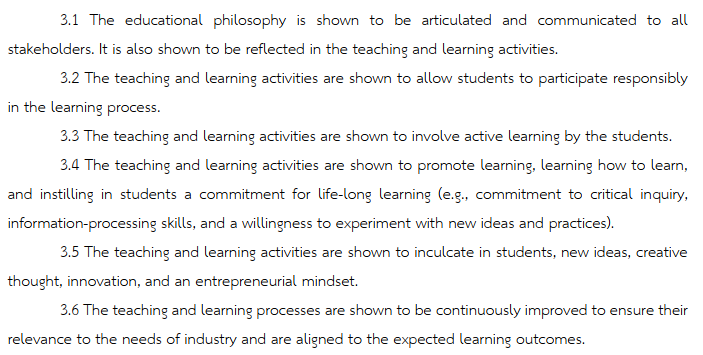
3.1 The educational philosophy is shown to be articulated and communicated to all stakeholders. It is also shown to be reflected in the teaching and learning activities.
Operational Result
The Faculty’s Education Philosophy is articulated and communicated to all stakeholders through multiple channels to ensure a shared understanding and commitment to our mission. Below is the Faculty’s Educational Philosophy, which is disseminated to all stakeholders.
Philosophy: Producing knowledgeable teachers and educational personnel who possess academic and professional skills, as well as strong morality, ethics, and professional ethics. Our aim is to develop teachers and educational personnel who are eager to learn, disciplined, kind, and responsible, contributing to both local development and the country in general.
For the Bachelor of Education in Science (B.Ed.-Science) Program, the philosophy is to produce science teachers with both academic and professional abilities, having high responsibility and continually developing oneself with long-life learning. This is achieved through a comprehensive curriculum that integrates knowledge in innovation, information technology, modern educational materials, and effective classroom management. The program emphasizes practical experience and theoretical knowledge, ensuring that students are well-prepared for the dynamic demands of the teaching profession.
The Faculty’s Educational Philosophy is communicated to stakeholders through various platforms, including official websites, brochures, orientation programs, and stakeholder meetings. Regular newsletters and updates are sent to keep stakeholders informed about the latest developments and how the philosophy is being implemented. Additionally, Professional Learning Community (PLCs) are held where faculty, students, and external partners discuss the philosophy and its application in the educational setting. Stakeholder feedback is actively sought and used to refine and improve the communication strategy.
Integration in Teaching and Learning Activities: The Educational Philosophy is integrated in the teaching and learning activities of the BEd-English Program. Courses are designed to integrate innovative teaching methods, information technology, and Modern trends in English Language Teaching and Assessments. Classroom management skills are developed through practical workshops and real-world teaching practicums. Students engage in activities that promote ethical behavior and professional conduct, such as case studies, role-playing, and discussions on ethical dilemmas.
Moreover, the program includes a variety of extracurricular activities aimed at fostering a commitment to local development through various projects by the program. These include community service projects, internships in local schools, and collaborative projects with educational institutions and local communities. Students are encouraged to participate in professional development seminars and conferences to stay abreast of the latest trends and practices in English language teaching.
Through this holistic approach, the program ensures that graduates are not only proficient in their academic and professional skills but also embody the moral and ethical standards outlined in the Faculty’s Educational Philosophy.
3.2 The teaching and learning activities are shown to allow students to participate responsibly in the learning process.
Operational Result
The program focuses on task and outcome-based learning wherein students are responsible for their own learning. This means that our students are involved in the teaching and learning process every step of the way. Both academic and co-curricular activities involve students, which are aimed at helping them advance academically, socially, nationally, and internationally.
Active Student Participation: Students are encouraged to take an active role in their learning by participating in setting personal learning goals and engaging in self-assessment and peer-assessment activities through our faculty wide project, Student Portfolios. This fosters a sense of ownership and responsibility for their own learning.
Collaborative Projects: Students are involved in collaborative projects that require teamwork, communication, and problem-solving skills. These projects are often designed to address real-world issues, allowing students to apply their theoretical knowledge in practical settings.
Research and Innovation: The program promotes research and innovation by involving students in research projects, encouraging them to explore new ideas and contribute to the advancement of knowledge in their field. Our students’ outputs are showcased in our annual Education Expo.
Practical Training and Internships: Practical training and internships are integral parts of the program. Students gain hands-on experience in real educational settings, working under the guidance of experienced mentors. This not only enhances their practical skills but also builds their confidence and professionalism.
Student-Led Initiatives: Students are given opportunities to lead and organize various activities and events, such as workshops, seminars, and community service projects. These initiatives help students develop leadership and organizational skills while contributing to their communities.
Feedback and Continuous Improvement: Regular feedback sessions are conducted where students can voice their opinions on the curriculum, teaching methods, and overall program effectiveness. This feedback is taken seriously and used to make continuous improvements, ensuring that the program meets the needs and expectations of the students.
Global Citizen: The program includes opportunities for students to participate in exchange programs, international camps and cultural immersion experiences. These activities broaden their perspectives, enhance their cultural awareness, and prepare them to be a global citizen.
Through these measures, students are empowered to take responsibility for their learning, actively engage in the educational process, and develop the skills and knowledge necessary for their personal and professional growth.
3.3 The teaching and learning activities are shown to involve active learning by the students.
Operational Result
The program actively involves students in their learning through student-centered activities, empowering them to play a significant role in teaching and learning processes. Students are not just passive recipients of knowledge; they are expected to actively create new knowledge and inventions. This is facilitated through cognitive processes (thinking processes) and social processes (group processes) that encourage interaction and participation. The teacher serves as a facilitator, ensuring that students’ interests, abilities, and skills are matched to focus on integrating knowledge from various fields, using a variety of teaching methods and knowledge sources, and employing diverse assessment approaches.
Teaching strategies and learning evaluations are designed to further enhance active student involvement. Defined teaching strategies aim to develop learning outcomes and achievements, fostering students’ active participation in the learning process. These strategies enable students to engage objectively, applying their learning in real-world situations through specific methods. Teachers are responsible for defining teaching and learning methods that align with student-centered learning and teaching strategies, along with appropriate evaluation strategies that promote active learning assessment.
The program places a strong emphasis on integrating co-curricular activities into teaching across most courses, maximizing students’ active participation in learning activities.
3.4 The teaching and learning activities are shown to promote learning, learning how to learn, and instilling in students a commitment for life-long learning (e.g., commitment to critical inquiry, information-processing skills, and a willingness to experiment with new ideas and practices).
Operational Result
Our Task-Based Learning & Work-Integrated Learning (WIL) approaches in the B.Ed.-Science program is designed to promote learning, nurture the skill of learning how to learn, and instill in students a profound commitment to life-long learning. This commitment encompasses a dedication to critical inquiry, the refinement of information-processing skills, and a willingness to experiment with new ideas and practices, preparing students for the demands of a dynamic world.
Aligned with the Higher Education missions, the program integrates courses with research, academic service to the community, arts, and culture, enriching the academic experience and fostering a sense of responsibility in students to engage with their learning journey beyond the classroom. Throughout 2023, the program has actively integrated these elements into its curriculum, ensuring that students not only acquire knowledge but also develop the skills and mindset necessary for continuous learning and growth.
Recognizing that learning extends beyond the confines of the classroom, the program’s teaching and learning activities are designed to be immersive and experiential. Students are encouraged to participate in activities that require critical thinking, leadership, and teamwork skills, preparing them for real-world challenges. Additionally, the program places a strong emphasis on student involvement in co-curricular activities, many of which are organized or facilitated by students themselves. These experiences provide valuable opportunities for students to apply their learning in practical contexts, further enhancing our commitment to life-long learning.
3.5 The teaching and learning activities are shown to inculcate in students, new ideas, creative thought, innovation, and an entrepreneurial mindset.
Operational Result
Our outcome-based learning approach is designed to actively cultivate in students the ability to generate new ideas, think creatively, innovate, and embrace an entrepreneurial mindset. The curriculum is structured to promote these qualities through a variety of teaching strategies and activities.
The design and planning of our teaching incorporate key theories, concepts, and principles such as Constructivism, Problem-based learning, Integration-based learning, learning from concrete to abstract, Authentic Learning, Learning from direct experience, and Induction and Deduction. These principles are applied in practice through engaging activities that challenge students to think creatively and develop innovative solutions to real-world problems.
Through projects, group work, and experiential learning opportunities, students are encouraged to explore new ideas, experiment with different approaches, and develop a mindset that is open to innovation and entrepreneurship. By actively engaging in these activities, students not only gain a deeper understanding of the subject matter but also acquire the skills and mindset necessary to thrive in a rapidly changing world.
3.6 The teaching and learning processes are shown to be continuously improved to ensure their relevance to the needs of industry and are aligned to the expected learning outcomes.
Operational Result
The B.Ed. curriculum and its teaching-learning approach are continuously refined to ensure their alignment with industry needs and the achievement of expected learning outcomes. Our teaching and learning practices are enhanced through the integration of Google Classroom and Moodle, enabling us to deliver instruction effectively and maximize student learning.
Evaluation Process
Program administrators and students provide feedback on teaching methods, course materials, and learning experiences. They also evaluate the instructors. This feedback is used to identify areas for improvement and to make adjustments to teaching strategies. Additionally, instructors conduct self-assessments to reflect on their teaching practices and identify opportunities for professional development. The feedback from both students and instructors plays a crucial role in improving the overall quality of teaching and learning practices.
Improvement Plan
As part of our Improvement Plan, we utilize the TQF5 & 6 framework to assess the effectiveness of our teaching and the achievement of learning outcomes. This framework allows us to track student progress, identify areas of strength and weakness, and implement targeted interventions to improve student learning. Through these continuous evaluation and improvement efforts, we ensure that our teaching and learning processes remain responsive to the evolving needs of the students and consistently deliver high-quality education.
Evidence
| ID_Evidence | Name_Evidence |
| 3.1-1 | TQF3 ปรัชญาการศึกษา |
| 3.1-2 | TQF3 Google Classroom |
| 3.1-3 | TQF3 Google Classroom |
| 3.1-4 | กิจกรรมการเรียนการสอนใน Google Classroom |
| 3.1-5 | การเรียนรู้ที่คาดหวัง |
| 3.2-1 | Project Teacher day |
| 3.2-2 | Project Academic Expo |
| 3.3-2 | Project Goodbye Seiner |
| 3.3-3 | Project Newyear Party |
| 3.3-4 | Project Moral & Ethic Camp |
| 3.3-5 | รายงานผลการนิเทศนักศึกษาฝึกงาน |
| 3.4-1 | กิจกรรมปฐมนิเทศในช่วงการเรียนปรับพื้นฐาน Intensive Orientation |
| 3.5-1 | โครงการประชุมสัมมนาทางวิชาการ |
| 3.5-2 | โครงการ Seminar Workshop |
Self-Assessment
| Requirements | Result | Score |
| 3.1 The educational philosophy is shown to be articulated and communicated to all stakeholders. It is also shown to be reflected in the teaching and learning activities. | / | 1 |
| 3.2 The teaching and learning activities are shown to allow students to participate responsibly in the learning process. | / | 1 |
| 3.3 The teaching and learning activities are shown to involve active learning by the students. | / | |
| 3.4 The teaching and learning activities are shown to promote learning, learning how to learn, and instilling in students a commitment for life-long learning. | / | 1 |
| 3.5 The teaching and learning activities are shown to inculcate in students, new ideas, creative thought, innovation, and an entrepreneurial mindset. | / | 1 |
| 3.6 The teaching and learning processes are shown to be continuously improved to ensure their relevance to the needs of industry and are aligned to the expected learning outcomes. | / | 1 |
| Overall | 5 | |