Criterion 4 – Student Assessment
Criterion
Requirements
Quality level assessment

Result
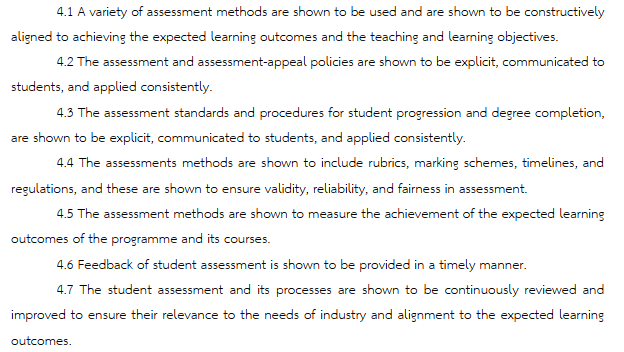
4.1 A variety of assessment methods are shown to be used and are shown to be constructively aligned to achieving the expected learning outcomes and the teaching and learning objectives.
Operational Result
Variety of Assessment Methods: The curriculum incorporates a diverse range of assessment methods to evaluate students’ learning comprehensively, including:
Written Exams: Midterm and final exams to assess students’ understanding of theoretical concepts.
Class Discussions: Regular class discussions to gauge students’ participation, critical thinking, and understanding of the subject matter.
Projects and Presentations: Group and individual projects, along with presentations, to evaluate practical application, creativity, and communication skills.
Quizzes and Tests: Frequent quizzes and tests to continuously monitor progress and understanding.
Practical Assessments: Hands-on tasks, lab work, and simulations to assess practical skills and problem-solving abilities.
Peer Assessments: Peer reviews and group evaluations to foster collaborative learning and self-assessment skills.
Portfolios: Compilation of student work over time to track progress and depth of learning.
Internship Evaluations: Feedback from internship supervisors to assess real-world application of skills and professional behavior.
Learning Assessment Plan: The curriculum or program sets up a learning assessment plan according to the Thailand Qualification Framework (TQF).
Assessment Criteria: The curriculum or program informs the learning assessment criteria to all students in the program.
Monitoring and Evaluation: The curriculum or program follows up and monitors teaching, learning, and assessment according to the plan and assessment specified in TQF 3 and TQF 4.
Review of Student Achievement: The curriculum or program provides a review of the students’ achievements.
Instructor Reporting: Instructors prepare TQF 5 and TQF 6 and submit them to the curriculum or program after the completion of teaching.
By implementing these comprehensive assessment methods, we ensure that our students not only meet but exceed the learning outcomes, preparing them to be effective learners, active citizens, and innovative co-creators.
4.2 The assessment and assessment-appeal policies are shown to be explicit, communicated to students, and applied consistently.
Operational Result
transparency and understanding of the expectations. Students are provided with detailed information about how their performance will be evaluated, including the weight of various assessments such as exams, projects, participation, and other assignments.
Student Rights and Appeals Process
- Right to Appeal: Students have the right to appeal or petition for their grades if they believe there has been an error or unfair assessment.
- Grade Re-Check Procedure: Students who wish to request a re-check of their grades must complete an official appeal form, available at the Examination Office. This process ensures that any concerns are formally documented and addressed systematically.
- Petition Fee: A petition fee is required to process the appeal, which covers administrative costs associated with the re-evaluation.
- Appeal Deadline: The deadline for submitting an appeal is the first day of the week of the following semester. This timeframe allows sufficient opportunity for students to review their grades and prepare their appeal if necessary.
Detailed Appeal Process
- Initial Communication: On the first day of class, instructors provide students with a syllabus that outlines the assessment criteria, grading policies, and important deadlines.
- Appeal Form Submission: Students must obtain and complete the official appeal form from the Examination Office, clearly stating the reasons for their appeal and the specific assessments in question.
- Supporting Documentation: Students are encouraged to include any relevant documentation or evidence that supports their appeal, such as graded assignments, exam papers, or feedback from instructors.
- Review Process: Once the appeal form and petition fee are submitted, the Examination Office will review the request and forward it to the appropriate faculty members for re-evaluation.
- Outcome Notification: Students will be notified of the outcome of their appeal within a specified period, typically within two weeks of submission. If the appeal is successful, the grade will be adjusted accordingly.
By clearly communicating the assessment criteria and providing a structured appeal process, we ensure that students have a fair opportunity to address any concerns regarding their grades and maintain trust in our academic evaluation system.
4.3 The assessment standards and procedures for student progression and degree completion, are shown to be explicit, communicated to students, and applied consistently.
Operational Result
Year 1:
Knowledge and Understanding: Students are expected to gain foundational knowledge about moral principles and ethics in life.
Skills Development: Basic knowledge and skills related to their field of study.
Personal Development: A strong sense of responsibility and an understanding of ethical behavior in personal and professional contexts.
Year 2:
Academic Proficiency: Students are expected to have acquired at least 40% of the knowledge and skills in their Science major.
Educational Foundations: An understanding of educational philosophy and key concepts in educational management.
Professional Growth: Enhanced skills in communication, critical thinking, and a deeper engagement with their chosen discipline.
Year 3:
Advanced Knowledge: Students are expected to have at least 80% of the required knowledge and skills in teaching Science.
Analytical and Problem-Solving Skills: The ability to think critically, analyze situations, and solve problems effectively.
Teamwork and Collaboration: Development of teamwork skills and the ability to face challenges collaboratively in a work environment.
Year 4:
Professional Competency: Mastery of the necessary skills in Science Teaching, preparing students for their teaching careers.
Leadership and Analytical Skills: Strong leadership abilities and analytical thinking skills relevant to the teaching profession.
Preparation for Employment: Equipped with the skills and knowledge to enter the workforce confidently, take on leadership roles, and contribute positively to their professional communities.
Assessment Procedures
- Continuous Evaluation: Throughout each academic year, students’ progress is continuously monitored through a combination of written exams, projects, presentations, practical assessments, and class participation.
- Midterm and Final Exams: Structured assessments at the midterm and end of each semester to evaluate students’ understanding and mastery of course material.
- Projects and Practical Work: Hands-on projects and practical tasks to assess students’ ability to apply theoretical knowledge to real-world scenarios.
- Portfolios: Encouraging students to track their progress over time through journals and portfolios.
- Internship and Fieldwork Assessments: Evaluations conducted during internships and fieldwork placements to assess students’ practical skills and professional behavior in real-world settings.
- Feedback and Improvement: Regular feedback sessions with instructors to discuss performance, identify areas for improvement, and set goals for further development.
By carefully aligning assessment standards and procedures with the Year Learning Outcomes, we ensure that students build the necessary knowledge, skills, and competencies progressively throughout their academic journey, culminating in their readiness for graduation and professional success.
4.4 The assessments methods are shown to include rubrics, marking schemes, timelines, and regulations, and these are shown to ensure validity, reliability, and fairness in assessment.
Operational Result
assessment procedures. Lecturers are required to submit exam papers with detailed scoring rubrics, marking schemes, and Tables of Specification. The following assessment guidelines and procedures are implemented to ensure fairness, validity, and reliability:
- The program follows up and monitors teaching, learning, and assessment according to the plans and specifications outlined in TQF 3 and TQF 4.
- The program sets schedules and guidelines for preparing midterm and final exam papers.
- Instructors prepare and submit exam papers, including Rubrics and Tables of Specification, according to the guidelines and criteria set by the program.
- The Program Academic Committee reviews and approves midterm exam papers to ensure their validity and reliability.
Evaluation and Improvement Plan
- The program reviews student achievement to ensure the effectiveness of teaching and learning.
- Instructors prepare TQF 5 and TQF 6 reports and submit them to the program after the completion of teaching to report student achievements.
- The program validates and corrects TQF 5 and TQF 6 reports within 30 days.
- The program submits academic results to the academic department for the announcement of grades.
- The program organizes meetings to assess teaching and learning management at the end of each semester.
- The program prepares TQF 7 within 60 days after the end of the academic year.
- The program assesses the quality of the curriculum and uses the evaluation results to improve quality in the next academic year.
These assessment methods, including rubrics, marking schemes, timelines, and regulations, are designed to ensure the validity, reliability, and fairness of the assessment process.
4.5 The assessment methods are shown to measure the achievement of the expected learning outcomes of the programme and its courses.
Operational Result
The assessment methods are meticulously designed to achieve the desired learning outcomes for students. Lecturers are encouraged to use diverse and varied assessment methods to ensure that the expected learning outcomes are achieved by the students at the end of the course. These methods are crafted to measure the achievement of the program’s and its courses’ expected learning outcomes, ensuring validity, reliability, and fairness in assessment.
Assessment Guidelines and Procedures
- Monitoring and Evaluation: The program follows up and monitors teaching, learning, and assessment according to the plans and specifications outlined in TQF 3 and TQF 4. This continuous monitoring ensures alignment with the program’s learning objectives.
- Scheduling and Guidelines: The program sets clear schedules and guidelines for preparing midterm and final exam papers. This includes ensuring that all assessments are aligned with the intended learning outcomes.
- Comprehensive Preparation: Instructors prepare and submit exam papers, including detailed scoring rubrics, marking schemes, and Tables of Specification, according to the guidelines and criteria set by the program. These tools help measure student performance accurately against the expected learning outcomes.
- Review and Approval: The Program Academic Committee reviews and approves midterm and final exam papers to ensure their validity and reliability. This review process guarantees that assessments are fair and measure the intended learning outcomes.
Evaluation and Improvement Plan
- Review of Student Achievement: The program provides a systematic review of student achievements to ensure the effectiveness of teaching and learning in meeting the learning outcomes.
- Reporting: Instructors prepare TQF 5 and TQF 6 reports, which detail student achievements and submit them to the program upon the completion of teaching. These reports are critical in assessing whether learning outcomes have been met.
- Validation and Correction: The program validates and corrects TQF 5 and TQF 6 reports within 30 days to ensure accuracy and reliability in reporting student achievements.
- Grade Announcement: The program submits academic results to the academic department for the announcement of grades, ensuring transparency and accountability in the assessment process.
- Semester Assessments: The program organizes meetings to assess teaching and learning management at the end of each semester. These assessments provide feedback on the effectiveness of the curriculum and teaching methods in achieving learning outcomes.
- Annual Review: The program prepares TQF 7 within 60 days after the end of the academic year, which includes a comprehensive evaluation of the curriculum and program quality.
- Continuous Improvement: The program assesses the quality of the curriculum and uses the evaluation results to make improvements for the next academic year. This continuous improvement cycle ensures that the curriculum remains effective in achieving the desired learning outcomes.
Employment of a variety of assessment methods, including rubrics, marking schemes, timelines, and regulations, the program ensures that all assessments are valid, reliable, and fair. These methods are integral in measuring the achievement of the program’s and courses’ expected learning outcomes.
4.6 Feedback of student assessment is shown to be provided in a timely manner.
Operational Result
performance in each course. The program committee reviews these evaluations and meets with instructors who receive assessment results lower than 3.51 to develop a personalized improvement plan. This process ensures that instructors are supported in enhancing their teaching quality.
At the end of the academic year, the program chair prepares TQF 7, which includes a summary of the teaching assessment results, the improvement plans, and any outcomes achieved. This report is submitted to the faculty for further review and discussion.
Regarding the assessment of learning outcomes, TQF 3 and TQF 5 are reviewed to ensure that course objectives align with the learning outcomes specified in TQF 2. Examination papers and student learning results are analyzed to assess the effectiveness of teaching methods in achieving these outcomes. Student feedback on their learning experiences is also considered, and the process of student evaluation is regularly reviewed to maintain its effectiveness.
In addition to student evaluations, feedback from the community and other stakeholders is sought to provide a broader perspective on student performance. For instance, the community evaluates students’ involvement in community services, which is an integral part of their learning experience. Furthermore, a peer assessment system involving other program instructors is implemented to provide comprehensive feedback on student performance.
To improve the timeliness of student feedback, the program can implement the following measures:
- Regular Feedback Sessions: During adviser sessions, advisors provide feedback to students on their performance.
- Feedback Mechanisms & Channels: Digital platforms like our Learning Management System and Google Classroom enable us to provide immediate feedback on assignments and assessments.
- Feedback Policies: The university has established clear policies regarding the timeline for providing feedback. Ensure that instructors adhere to these policies and provide feedback within a reasonable timeframe.
Implementing these measures can help improve the timeliness of student feedback, enhancing the overall learning experience for students in the program.
4.7 The student assessment and its processes are shown to be continuously reviewed and improved to ensure their relevance to the needs of industry and alignment to the expected learning outcomes.
Operational Result
To ensure the quality and relevance of student assessments, our institution employs a comprehensive and continuous review process overseen by two internal committees, in addition to external oversight.
These committees work tirelessly to ensure that student assessments align with the expected learning outcomes of each course and remain relevant to the needs of the industry.
At the Faculty Level, all exams are submitted to the head of the program. The designated faculty committee reviews all papers to ensure they meet the expected standards and that exam papers align with the expected learning outcomes for the course. This review process includes feedback from industry professionals to ensure that assessments reflect current industry needs and standards. Any necessary revisions to assessments are made based on this feedback to improve alignment with the professional requirements.
At the Institution Level, all exam papers reviewed at the faculty level are forwarded to the Office of the Vice President for Academic Affairs. The papers undergo a rigorous review process that includes input from industry experts. This ensures that assessments not only meet the Course Learning Outcomes (CLOs) but also remain relevant to the evolving professional requirements. Feedback from this review is used to continuously improve assessment processes and ensure alignment with both academic standards and professional requirements.
Overall, the continuous review and improvement of assessment processes are paramount to our commitment to academic excellence and student success. By incorporating feedback from both faculty students, school mentors , we ensure that our assessments prepare students for the challenges and opportunities of the modern classroom.
Evidence
Self-Assessment
| Requirements | Result | Score |
| 4.1 A variety of assessment methods are shown to be used and are shown to be constructively aligned to achieving the expected learning outcomes and the teaching and learning objectives. | / | 1 |
| 4.2 The assessment and assessment-appeal policies are shown to be explicit, communicated to students, and applied consistently. | / | 1 |
| 4.3 The assessment standards and procedures for student progression and degree completion, are shown to be explicit, communicated to students, and applied consistently. | / | 1 |
| 4.7 The student assessment and its processes are shown to be continuously reviewed and improved to ensure their relevance to the needs of industry and alignment to the expected learning outcomes. | ||
| 4.4 The assessments methods are shown to include rubrics, marking schemes, timelines, and regulations, and these are shown to ensure validity, reliability, and fairness in assessment. | / | 1 |
| 4.5 The assessment methods are shown to measure the achievement of the expected learning outcomes of the programme and its courses. | / | |
| 4.6 Feedback of student assessment is shown to be provided in a timely manner. | / | 1 |
| Overall | 5 | |