Criterion 6 – Student Support Services
Criterion
Requirements
Quality level assessment

Result
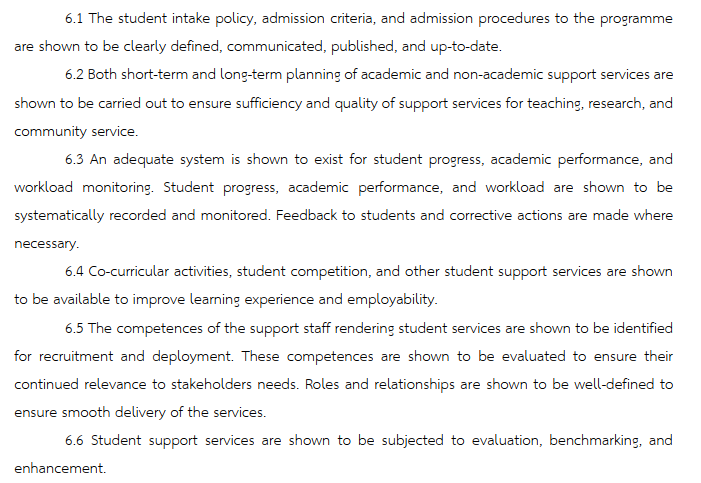
6.1 The student intake policy, admission criteria, and admission procedures to the programme are shown to be clearly defined, communicated, published, and up-to-date.
Operational Result
. Our student intake policy, admission criteria, and admission procedures are clearly defined, communicated, published, and regularly updated to reflect current standards and requirements. The process is designed to ensure that all applicants are assessed fairly and comprehensively. We require all student applicants to have a GPA of at least 2.5 on a scale of 4.0 from their high schools. The admissions office reviews the list of all applicants, who must also pass an interview test before being accepted into the program.
The following outlines the detailed process:
- Student Admission Plan: The program determines the student admission plan according to the TQF.
- Qualification Determination: The program establishes the qualifications of students and notifies the faculty/college.
- Selection Criteria: The program specifies the criteria used for student selection, which includes academic criteria, English language requirements (if any), and other areas, and notifies the faculty/college.
- Application Announcement: In cooperation with the faculty and the university the curriculum or program proceeds with the announcement of student applications.
- Qualification Examination: The program examines students’ qualifications.
- Student Selection: The curriculum or program selects students based on the established criteria.
- Announcement of Selected Students: The curriculum or program announces the list of selected students.
- Evaluation and Improvement: The curriculum or program evaluates the student admissions procedures, analyzes problems, and implements improvements to ensure the number of students aligns with the TQF 2.
- Registration: Students report and register to become university students.
- Readiness Preparation Programs: The curriculum or program sets up meetings to determine students’ readiness preparation programs before the commencement of academic or major study areas and Intensive English courses.
- Notification of Readiness Programs: The curriculum or program informs students to attend readiness preparation programs.
- Attendance of Readiness Programs: Students attend the readiness preparation courses.
- Assessment of Readiness Programs: The curriculum or program assesses the readiness preparation programs and students’ achievements.
- Continuous Improvement and International Expansion: The curriculum or program analyzes the readiness preparation programs and students’ achievements, setting up improvements for the next academic year to achieve the goals. Additionally, we are committed to expanding our reach to the international market, actively recruiting and welcoming international students into our program. This effort supports our vision of becoming the top destination for Teacher Education Program.
This program process ensures transparency, fairness, and the continuous improvement of the student admission system.
6.2 Both short-term and long-term planning of academic and non-academic support services are shown to be carried out to ensure sufficiency and quality of support services for teaching, research, and community service.
Operational Result
From admission to graduation, the Program promotes an environment where students not only excel academically but also thrive personally and professionally. This commitment is reflected in the comprehensive planning and execution of a framework of academic and non-academic support services. With a steadfast focus on sufficiency and quality, these services are designed to holistically support students in every facet of their educational journey, from facilitating their academic pursuits to empowering them to engage meaningfully contribute positively to community service initiatives
- Personalized Counselling: Upon enrollment, students are welcomed into a supportive environment where they are assigned a dedicated counselor, ensuring personalized guidance and assistance throughout their academic journey. These counselors serve as a crucial resource, offering support tailored to each student’s individual needs, whether academic, personal, or career-related.
- Academic Support Services. In addition to personalized counseling, students have access to a comprehensive range of academic support services designed to enhance their learning experience. This includes tutoring programs, writing centers, and academic workshops aimed at improving study skills, time management, and academic performance. State-of-the-art facilities are also provided to students, enabling them to gain hands-on experience and expertise in the practical aspects of their program.
- Collaboration with the University’s Student Affairs Office: The Faculty collaborates closely with the Office of Student Affairs to develop and implement strategic plans for student support and services. This includes a wide range of extracurricular activities outside the classroom, carefully curated to promote student growth and development. These activities encompass opportunities for leadership development, intercultural exchange, community engagement, and personal enrichment. By participating in these activities, students not only broaden their horizons but also develop essential skills and competencies.
The program’s commitment to both short-term and long-term planning ensures that students receive the support they need to succeed academically, personally, and professionally. Through a combination of personalized counseling, comprehensive academic support services, and enriching extracurricular activities, students are equipped with the tools and experiences necessary to thrive in their educational journey and beyond
6.3 An adequate system is shown to exist for student progress, academic performance, and workload monitoring. Student progress, academic performance, and workload are shown to be systematically recorded and monitored. Feedback to students and corrective actions are made where necessary.
Operational Result
The program has implemented a comprehensive system for monitoring student progress, academic performance, and workload, ensuring that these aspects are systematically recorded and tracked. Each student is assigned a dedicated academic advisor who diligently monitors their progress. Weekly meetings are scheduled in a designated room, providing students with consistent support and guidance throughout their academic journey.
Academic Advisor: The role of the academic advisor transcends mere course and program scheduling, encompassing a wide range of responsibilities aimed at supporting students holistically. This includes assisting students with goal setting, personal growth, and career development, as well as providing guidance on educational program selection and clarification of academic policies. Moreover, advisors are readily available to address academic issues and personal concerns, offering individualized support tailored to each student’s needs.
Student’s Progress Report: To facilitate effective monitoring and documentation, the Advisor manual contains detailed records, including the Individual Student Problem Record, Student Academic Performance Record, and Advisor Report Summary. These records enable advisors to track students’ progress and intervene when necessary to provide feedback and corrective actions.
Student Portfolios: Students have personalized portfolios students maintained with their advisors to track their progress, serving as dynamic records of academic achievement and personal growth throughout their university journey. These portfolios facilitate constructive discussions during weekly meetings, empowering students to actively engage in their development and make informed decisions aligned with their goals.
The Program Advising System further enhances the student-advisor relationship by offering personalized attention from faculty advisors with diverse educational backgrounds and experiences. Through one-on-one counseling sessions, advisors help students identify their individual goals and intentions while providing essential information about academic programs and study modes. The system encourages open communication channels, enabling students to engage in meaningful academic discussions with their advisors. Beyond academic support, advisors assist students in developing essential academic skills, navigating course scheduling, and exploring opportunities for personalizing their university experience, including moral and personality development. Through this comprehensive system, students are empowered to succeed academically and personally, with dedicated support
6.4 Co-curricular activities, student competition, and other student support services are shown to be available to improve learning experience and employability.
Operational Result
e BEd Program is committed to providing a comprehensive educational experience that extends beyond the classroom. In line with this commitment, we offer a diverse range of co-curricular activities and student support services aimed at enhancing the overall learning experience and bolstering employability. These activities are designed to foster holistic development, equipping students with the essential skills and competencies required to thrive in the 21st century. Through these initiatives, students are not only academically enriched but also empowered to become well-rounded individuals ready to make meaningful contributions to society.
Student Competitions: BEd -English students showcase their skills, knowledge, and talents in various fields such as academics, sports, arts, and entrepreneurship. These competitions encourage healthy competition, creativity, and innovation among students, fostering their personal and academic growth. Students in the program participated and won in several competition, including international competitions, where collaborated and competed with students from diverse cultural backgrounds.
- TRSU Summer English Festival Contest
- World Peace Ethics Contest
- Thailand Global Leaders Conference 2023
Co-Curricular & Extra Curricular Activities: The program has initiated several co-curricular activities that complement the academic curriculum which provide students with opportunities for personal development, social interaction, and skill enhancement outside of the classroom.
- International Youth Ambassador Camp 2023
- Academic Expo 2023
- Drama Presentation
- Education Night: Senior’s Night & Alumni Homecoming
- Freshmen – Seniors Team Building Activities
- Christmas & New Year’s Celebrations
- Teacher’s Day Celebration
- Educational & Cultural Trip
- Freshmen Night
- International Day
- CP’s Leadership Development Program
Student Support Services: We wide range of resources and programs designed to assist students in achieving their academic, personal, and career goals. These services include counseling, tutoring, mentoring, career guidance and more. The goal is to provide students with the necessary support and resources to thrive academically and personally during their educational journey.
- Language Proficiency Enhancement
- TOEIC Mini Test (35 Marks, 3x/semester)
- TOEIC Practice Test (200 marks, 1x/semester)
- Real TOEIC Test (Conducted by TOEIC Testing Centre)
- Dorm Nights
- Weekly Sports Challenge
- Counselling Services
Concrete Results: International Awards & Recognitions
Through our commitment to excellence in student activities and support services, we’ve garnered prestigious international awards and recognitions, underscoring the effectiveness of our system.
- Our students have garnered a very high TOEIC score and topped the government competitive examinations, showcasing their academic prowess.
- Three students ranked in the Top 20 of the World Ethics Contest, competing against 100 participants from local and overseas universities.
- Our students showcased their leadership abilities by securing a spot in the Top 10 of the Global Leadership Conference, a testament to their capabilities on a global stage. This conference was participated by around 500 students from local & overseas universities
These accomplishments affirm our dedication to nurturing well-rounded individuals who thrive both academically and in extracurricular pursuits.
6.5 The competences of the support staff rendering student services are shown to be identified for recruitment and deployment. These competences are shown to be evaluated to ensure their continued relevance to stakeholders needs. Roles and relationships are shown to be well-defined to ensure smooth delivery of the services.
Operational Result
Just like our academic staff, the competences of the support staff rendering student services are identified for recruitment and deployment. These competences are evaluated to ensure their continued relevance to stakeholders needs. Their Roles and relationships are well-defined to ensure smooth delivery of the services. This approach is designed to maintain the highest standards in the delivery of our student support services. These rigorous supervision, monitoring, and evaluation practices, alongside a structured and transparent recruitment and appointment process, ensure that our support staff rendering service arere well-equipped to ensure their continued relevance to stakeholders needs. This thorough process not only verifies the qualifications and expertise of our supporting staff but also facilitates continuous professional development and improvement.
Supervision, Monitoring, and Evaluation
The curriculum instructor supervises, monitors, and evaluates the performance of the supporting staff throughout the semester. This includes regular observations, feedback from students , and performance assessments to ensure supporting staff to ensure continued relevance to stakeholders needs. At the end of each semester, the program instructor summarizes the evaluation results and submit them to the Dean of the Faculty.
Recruitment and Appointment Process
- Meeting to Determine Supporting Numbers: The program organizes a meeting to assess and determine the number of supporting required in accordance with curriculum standards criteria.
- Specification of Supporting Staff Qualifications: The program specifies the qualifications required for supporting staff rendering services. These qualifications are aligned with the curriculum standards criteria to ensure that all supporting staff possess the necessary expertise and credentials.
- Review and Approval: New selected supporting staff are submitted to the Human Resource Office for checking and reviewing.
- Evaluation of Recruitment and Appointment Processes: The program evaluates the procedures and processes for recruiting and appointing supporting staff rendering services. This evaluation includes assessing the effectiveness and efficiency of the recruitment process and making recommendations for improvement to ensure the highest standards are maintained.
This comprehensive approach ensures that all supporting staff are highly qualified and capable of rendering excellent service. This structured approach not only supports our current educational goals but also promotes continuous improvement and excellence in all areas of supporting staff performance.
6.6 Student support services are shown to be subjected to evaluation, benchmarking, and enhancement.
Operational Result
a fruitful and meaningful campus life. Our commitment to excellence is demonstrated through regular evaluations, benchmarking against best practices, and continuous enhancements of our support services. By leveraging modern teaching media and comprehensive learning resources, we strive to create an environment that fosters academic success and personal growth. The program’s learning support system is meticulously designed to cater to the diverse needs of students ensuring that they receive the highest quality of education and support throughout their academic journey.
Benchmarking
To ensure our support services remain at the forefront of educational excellence, the program actively engages in benchmarking against leading institutions and educational standards. This process involves comparing our support services, resources, and practices with those of top-tier universities and education programs worldwide. By identifying areas where we excel and those needing improvement, we can adopt and implement best practices that enhance our support services. This benchmarking process not only helps maintain high standards but also drives innovation and continuous improvement, ensuring our students benefit from the most effective and up-to-date support mechanisms available.
Evaluation and Improvement
Our evaluation and improvement process are designed to ensure that our student support services continually meet the highest standards of educational excellence. This process involves several key steps:
- Regular Assessments: We conduct regular assessments of our support services through surveys, feedback forms, and focus group discussions with students and staff. These assessments help us identify strengths and areas for improvement.
- Data Analysis: Collected data is meticulously analyzed to understand trends and pinpoint specific issues. This analysis includes both quantitative and qualitative data, providing a comprehensive overview of our support services’ effectiveness.
- Action Plans: Based on the insights gained from assessments and benchmarking, we develop targeted action plans. These plans include specific goals, timelines, and responsible parties to ensure effective implementation.
- Implementation and Monitoring: Action plans are implemented with a focus on achieving measurable improvements. Progress is monitored continuously, with regular check-ins to ensure that objectives are being met.
- Feedback Loop: We maintain an open feedback loop with students, encouraging them to share their experiences and suggestions. This ongoing dialogue helps us stay responsive to their needs and make timely adjustments.
- Review and Adjustment: Periodic reviews of the implemented changes are conducted to evaluate their impact. Adjustments are made as necessary to ensure that our support services continue to evolve and improve.
With this process, we ensure that our student support services remain responsive, effective, and aligned with the needs and expectations of our students and other stakeholders.
Evidence
Self-Assessment
| Requirements | Result | Score |
| 6.1 The student intake policy, admission criteria, and admission procedures to the programme are shown to be clearly defined, communicated, published, and up-to-date. | / | 1 |
| 6.2 Both short-term and long-term planning of academic and non-academic support services are shown to be carried out to ensure sufficiency and quality of support services for teaching, research, and community service. | / | 1 |
| 6.4 Co-curricular activities, student competition, and other student support services are shown to be available to improve learning experience and employability. | / | |
| 6.3 An adequate system is shown to exist for student progress, academic performance, and workload monitoring. Student progress, academic performance, and workload are shown to be systematically recorded and monitored. Feedback to students and corrective actions are made where necessary. | / | 1 |
| 6.5 The competences of the support staff rendering student services are shown to be identified for recruitment and deployment. These competences are shown to be evaluated to ensure their continued relevance to stakeholders needs. Roles and relationships are shown to be well-defined to ensure smooth delivery of the services. | / | 1 |
| 6.6 Student support services are shown to be subjected to evaluation, benchmarking, and enhancement. | / | 1 |
| Overall | 5 | |