Criterion 1 – Expected Learning Outcomes
Criterion
Requirements
Quality level assessment

Result
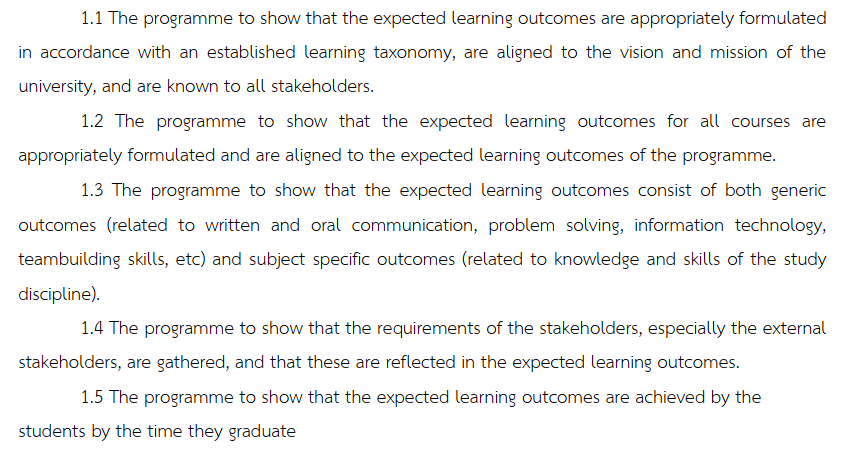
1.1 The programme to show that the expected learning outcomes are appropriately formulated in accordance with an established learning taxonomy, are aligned to the vision and mission of the university, and are known to all stakeholders.
Operational Result
The expected learning outcomes of the Graduate Diploma in Teaching Profession (Revised Program 2023(2566)) are aligned to St Teresa International University’s vision and mission
The vision of St Teresa International University:
“Aims to become a leading and outstanding university that would be acknowledged and accepted nationally and internationally”
The mission of St Teresa International University:
- Produce graduates with high academic achievement and English language proficiency
- Develop research and academic works that are acknowledged and recognized nationally and internationally.
- Develop a Center of Excellence for Academics, Professional Development, and English Language Competency.
- Preserve Thai and International arts and culture to form a coexisting multi-cultural society.
- Employ an administrative system that achieves excellence in organizational management.
- Educate young resources to generate high-quality manpower to integrate the local and global environment in several fields of science, technology, management, and teaching.
- Develop skill, knowledge, research, and English capabilities in teaching and other respective fields at par with global standards to meet relevant industrial and social needs.
The Graduate Diploma in Teaching Profession (English Program) is updated every five years
and approved by The Permanent Secretary Office, the Ministry of Higher Education, Science, Research and Innovation (MHESI), and The Teacher Council Of Thailand. The latest version is the Graduate Diploma in Teaching Profession (Revised 2023(2566)), which was developed following the concept of Outcomes-based Education (OBE) and is offered for cohorts of 2023 and 2024. (1.1-1 TQF 2) The Graduate Diploma in Teaching Profession (Revised 2023(2566)) was based on the Thai Qualifications Framework for Higher Education (TQF) 2022.
There were PLOs derived from the needs of the stakeholders and distributed into the courses as CLOs by curriculum mapping. (1.1-2 PLOs and CLOs). The development process of the Graduate Diploma in Teaching Profession (Revised 2023(2566)) started from the collection of all stakeholders’ needs and analysis to form the program learning outcomes (PLOs) and align with the vision and mission of St Teresa International University and the Faculty of Education. The four PLOs are Knowledge, Skills, Ethics, and Character which are aligned with Learning Taxonomy. PLO1 (Knowledge) is divided into 4 sub PLOs. PLO2 (Skills) are divided into 6 sub PLOs. PLO3 (Ethics) is divided into 2 sub PLOs. PLO4 (Character) is divided into 5 sub PLOs. The objectives and expected learning outcomes or program learning outcomes, the study activities, the teacher’s license application, and other curriculum information are introduced to all new students in the orientation session prior to the start of the semester. The ELOs or PLOs and CLOs are also communicated to all lecturers at the monthly faculty meeting and they understand when they design their course syllabus and TQF 3. The ELOs or PLOs and CLOs are sent to the Permanent Secretary Office, the Ministry of Higher Education, Science, Research and Innovation (MHESI), and The Teacher Council Of Thailand for curriculum approval. The program must admit new students after approval from the office mentioned above.
The Expected Learning Outcomes (ELOs) or Program Learning Outcomes (PLOs) of the Graduate Diploma in Teaching Profession (Revised 2023(2566)) program are shown in the table below:
|
Program Learning Outcomes [PLO] |
||
|
PLO1 |
Knowledge |
|
|
|
K1 |
Knowledge and understanding of the teaching profession |
|
K2 |
Knowledge of utilizing English for communication and digital technology for education |
|
|
K3 |
Application of knowledge in developing the teaching profession and living |
|
|
K4 |
Able to analyze, evaluate, and create new alternatives in the teaching profession development and living development |
|
|
PLO2 |
Skills |
|
|
|
S1 |
Self-knowledge-seeking |
|
S2 |
Communication |
|
|
S3 |
Teamworking and collaboration |
|
|
S4 |
Digital technology for living |
|
|
S5 |
Learning management and support, problem-solving, and learner’s development |
|
|
S6 |
Research and innovation development to support learning activities |
|
|
PLO3 |
Ethics |
|
|
|
E1 |
Awareness and compliance with laws and good cultural values |
|
E2 |
Recognize and act in accordance with the professional ethics of teachers. |
|
|
PLO4 |
Character |
|
|
|
C1 |
Good personality and role model |
|
C2 |
Critical, logical, systematical, and creative thinkings |
|
|
C3 |
Academic leader, lifelong learner, work-oriented, and self responsibility |
|
|
C4 |
Be friendly, kind, generous, respectful of children’s rights, and accept the differences between individuals |
|
|
C5 |
Self-confident, dare to express |
|
|
Vision/Mission |
Knowledge PLO 1 |
Skills PLO 2 |
Ethics PLO 3 |
Character PLO 4 |
|||||||||||||
|
K1 |
K2 |
K3 |
K4 |
S1 |
S2 |
S3 |
S4 |
S5 |
S6 |
E1 |
E2 |
C1 |
C2 |
C3 |
C4 |
C5 |
|
|
Vision Aims to become a leading and outstanding university that would be acknowledged and accepted nationally and internationally |
x |
x |
x |
x |
x |
x |
x |
x |
x |
x |
x |
x |
x |
x |
x |
x |
x |
|
Mission |
|||||||||||||||||
|
1. Produce graduates with high academic achievement and English language proficiency |
x | x | x | ||||||||||||||
|
2. Develop research and academic activities that would be acknowledged and recognized around the globe |
x | x | |||||||||||||||
|
3. Make a Center of Excellence for Academics, Professional Development and English Language Competency |
x | x | x | ||||||||||||||
|
4. Preserve Thai and International arts and culture to form a co-existing multi-cultural society |
x | x | x | ||||||||||||||
|
5. Employ an administrative system that achieves excellence in organizational management |
x | x | x | ||||||||||||||
|
6. Educate young resources to generate high quality manpower in order to integrate the local and global environment in several fields of science, technology, management and teaching |
x | x | x | x | x | ||||||||||||
|
7. Develop skill, knowledge, research and English capabilities in teaching and other respective fields at par with global standards to meet relevant industrial and social needs. |
x | x | x | x | x | x | |||||||||||
| Stakeholders | Communication Channels | ||
| Meeting | Document | Social media | |
| STIC’s Academic staff Academic Committee All academic staffs | Monthly Annually Course Orientation | Manual Meeting | STIC’s Website/ Facebook |
| Instructor of faculties: Faculty of Education Private and Government Schools | Annually | Manual Meeting | STIC’s Website/ Facebook |
| Current students | Biannually Course Orientation | manual | STIC’s Website/ Facebook |
| Employers | Informal discussion | manual | STIC’s Website/ Facebook |
| Alumni | Informal discussion | manual | STIC’s Website/ Facebook |
Evidence
1.2 The programme to show that the expected learning outcomes for all courses are appropriately formulated and are aligned to the expected learning outcomes of the programme.
Operational Result
The PLOs of the Graduate Diploma in Teaching Profession (International Program) (Revised 2023(2566)) were generated into every course as indicated in the curriculum mapping. Each course has formulated the course learning outcomes (CLOs) that are aligned to the PLOs. (1.1-2)
The alignment between Courses and Program Learning Outcomes
| Courses | Knowledge PLO 1 | Skills PLO 2 | Ethics PLO 3 | Character PLO 4 | |||||||||||||
| K1 | K2 | K3 | K4 | S1 | S2 | S3 | S4 | S5 | S6 | E1 | E2 | C1 | C2 | C3 | C4 | C5 | |
| Teaching Profession Core Courses | |||||||||||||||||
| 146 101 Principle of Teaching Profession | l | l | ¡ | ¡ | l | l | ¡ | ¡ | ¡ | ¡ | l | l | ¡ | ¡ | l | ¡ | l |
| 146 102 Self -Self-Actualization for Teachers | l | ¡ | ¡ | ¡ | l | ¡ | ¡ | ¡ | ¡ | ¡ | l | l | l | l | l | l | l |
| 146 104 Psychology for Teachers | l | l | ¡ | ¡ | l | l | ¡ | ¡ | ¡ | l | ¡ | ¡ | l | l | ¡ | l | l |
| 146 105 Curriculum and Learning Management | l | l | l | l | l | ¡ | l | l | l | l | ¡ | ¡ | l | l | l | l | l |
| 146 106 Educational Innovation and Information Technology | l | l | l | l | l | l | l | ¡ | l | ¡ | ¡ | ¡ | l | ¡ | ¡ | l | ¡ |
| 146 107 Learning Measurement and Evaluation | l | l | l | l | l | ¡ | l | ¡ | l | ¡ | ¡ | ¡ | l | ¡ | ¡ | ¡ | l |
| 146 108 Research for Learning Development | l | l | l | l | l | ¡ | l | l | l | l | ¡ | ¡ | l | ¡ | ¡ | ¡ | l |
| 146 109 Educational Quality Management | l | l | ¡ | ¡ | l | ¡ | l | l | ¡ | ¡ | l | ¡ | ¡ | ¡ | ¡ | l | l |
| 146 110 Communication Language for Teachers | l | l | ¡ | ¡ | ¡ | ¡ | ¡ | ¡ | ¡ | ¡ | ¡ | ¡ | ¡ | ¡ | ¡ | ¡ | |
| Profession Internship | |||||||||||||||||
| 146 201 Professional Practicum | l | l | ¡ | ¡ | l | l | ¡ | ¡ | l | ¡ | l | l | l | l | l | l | l |
| 146 202 Teaching Profession Internship 1 | l | l | l | l | l | l | l | l | l | l | l | l | l | l | l | l | l |
| 146 203 Teaching Profession Internship 2 | l | l | l | l | l | l | l | l | l | l | l | l | l | l | l | l | l |
l Major Responsibility ¡ Minor Responsibil
Evidence
1.3 The programme to show that the expected learning outcomes consist of both generic outcomes (related to written and oral communication, problem solving, information technology, teambuilding skills, etc) and subject specific outcomes (related to knowledge and skills of the study discipline).
Operational Result
The PLOs of the Graduate Diploma in Teaching Profession (Revised 2023(2566)) consist of both specific PLOs and generic PLOs. The specific PLOs are in accordance
with the professional competencies of the program. The general PLOs are to develop a good teacher and a life-long learner. The Graduate Diploma in Teaching Profession (International Program) (Revised 2023(2566)) has offered 13 subjects which are divided into 10 specific outcomes subjects and 3 generic outcomes subjects.
Evidence
1.4 The programme to show that the requirements of the stakeholders, especially the external stakeholders, are gathered, and that these are reflected in the expected learning outcomes.
Operational Result
The curriculum development process of the Graduate Diploma in Teaching Profession (Revised 2023(2566)) started from the collection of all stakeholders’ needs who were internal and external stakeholders through many types of information gathering. The internal stakeholders were current students, instructors responsible for the curriculum, teaching lecturers, and university administrators. All internal stakeholders gave the need for improving the curriculum through focus group meetings, and questionnaires The program arranged several meetings and collected data through various forms from external stakeholders such as focus group meetings, in-depth interviews, and questionnaires. The external stakeholders were alumni, teachers in schools, school administrators, The Teacher Council of Thailand (A Professional Organization), other faculty of Education, Parents, Communities, Local Government Administration Offices, and the Ministry of Higher Education, Science, Research, and Innovation. All data from stakeholders were brought into the Curriculum design committee to formulate the curriculum, especially to formulate the ELOs or PLOs of the curriculum. The developed curriculum was criticized by the Criticize Committee who were from many organizations involved in the education field and assigned by the university. The program or curriculum had brought all suggestions and recommendations to improve the curriculum and analysis to form the expected learning outcomes (ELOs) and Program learning outcomes (PLOs).
Evidence
1.5 The programme to show that the expected learning outcomes are achieved by the students by the time they graduate
Operational Result
Students who were admitted to the Graduate Diploma in Teaching Profession (Revised 2023(2566)) in the first semester of the 2023 academic year have completed 2 semesters of studying. They will continue to complete their study in the first semester of the 2024 academic year. The program now sets up a plan to assess the achievements of students (ELOs or PLOs) by the time they graduate in December 2024. Even the students who were admitted to the program, have studied only one academic year, the program has assessed the Yearly Learning Outcomes (YLOs). (1.5-1 Yearly Learning Outcomes- YLOs)
Yearly Learning Outcome: The expected learning Outcomes of each year are as follows:
| Year | List of Program Learning Outcomes that focus on Each Year |
| Year 1 | K01-K04 + S01-S05 + E01-E02 + C01-C05 |
| Year 2 | K01-K04 + S01-S06 + E01-E05 + C01-C05 |
Evidence
| ID_Evidence | Name_Evidence |
| 1.1-1 | TQF 2 |
| 1.1-2 | PLOs and CLOs |
| 1.5-1 | YLOs |
Self-Assessment
| Requirements | Result | Score |
| 1.1 The programme to show that the expected learning outcomes are appropriately formulated in accordance with an established learning taxonomy, are aligned to the vision and mission of the university, and are known to all stakeholders. | / | 1 |
| 1.2 The programme to show that the expected learning outcomes for all courses are appropriately formulated and are aligned to the expected learning outcomes of the programme. | / | 1 |
| 1.3 The programme to show that the expected learning outcomes consist of both generic outcomes and subject specific outcomes. | / | 1 |
| 1.4 The programme to show that the requirements of the stakeholders, especially the external stakeholders, are gathered, and that these are reflected in the expected learning outcomes. | / | 1 |
| 1.5 The programme to show that the expected learning outcomes are achieved by the students by the time they graduate | / | 1 |
| Overall | 5 | |