Criterion 2 – Programme Structure and Content
Criterion
Requirements
Quality level assessment

Result
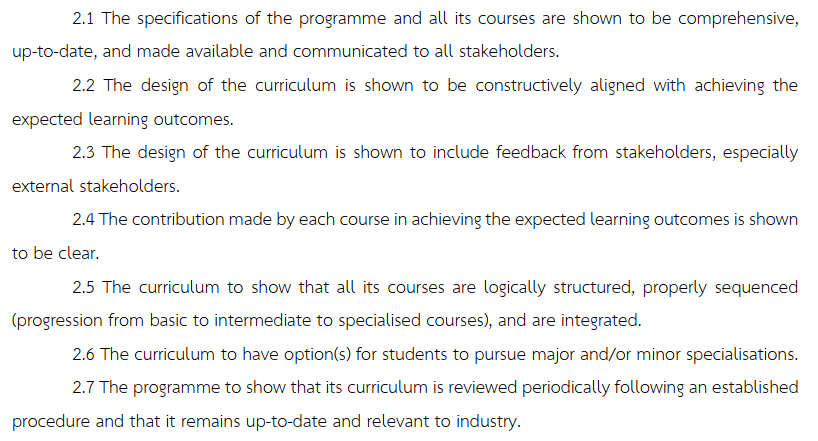
2.1 The specifications of the programme and all its courses are shown to be comprehensive, up-to-date, and made available and communicated to all stakeholders.
Operational Result
The Graduate Diploma in Teaching Profession (Revised 2023(2566)) program specification consisted of 10 subjects in the Teaching Profession Discipline area and 3 subjects in the Teaching Profession Internship. All subjects are aligned with the Ministry of Higher Education, Science, Research, and Innovation Regulations (Higher Education Qualification Framework 2022) and The Teacher Council of Thailand Teaching Profession Standards.
The Graduate Diploma in Teaching Profession (Revised 2023(2566)) Program was revised regularly (at least every five years). The current program (2023)was revised based on OBE and using the Backward design method to construct this program.
The objectives of producing graduates at the graduate diploma level in the teaching profession are as follows:
1. to know the science of the teaching profession and have basic knowledge and abilities in using Thai and English for communication and the use of digital technology for education Conforms to the professional standards of the Teachers Council.
2. To have skills in learning management and learning support through various
methods to develop students to their full potential and have important skills
necessary for professional performance, and skills in creating new knowledge in the teaching profession. To be able to develop the content and learning process continuously.
3. to have ethics according to the teaching professions, and conduct themselves bylaws and good culture of society and the community.
4. to possess important personal characteristics for professional performance, namely a good personality, trustworthiness, logical thinking; thinking systematically, and creativity. Be an academic leader, Committed to work and responsibility, friendly, generous, and respectful of children’s rights; accept individual differences and confidence in themselves, dare to think, and dare to express
There is the process to update the program specification regularly. The program coordinators will review the feedback from internal and external stakeholders, and revise and check the alignment with ELOs or PLOs. The program specification and updated subject specifications have been communicated to all related stakeholders regularly. Details of teaching and learning activities and assessment methods were designed and distributed to the related students, instructors, faculty. All materials of each subject is available in Learning Management System and Google Classroom application.
2.2 The design of the curriculum is shown to be constructively aligned with achieving the expected learning outcomes.
Operational Result
The courses of the Graduate Diploma in Teaching Profession (Revised 2023(2566)) Program were designed based on the concept of backward design to the PLOs as mentioned in requirement 1.2. The CLOs and LLOs of the subjects were formulated aligned to achieving the 4 PLOs in accordance with the learning Taxonomy.
2.3 The design of the curriculum is shown to include feedback from stakeholders, especially external stakeholders.
Operational Result
The curriculum development process of the Graduate Diploma in Teaching Profession (Revised 2023(2566)) started from the collection of all stakeholders’ needs who were internal and external stakeholders through many types of information gathering. The internal stakeholders were current students, instructors responsible for the curriculum, teaching lecturers, and university administrators. All internal stakeholders gave feedback to design the curriculum through focus group meetings, in-depth interviews, and questionnaires The program arranged several meetings and collected feedback through various forms from external stakeholders such as focus group meetings, in-depth interviews, and questionnaires. The external stakeholders were alumni, teachers in schools, school administrators, The Teacher Council of Thailand (A Professional Organization), other faculty of Education, Parents, Communities, Local Government Administration Offices, and the Ministry of Higher Education, Science, Research, and Innovation. All feedback from stakeholders was brought into the Curriculum design committee to formulate the curriculum, especially to formulate the ELOs or PLOs of the curriculum. The developed curriculum was criticized by the Criticize Committee who were from many organizations involved in the education field and assigned by the university. The program or curriculum had brought all suggestions and recommendations to improve the curriculum and analysis to form the expected learning outcomes (ELOs) and Program learning outcomes (PLOs).
2.4 The contribution made by each course in achieving the expected learning outcomes is shown to be clear.
Operational Result
Each subject has contributed to achieving the expected learning outcomes (ELOs) or program learning outcomes (PLOs) as stated in the table shows the curriculum mapping between ELOs or PLOs and Class learning outcomes (CLOs). To achieve the expected learning outcomes, each subject has various teaching strategies and assessment methods. These teaching strategies and assessment methods are stated in TQF3 (They are no longer implemented since the Ministry of Higher Education, Science, Research, and Innovation has regulated the new higher education qualification framework 2022 in 2022) and are informed to the faculty, lecturers, and students through the course syllabus.
The Program Committee has the responsibility to audit each subject to be designed
following CLOs that contribute to achieving PLOs.
2.5 The curriculum to show that all its courses are logically structured, properly sequenced (progression from basic to intermediate to specialised courses), and are integrated.
Operational Result
The St Teresa International University Graduate Diploma in Teaching Profession (Revised 2023(2566)) has been designed to have students study knowledge and skills that are necessary for teachers to work as professionals within an appropriate time of studying. All subjects will fulfill the competencies and proficiencies of the teaching profession for teachers who have not gained a bachelor’s degree in the education field and want to continue their teaching career in schools or educational institutions. The subjects are planned properly sequenced. In the first semester, students will get an overview scenario of the teaching profession’s character which is taught in 3 subjects; Principles of Teaching Profession, Self-Actualization for Teachers, and Communication Language for Teachers. These subjects are claimed as the starting points for pursuing a teaching career. After the first semester, students will be led into the necessary specific and essential knowledge that can be applied to everyday teaching and working; Psychology for Teachers, Curriculum and Learning Management, and Learning Measurement and Evaluation. For the last semester in the program, 3 more subjects are also essential subjects that contribute to the subjects from the second semester, Educational Innovation and Information Technology, Research for Learning Development. and Educational Quality Management.
2 Teaching Profession Internship subjects will be offered to observe students’ teaching progression as well. They will be assessed and get suggestions and recommendations from lecturers, peer teachers, mentors, and school administrators to improve their teaching characteristics.
2.6 The curriculum to have option(s) for students to pursue major and/or minor specialisations.
Operational Result
The St Teresa International University Graduate Diploma in Teaching Profession (Revised 2023(2566)) has been designed to develop the teaching profession’s competencies and proficiencies for teachers or prospective teachers who did not gain a bachelor’s degree in Education to take the teacher’s license examination from the Teacher Council of Thailand to get the teacher’s license legally. A student has to complete their study in 3 semesters. This program aims to have no options for students to choose any minor specializations. The students will study all subjects designed for the curriculum. The curriculum is designed to study 3 subjects in 1 semester for 3 semesters. All subjects are constructed only in the major specialization.
2.7 The programme to show that its curriculum is reviewed periodically following an established procedure and that it remains up-to-date and relevant to industry.
Operational Result
The program had 3 program meetings within the academic year to review the curriculum to be up-to-date and relevant to the schools needs, the Teacher Council of Thailand regulations, and the Ministry of Higher Education, Science, Research, and Innovation regulations as follows:
The first meeting was organized before the semester started to chek that lecturers followed the curriculum objectives and program learning outcomes effectively and efficiently.
The second meeting was held after the semester ended to assess the teaching and learning procedures and learning outcomes of students and prepare for the upcoming semester.
The third meeting was held after the academic year ended to assess the teaching and learning procedures and learning outcomes of students and prepare for the last semester for studying in the program in the upcoming academic year.
Evidence
| ID_Evidence | Name_Evidence |
| 2.1 | มคอ.2 หลักสูตรปรับปรุง 2566 |
| 2.2 | website คณะศึกษาศาสตร์ หลักสูตร ป.บัณฑิต inter |
| 2.3 | เอกสารประชาสัมพันธ์หลักสูตร |
| 2.4 | TQF3 Google Classroom |
| 2.5 | แผนการจัดการศึกษาในหลักสูตร |
| 2.6 | |
Self-Assessment
| Requirements | Result | Score |
| 2.1 The specifications of the programme and all its courses are shown to be comprehensive, up-to-date, and made available and communicated to all stakeholders. | / | 1 |
| 2.4 The contribution made by each course in achieving the expected learning outcomes is shown to be clear. | / | |
| 2.2 The design of the curriculum is shown to be constructively aligned with achieving the expected learning outcomes. | / | 1 |
| 2.3 The design of the curriculum is shown to include feedback from stakeholders, especially external stakeholders. | / | |
| 2.5 The curriculum to show that all its courses are logically structured, properly sequenced and integrated. | / | 1 |
| 2.6 The curriculum to have option(s) for students to pursue major and/or minor specialisations. | / | 1 |
| 2.7 The programme to show that its curriculum is reviewed periodically following an established procedure and that it remains up-to-date and relevant to industry. | / | 1 |
| Overall | 5 | |