Criterion 3 – Teaching and Learning Approach
Criterion
Requirements
Quality level assessment

Result
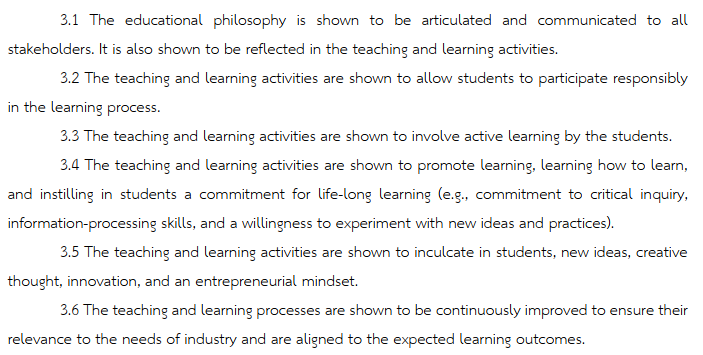
3.1 The educational philosophy is shown to be articulated and communicated to all stakeholders. It is also shown to be reflected in the teaching and learning activities.
Operational Result
The Graduate Diploma in Teaching Profession (Revised 2023(2566)) program’s educational philosophy is “Progressivism” and “Work Integrate In Learning (WIL). The program believes that
education should focus on students rather than on the content of the lecturers. The lecturers are the facilitators. Therefore, the teaching and learning approach focuses on student-centered activities facilitating self-directed learning in the teaching profession.
The educational philosophy is also discussed in the program meetings where the lecturers share their perspectives and concerns. It is also sent to the Human Resources officers in their schools for introducing and recommending our students for internships.
The program has made significant strides in articulating and communicating our educational philosophy to stakeholders. Through a clear mission and vision, defined core values, specific goals, and ongoing engagement and communication, the program have fostered a shared understanding and commitment among stakeholders. Documentation and training efforts have contributed to the consistent implementation of our philosophy across the program. The program will continue to assess and refine our communication strategies to ensure that our educational philosophy remains at the heart of our program’s operations.
3.2 The teaching and learning activities are shown to allow students to participate responsibly in the learning process.
Operational Result
In TQF 2 of the Graduate Diploma in Teaching Profession (Revised 2023(2566)) program, there were changes in the learning management to ensure students would fully participate and develop their own learning. Due to the changes in pedagogy, it is deemed necessary that there be changes in how students learn in the courses. The Faculty of education emphasizes work-integrated learning ( WIL), collaborative projects, and advice on teaching less and helping students learn more. The student centered learning processes are implemented:
- Every course in the program normally assigns students alternative assessment methods which they can link their learning with their schools, where they work as teachers of basic education
- Projects are signed for them to be able to participate fully in their learning
- They create seminars to apply their learning and deliver it to their other classmates.
- They do activities assigned to them in their respective courses during the term.
- They do research to apply their learnings in the field where they are working.
The program coordinator and the other stakeholders were monitored on how the curriculum was delivered to ensure participation by looking into the activities assigned to students. The lecturers prepare alternative assessments for learning to students with rubrics and guidelines. The processes in the classroom became more student-centered, as evidenced by the output of students. Lecturers collaborate in the assessment of the activities, where they serve as evaluators of research outputs and projects. Integrated projects can be a collaboration of two or three different classes.
The strategies, learning assessment, and learning outcomes should be aligned and be articulated to students.
3.3 The teaching and learning activities are shown to involve active learning by the students.
Operational Result
Project-based learning is an approach where students apply their learning in an actual setting. Their outputs and presentations are assessed using rubrics These guidelines in the development of their projects are released to the students so that they will have a guide on how to go about their projects. The projects were presented and assessed according to the guidelines. The lecturers monitor these projects via Google Classroom. Students show that they can produce quality outputs that are usable in their workplace.
3.4 The teaching and learning activities are shown to promote learning, learning how to learn, and instilling in students a commitment for life-long learning (e.g., commitment to critical inquiry, information-processing skills, and a willingness to experiment with new ideas and practices).
Operational Result
The program is provided with the MIS, where a learning plan is developed and monitored by the coordinators
- A Classroom is developed, which provides an avenue for the lecturers and students to communicate regarding all undertakings for the course. This is an avenue to provide materials, references, and even activities for easy submission and feedback.
- The projects and alternative assessments are released in Google Classroom.
- Reading materials are provided in the system for easy access by students
- Classrooms are equipped with projectors for students to present their outputs.
Due to these processes, the program heads monitors the implementation of the learning using a technology-based monitoring process and see to it that lecturers use IT in the learning process. and as a result, all lecturers and students are able to apply technology in their teaching and learning processes.
3.5 The teaching and learning activities are shown to inculcate in students, new ideas, creative thought, innovation, and an entrepreneurial mindset.
Operational Result
All lecturers used Google Classroom to upload resource materials and references for the courses they were teaching, which led them to a variety of worksheets and online activities. The program instructs faculty members to be more student-centered in their learning management, and Google Classrooms should be prepared properly so that intended activities of learning are already readily available for students.
The program head and the faculty members attended a mini-workshop on sharing best practices in teaching. Lecturers shared their knowledge and skills in integrating ICT into teaching and in providing varied learning activities that would lead to innovative products.
Program lecturers utilized digital platforms, such as Google Classroom for enrichment of learning activities.
Students were also exposed to practical application of theories learned in the classroom. They created their learning centers that showcased what they had learned in many courses.
Education Day, Virtual Expos, and Online Professional Development Seminars were also conducted to address the needs and challenges of education. Webinars were created to support learning processes
3.6 The teaching and learning processes are shown to be continuously improved to ensure their relevance to the needs of industry and are aligned to the expected learning outcomes.
Operational Result
Work-Integrated Learning (WIL) was introduced to let students connect the knowledge learned in the classroom to their work as teachers in basic education.
1. The lecturers were able to improve their quality of teaching and make their learners’ assessment and feedback mechanisms more organized and interactive. They were able to use Google Classroom to give online feedback on students’ outputs and teaching videos, mark assignments and projects, assign individual projects, and upload a variety of learning resource materials that would lead to teaching innovation and digital age technology. Through this process, the students were able to participate actively in the learning process
2. There is evidence of the integration of student research in their learning process to let them own their learning.
3. Students submitted their teacher’s portfolio with the inclusion of their learnings from the program.
| ID_Evidence | Name_Evidence |
| 3.1 | TQF2 Google Classroom |
| 3.2 | มคอ.3 คำอธิบายรายวิชา |
| 3.3 | มคอ.3 / Portfolio นักศึกษา |
| 3.4 | ตารางสอน |
| 3.5 | 1) TQF 3 2) Google classroom |
| 3.6 | 1) TQF 3 2) Google classroom |
Self-Assessment
| Requirements | Result | Score |
| 3.1 The educational philosophy is shown to be articulated and communicated to all stakeholders. It is also shown to be reflected in the teaching and learning activities. | / | 1 |
| 3.2 The teaching and learning activities are shown to allow students to participate responsibly in the learning process. | / | 1 |
| 3.3 The teaching and learning activities are shown to involve active learning by the students. | / | |
| 3.4 The teaching and learning activities are shown to promote learning, learning how to learn, and instilling in students a commitment for life-long learning. | / | 1 |
| 3.5 The teaching and learning activities are shown to inculcate in students, new ideas, creative thought, innovation, and an entrepreneurial mindset. | / | 1 |
| 3.6 The teaching and learning processes are shown to be continuously improved to ensure their relevance to the needs of industry and are aligned to the expected learning outcomes. | / | 1 |
| Overall | 5 | |