Criterion 5 – Academic Staff
Criterion
Requirements
Quality level assessment

Result
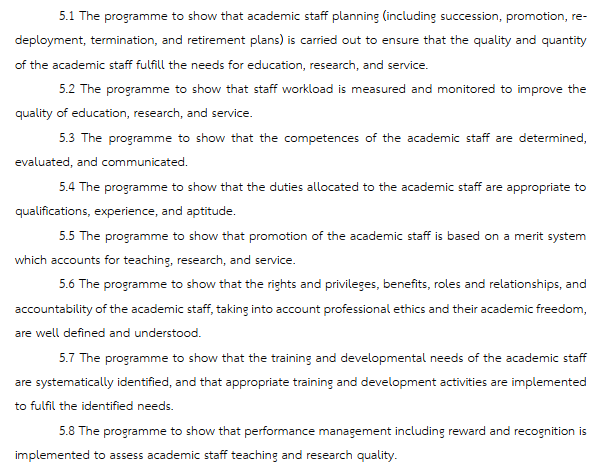
5.1 The programme to show that academic staff planning (including succession, promotion, re-deployment, termination, and retirement plans) is carried out to ensure that the quality and quantity of the academic staff fulfill the needs for education, research, and service.
Operational Result
The Human Resources Department has a systematic process of recruitment and it has assigned the steps of recruiting lecturers. The steps include the following:
- announcement of teaching job openings was made on web job portals and through communication letters.
- The lecturers’ qualifications are defined. The standards are stipulated in TQF2
- The applicants were requested to submit the necessary documents to the HR Office.
- The HR Office or the college appointment committee shortlisted the qualified applicants.
- The HR Office prepared the roster of shortlisted qualified applicants to teach the said program.
- There was a notification for interview dates and schedules among the shortlisted candidates.
- The results of the interview were announced or the successful candidates were notified through email or phone call. announcement date is on the third day after the interview.
- If the lecturer found out that he/she did not pass the screening process based on the application assessment system due to unclear qualifications,.The academic department’s information records should be sent to the Human Resources Department for not less than 15 working days.
- When a lecturer passes the interview, contract signing follows only when he/she has more than 5 years of teaching experience and has the ability to do research for at least once a year.
- In order to choose a new lecturer, the program director sets up a committee, with the dean serving as chairman, administrators speaking on behalf of the faculty committees, qualified staff from the department, the head of the department, two academic lecturer representatives, and the head of personnel serving as the meeting secretary.
The program implements a systematic and organized selection and appointment of program instructors. The process is as follows:
Finally, the University Council approves the application of program instructors as may be required in the program. The curriculum has an efficient number of academic staff to offer the Graduate Diploma in Teaching Profession program (English Program) (Revised 2023 (2566)) effectively and fulfill the needs for research and services.
A committee that includes representatives from the Human Resource Office, administrative personnel, and current program instructors will identify the need for program instructors in the faculty.
The faculty screens potential instructors as to their educational qualifications in the field or related field of studies and their teaching experiences in accordance with the Ministry of Higher Education, Science, Research, and Innovation criteria.
Those who pass the initial screening are referred to the academic board for further evaluation.
5.2 The programme to show that staff workload is measured and monitored to improve the quality of education, research, and service.
Operational Result
All lecturers in the Graduate Diploma in Teaching Profession program (Revised 2023 (2566)) are assigned workloads that are reviewed for fairness, ensuring that responsibilities are assigned evenly based on staff competence and capacity. It also assessed whether workload allocation took individual abilities, professional growth goals, and overall duties into account. This guaranteed that employees were not overburdened or underutilized, resulting in higher work quality as individuals are able to focus on their allocated jobs more effectively.
Each staff member’s responsibility is distributed to them before the start of each semester by allocating classes and time sufficient to complete the teaching plan outlined in the TQF3.
Workloads are assigned to each lecturer based on student input and evaluation in TQF5. This proactive approach improved job quality by allowing for prompt modifications and ensuring that employees have the required assistance and resources to carry out their duties.
5.3 The programme to show that the competences of the academic staff are determined, evaluated, and communicated.
Operational Result
Competent and skilled academic personnel are crucial for providing high-quality education, conducting research, and services, and contributing to the overall success of the institution.
The academic staff’s strengths in education, teaching, research, and academic service are prioritized by the St Teresa International University policy.
Teaching competency is also evaluated through student feedback, peer feedback, a course audit at the completion of each course, and a competency appraisal system designed by the university at the end of each academic year. The St Teresa International University sets an evaluation of the academic staff’s teaching performance systematically by peers regarding teaching ability, availability, mentorship skills of problem-solving, reflecting questioning, level of knowledge content, and ability to draw student participation in class. The supporting staff will collect all evaluation forms and submit the evaluation analysis to the Dean of the Faculty of Education to formulate an improvement plan.
Lecturers are expected to design a teaching plan and an assessment plan that match with the course and program learning outcomes in order to provide high-quality education to students. The Head of the Graduate Diploma in Teaching Profession program (Revised 2023 (2566)) reviews the teaching and assessment plans, and feedback is provided to the staff member in a timely way so that the lecturer can make modifications and prepare according to the reviewer’s criteria.
The questions prepared by lecturers for conducting midterm and final tests are reviewed by at least three reviewers, so that the lecturer may improve the questions to be competent and make the students successfully complete the examinations.
Each Program lecturer is assigned to conduct research for the academic year and is advised to conduct their study in their area of competence. The instructors have also conducted research and published publications in prestigious journals that are indexed in Scopus or TCI 1 or 2.
At the conclusion of the year, each faculty member submits a performance appraisal report to the college’s human resources department, which includes accomplishments, personal goals for the following year, and improvement plans. This allows staff employees to evaluate themselves and do what is necessary to attain the goals.
5.4 The programme to show that the duties allocated to the academic staff are appropriate to qualifications, experience, and aptitude.
Operational Result
The duties of the academic staff are allocated appropriately based on their educational background, their areas of expertise, and the personal choices made by the lecturers.
A plan regarding teaching research and academic title-oriented duties is allocated to the lecturers during the start of the academic year and is discussed in the program meetings. The staff are monitored and regular updates are discussed in the subsequent program meetings so that the lecturers are meeting the timelines to do their duties.
The appropriate allocation of duties resulted in increased productivity and efficiency among academic staff members. By aligning workload with individual competencies, staff members are able to focus on their areas of expertise, leading to improved teaching quality, research outcomes, and administrative effectiveness.
The program should continue to monitor staff quantity and workload allocation, emerging needs, and evolving industry requirements. Regular reviews and adjustments will help maintain the appropriateness of staff quantity and workload allocation, ensuring continued success in delivering quality education and achieving program objectives.
5.5 The programme to show that promotion of the academic staff is based on a merit system which accounts for teaching, research, and service.
Operational Result
The Human Resources Department office ( HRDO ) has policies for the promotion of academic staff based on the merit system. This policy is implemented all throughout the university. This is stipulated in the staff manual. The university has a set of regulations to evaluate the faculty member’s performance to improve their quality and standard of academic service.
To renew the yearly contract, faculty members must fulfill their academic requirements such as research publications, course completion, and assigned tasks. Also, they have to submit performance evaluation reports to the management for the evaluation process. After the evaluation, they have a meeting with the board members to assess their process. Every year the faculty members have to submit their achievable targets to the management which helps to track the faculty member’s progress to monitor and guide them to improve their academic performance.
Every year the university conducts the annual meeting to acknowledge the faculty member’s achievements in the academic services.
5.6 The programme to show that the rights and privileges, benefits, roles and relationships, and accountability of the academic staff, taking into account professional ethics and their academic freedom, are well defined and understood.
Operational Result
St Teresa International University stipulates in the contract the rights and privileges, benefits, roles and relationships, and accountability of academic staff, taking into account professional ethics and their academic freedom. The university has policies on how to evaluate academic staff.
5.7 The programme to show that the training and developmental needs of the academic staff are systematically identified, and that appropriate training and development activities are implemented to fulfil the identified needs.
Operational Result
To ensure that employees have the essential skills, knowledge, and abilities to effectively do their jobs. There is both in-house and external professional development for academic staff. For in-house training, Knowledge management is done regularly. The knowledge management sharing of outputs designated one session allocated for learning management. Different faculty participated in the process, including lecturers in the Faculty of Education. Responsible individuals identify training and development needs and they develop training platforms according to those needs. Training programs, such as seminars, are administered at the beginning of the school year or as needed. Evaluation of the seminar is usually done to serve as the basis of improvement for the next school year. Due to needs assessment, the training is relevant to the immediate needs of the academic staff. For external professional development, the curriculum assesses the academic staff’s needs to have professional development every academic year.
5.8 The programme to show that performance management including reward and recognition is implemented to assess academic staff teaching and research quality.
Operational Result
At the end of every term, the lecturer is evaluated by students. This evaluation tool is built into TQF 3 and TQF 5 of the MIS system. The numerical value of the assessment is not presented in the system and can only be seen by the lecturer after the grades are released.
These statistics were thoroughly analyzed to determine the lecturer’s strengths and weaknesses. Faculty members can also receive feedback on their teaching effectiveness, research contributions, and service commitments through performance evaluation. This feedback identifies faculty members’ strengths and areas for improvement, allowing them to improve their performance and continuously build their skills and expertise. This, in turn, leads to better program delivery and student learning experiences.
The department ensures that the program is responsive to changing educational needs and industrial requirements, especially the Teachers Council of Thailand, by assessing assessment results regularly and implementing initiatives to address identified areas of concern.
Evidence
| ID_Evidence | Name_Evidence |
| 5.1 | แผนพัฒนาบุคลากร |
| 5.2 | คู่มือบุคลากร การประชุมบุคลากร |
| 5.3 | แผนปฏิบัติการประจำปี |
| 5.4 | แผนพัฒนาบุคลากร |
| 5.5 | FTE ย้อนหลัง 5 ปี |
| 5.6 | ตารางสอนอาจารย์ |
| 5.7 | งานวิจัย/ผลงานวิชาการย้อนหลัง 5 ปี |
| 5.8 | Resume Staff |
Self-Assessment
| Requirements | Result | Score |
| 5.1 The programme to show that academic staff planning (including succession, promotion, re-deployment, termination, and retirement plans) is carried out to ensure that the quality and quantity of the academic staff fulfill the needs for education, research, and service. | / | 1 |
| 5.3 The programme to show that the competences of the academic staff are determined, evaluated, and communicated. | / | |
| 5.2 The programme to show that staff workload is measured and monitored to improve the quality of education, research, and service. | / | 1 |
| 5.4 The programme to show that the duties allocated to the academic staff are appropriate to qualifications, experience, and aptitude. | / | |
| 5.5 The programme to show that promotion of the academic staff is based on a merit system which accounts for teaching, research, and service. | / | 1 |
| 5.6 The programme to show that the rights and privileges, benefits, roles and relationships, and accountability of the academic staff, taking into account professional ethics and their academic freedom, are well defined and understood. | / | |
| 5.7 The programme to show that the training and developmental needs of the academic staff are systematically identified, and that appropriate training and development activities are implemented to fulfil the identified needs. | / | 1 |
| 5.8 The programme to show that performance management including reward and recognition is implemented to assess academic staff teaching and research quality. | / | 1 |
| Overall | 5 | |