Criterion 1 – Expected Learning Outcomes
Criterion
Requirements
Quality level assessment

Result
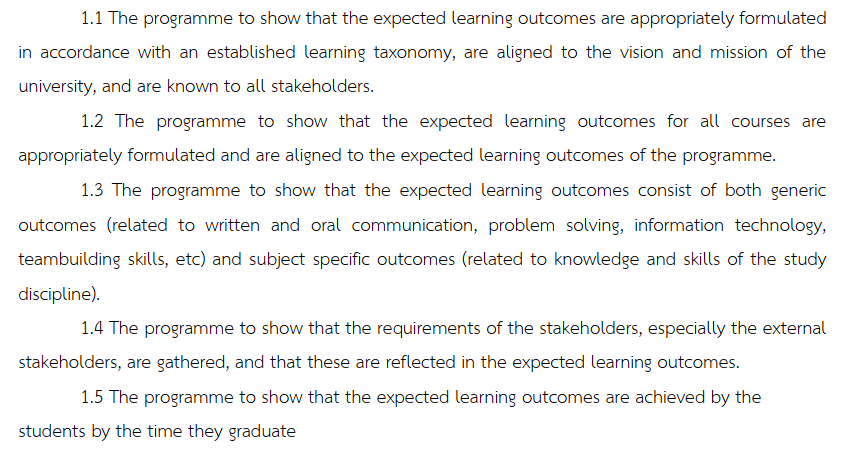
1.1 The programme to show that the expected learning outcomes are appropriately formulated in accordance with an established learning taxonomy, are aligned to the vision and mission of the university, and are known to all stakeholders.
Operational Result
The program has established expected learning outcomes aligned with the university’s philosophy, vision, and mission, derived from stakeholder engagement and communicated as follows:
1. University’s Philosophy, Vision, and Mission
University Philosophy:
Quality education fosters success and a better life in society.
University Vision:
To be a quality university recognized at national and international levels.
University Mission:
- Produce graduates with high competency in academics, professions, and English.
- Develop research and professional work recognized at national and international levels.
- Establish centers of excellence in academics, professions, and English.
- Preserve Thai and international arts and culture to foster a multicultural society.
- Manage the organization toward excellence.
2. Program’s Philosophy, Vision, and Mission
Program Philosophy:
Academic leadership at national and international levels enhances opportunities for success in quality educational management.
Faculty of Education Vision:
A model educational learning hub, a leading academic and learning management organization in local, regional, and national societies.
Faculty of Education Mission:
- Produce highly competent graduates in education, recognized by all sectors.
- Develop research in education and related fields to support teaching, local, regional, and national development.
- Provide academic services to local, regional, and national communities.
- Promote and develop Thai arts, culture, wisdom, and local knowledge.
- Enhance management systems and faculty potential to support effective education, while establishing academic collaboration networks with domestic and international institutions to strengthen mission fulfillment.
3. Stakeholders
The program identifies key stakeholders—individuals and organizations involved in curriculum development and implementation—both internal and external:
External:
- Teacher professional organizations
- Graduate employers
- Teachers, instructors, and prospective students
- School administrators, educational administrators
Internal:
- Faculty-level administrators
- Instructors, curriculum-responsible faculty
- Alumni (Master’s in Educational Administration graduates)
- Current students
4. Curriculum Development Process
The program analyzed the university’s philosophy, vision, and mission to define its own. Additionally, external factors were considered, such as:
- National development under the 13th National Economic and Social Development Plan (2023–2027)
- National Strategy (2017–2036), aiming for “stability and sustainability” (Thailand 4.0)
- Teacher Professional Standards set by the Teachers’ Council of Thailand, covering knowledge, professional experience, and practice standards for educators.
Through stakeholder engagement (faculty, curriculum developers, school administrators, professional organizations), the program collaboratively defined 12 expected learning outcomes (ELOs) across 3 domains:
1. Active/Master Learner (Knowledge)
- Mastery of subject content
- Inquisitiveness toward new theories/concepts in educational administration
- Ability to apply educational administration knowledge for work improvement
- Strategic management skills
2. Co-Creator (Skills)
- Analytical and synthesis skills
- Problem-solving, crisis management, and risk mitigation skills
- Numeracy, communication, and digital skills
- Research and innovation creation skills
3. Active Citizen (Ethics & Characteristics)
- Positive interpersonal interaction and teamwork
- Responsibility for oneself and colleagues
- Ethical conduct, professional integrity, and social accountability
- Global citizenship respecting diversity and human rights
The draft ELOs were reviewed and approved by curriculum committees, academic councils, university boards, and the Ministry of Higher Education (MHESI).
| Program Learning Outcomes (PLOs) | ||
| ความรู้ (Knowledge-K) | ||
| K1 | ความรอบรู้ในองค์ความรู้ทางการบริหารการศึกษา Comprehensive knowledge in the field of educational administration. | |
| K2 | ความสามารถในการวิเคราะห์สถานการณ์และประยุกต์ใช้ความรู้เพื่อการพัฒนาการจัดการศึกษา Situational Analysis and Knowledge Application for Educational Administration Development | |
| K3 | ความรอบรู้ในการจัดการเชิงยุทธศาสตร์การบริหารจัดการเชิงระบบ และการใช้ความรู้ด้าน การวิจัยเป็นเครื่องมือในการขับเคลื่อนองค์กรทางการศึกษา Mastery in strategic and systems management, and the application of research knowledge to drive educational organizations | |
| K4 | ความสามารถในการสร้างสรรค์ทางเลือกใหม่ๆ เพื่อพัฒนาองค์กรทางการศึกษาและ กระบวนการบริการจัดการองค์กรทางการศึกษา Ability to innovate new approaches for developing educational organizations and their management processes | |
| ทักษะ (Skills-S) | ||
| S1 | ทักษะภาษาเพื่อการสื่อสารและนิเทศเพื่อพัฒนาผู้อื่น Language proficiency for effective communication and the ability to coach and mentor others for their personal and professional growth. | |
| S2 | ทักษะดิจิทัลเพื่อการบริหารจัดการและการพัฒนางาน Digital literacy and technical abilities crucial for efficient administration and improving work processes in an organizational setting. | |
| S3 | ทักษะการบริหารจัดการเชิงยุทธศาสตร์การทำงานเป็นทีมและเป็นเครือข่าย The ability to apply strategic thinking to management, work effectively in teams, and build professional networks for collaborative success | |
| S4 | ทักษะการวิจัยเพื่อพัฒนางาน การวิจัยเพื่อสร้างองค์ความรู้ใหม่ทางการบริหารการศึกษา และการจัดการความรู้ The ability to conduct research for work improvement, generate new knowledge specifically within educational administration, and effectively manage and share knowledge within an organization | |
| จริยธรรม (Ethics-E) | ||
| E1 | จรรยาบรรณวชาชีพทางการบริหารการศึกษาและจรรยาบรรณของนักวิชาการ Professional Ethics in Educational Administration and Academic Ethics | |
| ลักษณะบุคคล (Character-C) | ||
| C1 | ความเป็นผู้นำทางวิชาการ To guide and inspire others within the academic sphere. | |
| C2 | การมีธรรมาภิบาลในการบริหารจัดการ To emphasizes the principles of good governance, including transparency, accountability, and ethical conduct, in administrative practices. | |
| C3 | ความรับผิดชอบและมุ่งมั่นในการนำองค์กรสู่ความสำเร็จ To highlights a strong sense of accountability and dedication in leading an organization toward achieving its goals. | |
| C4 | การเคารพสิทธิผู้อื่น To signifies the importance of upholding and valuing the rights and dignity of individuals. | |
Communication of Learning Outcomes
The program disseminates the expected learning outcomes (ELOs) through the following channels:
- Publication of the TQF-2 document on the university website and the Faculty of Education website for stakeholders and interested parties.
- Integration into Google Classroom for every course, where instructors explicitly state the ELOs.
- Distribution of TQF-2 handbooks to program instructors and curriculum coordinators, who also study the details via the faculty website.
- Regular faculty meetings each semester to reinforce awareness.
For students, the ELOs are communicated through:
- Orientation day introductions.
- Course instructors, who emphasize them in class.
- Google Classroom and the Faculty of Education website, where they can review details on learning outcomes, teaching strategies, and assessment methods.
Conclusion
The foregoing illustrates that the program has methodically established and disseminated its anticipated learning outcomes, aligning them with the university’s philosophy and mission. This approach actively engages stakeholders, fostering broad awareness and comprehension.
Evidence
1.2 The programme to show that the expected learning outcomes for all courses are appropriately formulated and are aligned to the expected learning outcomes of the programme.
Operational Result


Evidence
| ID_Evidence | Name_Evidence |
| 1.2-1 | มคอ.2 |
| …………………………………….. |
1.3 The programme to show that the expected learning outcomes consist of both generic outcomes (related to written and oral communication, problem solving, information technology, teambuilding skills, etc.) and subject specific outcomes (related to knowledge and skills of the study discipline).
Operational Result
The program has established a policy requiring instructors to assess students based on the learning outcomes defined in the National Higher Education Qualifications Framework, following this process:
- Feedback Provision – Instructors provide students with constructive feedback for continuous self-improvement.
- Curriculum Mapping Review – Instructors analyze the curriculum mapping for their respective courses.
- Assessment Plan Development – Instructors define evaluation methods, tools, scoring weightings, and timelines in TQF-3.
- Assessment Tool Preparation – Instructors develop appropriate assessment instruments aligned with learning outcomes.
- Implementation of Assessments – Instructors conduct evaluations using prepared tools, such as:
- Midterm/Final exams
- Assignment grading rubrics
- Interviews, etc.
Evidence
1.4 The programme to show that the requirements of the stakeholders, especially the external stakeholders, are gathered, and that these are reflected in the expected learning outcomes.
Operational Result
| Stakeholder | Relevant Information | Data Collection Method | Outcomes Applied to PLOs |
|---|---|---|---|
| Teacher Professional Organizations (e.g., Educational Administrators, Teachers’ Council Regulations, Curriculum Standards) | – Professional standards for educational administration – Educational administration/school management knowledge – Knowledge, experience, and competency standards for administrators | 1. Document review 2. Curriculum review committee feedback | – Professional ethics in educational administration – Knowledge of educational/school management principles – Standards of knowledge and experience for administrators |
| School Administrators (Network Schools), Education Specialists, Educational Administrators | – Graduate competencies & skills | Surveys, Interviews, Meetings | – Communication & supervision skills – Digital skills for management & work improvement – Modern administration knowledge – Research & strategic planning – Applied knowledge in practice – Academic leadership – Ethics, good governance, & respect for rights |
| Master’s in Educational Administration Alumni | – Recommended courses & additional skills needed | Surveys | – Modern leadership – Innovation & creative thinking – Problem-solving & conflict management – Strategic management – Advanced statistics & research |
| Visiting Lecturers / Instructors | – Knowledge, skills, & graduate attributes | Surveys, Curriculum Development Committee, Meetings | – Administrative theories & strategies – Excellence in management – Technological skills – Communication & teamwork/networking skills – Ethics & good governance – Creativity & conflict resolution – Risk management & research |
| Program Faculty Members | – Knowledge, skills, ethics, & personal attributes | Surveys, Meetings, Curriculum Development Committee | – Administrative theories & techniques – Strategic planning & change management – Technology & communication skills – Teamwork & networking – Ethics & good governance – Creativity & conflict management – Risk management, research, & innovation development |
Evidence
| ID_Evidence | Name_Evidence |
| 1.4-1 | มคอ.2 (Appendix: Order for the Appointment of Curriculum Development Committee Members and Curriculum Review Committee Members) |
| …………………………………….. |
1.5 The programme to show that the expected learning outcomes are achieved by the students by the time they graduate
Operational Result
The expected learning outcomes are achieved by students before they graduate, as indicated by evaluations from practicum site mentors and university supervisors
Practicum site mentors, who work closely with students during practicum, provide detailed assessments on the application of theoretical knowledge, problem-solving abilities, interpersonal skills, and overall professional readiness. Their feedback highlights students’ strengths and areas for improvement, ensuring they meet high industry standards.
University supervisors complement this by monitoring students’ progress through observations, evaluations, one-on-one meetings and our post- internship seminars. They review projects, presentations, and practical work, offering constructive feedback to help students achieve the desired learning outcomes.
The combined insights from mentors and supervisors confirm that our students have successfully achieved the program’s learning outcomes and are well-prepared for their careers. This continuous assessment process allows for necessary curriculum adjustments, ensuring alignment with industry standards and stakeholder expectations, ultimately guaranteeing our graduates are equipped with the necessary teaching skills and competencies.
Evidence
| ID_Evidence | Name_Evidence |
| 1.5-1E-portfolio | |
| 1.5-2 |
Self-Assessment
| Requirements | Result | Score |
| 1.1 The programme to show that the expected learning outcomes are appropriately formulated in accordance with an established learning taxonomy, are aligned to the vision and mission of the university and are known to all stakeholders. | / | 1 |
| 1.2 The programme to show that the expected learning outcomes for all courses are appropriately formulated and are aligned to the expected learning outcomes of the programme. | / | 1 |
| 1.3 The programme to show that the expected learning outcomes consist of both generic outcomes and subject specific outcomes. | / | 1 |
| 1.4 The programme to show that the requirements of the stakeholders, especially the external stakeholders, are gathered, and that these are reflected in the expected learning outcomes. | / | 1 |
| 1.5 The programme to show that the expected learning outcomes are achieved by the students by the time they graduate | / | 1 |
| Overall | 5 | |