Criterion 2 – Programme Structure and Content
Criterion
Requirements
Quality level assessment

Result
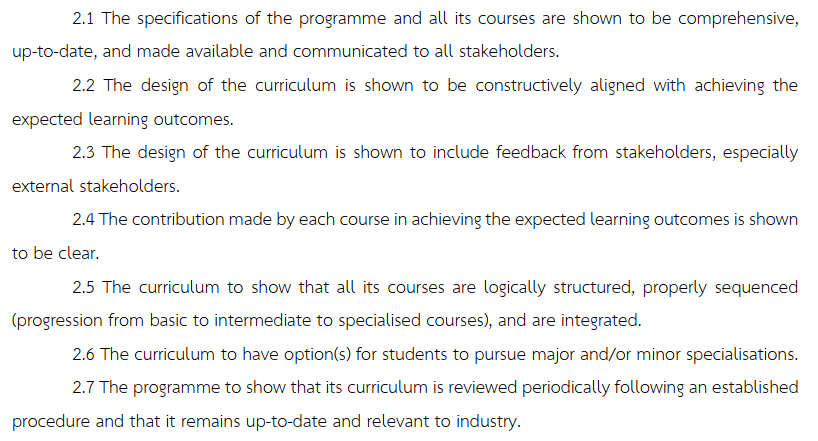
2.1 The specifications of the programme and all its courses are shown to be comprehensive, up-to-date, and made available and communicated to all stakeholders.
Operational Result
The Master of Education Program in Educational Administration (International Program/Revised 2021) is designed to be contemporary and adaptive to current transformations. The curriculum has been developed through a thorough analysis of evolving economic, social, and cultural landscapes, particularly in alignment with Thailand’s 20-Year National Strategy (2017–2036), which emphasizes the need for high-potential, ethical, and adaptive professionals.
Additionally, the program responds to updates in educational administration professional standards, as revised by the Teachers’ Council of Thailand in:
- Professional Standards Regulation No. 2 (2016)
- Professional Standards Regulation No. 3 (2018)
- Professional Standards Regulation No. 4 (2019)
- Professional Standards Regulation No. 5 (2024)
By integrating these changes, the program ensures its graduates possess globally competitive competencies, preparing them to lead in rapidly evolving educational and societal contexts. It also equips them with the knowledge and skills to thrive in a digital society, fostering innovation and effective management.
Furthermore, the program caters to experienced professionals in education or social development who seek to:
- Enhance their research capabilities for educational administration improvement.
- Advance their qualifications to contribute more effectively alongside other educational leaders.
Curriculum Development Process
The program’s objectives, learning outcomes, structure, course descriptions, and activities were collaboratively designed by stakeholders, incorporating analyses of:
- National and global educational trends
- Digital transformation challenges
- Professional standard requirements
Stakeholder Communication
To ensure transparency and maintain alignment with program objectives and institutional standards, the program communicates its framework through multiple channels and mechanisms. These include dissemination through the Faculty of Education’s website, providing accessible information for interested individuals, professional organizations, schools, and educational agencies. In addition, the program communicates relevant information through faculty and instructor meetings, student orientation sessions, and the publication of TQF-3 documents. These strategies facilitate effective information sharing and ensure that all stakeholders remain informed and engaged.
2.2 The design of the curriculum is shown to be constructively aligned with achieving the expected learning outcomes.
Operational Result
The program’s course structure is cohesively designed, ensuring that all courses align and collectively achieve the six key learning outcomes.
Program Objectives
- To instill in graduates a positive professional attitude, a strong commitment to the teaching and educational administration profession, and a sense of responsibility in their field.
- To equip graduates with in-depth knowledge of educational administration, contemporary management competencies, and the ability to apply their expertise in international professional practice.
- To develop graduates who are innovative, visionary, and skilled in critical thinking, problem-solving, decision-making, and strategic planning, enabling them to drive educational quality in their respective institutions.
- To cultivate graduates as effective educational leaders, valuable members of the profession who uphold ethics, professional standards, teamwork, and strong interpersonal skills.


As shown in the table above, the program’s structure consists of:
- 2 non-credit foundation courses (supplementary),
- 2 core foundational courses,
- 6 compulsory courses,
- 8 elective courses, and
- a 12-credit thesis.
All courses are systematically designed to align with the five expected learning outcomes outlined in the table.
Modern and Adaptive Curriculum Design
The program ensures relevance and responsiveness to emerging trends and current developments by integrating up-to-date course content, comprehensive course descriptions, and structured learning activities and projects within each semester’s study plan. This approach is designed to maintain the quality and currency of the curriculum, ensuring that graduates acquire relevant knowledge, practical competencies, and professional skills that meet contemporary educational and workforce demands.
2.3 The design of the curriculum is shown to include feedback from stakeholders, especially external stakeholders.
Operational Result
| Stakeholders | Relevant Information | Data Collection Methods | Learning Outcomes Derived |
|---|---|---|---|
| Teacher Professional Organizations | – Educational administration standards – Teachers’ Council regulations – Curriculum standards | 1. Document analysis 2. Curriculum review committee | – Professional ethics in educational administration – Knowledge of school/educational management – Administrator competency standards |
| Ministry of Higher Education, Science, Research and Innovation | – Curriculum standards – Learning outcome standards – National education development plans – Socio-economic changes | 1. Document review: – Curriculum standards – National education standards – 20-year national education plan – National economic and social development plan | – Alignment with national education policies – Responsiveness to socio-economic trends |
| Network School Administrators | – Graduate competencies – Required skills | Surveys Interviews Meetings | – Communication and supervision skills – Digital management skills – Modern administration knowledge – Research and strategic planning – Applied knowledge – Academic leadership – Ethics and governance |
| M.Ed. in Educational Administration Alumni | – Recommended courses – Needed skills | Surveys | – Modern leadership – Innovation and creativity – Problem-solving – Conflict management – Advanced statistics and research |
| Visiting Faculty/Instructors | – Ethics – Knowledge – Cognitive skills – Interpersonal skills – Analytical/IT skills – Professional management skills | Surveys Curriculum committee meetings | – Administrative theories and strategies – Excellence in management – Technology and communication skills – Teamwork and networking – Ethical governance – Creative conflict resolution – Risk management and research |
| Program Faculty/Curriculum Coordinators | – Ethics – Knowledge – Cognitive skills – Interpersonal skills – Analytical/IT skills – Professional skills | Surveys Meetings Curriculum committee | – Administrative techniques – Strategic planning – Change management – Technology skills – Communication – Teamwork – Ethical practice – Innovation and research |
Key Conclusions
- Comprehensive Curriculum Design:
The program has systematically incorporated stakeholder feedback into all aspects of curriculum development, including:- Program objectives
- Learning outcomes
- Course structure
- Course descriptions
- Stakeholder-Aligned Approach:
The participatory design process ensures the curriculum:- Meets professional standards
- Addresses current educational needs
- Prepares graduates for real-world challenges
- Incorporates modern management competencies
- Quality Assurance:
The curriculum demonstrates:- Relevance to national and international standards
- Responsiveness to sector needs
- Commitment to continuous improvement
This stakeholder-engaged approach guarantees that graduates will possess the knowledge, skills, and ethical grounding required for excellence in educational administration.
2.4 The contribution made by each course in achieving the expected learning outcomes is shown to be clear.
Operational Result
Findings from Graduate and Student Interviews Regarding Learning Outcome Achievement
Our evaluation of learning outcomes through graduate and student interviews demonstrates successful achievement across all courses in the program. The carefully distributed weight and responsibilities of each course effectively drive the attainment of expected learning outcomes. Students show progressive development in meeting all learning outcomes throughout their studies. During thesis development, students particularly demonstrate the following desirable attributes:
- Knowledge and Cognitive Skills
Students exhibit comprehensive understanding of research methodology by:
- Applying relevant educational administration theories
- Effectively communicating research reports in English
- Utilizing digital technologies for knowledge analysis and synthesis
- Successfully developing conceptual research frameworks
- Interpersonal Skills, Responsibility, and Analytical Abilities
Students develop:
- Strong administrative competence and leadership qualities
- Professional responsibility in applying educational administration theories to institutional settings
- Enhanced English communication skills aligned with educational administration principles
- Creative application of digital technologies in educational management
- Professional Ethics and Conduct
Students consistently adhere to:
- Professional ethical standards
- Educational administration frameworks
- Teachers’ Council educational standards
- Contemporary Professional Management Skills
Through all program courses meeting established standards, students:
- Achieve all defined learning outcomes
- Develop into “professional educational administrators” as per Teachers’ Council standards
| รายวิชา | 1. คุณธรรม จริยธรรม | 2. ความรู้ | 3. ทักษะทางปัญญา | 4. ทักษะความสัมพันธ์ระหว่างบุคคลและความรับผิดชอบ | 5. ทักษะการวิเคราะห์ เชิงตัวเลข การสื่อสาร และเทคโนโลยีสารสนเทศ | 6. ทักษะความเป็น มืออาชีพในการบริหารจัดการร่วมสมัย | |||||||||||||||||||||||||||||||||
| 1 | 2 | 3 | 4 | 1 | 2 | 3 | 4 | 1 | 2 | 3 | 4 | 5 | 1 | 2 | 3 | 4 | 1 | 2 | 3 | 4 | 1 | 2 | 3 | 4 | |||||||||||||||
| 141 001 ความรู้พื้นฐานทางการศึกษา | | | | | | | | | | | | | | | | | | | | ||||||||||||||||||||
| 141 002 การวิเคราะห์เชิงปริมาณและการประยุกต์ใช้สารสนเทศทางการศึกษา | | | | | | | | | | | | | | | | | | | | | | ||||||||||||||||||
| 141 101 หลักจัดการศึกษาร่วมสมัย | | | | | | | | | | | | | | | | | | | | ||||||||||||||||||||
| 141 102 ระเบียบวิธีวิจัยทางการศึกษา | | | | | | | | | | | | | | | | | | | | | | ||||||||||||||||||
| 141 201 ระบบการศึกษาและทฤษฎีการบริหารการศึกษา | | | | | | | | | | | | | | | | | | | | | |||||||||||||||||||
| 141 202 การบริหารนโยบายและกลยุทธ์การศึกษา | | | | | | | | | | | | | | | | | | | | | | ||||||||||||||||||
| 141 203 การบริหารหลักสูตร การเรียนรู้ และกิจการนักเรียน | | | | | | | | | | | | | | | | | | | | | | ||||||||||||||||||
| 141 204 การบริหารทั่วไป งบประมาณ การเงินและทรัพยากรทางการศึกษา | | | | | | | | | | | | | | | | | | | | | | ||||||||||||||||||
| 141 205 การพัฒนาขีดความสามารถวิชาชีพบริหารการศึกษา | | | | | | | | | | | | | | | | | | | | ||||||||||||||||||||
| 141 206 ปฏิบัติการวิชาชีพบริหารการศึกษา | | | | | | | | | | | | | | | | | | | | | | ||||||||||||||||||
| 141 301 สัมมนาการวิจัยทางการบริหารการศึกษา | | | | | | | | | | | | | | | | | | | | | | | | | |||||||||||||||
| 141 302 สัมมนาการจัดการคุณภาพการศึกษา | | | | | | | | | | | | | | | | | | | | | | | | ||||||||||||||||
| 141 303 ยุทธศาสตร์สำหรับการเรียนที่มีประสิทธิภาพ | | | | | | | | | | | | | | | | | | | |||||||||||||||||||||
| 141 304 ภาวะผู้นำเพื่อการบริหารการเปลี่ยนแปลงและการบริหารความเสี่ยง | | | | | | | | | | | | | | | | | | | | | |||||||||||||||||||
| 141 305 การสัมมนาการจัดหลักสูตรสองภาษา | | | | | | | | | | | | | | | | | |||||||||||||||||||||||
| 141 306 การบริหารจัดการการเรียนรู้ในระบบทางไกล | | | | | | | | | | | | | | | | | | | | | | | | ||||||||||||||||
| 141 307 นวัตกรรมและการปฏิบัติที่เป็นเลิศทางการบริหารการศึกษา | | | | | | | | | | | | | | | | | |||||||||||||||||||||||
| 141 401 วิทยานิพนธ์(42) | | | | | | | | | | | | | | | | | | | | | | ||||||||||||||||||
| 141 501 วิทยานิพนธ์(12) | | | | | | | | | | | | | | | | | | | | | |||||||||||||||||||
| ผลการเรียนรู้ตลอดหลักสูตร | | | | | | | | | | | | | | | | | | | | | | | | | | ||||||||||||||
2.5 The curriculum to show that all its courses are logically structured, properly sequenced (progression from basic to intermediate to specialised courses), and are integrated.
Operational Result
All courses within the program are systematically sequenced to ensure effective integration and continuity throughout the curriculum. This alignment is carefully analyzed and implemented through several key components:
- Course Descriptions – Clearly defining learning objectives and ensuring alignment between course content and program outcomes.
- Instructional Activity Design – Structuring projects and learning activities to strengthen interdisciplinary connections and practical application.
- Integrated Teaching Methods – Utilizing diverse and blended pedagogical approaches that encourage the synthesis and application of knowledge.
- Assessment and Evaluation (TQF 3) – Developing assessment tools and evaluation methods that measure both discipline-specific competencies and broader cross-curricular skills.
This comprehensive and integrated framework ensures that knowledge is developed progressively throughout the program, learning experiences are interconnected and practice-oriented, and graduates acquire comprehensive expertise and well-rounded competencies in educational administration.
Year 1
| หมวดวิชา | รหัสวิชา | ชื่อวิชา | หน่วยกิต | โครงงานบูรณาการกับงานในหน้าที่ |
| เสริมพื้นฐาน (ไม่นับหน่วยกิต) | 141 001 | Foundations of Education | (3) | Project 1: Needs Assessment & Risk Analysis of the School that they belong. Project 2: Creating Strategic Plan, Operation Plan and Risk Management Plan |
| เสริมพื้นฐาน (ไม่นับหน่วยกิต) | 141 002 | Quantitative Methods and ICT Application in Education | (3) | |
| พื้นฐานสัมพันธ์ | 141 101 | Current Principle and Concepts in Education | 3 | |
| บังคับ | 141 201 | Educational Systems and Theories of Educational Administration | 3 | |
| 141 202 | Policy and Strategic Management in Education | 3 | ||
| รวม | (6)/9 | |||
Year 1 : Semeter 2
| หมวดวิชา | รหัสวิชา | ชื่อวิชา | หน่วยกิต | โครงงานบูรณาการกับงานในหน้าที่ |
| พื้นฐานสัมพันธ์ | 141 102 | Research Methodology in Education | 3 | |
| บังคับ | 141 203 | Management of Curriculum, Learning and Student Affairs | 3 | Project 3 : Creating the Monitoring Calendar and Monitor the Curriculum & Instruction ,follow up and Supervise to the teachers |
| บังคับ | 141 204 | General, Budgeting, Financial and Resources Management in Education | 3 | |
| 141 206 | Practicum in Educational Administration | 3 | ||
| รวม | 12 | |||
Year 2 : Sem. 1
| หมวดวิชา | รหัสวิชา | ชื่อวิชา | หน่วยกิต | โครงงานบูรณาการกับงานในหน้าที่ |
| บังคับ | 141 205 | Capacity Building in Educational Administration Profession | 3 | Project 4: Creating the R&D project to improve Educational Quality focus on academic and student affairs. |
| เลือก | 141 3XX | วิชาเลือก 1 | 3 | |
| วิทยานิพนธ์ | 141 501 | วิทยานิพนธ์ | 4 | |
| รวม | 10 | |||
Year 2 : Semester 2
| หมวดวิชา | รหัสวิชา | ชื่อวิชา | หน่วยกิต | โครงงานบูรณาการกับงานในหน้าที่ |
| เลือก | 141 3XX | วิชาเลือก 2 | 3 | Project 5 : Evaluating some strategies/program /projects/ or Self- assessment according to school’s standards. |
| วิทยานิพนธ์ | 141 501 | วิทยานิพนธ์ | 8 | |
| รวม | 11 | |||
2.6 The curriculum to have option(s) for students to pursue major and/or minor specialisations.
Operational Result
Curriculum Structure and Research-Oriented Learning Process
1. Curriculum Structure
The program offers the following study plans:
- Plan A (A1): Thesis Only – 36 credits
- Plan A (A2): Coursework and Thesis – 42 credits
2. Elective Courses (6 Credits)
Students are required to complete 6 credits of elective courses, allowing them to pursue areas aligned with their interests and professional goals. The available elective courses include:
- 141301 – Seminar on Research in Educational Administration
- 141302 – Seminar on Educational Quality Management
- 141303 – Strategies for Effective Learning
- 141304 – Leadership for Change and Risk Management in Education
- 141305 – Seminar on Bilingual Program Administration
- 141306 – Distance Learning Management
- 141307 – Innovation and Best Practice in Educational Management
- 141308 – Individual Study
3. Research Topic Selection and Comparative Studies
Students are encouraged to select research topics from themes introduced throughout their coursework. They conduct comparative studies of educational administration theories and practices within both Thai and international contexts. Findings are presented and discussed during classroom sessions, while course instructors function as academic mentors and coaches, facilitating knowledge exchange and critical discussions.
4. Thesis Topic Identification
Students determine their thesis topics based on:
- Specific administrative issues or challenges they intend to investigate, or
- Particular areas of professional interest related to educational leadership and administration.
This process enables students to align their research with both academic interests and professional aspirations.
5. Engagement with Contemporary Educational Administration Theories
All students are required to engage with current developments and perspectives in educational administration through:
- Examining contemporary educational administration theories, and/or
- Studying successful educational leaders as professional models and examples of effective practice.
Insights and findings from these studies are subsequently presented and discussed in seminar sessions to promote collaborative learning and critical reflection among peers.
Key Features of the Approach
- Promotes collaborative learning and knowledge sharing among students
- Sustains continuous faculty guidance and mentorship throughout the learning and research process
- Integrates theoretical knowledge with practical application
- Encourages comparative perspectives across local and international contexts
- Strengthens independent research and analytical skills
2.7 The programme to show that its curriculum is reviewed periodically following an established procedure and that it remains up-to-date and relevant to industry.
Operational Result
The faculty adopts a comprehensive and participatory approach to curriculum development, integrating contributions from a wide range of stakeholders to ensure the program’s relevance, quality, and effectiveness. Curriculum development committees are composed of experts from both within and outside the university, enabling the inclusion of diverse perspectives, professional expertise, and industry insights in the curriculum design process. These committees systematically review, evaluate, and revise the curriculum in accordance with institutional standards and established criteria, including the university’s philosophy, educational objectives, curriculum structure, and course content requirements.
The curriculum development process is guided by clearly defined standards and quality measures to address the evolving needs and demands of the educational sector. Committee members work collaboratively to design and enhance a curriculum that not only fulfills academic and institutional requirements but also incorporates contemporary trends, emerging practices, and advancements in the field of Educational Administration. Furthermore, the committees oversee the management and maintenance of curriculum-related documents, ensuring that information remains accurate, updated, and readily accessible to both faculty members and students.
Evidence
Self-Assessment
| Requirements | Result | Score |
| 2.1 The specifications of the programme and all its courses are shown to be comprehensive, up-to-date, and made available and communicated to all stakeholders. | / | 1 |
| 2.4 The contribution made by each course in achieving the expected learning outcomes is shown to be clear. | / | |
| 2.2 The design of the curriculum is shown to be constructively aligned with achieving the expected learning outcomes. | / | 1 |
| 2.3 The design of the curriculum is shown to include feedback from stakeholders, especially external stakeholders. | / | |
| 2.5 The curriculum to show that all its courses are logically structured, properly sequenced and integrated. | / | 1 |
| 2.6 The curriculum to have option(s) for students to pursue major and/or minor specialisations. | / | 1 |
| 2.7 The programme to show that its curriculum is reviewed periodically following an established procedure and that it remains up-to-date and relevant to industry. | / | 1 |
| Overall | 5 | |