Criterion 3 – Teaching and Learning Approach
Criterion
Requirements
Quality level assessment

Result
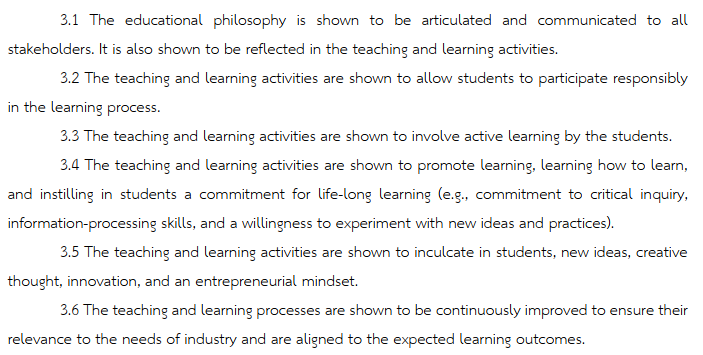
3.1 The educational philosophy is shown to be articulated and communicated to all stakeholders. It is also shown to be reflected in the teaching and learning activities.
Operational Result
3.1 The educational philosophy is shown to be articulated and communicated to all stakeholders. It is also shown to be reflected in the teaching and learning activities.
The program is carried out based on an educational philosophy that prioritizes learner-centered approaches, Work Integrated Learning (WIL), active learning strategies, and the continuous development of skills. The curriculum structure is designed in alignment with the institution’s philosophy, vision, and mission, ensuring that course content supports these guiding principles as outlined in the TQF 3 of each subject. In terms of instructional practices, faculty members develop teaching approaches that promote critical thinking, interdisciplinary integration, practical exposure to educational administration, and the application of knowledge through structured discussions and presentations. Students participate in both individual and collaborative projects, submit and present their work through the Google Classroom platform, and utilize interactive learning materials such as video presentations developed using Canva. Furthermore, relevant information is disseminated to stakeholders through multiple communication channels, including the TQF 3 documents prepared for all courses.
3.2 The teaching and learning activities are shown to allow students to participate responsibly in the learning process.
Operational Result
Teaching and Learning Arrangements
Course instructors evaluate student learning outcomes using authentic assessment approaches. Assessment methods include classroom observation, listening to course and research presentations, quizzes, graded examinations, midterm and final tests, as well as the evaluation of students’ completed work documented and compiled in e-Portfolios.
Faculty members provide students with course information, including course descriptions and the intended competencies, skills, and attributes that learners are expected to acquire throughout the program.
Students are also encouraged to actively engage in decisions related to teaching and learning processes. Based on student interview findings, learners are given the flexibility to select topics and venues for activities according to their interests, determine research or thesis topics with instructor guidance, and further develop these areas of study.
In addition, students identify their preferred areas of interest and participate in knowledge sharing through information technology platforms, enabling them to exchange experiences and perspectives related to educational administration.
3.3 The teaching and learning activities are shown to involve active learning by the students.
Operational Result
Students participate in hands-on training in educational administration through both simulated classroom environments and real-world settings such as schools or workplaces. They work closely with instructors in academic activities and seminars, sharing and discussing administrative concepts and experiences. Active learning approaches are emphasized, including student-led presentations of assigned tasks to promote knowledge exchange and practical insight. These learning experiences are designed to support and achieve the intended learning outcomes outlined in the curriculum for each course.
3.4 The teaching and learning activities are shown to promote learning, learning how to learn, and instilling in students a commitment for life-long learning (e.g., commitment to critical inquiry, information-processing skills, and a willingness to experiment with new ideas and practices).
Operational Result
The program incorporates teaching and learning approaches that enhance students’ ability to learn independently, including the development of research skills. The curriculum is structured to define key competencies and characteristics, such as expertise in educational administration and school management, ethical awareness, professional behavior in education, effective English communication for administrative purposes, and the application of information technology in educational management.
Students are also encouraged to build strong teamwork abilities and to collaborate effectively with communities and society. This learner development approach is aligned with fostering essential student qualities, with a focus on ethics, professional integrity, leadership and academic leadership, administrative competence, and the ability to work collaboratively while engaging with the community.
3.5 The teaching and learning activities are shown to inculcate in students, new ideas, creative thought, innovation, and an entrepreneurial mindset.
Operational Result
The curriculum’s teaching and learning management incorporates activities that stimulate students to generate creative and innovative ideas, promoting innovation in educational administration within an organizational management context. This is achieved through the application of creative thinking alongside contemporary management and entrepreneurial principles.
The program further supports innovation in teaching and learning by encouraging the development of academic and modern organizational leadership through practical experiences in both classroom and workplace settings. Students are trained to function effectively as both leaders and followers, rotating roles on a weekly basis to demonstrate these capacities. This process enables them to integrate and apply their acquired knowledge through practical demonstrations.
3.6 The teaching and learning processes are shown to be continuously improved to ensure their relevance to the needs of industry and are aligned to the expected learning outcomes.
Operational Result
The program regularly evaluates and reviews the curriculum in collaboration with key stakeholders, including educators and school administrators involved in educational management. These stakeholders have recommended that instructors take on a coaching role by offering guidance and support to students in areas such as learning activities, assessment and evaluation, research development, and related academic processes.
Evidence
Self-Assessment
| Requirements | Result | Score |
| 3.1 The educational philosophy is shown to be articulated and communicated to all stakeholders. It is also shown to be reflected in the teaching and learning activities. | / | 1 |
| 3.2 The teaching and learning activities are shown to allow students to participate responsibly in the learning process. | / | 1 |
| 3.3 The teaching and learning activities are shown to involve active learning by the students. | / | |
| 3.4 The teaching and learning activities are shown to promote learning, learning how to learn, and instilling in students a commitment for life-long learning. | / | 1 |
| 3.5 The teaching and learning activities are shown to inculcate in students, new ideas, creative thought, innovation, and an entrepreneurial mindset. | / | 1 |
| 3.6 The teaching and learning processes are shown to be continuously improved to ensure their relevance to the needs of industry and are aligned to the expected learning outcomes. | / | 1 |
| Overall | 5 | |