Criterion 4 – Student Assessment
Criterion
Requirements
Quality level assessment

Result
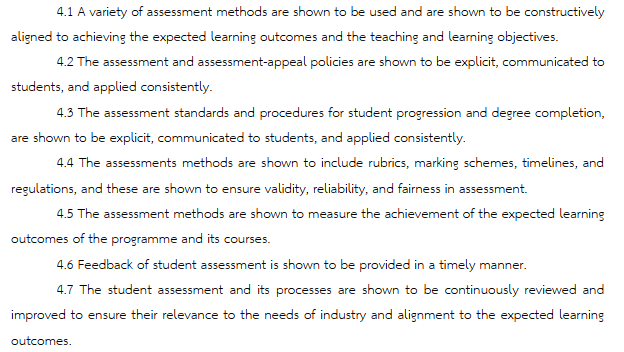
4.1 A variety of assessment methods are shown to be used and are shown to be constructively aligned to achieving the expected learning outcomes and the teaching and learning objectives.
Operational Result
The program has established an assessment framework aligned with recognized standards to ensure the achievement of course-specific learning outcomes. Assessment criteria are clearly defined and communicated to students to promote transparency.
A range of evaluation methods is employed, including direct observation, presentation and discussion assessment, midterm and final examinations, and e-portfolio evaluation using digital platforms such as Google Sites and Wix. These approaches are designed to measure comprehensive learning outcomes while integrating both traditional and technology-enhanced assessment tools.
Assessment implementation includes continuous formative evaluation throughout the course and summative assessment at key stages. Ongoing feedback is provided through digital portfolio systems to support student learning and development.
4.2 The assessment and assessment-appeal policies are shown to be explicit, communicated to students, and applied consistently.
Operational Result
The Faculty of Education has officially disseminated information about the Master’s Program in Educational Administration through its website, providing students with comprehensive and accessible program details. This includes the curriculum structure, course descriptions and learning outcomes, research development guidelines, and thesis requirements and procedures.
The dissemination aims to ensure that students clearly understand program expectations, adhere to academic standards, comprehend research components, and systematically develop their theses.
Implementation is supported through regular updates of program information, clear presentation of academic pathways, accessible research guidelines, and transparent procedures for thesis preparation.
4.3 The assessment standards and procedures for student progression and degree completion, are shown to be explicit, communicated to students, and applied consistently.
Operational Result
The program systematically monitors students’ academic progress and graduation status through multiple tracking channels, while ensuring effective communication of essential academic information. A multi-platform system is utilized to track student progress, provide regular status updates, and verify the completion of graduation requirements.
Official communication is primarily conducted through Google Classroom for each course, which serves as a central platform for distributing learning materials, sharing assessment and evaluation information, collecting assignments, and making academic announcements.
Key academic information, including learning resources, evaluation criteria, submission procedures, and academic timelines, is clearly communicated to students. The system incorporates real-time progress monitoring, standardized submission processes, transparent evaluation practices, and accessible academic documentation.
This integrated approach supports effective academic progress management, consistent communication, efficient assignment submission and grading, and organized distribution of learning resources. In particular, the use of Google Classroom facilitates streamlined course administration, direct interaction between instructors and students, structured document sharing, systematic assignment submission, and transparent tracking of student performance.
4.4 The assessments methods are shown to include rubrics, marking schemes, timelines, and regulations, and these are shown to ensure validity, reliability, and fairness in assessment.
Operational Result
Course instructors regularly assess student progress in accordance with established timelines, with clearly defined and up-to-date evaluation criteria communicated across all courses.
To ensure accuracy, reliability, and fairness in assessment, instructors implement clear and timely communication of expectations and feedback, utilize standardized rubrics that specify performance criteria, and apply transparent marking schemes with defined scoring guidelines to maintain consistency in evaluation.
4.5 The assessment methods are shown to measure the achievement of the expected learning outcomes of the programme and its courses.
Operational Result
All course instructors apply assessment methods that effectively measure students’ achievement of both program-level and course-specific learning outcomes.
Assessments are systematically aligned at two levels: Program Learning Outcomes (PLOs), which reflect the institution’s expected graduate attributes, and Course Learning Outcomes (CLOs), which focus on subject-specific knowledge and competencies. This dual alignment ensures comprehensive evaluation of student performance in relation to both institutional and disciplinary expectations.
4.6 Feedback of student assessment is shown to be provided in a timely manner.
Operational Result
Course instructors conduct assessments in strict alignment with the Program Learning Outcomes (PLOs) and Course Learning Outcomes (CLOs) defined in the curriculum. Assessment tools and examinations are systematically designed to directly measure PLO achievement while explicitly addressing CLOs, ensuring content validity through blueprint alignment, expert review, and standard-setting procedures.
The program implements a structured feedback system in which evaluated work is returned within a specified timeframe. Feedback is delivered through multiple channels, including written comments, rubric-based scoring with clear descriptors, and opportunities for individual consultation. It focuses on students’ strengths, areas for improvement, and actionable strategies for further development.
Quality assurance is maintained through regular faculty calibration sessions to ensure consistency in interpreting learning outcomes and applying assessment standards. In addition, digital systems are used to monitor feedback timeliness, track student performance trends, and evaluate outcome achievement.
This integrated approach ensures valid measurement of competencies, transparent assessment practices, and evidence-based student development, while supporting continuous curriculum improvement through data-informed teaching and forward-looking feedback.
4.7 The student assessment and its processes are shown to be continuously reviewed and improved to ensure their relevance to the needs of industry and alignment to the expected learning outcomes.
Operational Result
Course instructors implement student assessments in strict alignment with the Program Learning Outcomes (PLOs) and Course Learning Outcomes (CLOs) specified in the curriculum. Assessment design follows an outcome-based framework, with examinations and evaluation methods developed to measure PLO achievement through standardized benchmarks and CLO attainment through discipline-specific criteria. Content validity is ensured through the use of assessment blueprints, faculty review processes, and psychometric analysis.
A structured and timely feedback system is in place, ensuring that evaluated work is returned within a specified timeframe. Feedback is delivered through multiple formats, including annotated rubrics, individualized performance reports, and scheduled consultation sessions. It emphasizes demonstrated competencies, targeted areas for improvement, and strategies for professional growth.
Quality assurance is maintained through regular faculty calibration workshops to ensure consistent interpretation of learning outcomes and reliability of assessment standards. In addition, digital monitoring systems are used to track feedback turnaround time, learning outcome achievement, and the effectiveness of assessment tools.
This comprehensive approach supports authentic competency measurement, transparent evaluation, data-driven student development, and continuous curriculum improvement, with a strong emphasis on feedforward practices, explicit alignment between outcomes and assessment, and evidence-based teaching refinement.
Evidence
Self-Assessment
| Requirements | Result | Score |
| 4.1 A variety of assessment methods are shown to be used and are shown to be constructively aligned to achieving the expected learning outcomes and the teaching and learning objectives. | / | 1 |
| 4.2 The assessment and assessment-appeal policies are shown to be explicit, communicated to students, and applied consistently. | / | 1 |
| 4.3 The assessment standards and procedures for student progression and degree completion, are shown to be explicit, communicated to students, and applied consistently. | / | 1 |
| 4.7 The student assessment and its processes are shown to be continuously reviewed and improved to ensure their relevance to the needs of industry and alignment to the expected learning outcomes. | ||
| 4.4 The assessments methods are shown to include rubrics, marking schemes, timelines, and regulations, and these are shown to ensure validity, reliability, and fairness in assessment. | / | 1 |
| 4.5 The assessment methods are shown to measure the achievement of the expected learning outcomes of the programme and its courses. | / | |
| 4.6 Feedback of student assessment is shown to be provided in a timely manner. | / | 1 |
| Overall | 5 | |