Criterion 5 – Academic Staff
Criterion
Requirements
Quality level assessment

Result
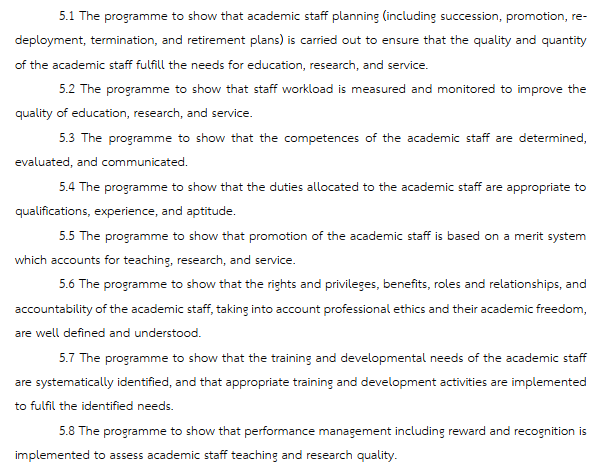
5.1 The programme to show that academic staff planning (including succession, promotion, re-deployment, termination, and retirement plans) is carried out to ensure that the quality and quantity of the academic staff fulfill the needs for education, research, and service.
Operational Result
Faculty Development Initiatives
The Curriculum Management Committee reports that the program implements continuous faculty development initiatives through regular preparatory meetings involving curriculum coordinators, core faculty members, and teaching staff. These activities aim to enhance instructional quality by promoting the use of updated teaching materials, the production of academic and research outputs, and the maintenance of graduate-level academic standards.
Instructional Planning & Delivery
Faculty members systematically plan and deliver instruction by preparing course syllabi, teaching plans, instructional methods, learning activities, and assessment tools, including examinations and education management-related tasks. This structured approach ensures timely course delivery and alignment with academic performance and promotion criteria.
Strategic Resource Planning
In addition, the program undertakes strategic resource planning by maintaining comprehensive staffing plans that address both quantitative and functional requirements. These plans support institutional needs in graduate education, research productivity, academic services, and quality assurance.
5.2 The programme to show that staff workload is measured and monitored to improve the quality of education, research, and service.
Operational Result
Faculty Workload Monitoring System
The program implements a structured faculty workload monitoring system in which each faculty member’s teaching responsibilities, including classroom instruction and thesis supervision, are limited to a maximum of 15 hours per week. Workload allocation is systematically tracked through official teaching schedules, regularly reviewed for compliance, and balanced across program courses to ensure equity and efficiency.
Digital Tracking & Student Support Platform
In addition, the university utilizes a digital tracking and student support platform that provides a verifiable and centralized system for academic management. A dedicated student support committee monitors student progress proactively through communication channels such as phone and Line, ensures timely academic coordination, and facilitates rapid information dissemination.
The system includes centralized dashboards that display individual teaching schedules and faculty work plans, supported by automated features such as personalized data recording and real-time schedule updates. This integrated approach enhances workload management, transparency, and student support services.
5.3 The programme to show that the competences of the academic staff are determined, evaluated, and communicated.
Operational Result
Faculty Development and Evaluation System
St Teresa International University implements a comprehensive faculty development and evaluation system to ensure academic quality and continuous improvement. Thesis quality is strengthened through mentorship by senior researchers, supporting faculty in guiding graduate-level research effectively.
The Academic Administration Committee plays a key role in communicating institutional policies, while the Dean of the Faculty of Education leads faculty meetings to evaluate teaching competencies, enhance instructional capabilities, and certify instructors for program delivery.
Structured Faculty Development Program
The Curriculum Committee oversees a structured faculty development framework, including systematic competency assessments and Training Needs Analysis (TNA). Based on these evaluations, professional development plans are formulated, encompassing pedagogical training, research skill enhancement, and academic service improvement.
Professional Development Planning
Additionally, the university conducts comprehensive needs assessments focusing on teaching innovation, research productivity, and academic service contributions. Training programs are prioritized according to identified needs to ensure targeted and effective development.
Targeted Needs Assessment & Development
Specialized training is also provided for graduate faculty serving as thesis advisors, equipping them with advanced research supervision skills, including modern consultation techniques and analytical methods in both qualitative and quantitative research.
5.4 The programme to show that the duties allocated to the academic staff are appropriate to qualifications, experience, and aptitude.
Operational Result
The program strategically allocates faculty workloads based on individualized assessments that consider alignment with institutional values, professional qualifications, demonstrated competencies, relevant experience, and professional disposition.
These assessments include evaluation of academic credentials and specialized certifications, subject matter expertise and technical skills, years of service and prior achievements, as well as alignment with the institution’s teaching philosophy. This approach ensures that workload assignments are appropriate, balanced, and supportive of both program quality and institutional goals.
5.5 The programme to show that promotion of the academic staff is based on a merit system which accounts for teaching, research, and service.
Operational Result
The program adopts a merit-based promotion system for faculty members, guided by ethical principles and aligned with institutional policies and standards.
5.6 The programme to show that the rights and privileges, benefits, roles and relationships, and accountability of the academic staff, taking into account professional ethics and their academic freedom, are well defined and understood.
Operational Result
The program defines clear guidelines for faculty roles and responsibilities to ensure that instructors have a comprehensive understanding of their duties and expectations.
5.7 The programme to show that the training and developmental needs of the academic staff are systematically identified, and that appropriate training and development activities are implemented to fulfil the identified needs.
Operational Result
The program adopts an individualized faculty development framework tailored to support the professional growth of each academic staff member.
5.8 The programme to show that performance management including reward and recognition is implemented to assess academic staff teaching and research quality.
Operational Result
The program establishes a faculty performance recognition system that incorporates key features to acknowledge and reward academic staff achievements.
Evidence
| ID_Evidence | Name_Evidence |
| 5.1-1 | Policies on recruitment and deployment |
| 5.1-2 | Qualification of program instructors: Stipulated in the website |
| 5.2-1 | Workload of academic staff, 2nd Semester AY 2024 |
| 5.2-2 | Criteria in Approving a Well-Prepared Google Classrooms |
| 5.3 | Sample of Approved TQF 5 |
| 5.4 | Sample Lecturer schedule to show appropriate allocation of teaching load |
| 5.5 | Personnel Manual Basis Evaluation of academic staff |
| 5.6 | Sample Contract |
| 5.7 | Yearly Meating & Seminar KM Activities |
| 5.8-1 | Evaluation of the lecturer in the TQF 5 |
| 5.8-2 | Sample self-assessment |
| 5.8-3 | Assessment tool to evaluate lecturers |
| 5.8-4 | Sample Certificate of Awards Given to Academic Staff |
Self-Assessment
| Requirements | Result | Score |
| 5.1 The programme to show that academic staff planning (including succession, promotion, re-deployment, termination, and retirement plans) is carried out to ensure that the quality and quantity of the academic staff fulfill the needs for education, research, and service. | / | 1 |
| 5.3 The programme to show that the competences of the academic staff are determined, evaluated, and communicated. | / | |
| 5.2 The programme to show that staff workload is measured and monitored to improve the quality of education, research, and service. | / | 1 |
| 5.4 The programme to show that the duties allocated to the academic staff are appropriate to qualifications, experience, and aptitude. | / | |
| 5.5 The programme to show that promotion of the academic staff is based on a merit system which accounts for teaching, research, and service. | / | 1 |
| 5.6 The programme to show that the rights and privileges, benefits, roles and relationships, and accountability of the academic staff, taking into account professional ethics and their academic freedom, are well defined and understood. | / | |
| 5.7 The programme to show that the training and developmental needs of the academic staff are systematically identified, and that appropriate training and development activities are implemented to fulfil the identified needs. | / | 1 |
| 5.8 The programme to show that performance management including reward and recognition is implemented to assess academic staff teaching and research quality. | / | 1 |
| Overall | 5 | |